E-10
the unified light tank destroyer project
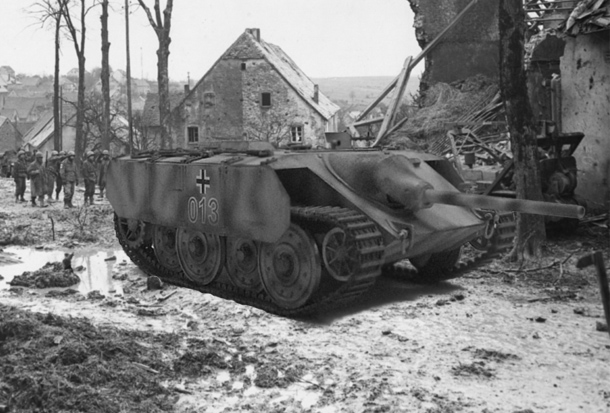
American soldiers observe an abandoned E-10 light tank destroyer in a ruined German village near the end of the war. Whether the vehicle was genuinely intended to carry a roof-mounted machine gun remains uncertain. Background: internet (public domain), plastic model: Marcos Serra (panzerserra.blogspot.com), composite image: Panzernet
Historical Context
By the turn of 1941 and 1942, it was abundantly clear to any clear-headed German military commander that the Blitzkrieg against the Soviet Union had failed, and that the fighting in the east would not be over in a matter of weeks or even months. It was only a question of time before the Russians recovered from their staggering early losses and their evacuated or newly built factories began churning out tanks in enormous quantities. The Germans decided to try to offset Russia's numerical superiority with qualitative superiority of their own — rearming existing units and developing new tanks — but at the same time they also began thinking seriously about how to substantially increase their own production volumes. In May 1942, this problem began to occupy the attention of Ing. Kniepkamp, head of one of the development departments at the German Army Weapons Office.
Entwicklungsreihe
Kniepkamp argued that the path to mass production lay through standardisation — producing fewer types, of simpler construction, sharing as many components as possible. The idea did not become an official programme until almost a year later, in April 1943, under the designation Entwicklungsreihe (or more commonly Entwicklungserie, abbreviated E-Serie — roughly "development series" in English). The programme envisaged five types of armoured fighting vehicle across different weight categories and roles: the tank destroyers E-10 and E-25, and the tanks E-50, E-75, and E-100. As the reader may have already guessed, the number in each vehicle's designation indicated its weight category — albeit, it must be said, only very roughly.
The lightest vehicle in the E-Serie was the Entwicklungsfahrzeug E-10 tank destroyer. Development was entrusted to Magirus, which had been part of the Klöckner-Humboldt-Deutz AG conglomerate since 1936. According to some authors, the E-10 was conceived as a replacement for the Jagdpanzer 38(t), better known as the Hetzer. Given that development of the Jagdpanzer 38(t) did not begin until December 1943, this claim is perhaps better understood to mean that the E-10 was intended to replace comparable existing types in general and become the German army's standard light tank destroyer. In this context it is worth noting that the name Hetzer was most likely first used in connection with the E-10 project — which makes a certain sense, since Hetzer means "harrier" or "hunting dog", and the E-10 was indeed meant to be very fast. By a twist of fate, however, the name Hetzer ultimately came to be applied to the aforementioned Jagdpanzer 38(t).
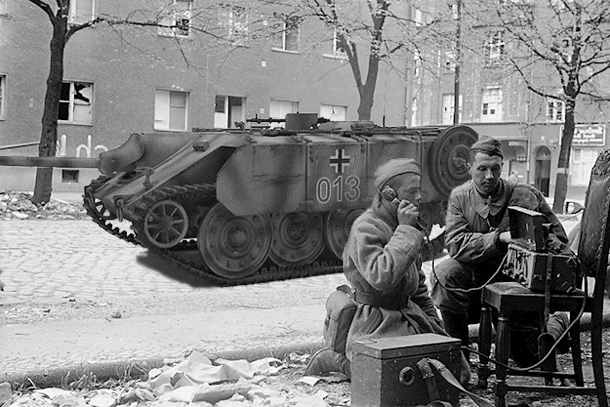
An abandoned E-10 light tank destroyer in the streets of a German town captured by the Red Army. Background: internet (public domain), plastic model: Marcos Serra (panzerserra.blogspot.com), composite image: Panzernet
During development, emphasis was placed not only on commonality with the E-25, but also on making the vehicle as simple as possible to manufacture and maintain. The suspension system, for example, was designed to allow straightforward like-for-like component replacement, and easy service access to the engine and gearbox was another key requirement.
Vehicle Description
According to Magirus's design, the E-10 was to be built around a newly developed running gear, with four large road wheels on each side, a front idler wheel, and a rear drive sprocket. The road wheels, inspired by those of the heavy tank Tiger II, were all-metal, with only a thin rubber tyre around the rim, protected by a steel band. Each wheel consisted of a single disc 100 cm in diameter. The wheels were arranged in two slightly overlapping rows, with each wheel independently suspended and sprung.
The requirement for the lowest possible overall height ruled out torsion bar suspension, which takes up considerable space in the hull floor and thereby increases the vehicle's height. Torsion bars would also have been incompatible with the requirement for easy wheel and suspension replacement. An unconventional solution was therefore chosen instead. Each wheel was mounted on a large but hollow swingarm. The swing of this arm was damped by a stack of pre-loaded conical disc springs — known as Belleville washers — housed inside the arm's tubular body. You may well be familiar with this type of washer from everyday life or the hardware shop: it has a slightly conical shape and compresses flat when a bolt is tightened, springing back to its original form when the bolt is loosened — in other words, it acts as a spring. A single ordinary hardware-shop washer of this type allows only a few millimetres of travel under compression, but if you take somewhat larger washers and stack several dozen of them together — alternating the orientation of each one as you go — you end up with a spring with a surprisingly useful working range (a spring of this kind looks something like THIS).
The entire swingarm assembly, with its stack of disc springs inside, was bolted to the side of the hull from the outside. Once the road wheel disc itself had been removed, a mechanic could very easily unbolt the entire damaged arm and bolt a replacement straight on in its place — a simple, quick, like-for-like swap. We have no specific comparison figures to hand, but it is reasonable to assume that this type of suspension offered no particular dynamic advantages and was chosen purely because it met the Weapons Office's specific requirements. Had it been a broadly superior solution, it would presumably have found some application after the war — which it did not, with a few exceptions such as the Swedish Pz-61 tank.
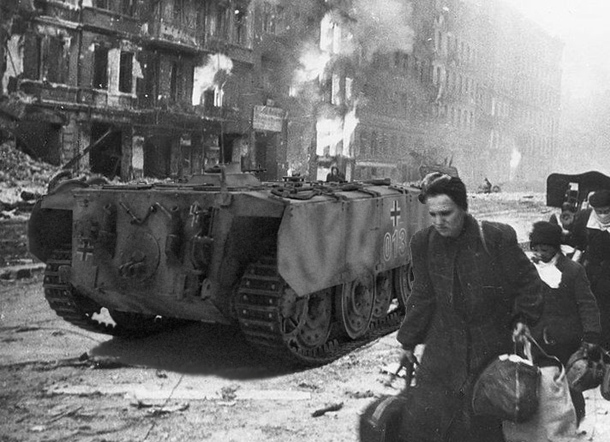
Unfortunate German civilians walk past a knocked-out E-10 in the streets of a captured Berlin. Background: internet (public domain), plastic model: Marcos Serra (panzerserra.blogspot.com), composite image: Panzernet
The running gear was apparently intended to have one further unique feature: adjustable ground clearance. Like other tank destroyers, the E-10 was conceived primarily as an ambush weapon — a vehicle that would lie in wait in a concealed firing position and strike from there without warning. The suspension was therefore designed to allow the road wheels to be raised upward against the hull sides, lowering the entire vehicle. The tank destroyer could, in effect, lie flat on its belly and become almost invisible. The wheels were most likely raised by rotating their swingarms into the opposite — upward — position. How the arms in this position coped with the forces generated by gun firing is unknown, but a workable solution must have been envisaged. The mechanism for raising and lowering the wheels was of course driven by the vehicle's engine.
But let us also look at the other elements of the running gear. As noted above, the E-10 was to have its drive sprocket at the rear and the idler wheel at the front — the opposite of German conventional practice. This arrangement naturally also determined the placement of the gearbox, final drives, and steering brakes, all of which were located at the rear together with the engine. There were several reasons for this design choice. One was the already-mentioned ease of maintenance. Removing a gearbox mounted in the nose of a vehicle with a fully enclosed fighting compartment was a deeply awkward business. Access to a gearbox positioned at the rear of the hull, by contrast, was straightforward. In the case of the E-10, the designers went so far as to make the entire rear hull wall removable — quite possibly inspired by the Soviet T-34. The rear wall was held in place by 17 bolts; once these were undone, the entire wall could be folded down and the gearbox or engine lifted out of the vehicle without difficulty.
Another reason for placing the gearbox at the rear was better weight distribution. The overall vehicle had to be relatively light by design, which meant that heavier armour could only be applied to the front plate — the rest of the hull had to make do with light protection. The heavy front plate combined with the gun, however, created an unwelcome concentration of mass at the front of the vehicle, and the rear-mounted gearbox served as a useful counterweight, shifting the centre of gravity further rearward. The final reason for this arrangement was the desire to save space in the fighting compartment. The E-10 was necessarily a fairly compact vehicle, and the requirement for the road wheels to be raised alongside the hull sides meant the hull had to remain relatively narrow from floor to ceiling — there could be no typical overhang above the tracks. Had the gearbox also been inside the fighting compartment, the interior would have been impossibly cramped.
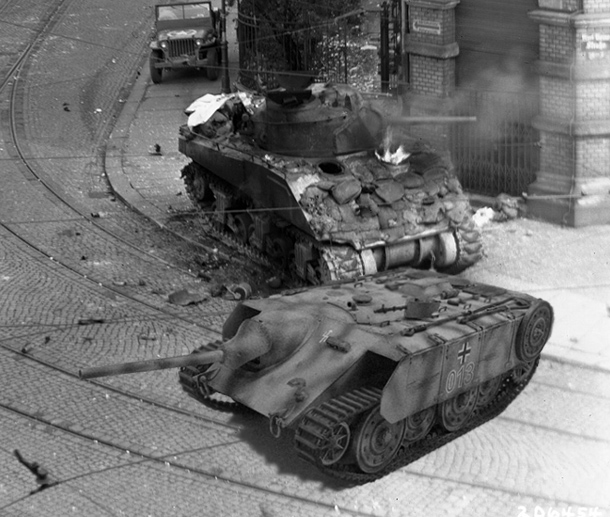
E-10 passing its victim — an American Sherman tank. Background: internet (public domain), plastic model: Marcos Serra (panzerserra.blogspot.com), composite image: Panzernet
The hull of the E-10 was to have a front plate 60 mm thick, angled at 60°. The lower hull front was 30 mm, the sides and rear 20 mm, and the floor and roof just 10 mm. The driver's vision port was positioned in the left side of the front plate, with the main gun to the right. The drawings produced by Magirus show a 7.5 cm PaK 39 L/48 gun — the same weapon carried by the Jagdpanzer 38(t) — though a different gun type was most likely planned for the production version. In the roof above the fighting compartment there was a sliding hatch for the gun's periscopic sight and three crew hatches. At the rear of the roof, above the engine section, were three ventilation grilles: the two rectangular ones on either side presumably drew air in, while the central circular one expelled it outward via a fan. According to some visualisations, the E-10 was also to be fitted with a remotely operated roof-mounted machine gun, controlled from inside the fighting compartment — similar to the arrangement on the aforementioned Jagdpanzer 38(t).
The expected overall length of the tank destroyer without the gun overhang was 535 cm; with the 7.5 cm PaK 39 L/48 it extended to 691 cm. The vehicle was to be 286 cm wide and 176 cm tall in normal travel mode, dropping to just 140 cm in combat mode — that is, when lowered to the ground. The powerplant under consideration was either the new Maybach HL 100 producing 400 horsepower, or the HL 101, which was expected to deliver as much as 550 horsepower. The ratio of track contact length to track spacing was just 1.04, which promised excellent manoeuvrability. The 400 mm wide tracks would also have ensured very low ground pressure. With these characteristics, the E-10 would undoubtedly have been a highly agile fighting vehicle.
Conclusion and Assessment
The drawings for the E-10 were most likely completed in the summer of 1944, and Magirus subsequently received a contract for three evaluation prototypes. By the end of the war, however, only the bare beginnings of three armoured hulls had been produced. The E-10 was a remarkably modern yet economical concept. One thing that strikes anyone studying its plans is the almost total lack of crew observation equipment — beyond the driver's vision port and the gun sight, the vehicle had no further means of observing the outside world. A retractable scissor periscope for the commander was most likely intended, but even so the situational awareness of the crew would have left much to be desired.
ARTICLE
CONTENTS:
Reproducing text from the Panzernet website without the written consent of the operator is prohibited.