TIGERFIBEL
the first tank primer
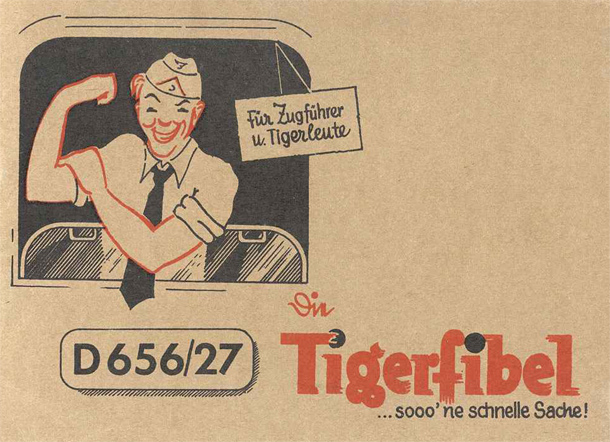
Cover of the Tigerfibel manual: for platoon commanders and "Tiger men", source: internet, public domain
When the first production Tiger rolled out of the Henschel factory in June 1942, it represented an extraordinary leap forward for the German armoured forces. Consider that the heaviest production tank the Germans had fielded up to that point was the Panzer IV Ausf. G, weighing 23.6 tonnes. And now here was a new heavy tank weighing nearly 57 tonnes. The mechanical components of such a heavy machine were subjected to enormous stress, and careless or insensitive handling could easily overload and damage them. Repairs under field conditions were far more demanding than with lighter types, and towing a knocked-out heavy tank back to a workshop could fairly be described as a nightmare. Great emphasis was therefore placed on correct operation and proper maintenance, so that breakdowns could be prevented as far as possible. Tiger crews were expected to devote every spare moment to looking after their machine.
The correct combat tactics for a heavy tank armed with a powerful 88 mm gun also differed considerably from those applied to the lighter Panzer III and Panzer IV. The enormous effective range of the weapon made accurate range estimation and target acquisition far more critical. And then there was the sheer cost of the heavy tank. Losing a medium Panzer IV cost the German taxpayer just over 100,000 Reichsmarks. Losing a Tiger, on the other hand, left a full quarter of a million marks lying on the battlefield*. Avoiding unnecessary losses through ignorance or carelessness was therefore very much in everyone's interest.
In an ideal world, unnecessary breakdowns and losses would be prevented by thorough crew training. And the crews of the first Tiger tanks did indeed receive a comparatively long period in which to properly familiarise themselves with their new machine before being sent to the front. But the war was going very badly for Germany. 1943 arrived, bringing defeat at Stalingrad and a long retreat in southern Russia and North Africa. Mounting losses had to be replaced quickly, and that brought pressure to shorten the training of tank crews – and indeed of everyone else.
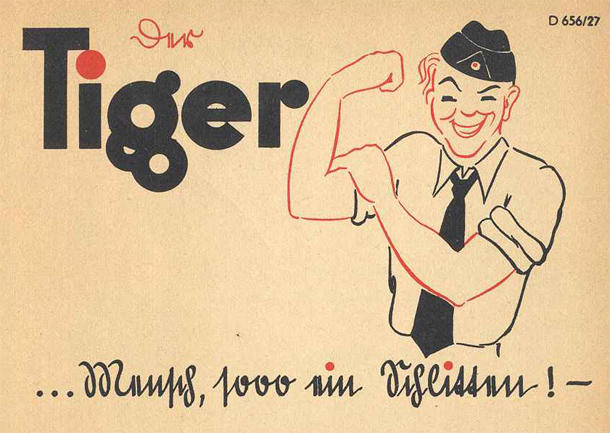
"Title page" of the manual... the last word of the text at the bottom was unfortunately beyond even Google Translate, source: internet, public domain
At that time, training for Tiger tank crews was the responsibility of Colonel Hans Christern. At the tank school in Paderborn, he watched first-hand as instructors tried to pack as much information as possible into soldiers in the shortest possible time, and felt that this approach could not give young tankmen what they actually needed to take away from their training. Christern concluded that the men would benefit from a very simple and straightforward guide that would briefly and clearly explain and remind them how to handle their tank at the front. It was not to be a detailed technical manual, but more of a "user's handbook" containing only the essentials. The Tigerfibel was therefore not born at the order of the Army High Command, but at the initiative of a man directly involved in crew training.
By the time Hans Christern began thinking about the new manual, the Tiger tank had already been in combat service for nearly a year. This allowed Christern to base the handbook on real operational experience. The guide could therefore highlight the specific maintenance and care that would help prevent the most commonly reported problems and failures. Christern also paid close attention to the fact that the age of the tankmen coming through training was falling steadily, and he wanted to tailor the manual accordingly. The document was to be both clear and entertaining, so that even young soldiers would actually enjoy reading it. Christern entrusted the preparation of a concrete draft to his subordinate, Lieutenant Josef von Glatter-Götz.
The actual author of the texts in the manual was therefore Von Glatter-Götz himself – and they were no ordinary texts. Von Glatter-Götz made extensive use of colloquial language, rhymes, mottos, and various analogies. All of this was accompanied by a wealth of cartoon illustrations, reportedly prepared by two non-commissioned officers named Gessinger and Wagner. It is reasonable to assume that one of them was responsible for the character drawings and comic scenes, while the other contributed the more technical illustrations depicting actual tank components. Von Glatter-Götz is also credited with inventing the title of the whole work – Tigerfibel. The word Fibel means "primer" in German – a children's first reading book – which was not only very witty but also entirely apt, since the manual genuinely did resemble an elementary school textbook in more ways than one.
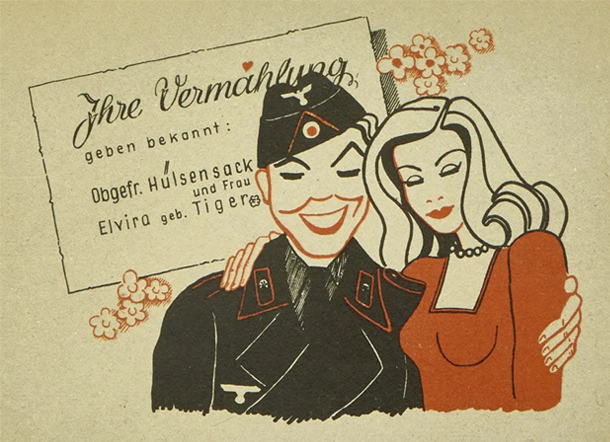
The manual's main characters: Corporal Hülsensack and his fiancée Elvira (née Tygrová)... their story appears to have had a happy ending, source: internet, public domain
The comic-book format of the document must have seemed like a revelation from another world at the time we are speaking of. One only has to compare the Tigerfibel with what manuals for other vehicles looked like – for instance, the manual for the Wespe self-propelled gun, available HERE.
The "heroes" of the Tigerfibel were the members of a fictional tank crew: driver Gustav, radio operator Piepmatz (Tweety), loader Hülsensack (shell bag), gunner Holzauge (wooden eye), and commander Schnellmerker (quick-on-the-draw). The most original and at the same time boldest element of the entire manual, however, was the character of a beautiful young woman named Elvira – the fiancée of loader Hülsensack. On some pages, mildly erotic drawings of Elvira even made an appearance, which was something completely unprecedented.
I should point out to readers that they will not find every page of the Tigerfibel below – only a selection of the more interesting ones. Likewise, the summaries of each page are by no means literal translations; they are brief summaries of the content with any notable points of interest highlighted.
* Virtually all sources agree on production costs for the Tiger of around 250,000 Reichsmarks. However, the Tigerfibel itself (page 91) states for some reason that the cost of a Tiger tank "all in" was 800,000 marks.
SELECTION OF CONTENTS:
Page 2
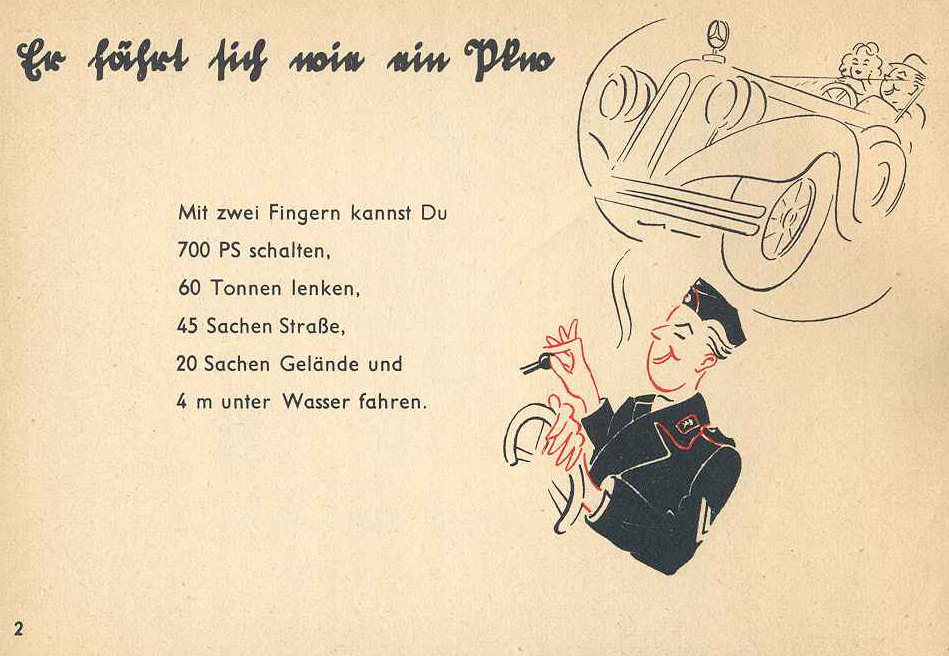
Quite literally with two fingers you can "kick" 700 horsepower into action, steer 60 tonnes, travel at 45 km/h on road, 20 km/h cross-country, and up to four metres underwater!
Page 4
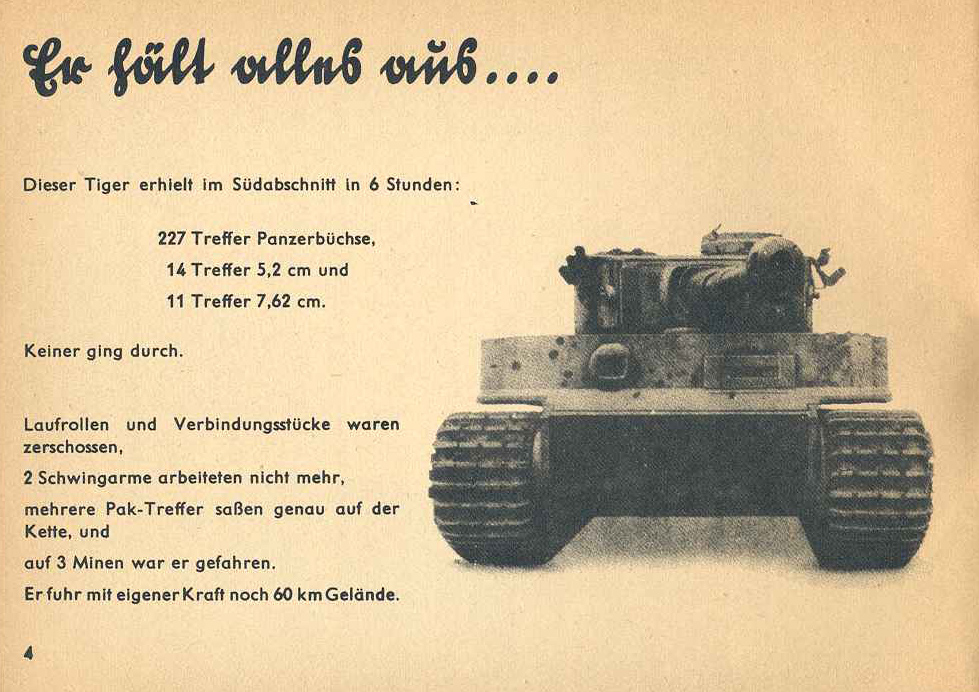
This Tiger took 227 hits from an anti-tank rifle, 14 hits from a 52 mm gun and 11 hits from a 76.2 mm gun during six hours of fighting... not a single round penetrated the armour. On top of that it took several more hits to the tracks and drove over three mines. Two road wheel swing arms gave out. Despite all of this, the tank was able to drive under its own power 60 km to safety. An encouraging fact for future crews of these machines!
Page 13
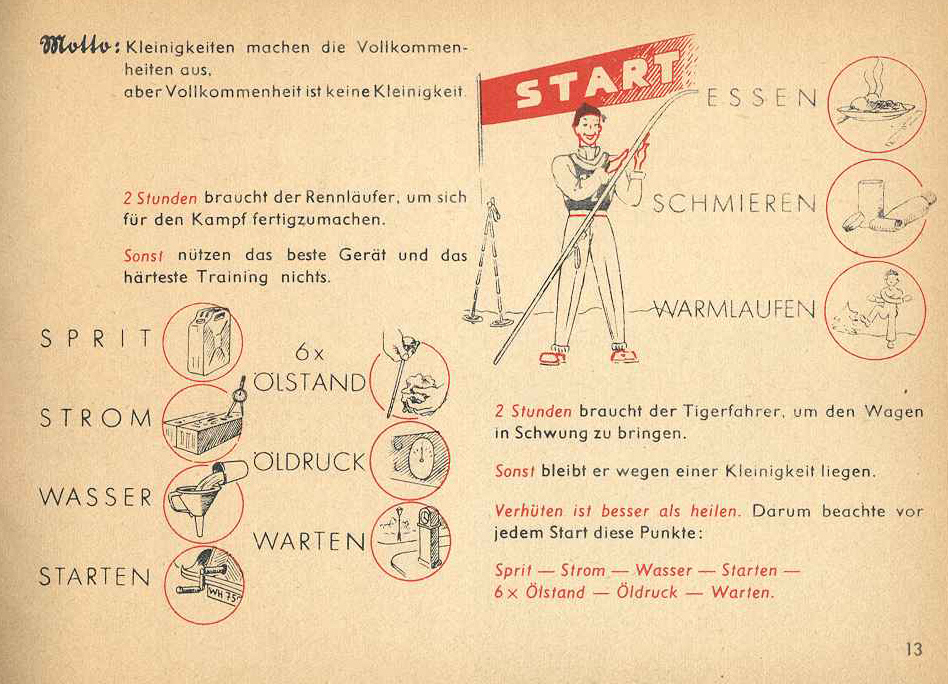
Trifles make perfection, but perfection is no trifle! A skier needs two hours to prepare before a race – otherwise even the best equipment and the hardest training will not save him. And in the same way, a Tiger driver needs two hours to prepare his machine for action, or some little trifle will be his undoing. The fuel, batteries, coolant and oil levels on all six dipsticks must be checked, as well as the oil pressure. And once the engine is started, a little more waiting is required.
Page 14
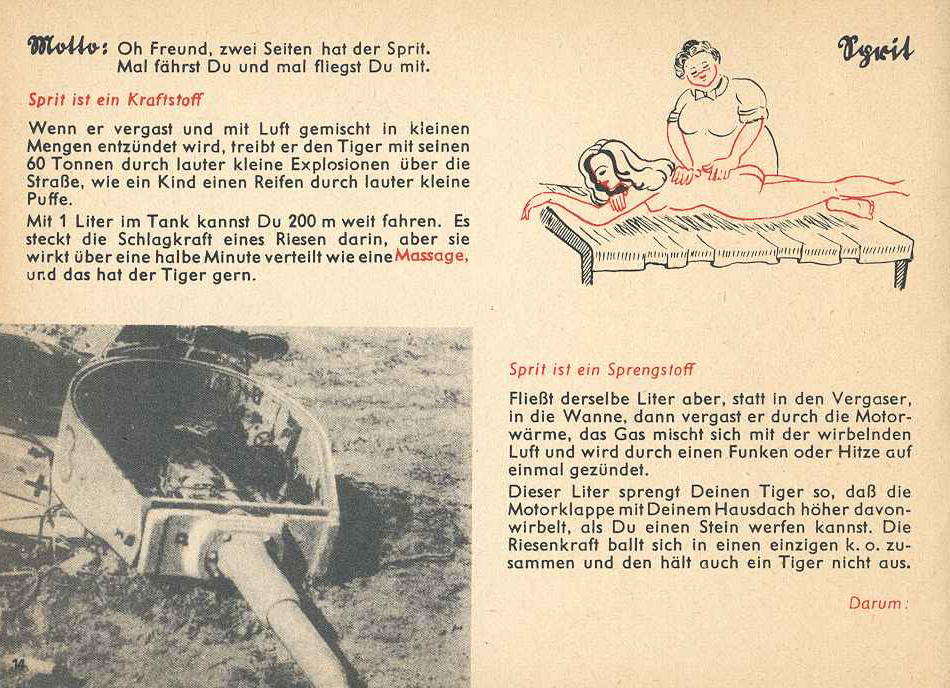
Petrol is fuel! In small doses, mixed with air and ignited, it will set a 60-tonne Tiger moving as if it were nothing. One litre will take you up to 200 metres. But petrol is also an explosive! If a litre spills onto the floor of the hull tray and is ignited by a spark or the heat of the engine, the resulting explosion can destroy even a Tiger. So...
Page 15
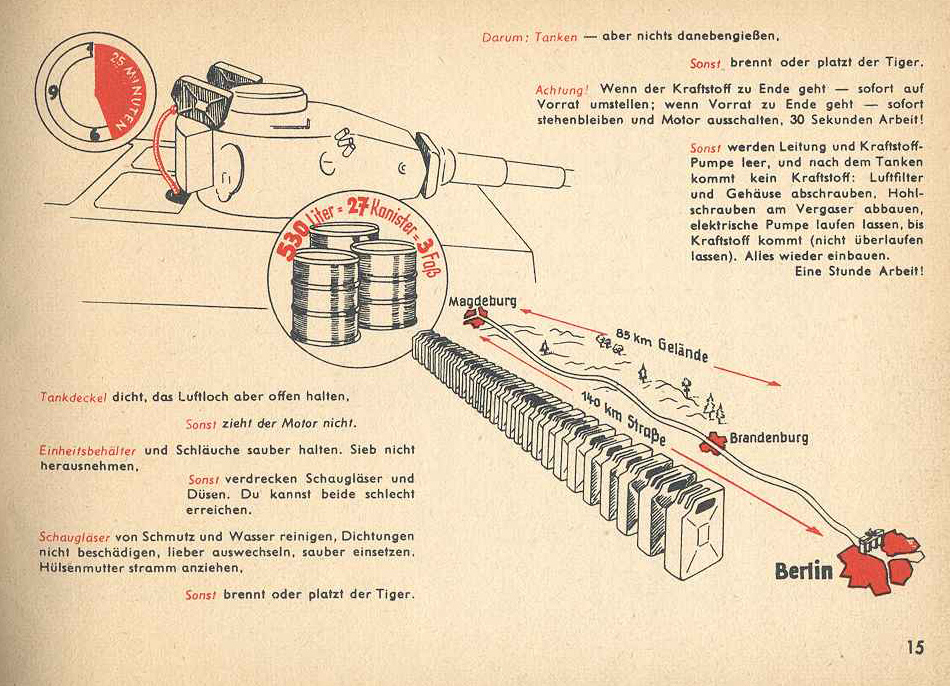
... so take care when refuelling that nothing goes where it shouldn't. When your fuel runs low, switch quickly to reserve, and when the reserve is running out too, you should stop and switch off the engine in good time. That is 30 seconds' work – but if you don't do it in time and run the remaining petrol out of the pipes and carburettor, you face an hour's work to put everything right again. The tank holds 530 litres of petrol – equivalent to 27 jerrycans – giving you a range of 140 km on road and 85 km cross-country.
Page 18
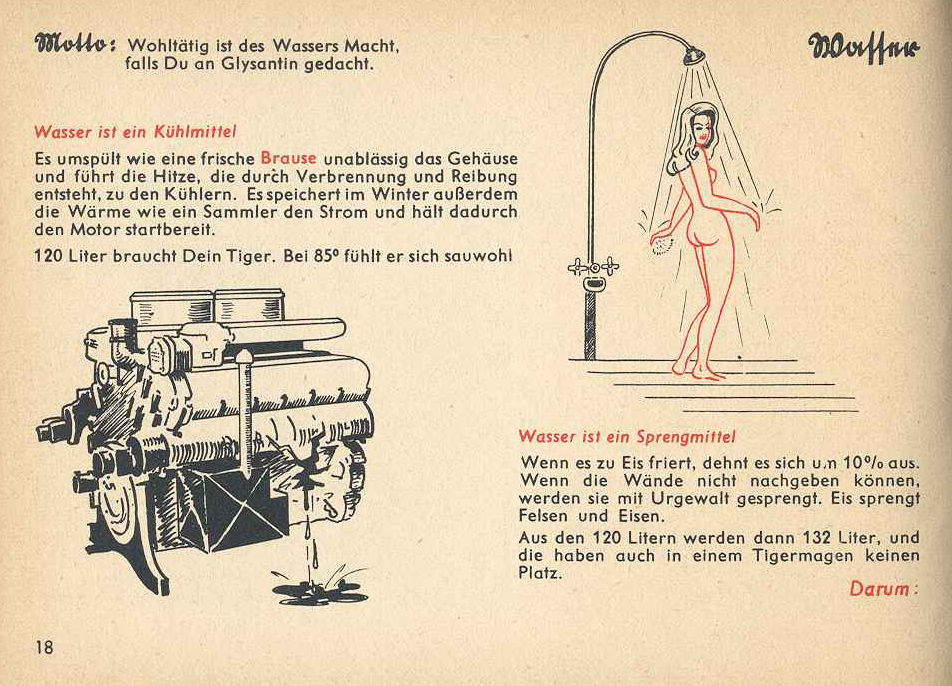
Water is a cooling medium. It circulates constantly around the engine block, carrying away excess heat. In winter it keeps a switched-off engine warm for a while so it can be started again easily and quickly. The Tiger needs 120 litres of coolant and is happiest when its temperature is 85°C. But when water freezes, it expands by 10%. Those 120 litres of water become 132 litres of ice – and that won't fit inside the engine, so the frozen water will crack it apart.
Page 23
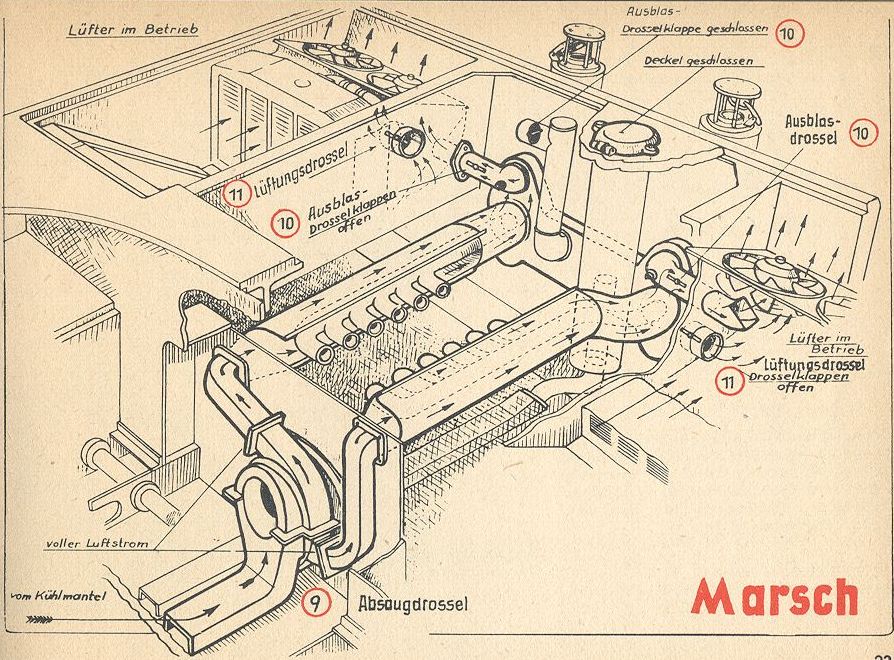
Diagram of the airflow during normal driving (when the snorkel for deep wading is not fitted). The air intake is located on the hull roof between the driver's and radio operator's hatches. From there the air passes under the gearbox cover (not shown in the diagram), through ducting under the fighting compartment floor, to a fan located just behind the bulkhead separating the fighting compartment from the engine section. The fan then drives the air further along two channels alongside the exhaust manifolds to the rear wall of the hull and from there out through the sides of the tank via the rear radiator fans.
Page 24
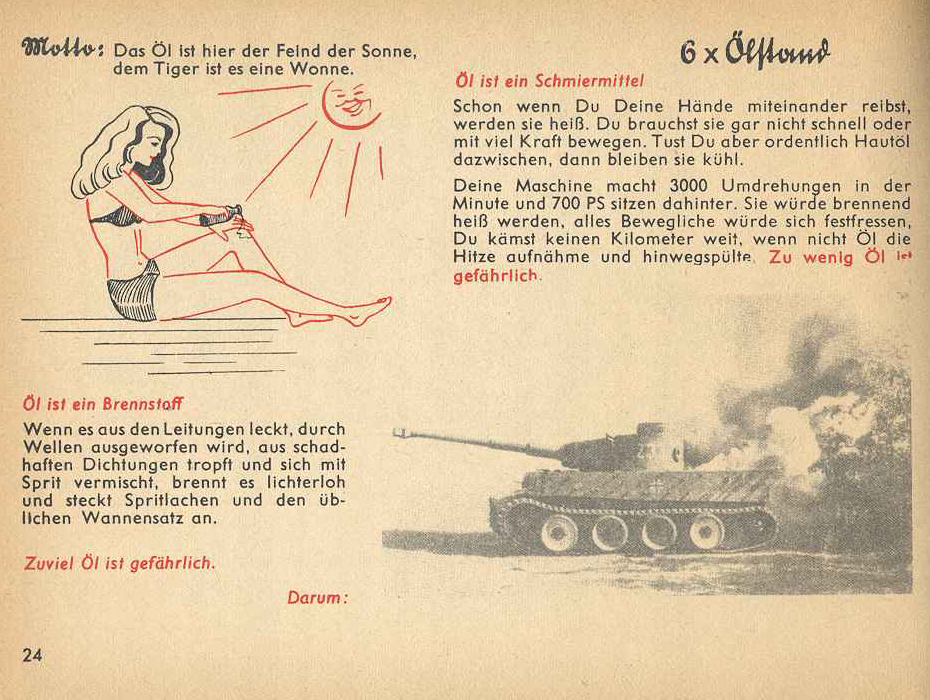
When you rub your hands together you can feel them warming up. But put a little body oil on them and they won't heat up at all. Your machine performs 3,000 revolutions per minute with 700 horsepower behind it. If the oil did not carry away the heat generated by the friction of the moving parts, they would literally cook, seize up, and that would be the end. That is what happens when there is too little oil. But if there is too much oil and it overflows somewhere it shouldn't, it can cause a fire.
Page 26
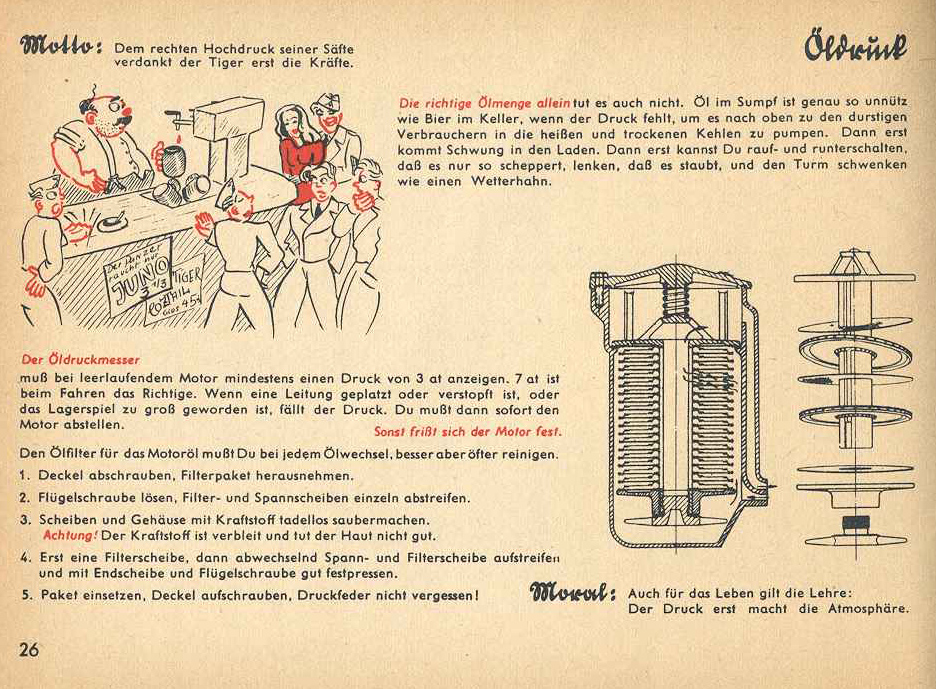
Oil sitting at the bottom of the sump is as useless as beer in the cellar if there is no pressure to drive it up to thirsty customers. The oil pressure gauge should read 3 when the engine is idling and 7 during driving. If the oil pressure drops, stop immediately and switch off the engine. The oil filter should be cleaned at least every time the oil is changed – ideally even more frequently than that.
Page 27
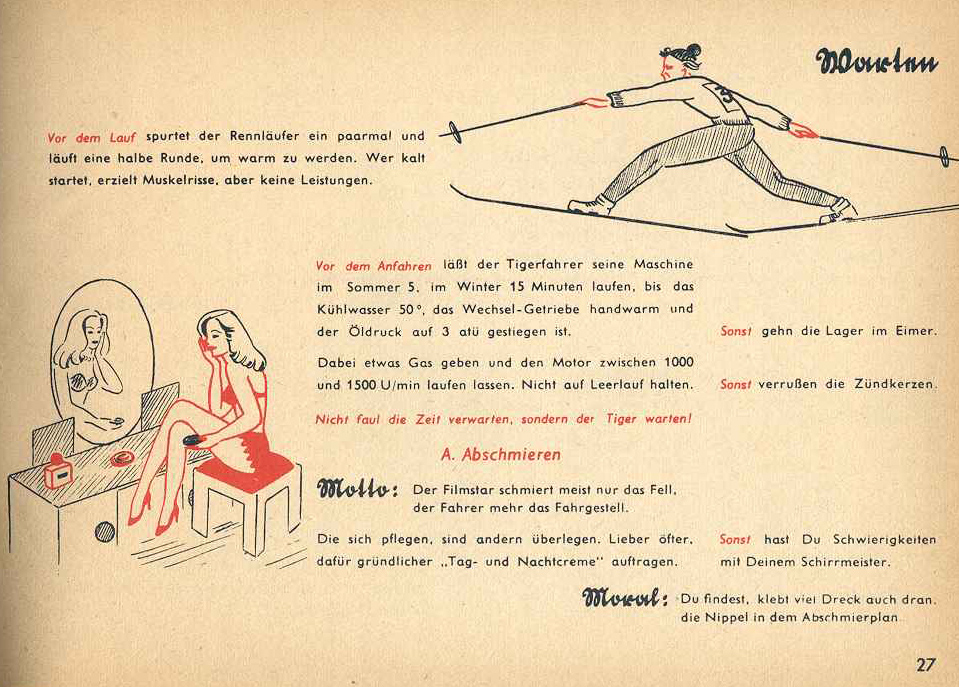
A good racing driver does a warm-up lap before the race to get his blood going. In the same way, a Tiger driver should let his tank warm up before moving off. In summer five minutes is enough; in winter you should allow more like 15 minutes, until the coolant reaches 50°C, the oil pressure is at 3 atmospheres and the gearbox is warm to the touch. Help things along by gently pressing the accelerator while you wait and running the engine at 1,000 to 1,500 rpm.
Page 28
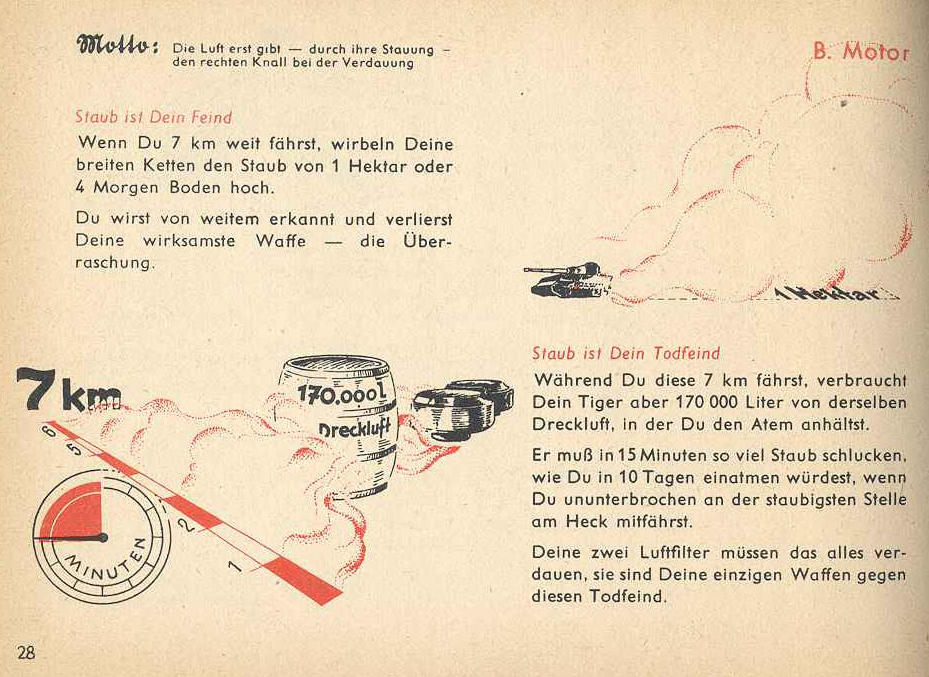
Dust is your enemy! In seven kilometres of driving on combat tracks you will raise dust from an area equivalent to one hectare of ground. During that same journey your Tiger will consume 170,000 litres of air – air containing all that dust. In 15 minutes the Tiger "breathes" the same volume of air as you do in 10 days. Only two air filters have to deal with all that dust. They are your only weapon against the enemy called dust.
Page 36
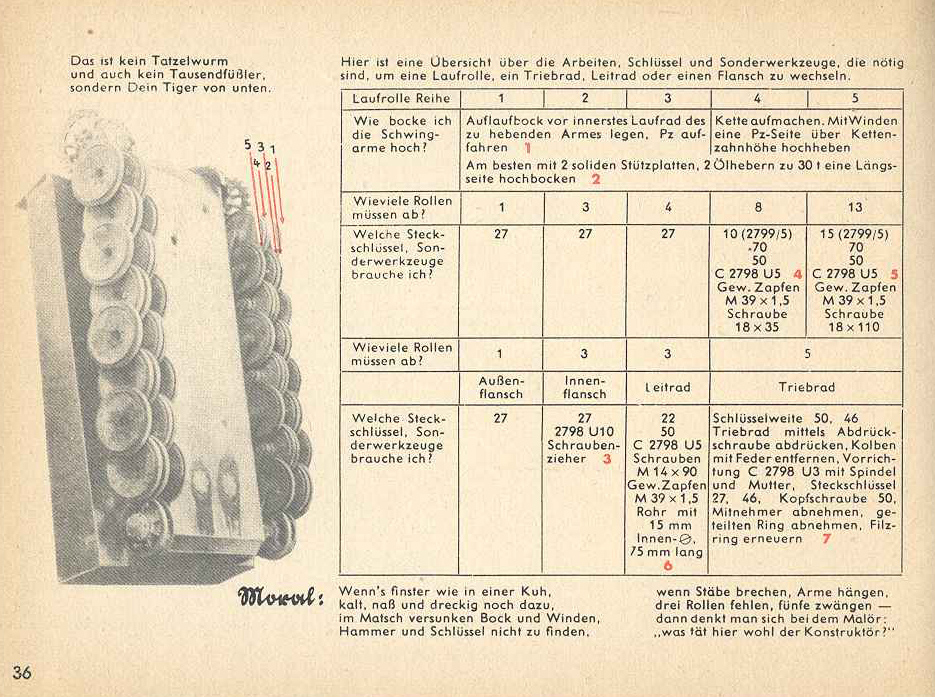
This is neither a centipede nor a "Tatzelwurm" (a clawed worm from Alpine legend) – it is your Tiger viewed from below! The road wheels are arranged in a total of five rows (though strictly speaking there were actually six). The table shows how many wheels must be removed and what tools are needed to replace the road wheels in each row, as well as the drive sprockets and idler wheels. Note, for example, that to access a wheel in the fifth row, no fewer than 13 road wheel discs must be removed first!
Page 37
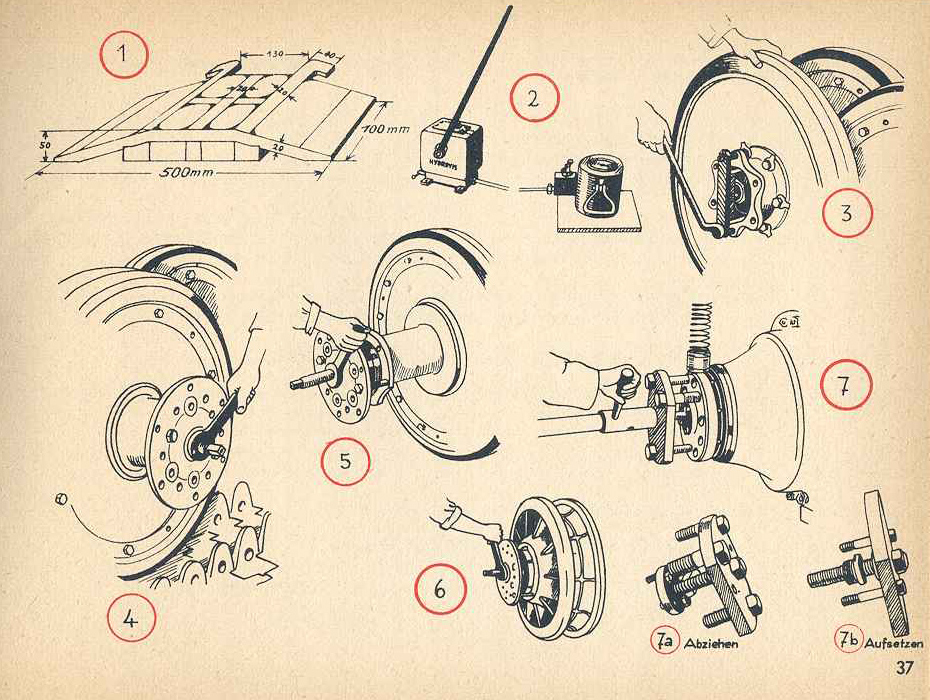
Continued instructions for wheel replacement. This page illustrates the basic tools and their use in removing road wheels, drive sprockets and idler wheels. It is worth noting that a crew manual would address something like this at all, since this kind of "operation" was not normally within the crew's responsibilities but was the business of tank repair units.
Page 38
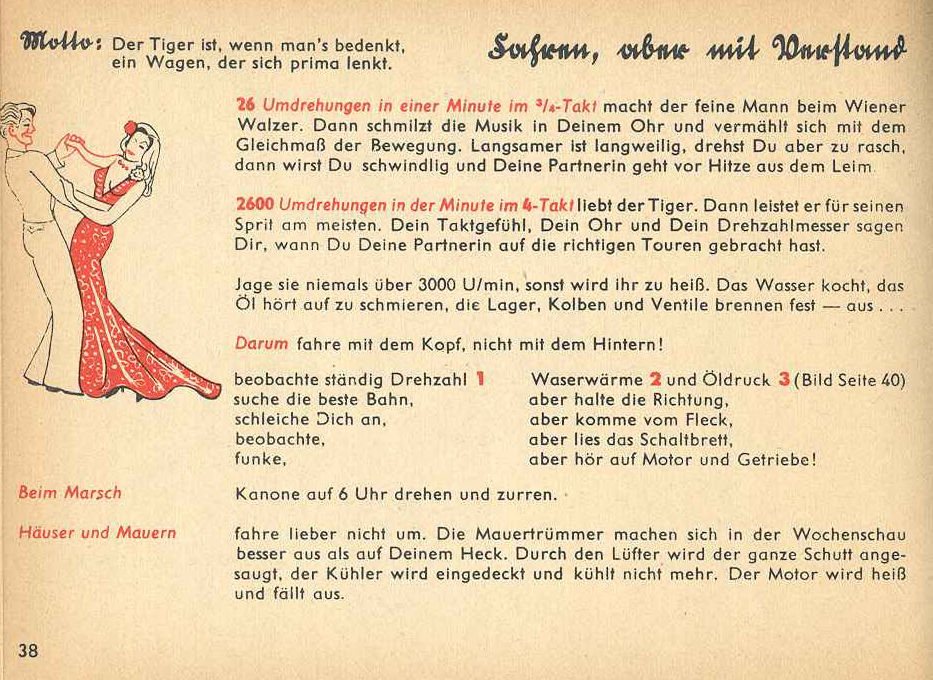
A good dancer makes 26 turns per minute doing the Viennese waltz in three-quarter time. Go slower and it's boring; go faster and he'll get dizzy. But a Tiger prefers 2,600 revolutions per minute in four-stroke rhythm. Never exceed 3,000 rpm! The water will boil, the heated oil will stop lubricating properly and the cylinders will seize. Watch the rev counter and the water temperature and oil pressure gauges constantly!
Page 40
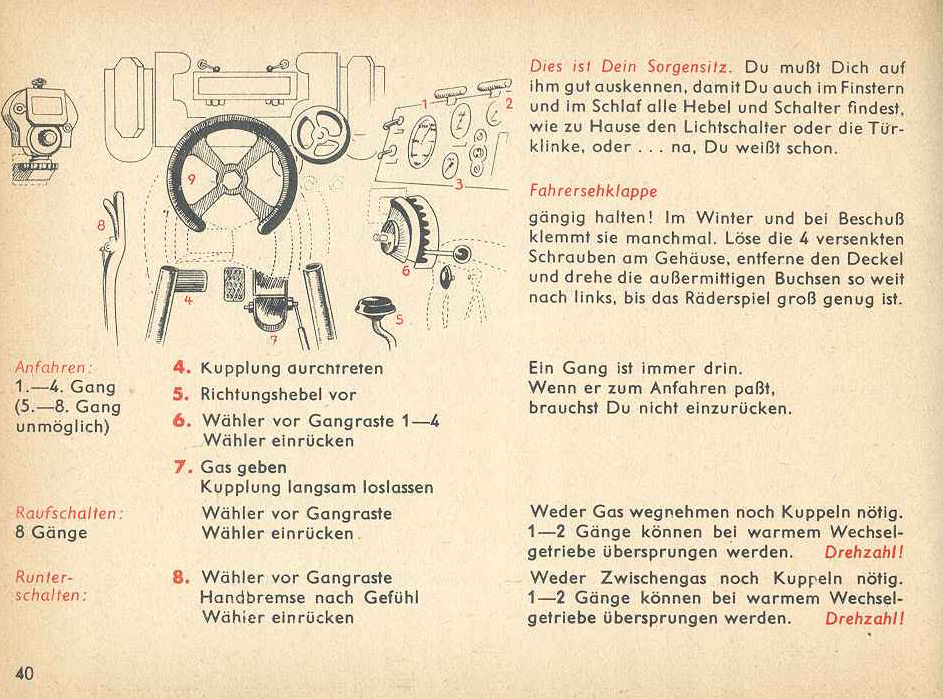
Description of the driver's station, operation of the front vision port shutter flap, and a guide to the correct start-up sequence and gear-changing procedure. "This is your domain! You must know where every lever is even in the dark, just as you can find a light switch, a door handle, or... well, you know who, back home with your eyes shut." Note that the directional gyroscope is also shown in the illustration (the device on the far left).
Page 42
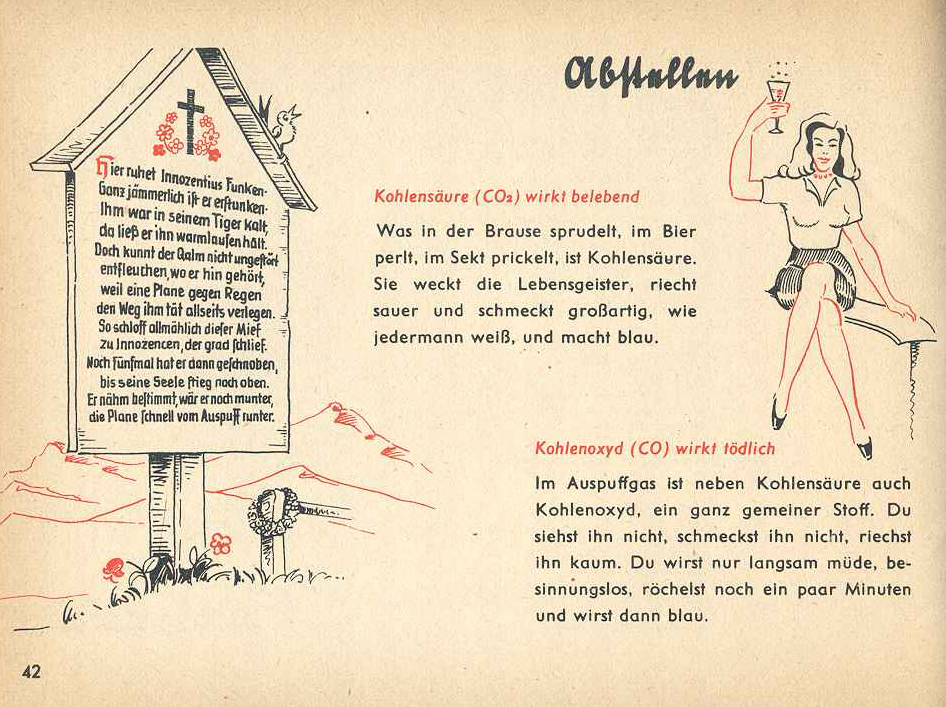
Carbon dioxide (CO2) can be a fine thing. It makes bubbles in soda water, in beer and in sparkling wine, so it can smell good, taste good and get you pleasantly drunk. Carbon monoxide (CO), on the other hand, is lethal. Exhaust gases contain not only CO2 but also CO – colourless, tasteless and virtually odourless. After a while you feel tired, then you lose consciousness and never wake up. The gravestone tells the story of a crew who wanted to warm up in the cold by running the engine, but forgot they had covered the ventilation openings with a tarpaulin to keep out the rain, preventing the exhaust gases and air from circulating as they should.
Page 44
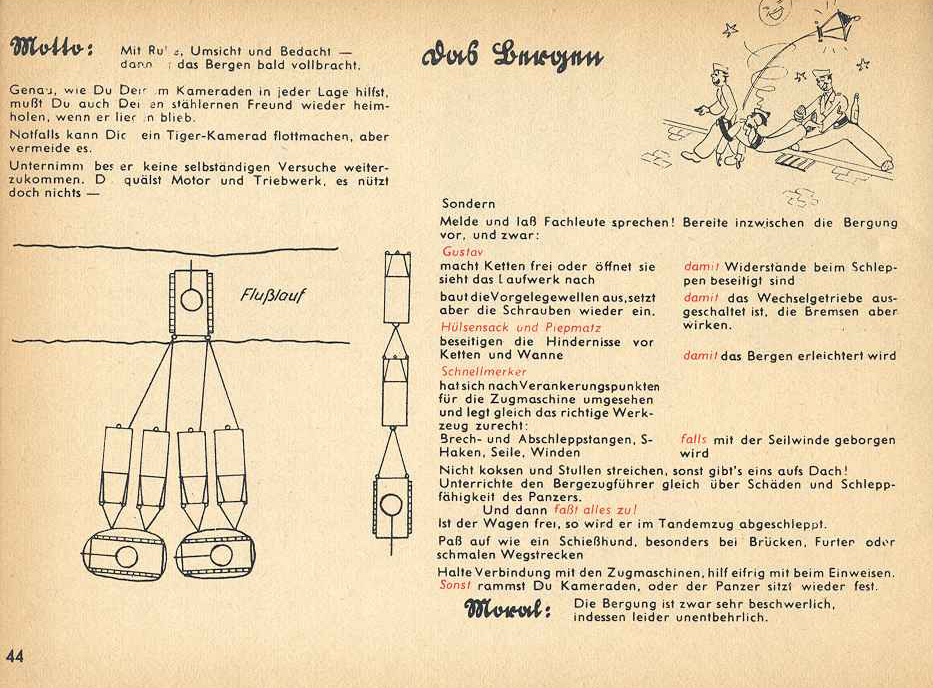
Just as you would always help a friend in need, so you should always look after your steel companion. If you get stuck, don't try to free yourself alone – you will only strain the engine and gearbox. If there is no other option, a comrade can help with his tank, but try to avoid even that. Better to call in the specialists and prepare your tank for recovery: disengage the gearbox, but not the brakes! Clear any obstacles around the tank, look around for suitable anchor points for a pulley block, prepare the necessary equipment, and brief the recovery platoon commander on the condition of your vehicle.
Page 48
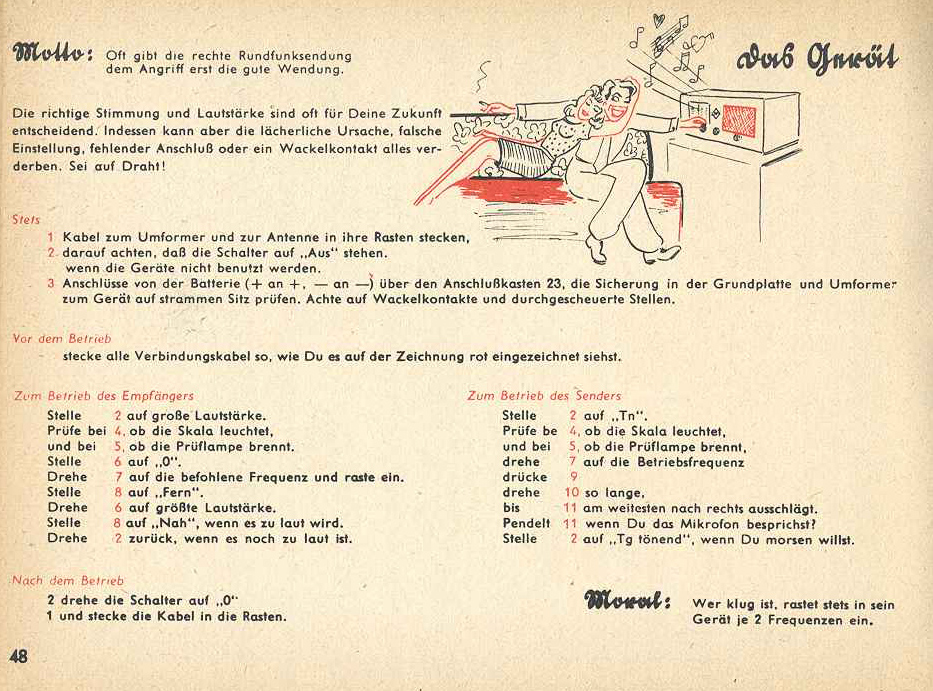
The right tuning and the right volume can decide your future. Poor settings or a loose contact can ruin everything, so pay attention! What follows is a list of actions the radio operator should carry out: which cables to connect, which contacts to check, how to set each switch and control on the receiver and transmitter – all aided by red-highlighted numbers referring to the radio set diagram on the next page of the manual.
Page 49
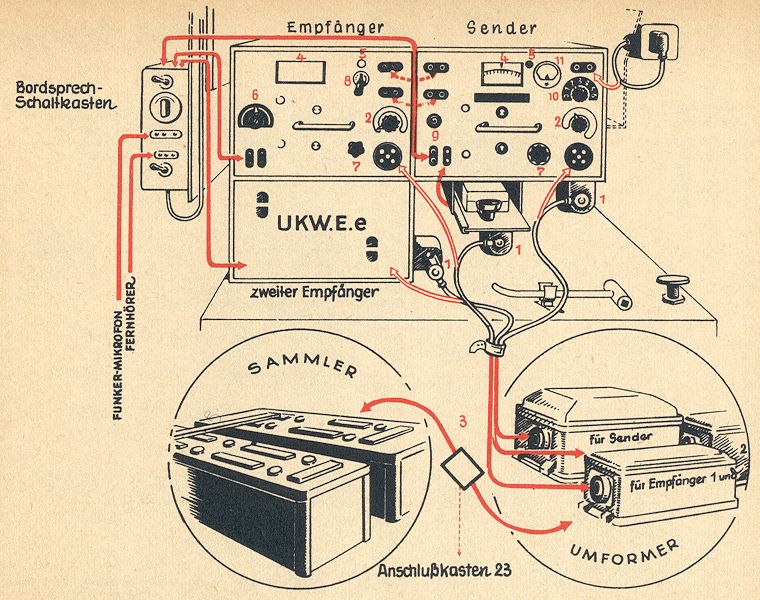
The radio equipment on board the Tiger tank, here in the configuration for a platoon commander with one transmitter (Sender) and two receivers (Empfänger). To the left of the radio sets you can see the intercom box; to the right, the connection point for the external antenna. Below the radio sets the power supply from the tank's batteries via three voltage converters is indicated. Note also the hand Morse key positioned below the transmitter.
Page 50
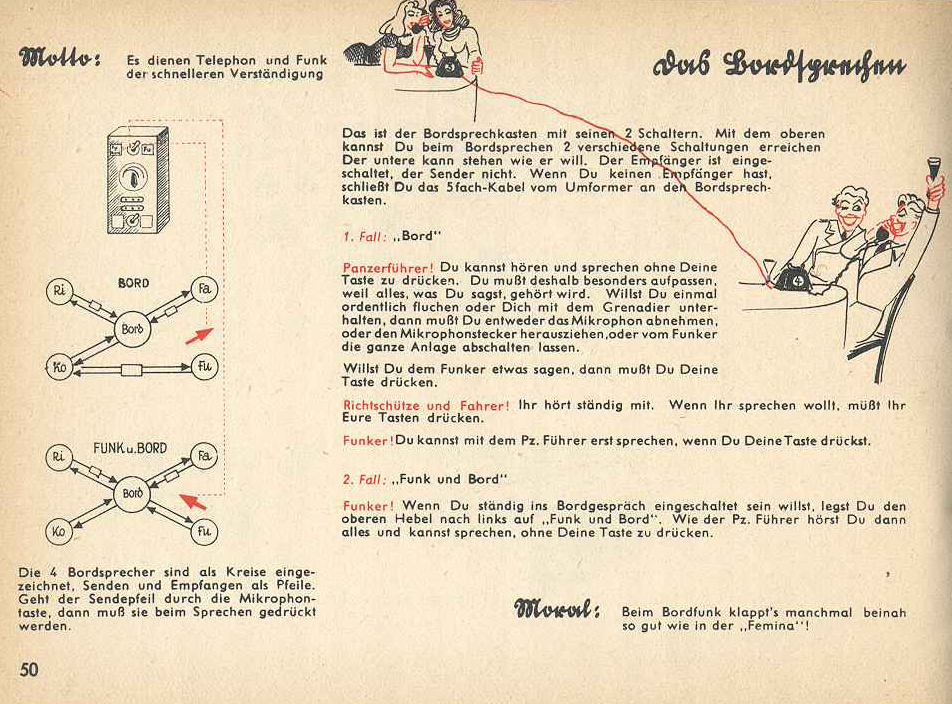
The intercom box has two switches. The upper one has positions "Bord" and "Funk und Bord". If the radio operator switches off the transmitter and leaves only the receiver on, he can select between two modes of communication. "Bord" position: the commander (Ko) speaks to the driver (Fa) and gunner (Ri) without needing to press a button – they hear his every word. If the driver or radio operator want to speak, they must press the button on their microphone. The radio operator (Fu) is connected only to the commander, and both must press their microphone button to speak to each other. "Funk und Bord" position: all four men are connected; the commander and radio operator are heard continuously, while the gunner and driver are heard only when they activate their microphones.
Page 51
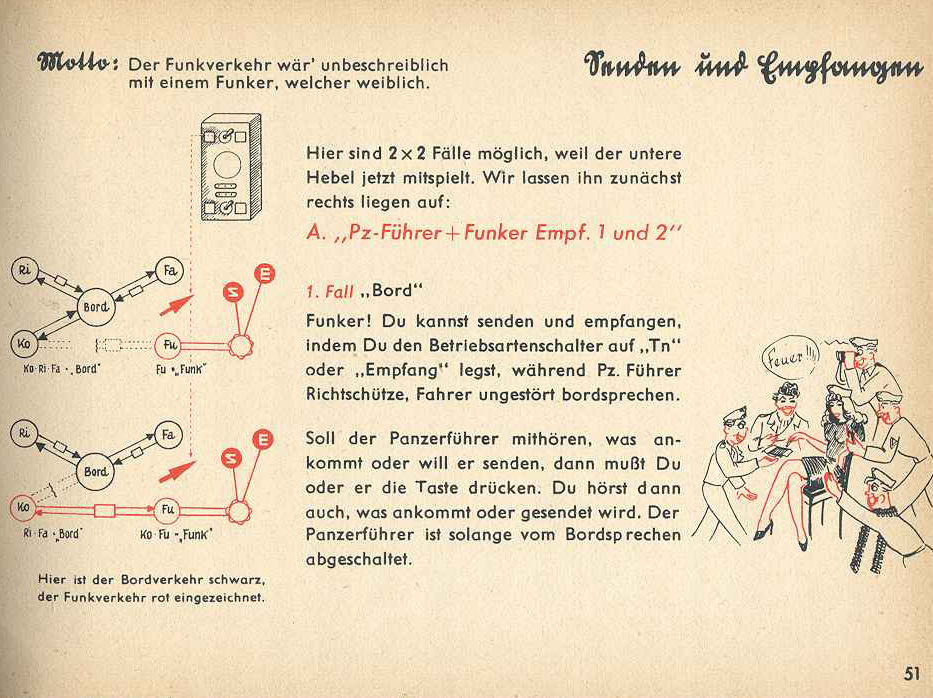
Now we bring the transmitter into play as well. Lower switch in "Trennung" position, upper switch in "Bord" position. Black lines in the diagram represent communication inside the tank; red lines represent radio traffic with the outside world. Under normal conditions only the radio operator monitors the airwaves while the others talk among themselves (first diagram). If the radio operator wants to bring the commander in on incoming traffic, or if the commander wants to start transmitting outside the tank, either of them simply presses his microphone button. At that moment, however, the commander is disconnected from communication with the driver and gunner (second diagram).
Page 52
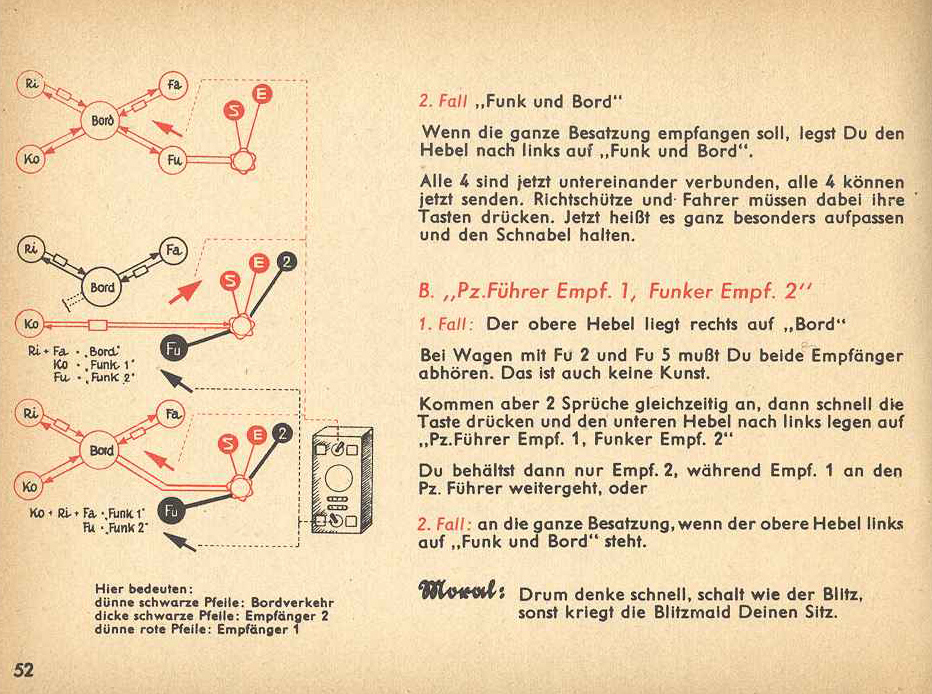
Lower switch in "Trennung" position, upper switch in "Funk und Bord" position. First diagram: the black lines disappear – the entire crew is now connected to external communications, so be careful what you say. Then there are two diagrams that take account of the second receiver on board a command tank... and here things start to get a little more complex. External radio traffic is normally monitored by the radio operator alone. But if messages start arriving on both receivers simultaneously, the radio operator must quickly switch the first receiver to the commander and record the messages on the second receiver himself. By switching the upper switch to "Funk und Bord" he can bring the other crew members into the first receiver's communications as well.
Page 54
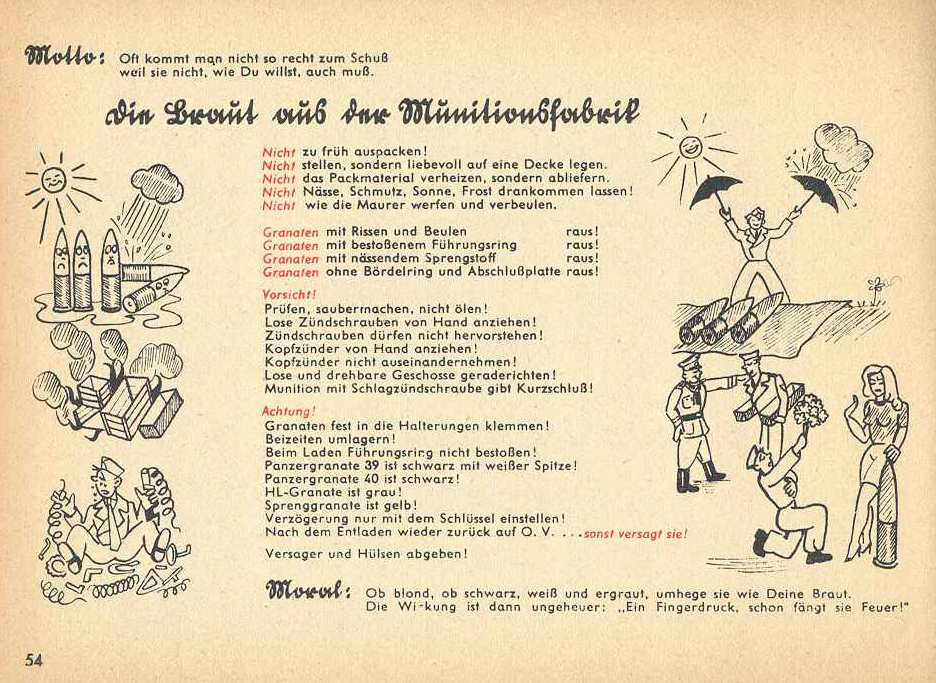
The bride from the ammunition factory. Don't unwrap them too early, lay them nicely on a blanket, keep them away from sun, rain, dust and frost, and discard any damaged rounds immediately. Inside the tank, secure the rounds firmly in their holders and remember: armour-piercing Panzergranate 39 rounds are black with a white tip; Panzergranate 40 rounds with a tungsten core are black; shaped-charge HL-Granate rounds are grey; and high-explosive Sprenggranate rounds are yellow.
Page 55
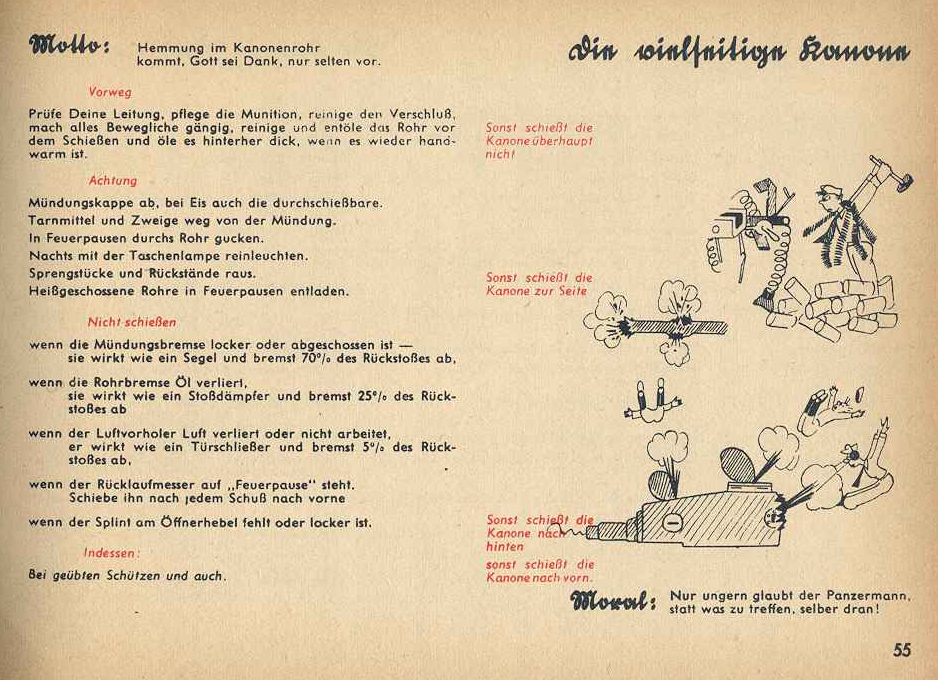
Always check the electrical wiring first (the Tiger's gun was electrically fired), clean the chamber, and make sure all moving parts move freely. There must be no oil in the barrel before firing. Conversely, after firing, once the barrel has cooled enough to keep your hand on it, the inside of the barrel must be oiled again. Before firing, remove any camouflage and the muzzle cover from the barrel. During every pause in firing, look down the barrel to check that no residue remains inside. Never fire if the muzzle brake is missing, and never fire if fluid is leaking from the gun's recoil mechanism.
Page 66
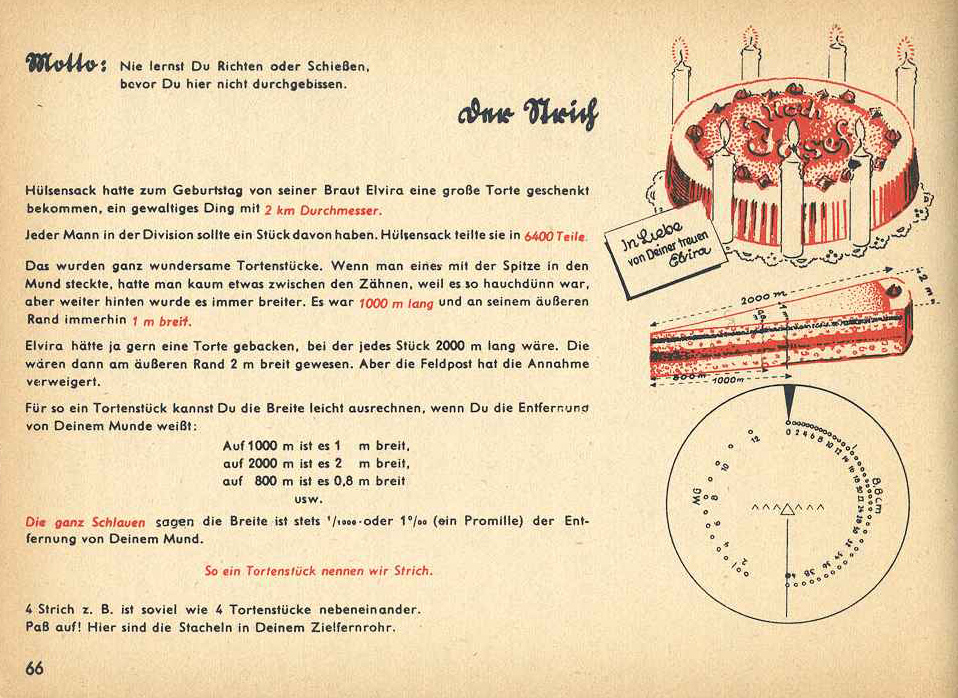
A beautiful metaphor to explain the concept of the mil. Loader Hülsensack received a birthday cake from his fiancée Elvira with a diameter of 2 km. Hülsensack wants to share it with the men of his division and cuts it into 6,400 slices. Each such wedge is therefore 1,000 metres long and exactly 1 metre wide at its outer end – and that is one artillery mil. If Elvira baked an even larger cake with a diameter of 4 km, each slice would be 2,000 metres long and 2 metres wide at the end. The sharper minds among you will note that the width of a mil is one thousandth (or one per mille) of its length.
Page 67
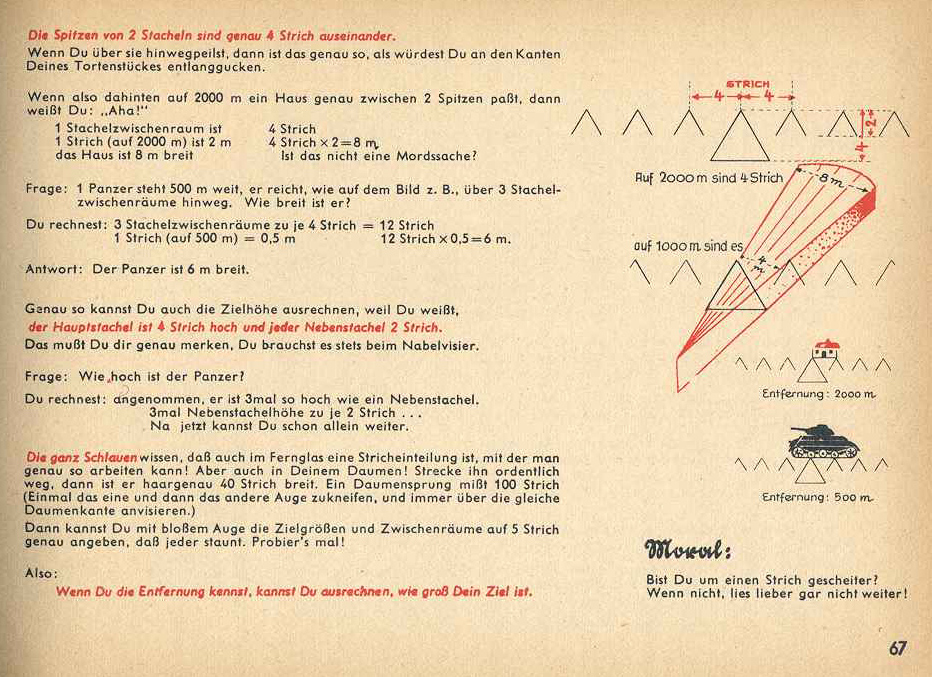
Explanation of how to use mils when aiming. The gunner sees a series of chevrons in his sight. The distance between the tips of two adjacent chevrons corresponds to a width of 4 mils – meaning exactly four slices of Elvira's enormous cake would fit between two chevrons. When the range to a target is known, its size can therefore be calculated. A house 2 km away that fills exactly the gap between two chevrons in the sight (4 mils) is 8 metres wide. A tank 0.5 km away that spans three gaps between chevrons (12 mils) is 6 metres wide (12 × 0.5).
Page 68
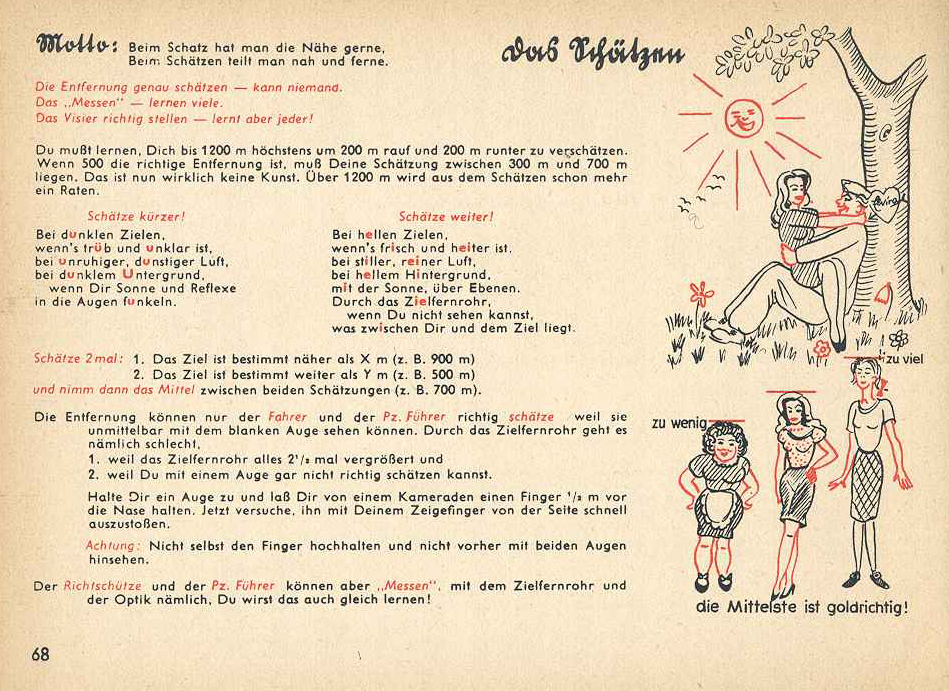
For ranges up to 1,200 metres it is possible to learn to estimate correctly to within plus or minus 200 metres. Beyond 1,200 metres it is no longer estimation – it is guesswork. The gunner should determine the range; the driver and commander can estimate it, since both of them look out with both eyes through optics with no magnification. When estimating range, err on the low side if the target is dark, if it is overcast or misty, or if you are shooting into the sun. Conversely, err on the high side if the target is light in colour, if it is fine weather, if the sun is behind you, or if you are unsure what lies between you and the target.
Page 69
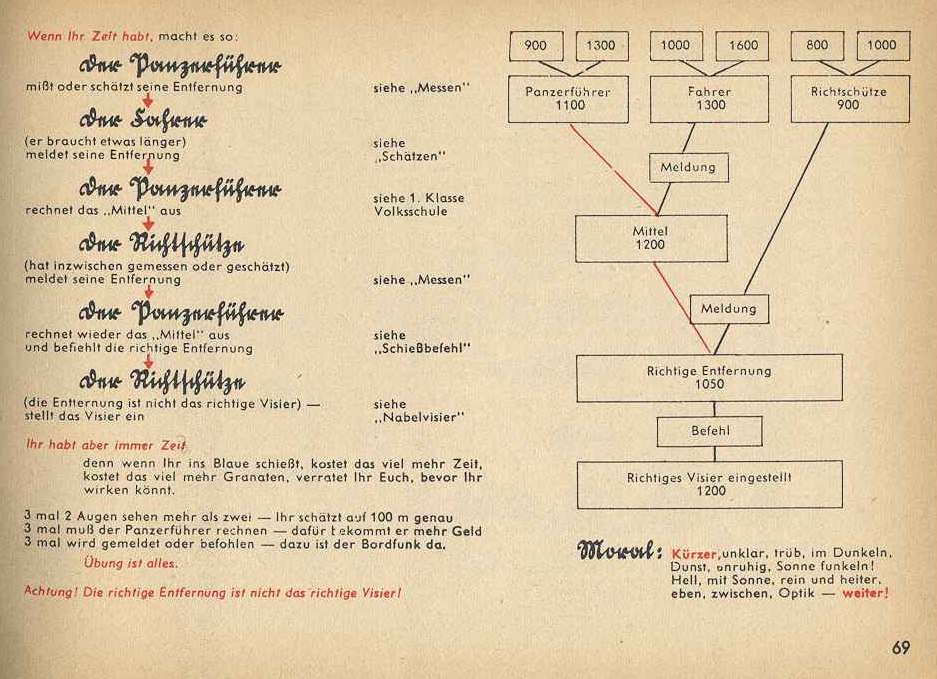
This is how the final range to a target is determined. The commander makes his own estimate; the driver reports his. The commander calculates their average. The gunner then reports his measurement. The commander averages again, determines the range, and issues it as an order to the gunner. The gunner adds half the target's height to ensure he hits the centre, and enters this value into the sight. Three pairs of eyes simply see more than one. (Humorous aside: the commander has to calculate three times in total – which is why he gets paid more than you.)
Page 70
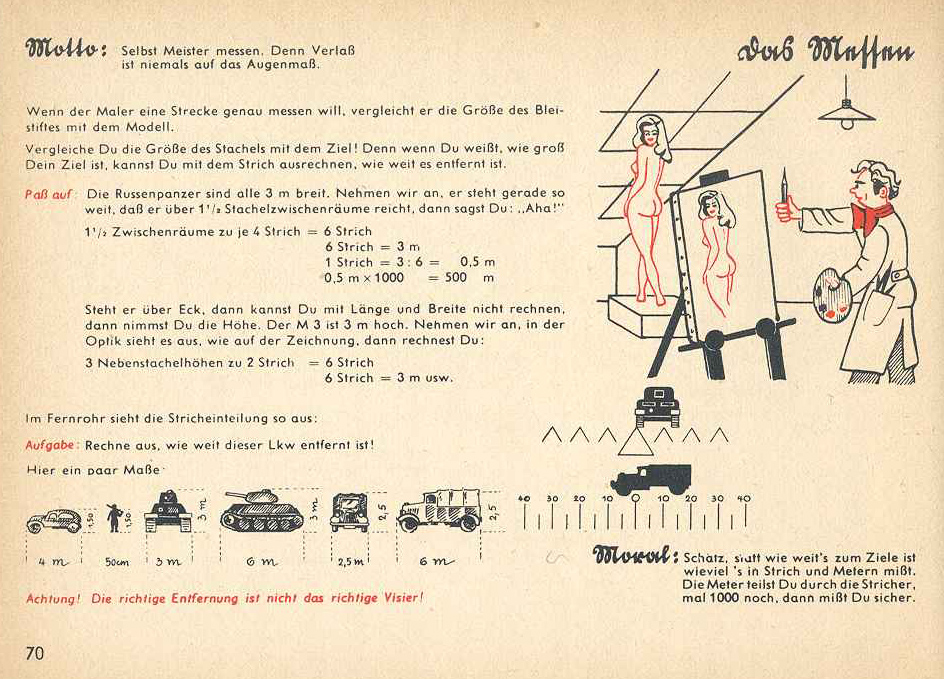
To determine the range to a target whose dimensions you know, simply compare its size against the chevrons in the sight. All Russian tanks are roughly three metres wide. Suppose such a tank fills 1.5 gaps between chevrons in the sight – that is 6 mils. So each mil corresponds to 0.5 metres of actual tank width (3 metres across 6 mils). And we already know that a mil is 0.5 metres wide at a distance of 500 metres. If the tank is approaching at an angle and you cannot work with its length or width, simply use its height to determine the range instead.
Page 72
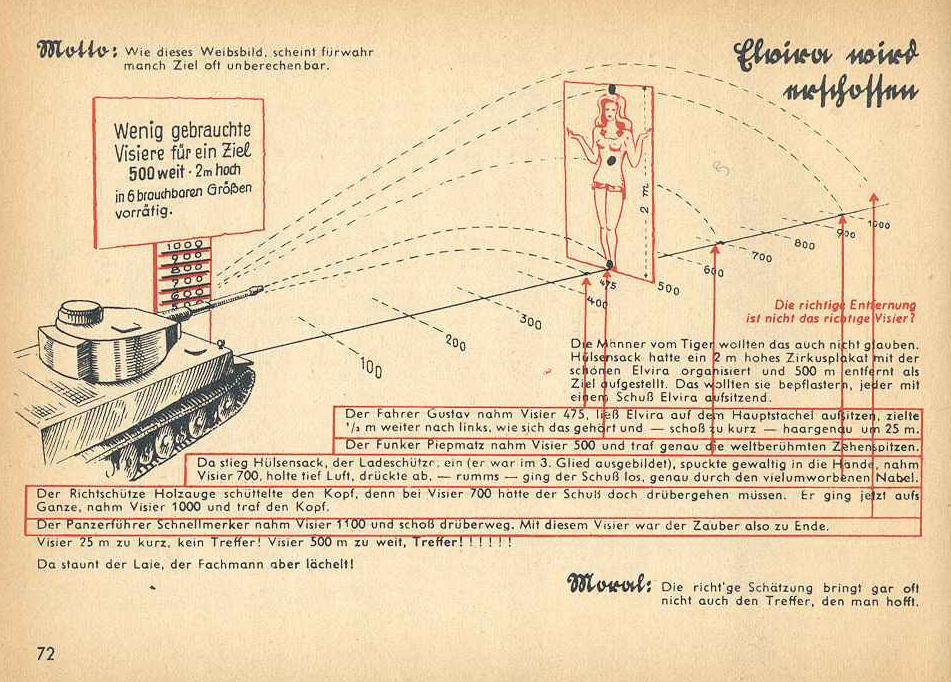
The crew were quite astonished when loader Hülsensack produced a two-metre poster of Elvira and set it up 500 metres from the tank as a target. Each man got one shot. Driver Gustav set the sight to 475 metres and the round landed 25 metres short of the poster. Radio operator Piepmatz set it to an even 500 metres and hit Elvira's cute little toes. Loader Hülsensack set 700 metres and struck her precisely in the belly button. Gunner Holzauge moved the sight to 1,000 metres and hit the very top of the poster. And commander Schnellmerker set 1,100 metres and overshot Elvira entirely. If you go just 25 metres below the correct range, you will miss. But above the correct range you have 500 metres of margin and you will still score a hit!
Page 73
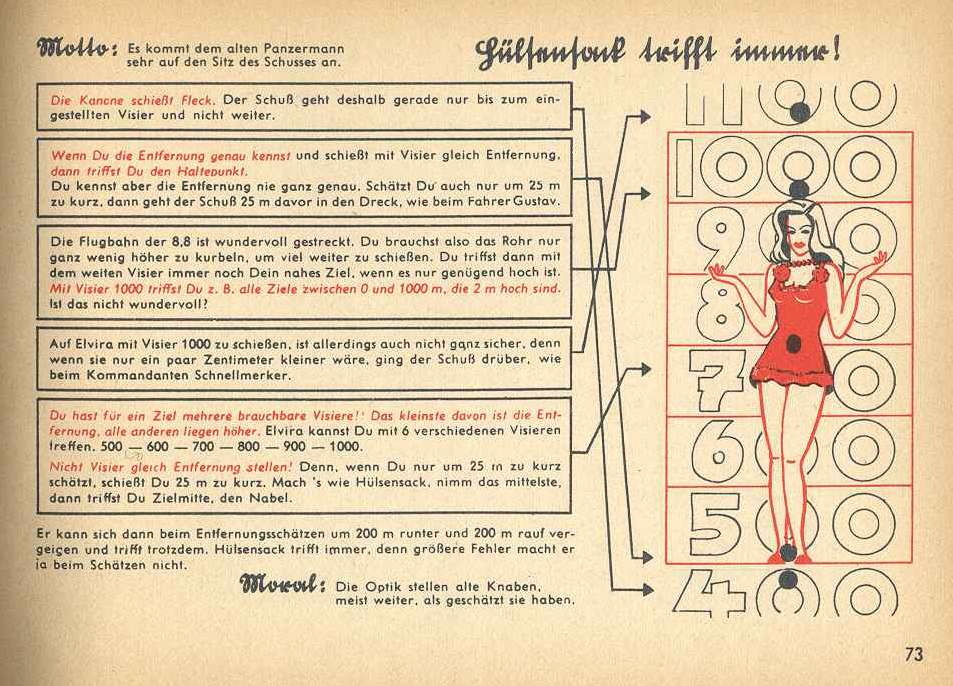
Continuing the example from the previous page. The range to a target and the value you set in the sight are not the same thing. If you set the sight to the exact range, the shell would land at the target's feet. You must take the target's height into account and add it to the range setting. A two-metre Elvira standing 500 metres away will be hit with any sight setting from 500 to 1,000 metres. But set the sight to 475 metres and the round will fall short. You can therefore err upwards without consequence, but not downwards.
Page 75
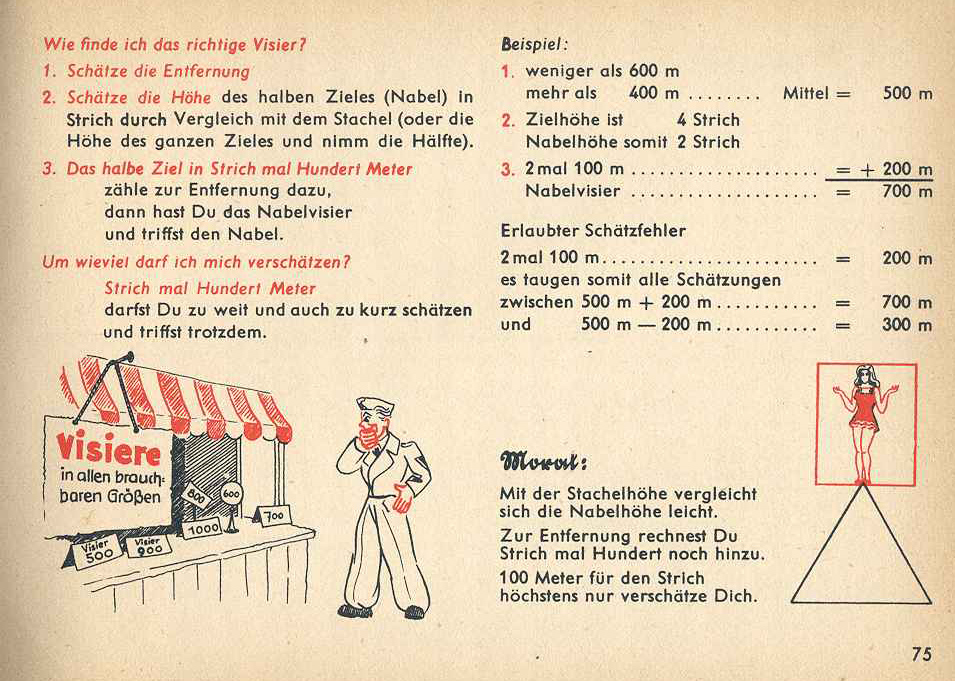
A correctly aimed shell should strike the centre of the target. It is therefore necessary to account not only for range but also for the target's height. First, estimate the distance by comparing the target's size against the aiming chevrons. Then, in exactly the same way, determine the target's height in mils. Take half the estimated height in mils, multiply by 100 metres, and add that figure to the estimated range. Example: the target is 500 metres away and 4 mils tall (corresponding to the height of the large chevron). Half of 4 is 2. Times 100 gives 200. So you set the sight to 500 + 200 metres.
Page 76
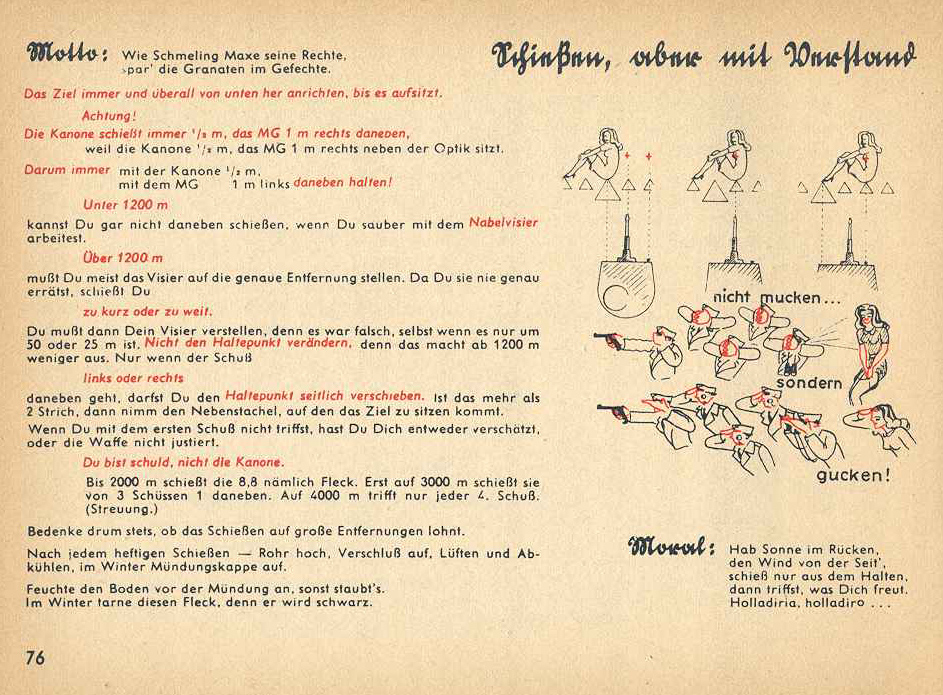
This page reminds the gunner that the sight axis is offset from the gun axis by approximately half a metre, and from the co-axial machine gun axis by a full metre. At close ranges this can make a difference. After sustained firing, raise the barrel, open the breech and let the gun breathe and cool. In dry conditions, wet the ground below the muzzle so that firing raises less dust. In winter, camouflage this area, as the snow beneath the muzzle will be blackened after firing and give your position away.
Page 77
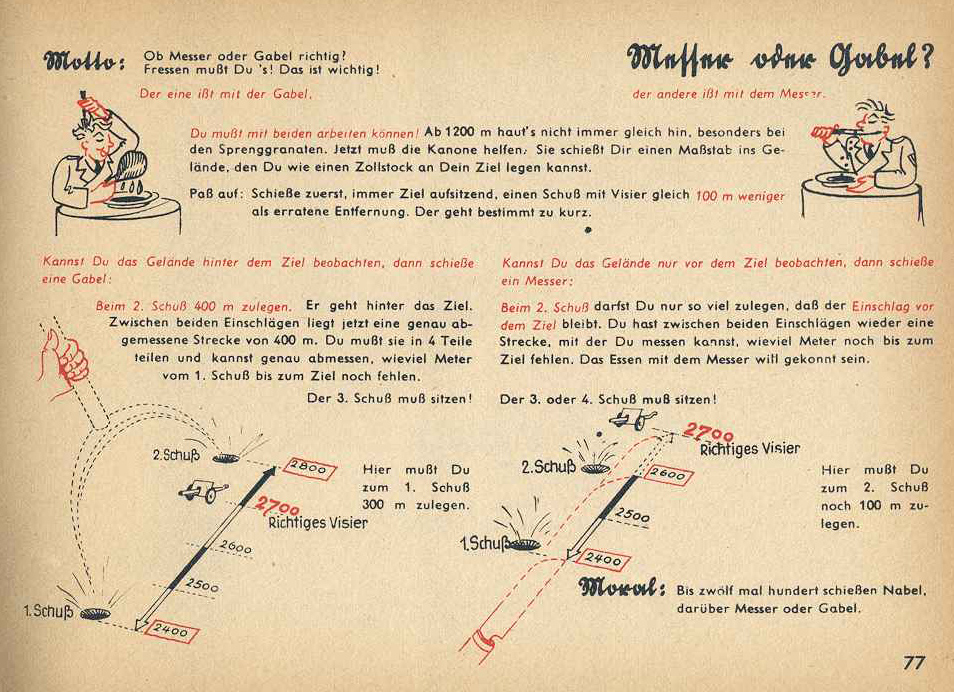
Bracket and knife. When firing at ranges beyond 1,200 metres things become more complex, especially with high-explosive rounds. If you have a clear view of the ground both in front of and behind the target, use the bracket method. First estimate the target's range, then set 100 metres less in the sight and fire the first round. Then shift the sight 400 metres further and fire again. The target lies somewhere between where the two shells landed – from this you can estimate where to send the third round and score a hit. Use the knife method if you cannot see the ground behind the target. Again fire the first round deliberately short of the target. Then add 200 metres and observe how much closer the impact came to the target. From this you should again be able to aim the third shot correctly.
Page 78
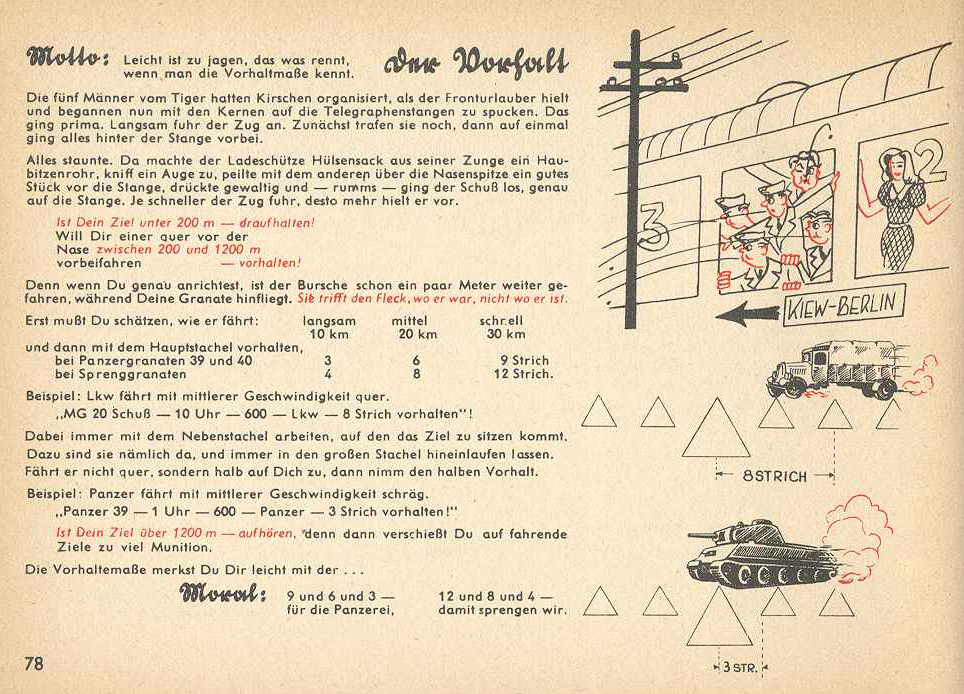
On their way home on leave the men organised a spitting competition against telegraph poles. While the train moved slowly it was easy to hit them. But when it picked up speed their spit flew behind the target. So loader Hülsensack closed one eye, took aim, spat a good way ahead of the pole and hit it. When firing at a moving target you must estimate its speed. At around 10 km/h, lead the sight by 3 mils for an armour-piercing round and 4 mils for a high-explosive round. At around 20 km/h the lead should be 6 and 8 mils respectively, and for a target moving at 30 km/h, 9 and 12 mils.
Page 84
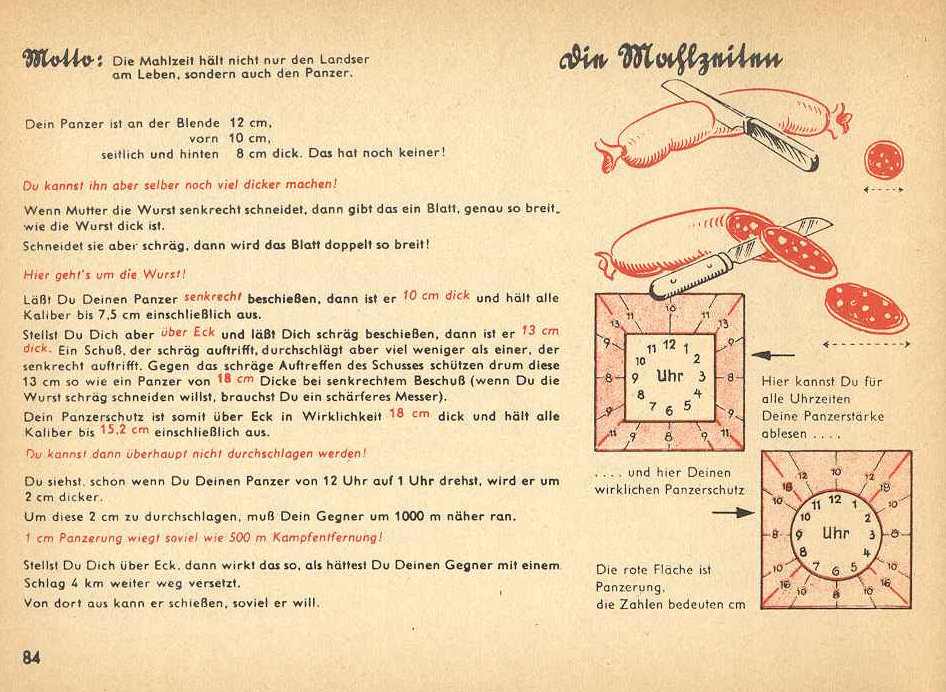
When your mother slices a sausage straight across, the slices are the same diameter as the sausage. But when she starts cutting at an angle, the slices suddenly appear larger. Your tank has frontal armour 10 cm thick on the hull and even 12 cm on the turret. Those 10 cm will resist fire from any gun up to 75 mm calibre. But if you angle yourself towards the enemy at 60° (the 2 o'clock position on the clock face), the actual thickness of armour the shell must penetrate increases to 13 cm and the effective armour resistance rises to 18 cm – enough to defeat even a 152 mm shell.
Page 85
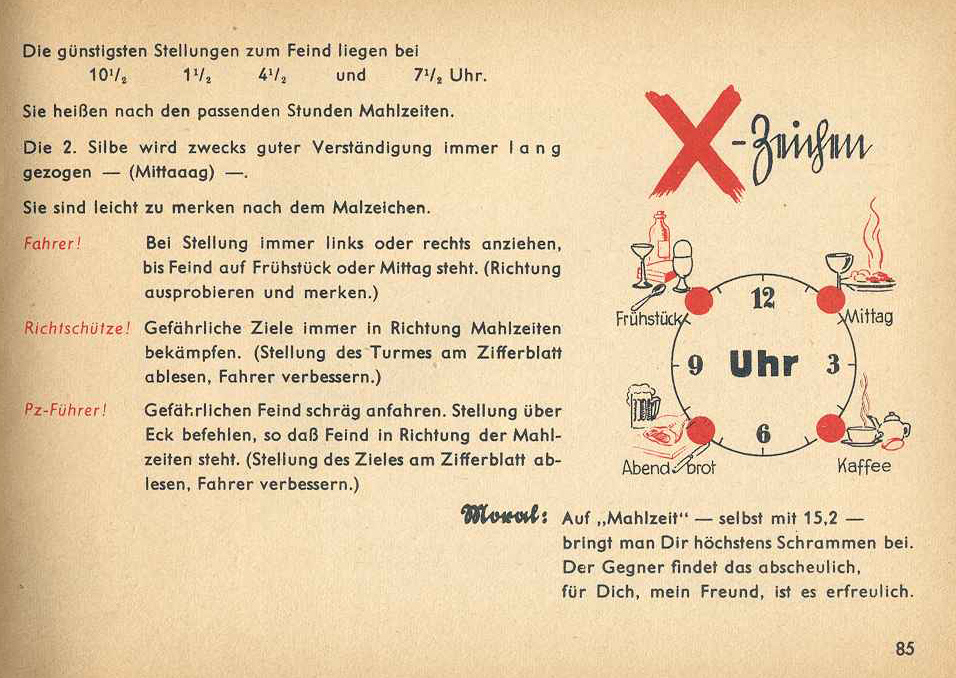
The most favourable positions relative to the enemy correspond to 10:30, 1:30, 4:30 and 7:30 on a clock face. For easy memorisation they are named after the meal eaten at roughly that time of day: breakfast, lunch, coffee and dinner. Driver, gunner, commander – remember that in combat you should present your tank to the enemy at these angles, as your armour will then be at its most effective.
Page 91
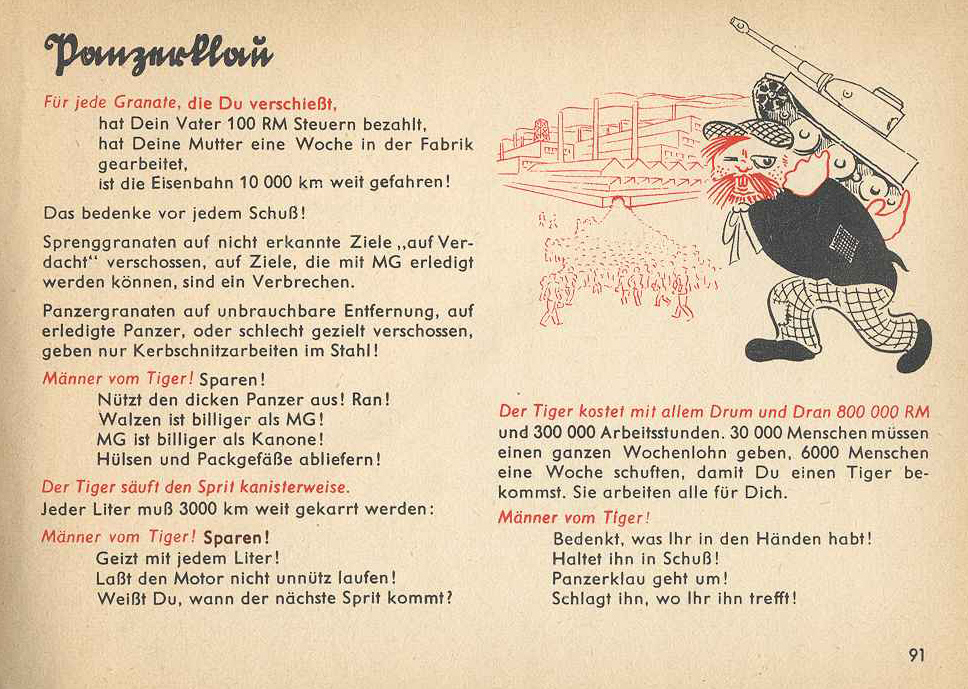
Tiger men, be careful with what you use! For every round you fire, your father must pay 100 marks in tax, your mother must work a week in a factory, and the railways must cover 10,000 km! Think carefully before every shot. Running over a target is cheaper than a machine gun, and a machine gun is cheaper than a cannon. Every litre of fuel has also had to travel 3,000 km to reach you, so never leave the engine running unnecessarily. It takes 6,000 people spending a week in a factory to build one Tiger tank, and a further 30,000 people must contribute a week's wages in tax. Remember what an expensive machine you have in your hands – and look after it well!
Appendix: T-34
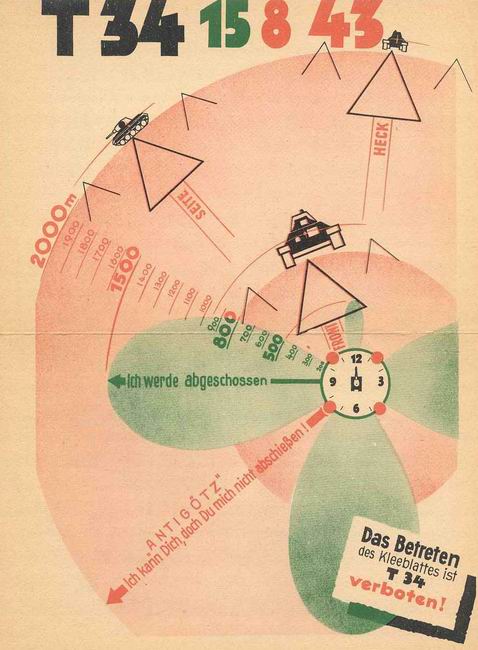
Graphical representation of the minimum safe distance from the T-34 tank (green shamrock) and the maximum ranges for effective fire against it (red circles). Note the enormous difference between the two sets of distances.
Appendix: Sherman
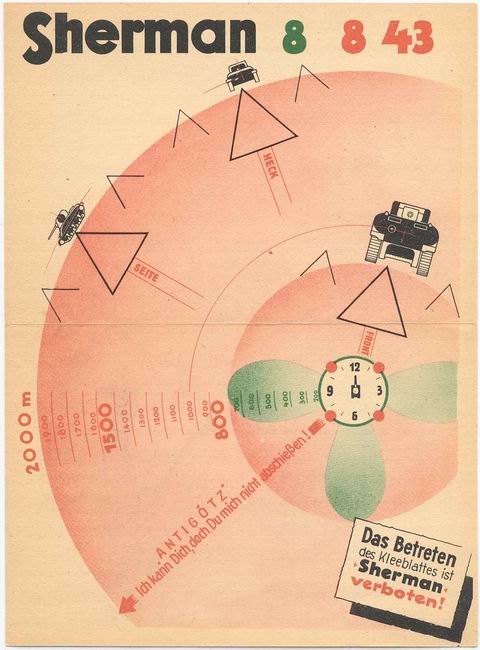
Graphical representation of the minimum safe distance from the Sherman tank (green shamrock) and the maximum ranges for effective fire against it (red circles). Note that no green zone exists in front of the Tiger's bow – meaning the Sherman was unable to penetrate the Tiger's frontal armour even at point-blank range.
Appendix: Churchill
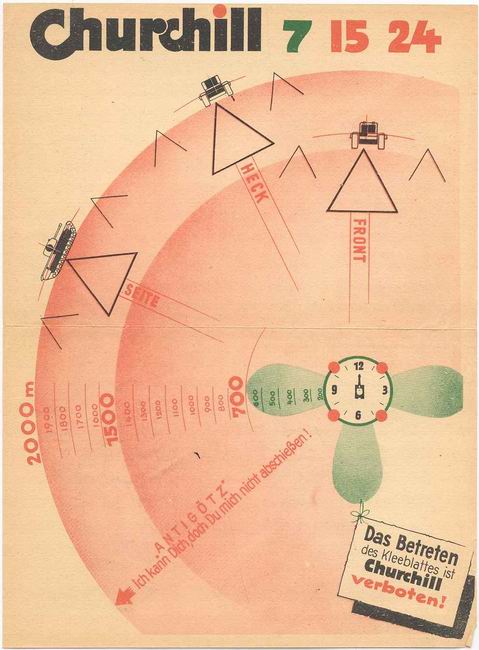
Graphical representation of the minimum safe distance from the Churchill tank (green shamrock) and the maximum ranges for effective fire against it (red circles). Note that no green zone exists in front of the Tiger's bow – meaning the Churchill was unable to penetrate the Tiger's frontal armour even at point-blank range.

Reproducing text from the Panzernet website without the written consent of the operator is prohibited.