TANK T-29
convertible tank derived from the T-28
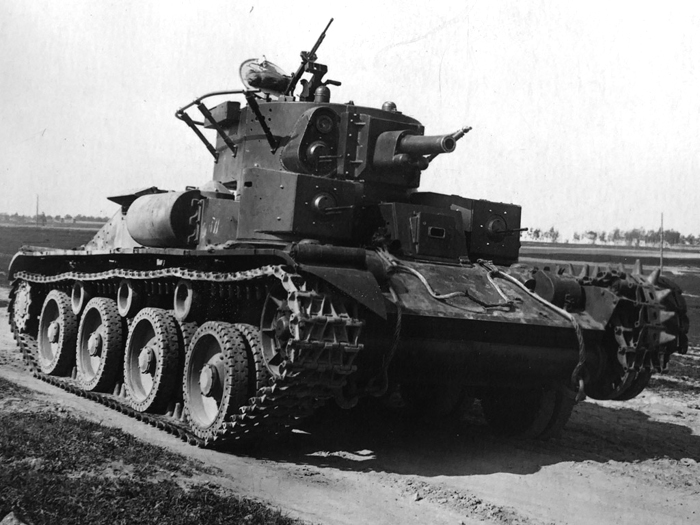
T-29-4 prototype, source: Wikimedia, Public domain, edited
Origins of the Tank
As production of the T-28 got under way, Soviet military planners began developing the idea of a new tank derived from that three-turret design. The new vehicle was to follow a broadly similar layout to the T-28, but was to feature a convertible running gear — one that allowed the tank to travel either on tracks or on its road wheels alone.
The tracks were used whenever the tank had to cross soft or uneven ground. On roads or other hard surfaces the tracks could be removed, allowing the tank to travel on its road wheels at speeds that would have been unthinkable with tracks fitted. This was the chief advantage of the convertible suspension. The drawback was reduced cross-country performance: the tracks of convertible tanks were not as robust as those of conventional tanks, since they had to be easy to handle. Under heavy load on difficult terrain they tended to shed. Convertible running gear was by no means unusual among Soviet tanks of the era — it was fitted as standard to the BT series, among others, and was considered for several other types as well.
Development of the new convertible tank derived from the T-28 was entrusted to a team of designers at the Kirov plant, led by N. V. Tseyts. The design was ready by the end of 1934 and came in two versions, designated T-29-4 and T-29-5 — why those particular numbers were chosen I was unable to determine. Prototypes of both versions were also built in 1936. At first glance the T-29-4 and T-29-5 differed only in their running gear arrangement, but there were additional less obvious differences, including armour thickness.

T-29-5 prototype — note the absence of return rollers, source: Aviarmor.net with permission, edited
Technical Description
The T-29-4 was the lighter of the two prototypes. It rode on a running gear consisting of four large-diameter solid road wheels on each side, fitted with rubber tyres around their circumference. Each wheel was independently suspended and sprung by a torsion bar. At the front was a lightened perforated idler wheel, and at the rear was the toothed drive sprocket. The upper run of the track rested on three return rollers. The heavier T-29-5, which more closely represented the intended production version, dispensed with the return rollers entirely — the track ran directly over the tops of the road wheels instead, though this was only fully the case at the rear of the running gear, since at the front the track rose well above the road wheels.
The hull layout was very similar to that of the T-28, with an identical turret arrangement. The main gun turret was taken from the light tank T-26 and modified. Its front face housed a 76.2 mm cannon, with a supplementary 7.62 mm DT machine gun to its right and another of the same type in the rear turret wall. The supplementary machine-gun sub-turrets were taken directly from the T-28 without modification, complete with their 7.62 mm DT machine guns. A fifth machine gun could be mounted on a ring mount around the hatch in the main turret roof. Ammunition stowage was 78 rounds for the cannon and 6,830 rounds for the machine guns.
The engine and gearbox were installed in the rear of the hull in the conventional manner. The tank was powered by the M-17 petrol engine producing a maximum of 500 horsepower. The gearbox offered five forward gears and one reverse. The heavier T-29-5 weighed around 24 tonnes. On tracks it could reach a road speed of up to 51 km/h — but with the tracks removed, an impressive 72 km/h was achievable. What exactly happened to the tracks once removed is not entirely clear from photographs. Some images suggest they had to be disconnected into sections roughly 3 metres long, which were then hung along the hull sides above the mudguards.
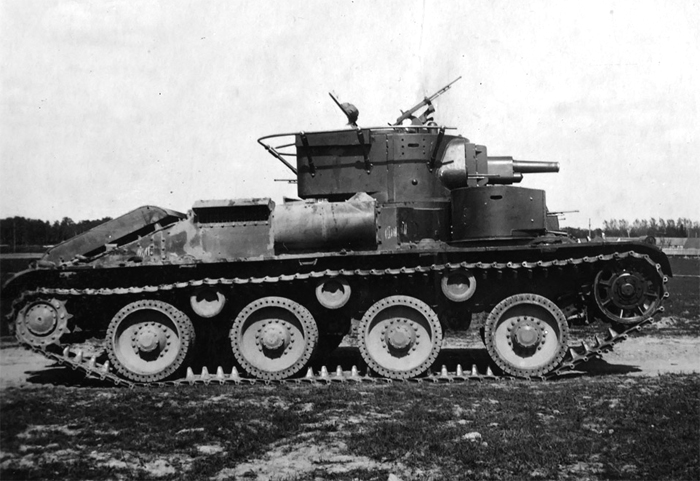
T-29-4 prototype, source: Aviarmor.net with permission, edited
The crew consisted of five men. The driver sat in the centre of the forward hull section, his head enclosed — just as in the T-28 — in a small armoured box projecting from the hull roof between the machine-gun sub-turrets. In the front face of this box was a closable rectangular vision port. When the cover was shut, the driver could still observe through a vision slit. The entire front plate of the driver's box was also hinged, as was the forward section of the hull roof above it — when both were folded open, they formed a hatch large enough for the driver to enter and exit the vehicle.
The other two hull crew members were the machine gunners, each stationed in one of the sub-turrets, with their own square roof hatch for entry and exit. The remaining two men occupied the main turret: the loader and the commander, who also served as gunner. These last two crew members entered through a large circular hatch in the turret roof, closed by a single-piece cover. Compared to the T-28, the T-29 had one fewer crew member — a consequence of its smaller main turret.
The T-29 was planned to be equipped with radios as standard — specifically the 71-TK-1 type — and both prototypes accordingly carried frame antennas. On the T-29-4 it was mounted on struts around the main turret; on the T-29-5 it encircled the rear half of the hull above the engine compartment. The prototypes underwent army trials in 1936, and a year later two further examples were built, already conforming to the planned production configuration. Production was ultimately never launched, primarily due to high manufacturing costs and the overall complexity of the vehicle.
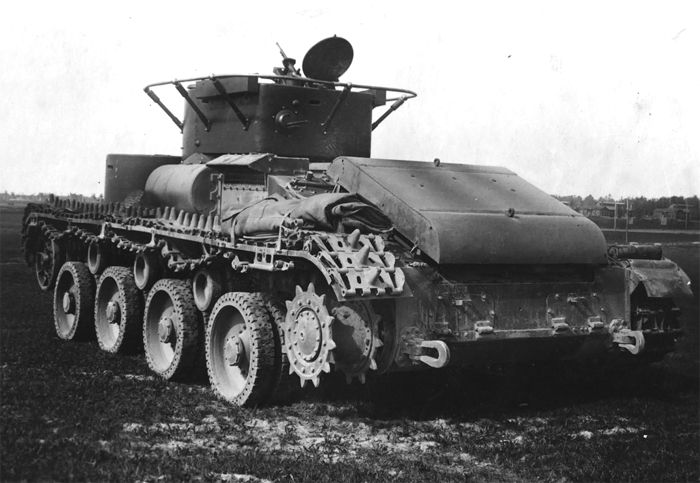
T-29-4 prototype with tracks fitted, source: Aviarmor.net with permission, edited
What became of the four T-29 tanks that were built is not known with certainty. Some sources claim they were committed to combat against the German invaders; others suggest they ended their days as target hulks on firing ranges.
Technical Specifications
Weight |
24 t |
Length |
6.63 m |
Width |
3.05 m |
Height |
2.85 m |
Engine |
M-17 |
Maximum output |
500 hp |
Maximum speed |
on tracks: 51 km/h on wheels: 72 km/h |
Turret armour |
20 mm |
Hull armour |
30 mm |
Armament |
1 x 76.2 mm cannon 4 to 5 x 7.62 mm DT machine gun |
Crew |
5 men |

ARTICLE
CONTENTS:
Reproducing text from the Tankist website without the written consent of the operator is prohibited.