SU-6
self-propelled anti-aircraft gun
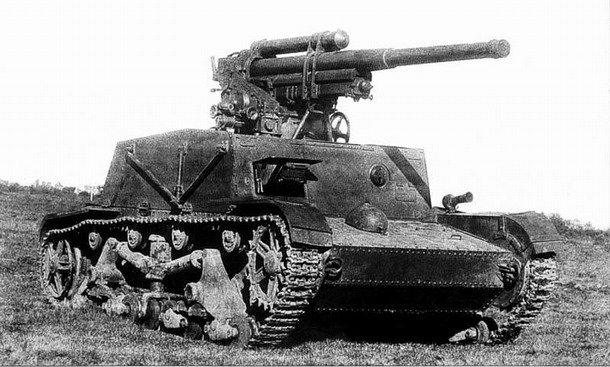
prototype of the SU-6 self-propelled anti-aircraft gun, source: Aviarmor.net with permission of the operator, edited
In 1932, F.L. Khlystov of the design bureau at the Artillery Academy began work on a vehicle that was remarkably advanced for its time: a self-propelled anti-aircraft gun. The vehicle, designated SU-6, was built on a modified chassis of the T-26 light tank. An additional road wheel was added to the chassis to suit the new role, bringing the total on each side from the original eight to nine. As on the original tank, the first and last four wheels were paired into bogies, with each pair of adjacent bogies suspended together on a pivoting arm with a leaf spring and piston.
The new ninth wheel was installed in the centre and had its own piston — a feature absent from the original tank, where no pistons were used at all. The most likely reason for their addition was the need to absorb the greater stress and vibration generated by firing such a powerful weapon, which was probably also the reason for adding the ninth road wheel in the first place. The powerplant and other mechanical components were also carried over from the tank.
The original upper hull and turret were removed entirely and replaced with a flat platform, in the centre of which a 76.2 mm Model 1931 anti-aircraft gun was mounted on a rotating pedestal. The weapon could traverse through a full 360°. Vertical elevation ranged from -5° to +85°, which also allowed direct fire against ground targets when required. The gun could fire a 6.6 kg shell to a maximum range of 9,200 m at a muzzle velocity of 813 m/s.
The platform was enclosed by a surround of flat armoured panels. During transit these panels were raised, providing protection for the gun crew. The front and rear panels each had a ball mount for a DT machine gun, of which two were carried on board. When preparing to engage a target, the panels were folded down to allow the gun to traverse freely — the front and rear panels laid flat on the hull, while the side panels were held up on props. In this configuration the gun and its crew were left completely exposed.
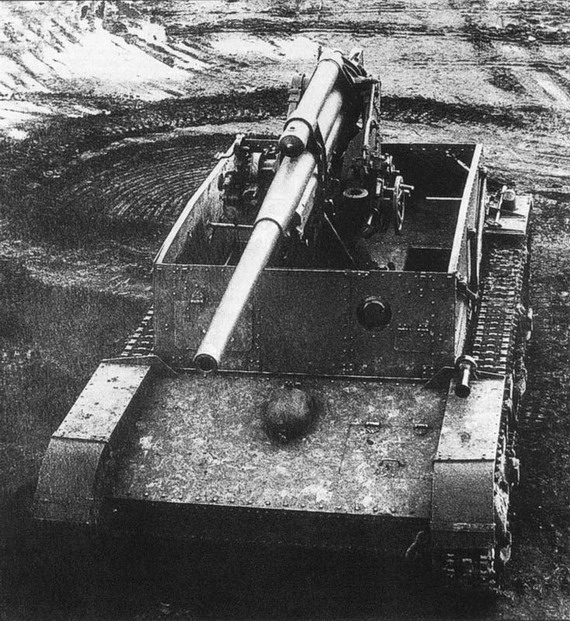
SU-6 with side armour panels raised, source: Aviarmor.net with permission of the operator, edited
Only a minimal ammunition load could be carried on board, with additional rounds having to be transported by an accompanying truck. The crew is generally given as six men — though I will allow myself a purely subjective observation here: it is genuinely difficult to imagine what two or three of those six were actually doing, unless the figure also includes the crew of the accompanying vehicle.
The prototype was completed in 1934, and a small number of additional evaluation vehicles may have been built in 1935. The SU-6 underwent military trials, which resulted in rejection. The primary reason was most likely technical unreliability — the tank chassis was subjected to excessive stress during firing and consequently proved prone to frequent breakdowns. The near-total lack of passive protection for the gun crew and the requirement for a dedicated support vehicle were further significant drawbacks. The SU-6 never entered series production.

Reproducing text from the Tankist website without the written consent of the operator is prohibited.