BA-5
a rejected prototype
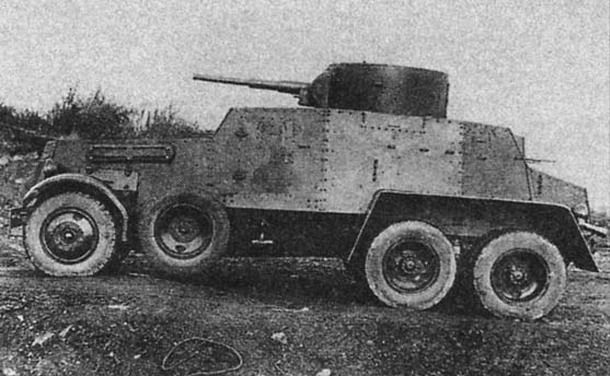
BA-5 armoured car prototype, source: Aviarmor.net with permission of the operator, edited
Origins of the Vehicle
Practical experience with the BA-3 armoured car revealed that the Ford Timken chassis (and later the GAZ-AAA) was being pushed beyond its limits, and that the 40 hp engine was unable to provide the vehicle with adequate acceleration. A solution to these problems was offered by a Moscow truck factory that had been producing the three-axle ZIS-6 lorry since 1934. Its chassis was far more robust, and the ZIS-5 petrol engine developing 73 hp allowed for the construction of an armoured car that could exceed six tonnes in weight. Work on the new design, which received the military designation BA-5 (BA standing for "Bronevoy avtomobil"), began at the Moscow factory before the end of 1934. The first prototype was completed in the autumn of 1935.
Description of the Design
The running gear consisted of two rear driven axles and a front steerable axle. The rear axles were fitted with dual wheels, giving the vehicle a total of ten wheels. The general layout of the hull was similar to the BA-3: the engine compartment occupied the front, followed by the crew fighting compartment and the gun turret. The hull was built from flat steel plates joined primarily by riveting. Armour thickness was 9 mm on the front faces, 8 mm on the sides and rear, 6 mm on the roof and 4 mm on the floor.
The hull widened gradually from the narrow front plate towards the crew cabin. The front wheel mudguards, headlights and front bumper were carried over from the truck chassis, giving the fighting vehicle a rather civilian appearance. The engine bonnet extended for roughly the first third of the vehicle's length, after which the front wall of the crew cabin rose above it. Behind this wall sat the driver and the machine gunner. The driver occupied the left-hand seat and looked out through a rectangular vision port in the plate ahead of him. In dangerous situations the port could be closed with an armoured cover, leaving only a narrow slit to see through. To the right of the driver sat the machine gunner, who operated a DT machine gun of 7.62 mm calibre mounted in a ball socket. The driver and machine gunner each had their own door in the side walls of the hull.

BA-5 armoured car prototype, source: Aviarmor.net with permission of the operator, edited
At the very rear of the hull was a second, fully equipped driving position. This was used to control the vehicle when reversing. Manoeuvring a 5.3-metre-long vehicle without mirrors was far from straightforward, and in combat there was not always time to turn the entire machine around — making the rear driving position a very practical feature (incidentally, most German armoured cars of the Second World War were also equipped with two driving positions). There was only one driver in the crew, however, who moved between the two positions as needed. To the right of the rear driver's seat sat, as at the front, a machine gunner operating a rear-facing DT machine gun. Reversing lights and even a horn were also fitted on the rear mudguards.
The turret was positioned centrally on the roof of the hull. It was derived from the turret of the T-26 tank, but lacked the bustle extension at the rear. The turret walls were 9 mm thick. A rounded gun mantlet projected from the front face, housing the main cannon and its coaxial machine gun. The cannon was the 20K model 1932 of 45 mm calibre. To the right of the barrel was a coaxially mounted DT machine gun — the third such weapon the vehicle carried. Observation from the turret was provided by slit vision ports in the side walls, while a periscope in the roof served for aiming. Ammunition figures vary between sources: for the cannon, some quote as few as 60 rounds while others give up to 114. For the machine guns the figure was around three thousand rounds.
The turret housed the last two members of the five-man crew: the loader and the commander, who also served as the cannon gunner. These men entered and exited through hatches in the turret roof. The vehicle was not equipped with any means of internal or external communication. The crew could speak to one another directly inside the vehicle, but there was no way to communicate with other vehicles or with headquarters.
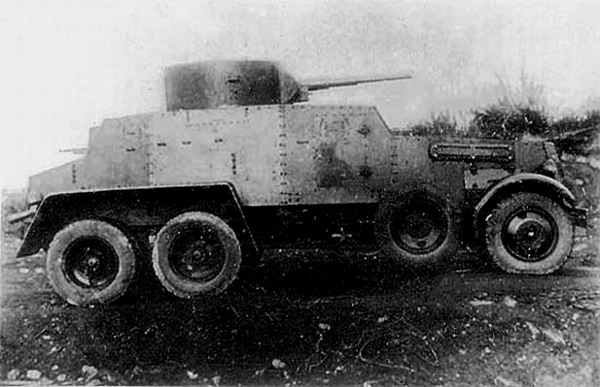
BA-5 armoured car prototype, source: Aviarmor.net with permission of the operator, edited
The BA-5 was powered by the six-cylinder ZIS-5 engine mentioned above. With this unit the vehicle could reach a top road speed of 50 km/h — respectable for a machine weighing 8 tonnes. The fuel capacity was 120 litres and the road range was approximately 250 km. One interesting feature — though not an entirely new one — was the use of freely rotating spare wheels. These were mounted on the sides of the hull behind the front mudguards, attached in such a way that they could spin freely. This helped the vehicle negotiate significant obstacles and uneven ground without damaging the chassis or becoming stuck.
The BA-5 prototype was tested in late 1935 and early 1936. The trials revealed a high rate of mechanical failures, among other issues. The main reason for its rejection, however, was that the vehicle offered nothing decisively better than the BA-3. The sturdier chassis had indeed been adopted, but the hull was so large that the vehicle reached its maximum permissible weight at a level of armour protection very similar to that of the BA-3. The armament was unchanged as well — still the same 45 mm cannon. An additional machine gun had been added at the rear, but that was not enough to sway the evaluation committee. The story of the BA-5 armoured car thus ended with the single prototype that was built.
Technical Specifications
Weight |
8.0 t |
Length |
5.3 m |
Width |
2.4 m |
Height |
2.5 m |
Engine |
ZIS-5 |
Maximum power |
73 hp |
Maximum speed |
50 km/h |
Fuel capacity |
120 l |
Range – road |
250 km |
Turret armour |
9 mm |
Hull armour |
4–9 mm |
Armament |
1 × 45 mm cannon 3 × DT machine gun, 7.62 mm |
Crew |
5 men |

ARTICLE
CONTENTS:
Reproducing text from the Tankist website without the written consent of the operator is prohibited.