BA-3
"Bronevoy Avtomobil" from Leningrad
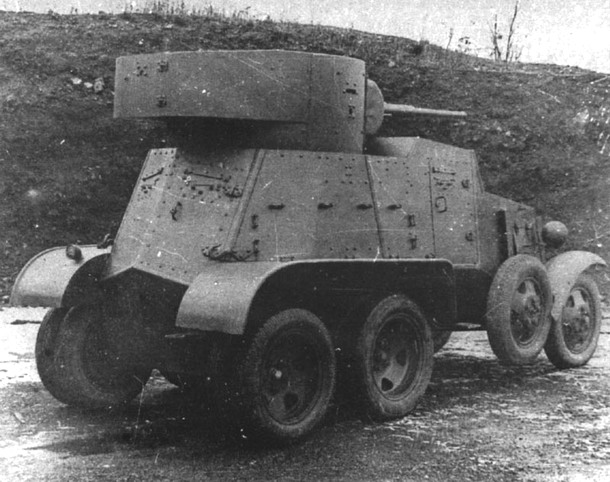
BA-3 armoured car, source: Aviarmor.net with permission of the operator, edited
Origins of the Vehicle
The BA-3 armoured car (BA standing for "Bronevoy avtomobil") was developed in 1934 at the Izhora Factory in Leningrad, as the work of designer A. D. Kuzmin and his team. The design was based on the earlier BAI type, which it closely resembled in many respects. The BA-3 was built on the chassis of the Ford Timken truck, produced under licence. Later in production this chassis was replaced by the Soviet-designed GAZ-AAA chassis. According to some sources, the BA-3 fitted with the new chassis even received a distinct designation — BA-3M.
The running gear consisted of a front steerable axle with single wheels and two rear driven axles fitted with dual wheels, giving the vehicle a total of ten wheels. The rear axle wheels on each side were covered by a single large shared mudguard. The hull rested on ten longitudinal beams through which it was attached to the chassis.
To improve cross-country mobility, the vehicle could be fitted with light tracks that slipped over the wheels of the two rear axles. Each track was 4.5 metres long, 18 cm wide, weighed 71 kg and consisted of 25 links. Fitting them was reportedly not a particularly difficult task — with the whole crew working together it could be done in 10 to 15 minutes. The tracks did not grip the rubber tyres very firmly, however, and had a tendency to slip off rather frequently. Despite this shortcoming they served their purpose well enough, allowing the vehicle to tackle terrain it would otherwise have been unable to cross. When not in use, the tracks were stowed on the rear mudguards or hung on the sides of the hull.
Description of the Design
The hull was constructed from flat 8 mm armour plates joined by a combination of welding and riveting. Internal fittings — brackets, bulkheads, braces and the like — were attached almost exclusively by riveting. The hull was narrow at the front and gradually widened towards the rear, remaining at full width for roughly the back two-thirds of its length before tapering again at the very stern. The engine compartment in the nose housed a GAZ-AA petrol engine producing a maximum of 40 horsepower. For a vehicle weighing 5.8 tonnes this was a rather modest powerplant, yet it was sufficient to achieve a top road speed of 42 km/h (though some sources quote figures of up to around 60 km/h). Off-road performance was considerably poorer, and the inadequacy of the engine made itself fully felt in those conditions.
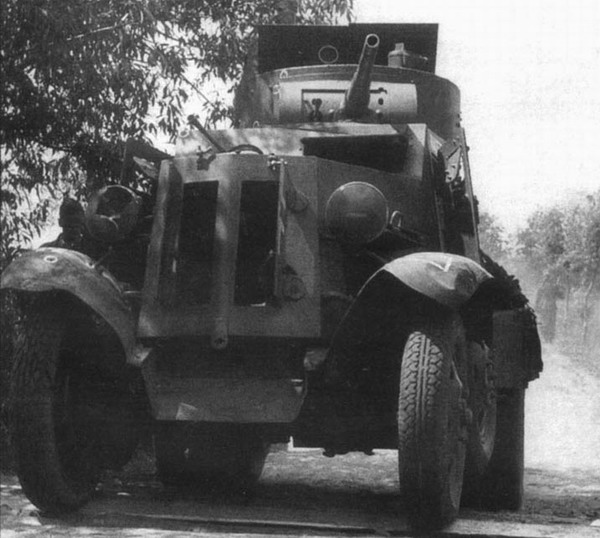
BA-3 armoured car, source: Aviarmor.net with permission of the operator, edited
The front plate carried two closable air intake louvers for engine cooling. Additional ventilation and service openings were provided on the sides and top of the engine compartment cover. Spare wheels were mounted on the sides of the engine compartment, one on each side, just behind the front wheels. The engine cover rose gradually from the nose to an angled plate, behind which sat the crew compartment. The driver and the machine gunner sat side by side behind this plate. To the left, in front of the driver's seat, was a rectangular vision port. In dangerous areas it could be closed with an armoured cover, leaving only a narrow slit for the driver to see through. A DT machine gun of 7.62 mm calibre was mounted in the right half of the front plate.
At the rear of the hull sat a fully rotating turret taken directly from the T-26 tank. Compared to the tank version, however, the turret had thinner armour — only 8 mm as opposed to 9 mm on the tank. The main armament, a 20K model 1932 cannon of 45 mm calibre, was mounted in the turret's front plate, with a coaxially installed DT machine gun of 7.62 mm to its right. Observation from the turret was provided by slit vision ports in the side walls, while a periscope in the roof served for aiming. The vehicle carried 60 rounds for the cannon and 3,402 rounds for the machine guns (other figures are sometimes cited).
The crew consisted of four men. The driver and the machine gunner sat side by side in the hull, each with a large door on their respective side for entry and exit. These doors also featured slit vision ports for lateral observation. The remaining two crew members — the loader and the commander, who doubled as the cannon gunner — were stationed in the turret. They entered and exited through two rectangular hatches in the turret roof, though in an emergency they could also use a small door in the rear wall of the hull.
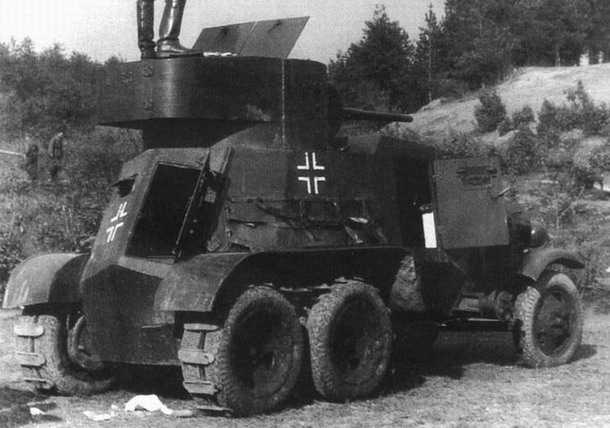
a captured BA-3 in German service, with auxiliary tracks fitted to the rear wheels, source: Aviarmor.net with permission of the operator, edited
The first BA-3 prototype had a hull made of mild, non-armoured steel. In June 1934 it underwent trials at the Kubinka proving ground near Moscow. The tests revealed a number of shortcomings that needed to be addressed before series production could begin. Chief among them was a severe tendency for the engine to overheat. At an ambient temperature of around 20 degrees Celsius with the engine compartment louvers closed, the coolant reached boiling point after just six to seven minutes of driving at high revs. The engine heat also warmed the crew compartment considerably. In winter this might have been welcome, but at the June ambient temperature of 25 degrees Celsius the thermometer inside the fighting compartment read an unbearable 45 to 50 degrees after just 15 minutes of driving with the vision ports and hatches shut. In actual combat, the additional heat generated by firing the cannon and machine guns would have made effective crew performance virtually impossible. The cooling system therefore had to be significantly improved.
Another problem was the excessive noise inside the hull caused by vibration during driving. It was decided to fit rubber shock absorbers at the points where the hull was attached to the chassis beams. A further measure adopted after the trials was the addition of an extra leaf to the front wheel springs to increase their load capacity.
Series production of the BA-3 began in 1934 and lasted just one year. The total number of vehicles built varies by source, with figures ranging from 168 to 180. The BA-3 represented a significant step forward compared to earlier Soviet armoured cars, yet it still suffered from a number of drawbacks. Its armour protection was thin, the engine underpowered, and — most critically for a reconnaissance vehicle — it carried no radio, which was a serious handicap. On the other hand, its modern tank cannon was a considerable asset: it not only gave the BA-3 a clear edge over virtually any enemy armoured car of the era, but also gave it a fighting chance against many opposing tanks.
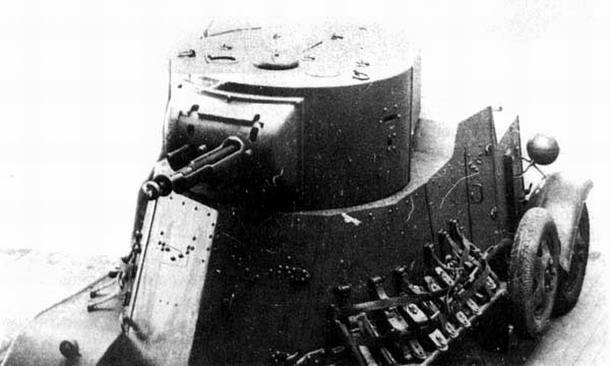
BA-3 prototype armed with the DK heavy machine gun, source: Aviarmor.net with permission of the operator, edited
Combat Deployment
The BA-3 saw its combat debut during clashes with Japanese forces in Mongolia. It was subsequently deployed in the Winter War against Finland and during the Soviet invasion of Poland in September 1939. BA-3s also fought in the early stages of the war against Nazi Germany, though they were soon withdrawn from front-line units as obsolete. Captured examples were put to use by both the Finnish and German armies, and a large proportion of wartime photographs show the vehicle in the hands of Soviet adversaries. To this day, only a single known operational example survives — it can be seen at the Kubinka museum complex in Russia.
Also worth mentioning is a Soviet attempt to re-arm the vehicle. In September 1936 a prototype BA-3 was built with a DK heavy machine gun of 12.7 mm calibre in place of the cannon. The motivation appears to have been a desire to reduce the vehicle's weight and thereby improve its mobility. The prototype was not accepted for production. There are also references to another interesting prototype that was adapted for operation on railway tracks, though if it ever existed it is certain that it too never entered series production.
Technical Specifications
Weight |
5.82 t |
Length |
4.77 m |
Width |
2.11 m |
Height |
2.35 m |
Engine |
GAZ-AA |
Maximum power |
40 hp |
Maximum speed |
42 km/h |
Fuel capacity |
65 l |
Range – road |
250 km |
Range – off-road |
140 km |
Turret armour |
8–10 mm |
Hull armour |
4–8 mm |
Armament |
1 × 45 mm cannon 2 × DT machine gun, 7.62 mm |
Crew |
4 men |

ARTICLE
CONTENTS:
Reproducing text from the Tankist website without the written consent of the operator is prohibited.