T-15
Škoda's reconnaissance tank proposal
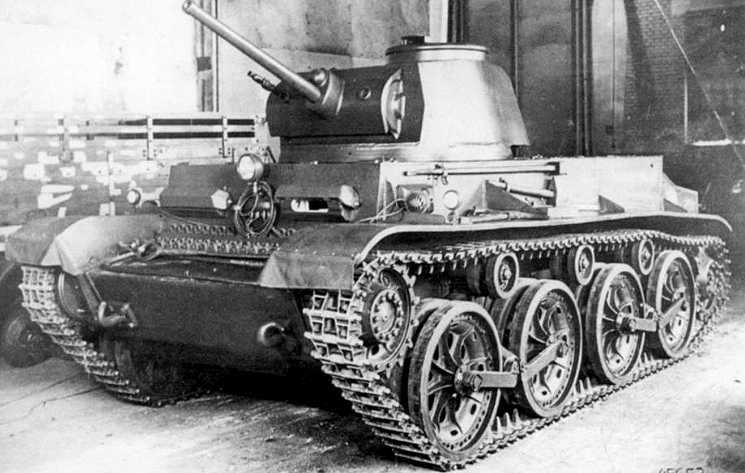
T-15 prototype, source: Regional Archives in Plzeň, 4th Department
Wanted: A Reconnaissance Tank
Already during the first year of the war, the Wehrmacht came to recognise a significant gap in its armoured inventory: a fast tank capable of carrying out reconnaissance missions. At that time, reconnaissance was the domain of armoured cars and, to some extent, half-tracked vehicles. Both types, however, had their limitations – particularly in terms of cross-country mobility, armour protection, and firepower. An armoured car was a perfectly capable scout as long as it could travel on roads and stay out of enemy fire, but off-road it became clumsy, and in theory a single infantryman with a rifle and a well-aimed shot at its tyres could put it out of action. Reconnaissance vehicles based on half-tracked chassis, such as the Sd.Kfz. 250, fared better in cross-country conditions, but they too were no match for tanks when it came to armour and armament.
None of the tanks then available to the Germans met the requirements of the reconnaissance role either. The light tanks PzKpfw I and PzKpfw II were outdated, with weak armour and armament. The captured PzKpfw 35(t) and PzKpfw 38(t) were not fast enough. And the most modern medium tanks, the PzKpfw III and PzKpfw IV, were unsuited to the reconnaissance role and – more importantly – were needed as main battle vehicles, not scouts. The German Ordnance Office therefore decided to initiate development of an entirely new type of tank, purpose-built for reconnaissance.
Army Requirements
In July 1940, three competing firms were invited to develop such a vehicle. These were the German company MAN (Maschinenfabrik Augsburg-Nürnberg) and two originally Czechoslovak plants: BMM (the former ČKD) and Skoda-Werke (Škoda Plzeň). Each manufacturer was to build five development prototypes – two in mild steel and three with full armour. The specification called for a tank weighing between 11 and 13 tonnes with a top speed of 50 to 60 km/h. Armament was to consist of a 20 mm or 37 mm gun and a single machine gun, both mounted in a rotating fighting turret.
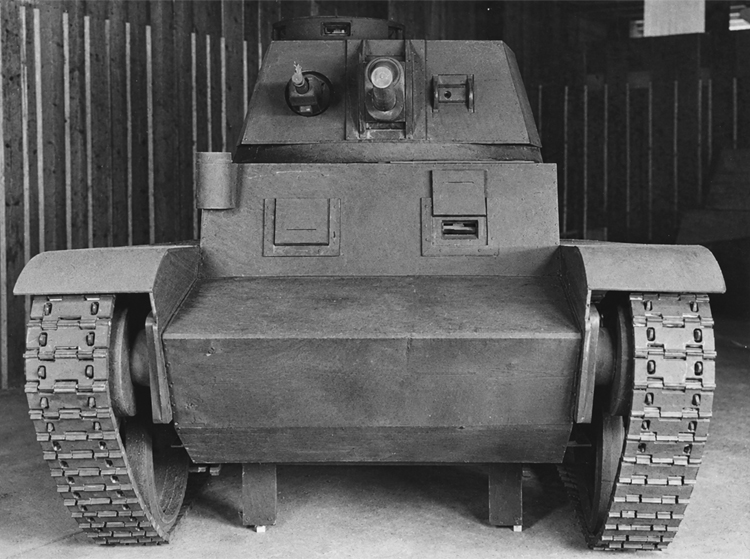
Full-scale wooden mock-up of the T-15 in its original form – note the front wall of the turret and the vision ports in the hull, source: Regional Archives in Plzeň, 4th Department
A welded rather than riveted construction was specifically required. This stipulation was certainly worth spelling out explicitly in the tender documentation, since two of the three invited firms risked being influenced by the "Czechoslovak engineering tradition" – and thus the use of rivets, as had been the case with the PzKpfw 35(t) and PzKpfw 38(t). Combat experience with those tanks had revealed more than a few weaknesses inherent to riveted joints, which is why the Germans were now favouring the more modern welded approach.
The Design from Plzeň
Škoda's answer to the German requirement described above was a prototype tank designated T-15. By the end of 1940 the engineers had completed drawings of the new vehicle, and in January 1941 a full-scale wooden mock-up was constructed. The first functional prototype was to be delivered in October or November 1941, and if the Army accepted the design, production was to begin the following year.
The initial T-15 design made no secret of its inspiration from the PzKpfw 38(t). The front hull section was handled in almost exactly the same way, the only difference being the absence of a hull machine gun in the front wall of the crew compartment – one was not required on the new vehicle. The front face of the fighting turret was also approached in a very similar manner to the older type. The same gun (Škoda A7, 37 mm calibre) and machine gun (ZB vz. 37, 7.92 mm calibre) were used, mounted in identically designed cradles. However, an early review of the technical drawings and the wooden mock-up quickly led to significant redesign of the fighting turret, which reduced the similarity to the PzKpfw 38(t). The originally angled rear turret wall was replaced by a simpler flat wall, and the turret received a single combined mantlet mounting both the gun and the machine gun. The mantlet was cylindrical in shape, similar in design to that used on later versions of the Panzer III.

Full-scale wooden mock-up of the T-15 in its original form – note the front wall of the turret and the vision ports in the hull, source: Regional Archives in Plzeň, 4th Department
The tank gun A7 also had to be adapted to fit the new mantlet. Its modified version received the designation A19, though it remained essentially the same weapon. The machine gun type, however, was changed: instead of the Czechoslovak ZB vz. 37, the German MG 34 of 7.92 mm calibre was to be fitted.
The first T-15 prototype was completed in October 1941, with the second following in December of the same year. The running gear of the new tank consisted of four road wheels on each side, 726 mm in diameter and fitted with solid rubber tyres around their circumference. The wheels were of double-disc construction, with the track guide teeth engaging between the two discs. The wheel discs were reinforced by spokes, between which lightening holes were cut. The wheels were suspended on swinging arms, including from the outside. The arms of two adjacent wheels converged toward each other and were connected to two shared leaf springs – one positioned between the first and second wheels, and one between the third and fourth. The front pair of road wheels was thus sprung by one leaf spring and the rear pair by the other.
At the front of the running gear was a toothed idler wheel 485 mm in diameter; at the rear was a drive sprocket with a diameter of 574 mm. The upper run of the track was supported by three return rollers spaced evenly above the gaps between the road wheels. The tracks were 270 mm wide. At first glance, the suspension and wheel arrangement appeared to be a step backward toward the complex systems of interwar tanks. In truth, the mechanism was relatively straightforward. Nevertheless, it once again proved that mounting these elements on the outside of the running gear created more problems than benefits. The external swinging arms were vulnerable to enemy fire – a hole through a road wheel will not stop a tank, but a shot-off suspension arm certainly complicates matters – and they could also be damaged during cross-country driving, by rocks, tree stumps, and similar obstacles. Testing of the T-15 prototype also revealed that dirt was finding its way into the exposed outer wheel bearings.
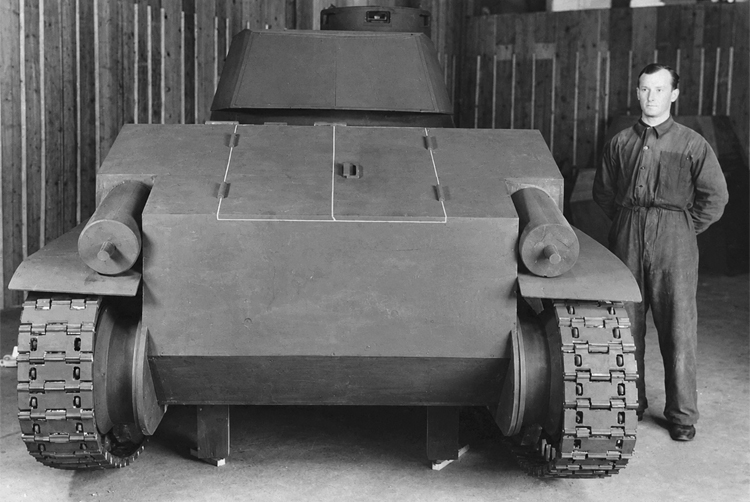
Full-scale wooden mock-up of the T-15 in its original form, source: Regional Archives in Plzeň, 4th Department
The engine compartment occupied the rear of the hull. The tank was powered by a Škoda T-15 petrol eight-cylinder engine of 10.8 litres displacement, producing a maximum output of 220 hp at 2,800 rpm. One exhaust pipe ran along the track mudguard on each side of the engine compartment, with its outlet directed towards the rear of the vehicle. The gearbox offered six forward and reverse speed ratios, meaning that in theory the tank could reach the same speed going backwards as forwards. Maximum road speed was around 60 km/h, in line with the Army specification. As for fuel capacity, different sources give varying figures; the highest quoted is 300 litres of petrol stored in two tanks, giving a range of 250 to 280 kilometres.
The hull was welded from flat armour plates of varying thickness. The front wall of the crew compartment rose from the hull nose. Two vision ports for the driver and radio operator – seated behind this wall – were cut into it. In the original design (and on the wooden mock-up) these ports were closed by square sliding covers, but the prototypes were fitted with oblong solid-flap covers instead. These flaps appear to have been set to become the standard solution in the German Army, as they were also used on the competing prototypes from MAN and BMM, and can be found on other contemporary light tank projects such as the PzKpfw I Ausf. C and PzKpfw II Ausf. G.
The driver (seated on the left) and radio operator (on the right) also had vision slits in the side walls of the crew compartment, one on each side. Above the head of each of these crew members, an individual access hatch was cut into the roof of the compartment, ahead of the turret. The remaining two men on board had their stations in the fighting turret. The turret had a flat front and rear wall with rounded sides, and was slightly conical – tapering gently upward on the sides and at the rear. Almost the entire front plate was occupied by the combined gun mantlet already described. The barrel of the 37 mm A19 gun passed through the centre of the mantlet, with the gun sight outlet to its left. The MG 34 machine gun was mounted to the right of the gun. Ammunition stowage comprised 78 rounds for the gun and 2,100 rounds for the machine gun.

T-15 prototype, source: Regional Archives in Plzeň, 4th Department
The right side wall of the turret contained a single vision slit. No observation openings were provided in the rear wall or on the other side. A raised commander's cupola was fitted on the turret roof. It contained a single-piece hatch cover serving both the commander and the gunner – the two men stationed in the turret. Unlike most contemporary German tanks, the commander's cupola was not provided with vision ports around its circumference; instead, a periscope was installed in the forward part of its roof. Logic would suggest that the cupola roof – with its periscope – would be rotatable, allowing the commander to observe the full area around the vehicle. This cannot be confirmed from the available photographs, however, as virtually all of them show the periscope pointing forward.
Prototype number 2, which participated in the comparative trials, remained at Kummersdorf and was apparently used there as a training vehicle, being sent back to Plzeň twice for repairs before 1944. Prototype number 1 was retained by the Plzeň factory for its own purposes until December 1942, when it was sent to the Alkett firm in Berlin for further testing. Despite the rejection of the entire project, the Plzeň plant decided to continue building the remaining three prototypes. Prototypes 3 and 4 were completed apparently as late as 1943, and in October of that year were also dispatched to the Alkett proving ground, where they likely saw out their days.
Armour protection was at its thickest on the front walls of the hull tub, crew compartment, and turret, where it reached a full 30 mm. The side and rear walls of both the hull and turret were 20 mm thick. The floor and roof of the fighting compartment were 12 mm, while the turret roof and engine compartment roof were only 8 mm. The weight of the tank is sometimes quoted as 10.86 tonnes and sometimes as an even 11 tonnes.
Comparative Trials
From March to June 1942, prototypes from all three invited manufacturers were put through their paces at the Kummersdorf proving ground. BMM (the former ČKD) submitted two examples of its design, designated TNH n.A., which was based on the older PzKpfw 38(t). MAN submitted a prototype designated PzKpfw II n.A. Škoda sent its prototype number two. The trial results were not encouraging. The report prepared by the evaluation board on 27 June 1942 summarised the problems that had appeared in the T-15 after covering a total of 4,022 km: damage to the crankshaft bearings, cylinder heads, and gearbox components. On the basis of the trials, the board assessed the tank as immature.
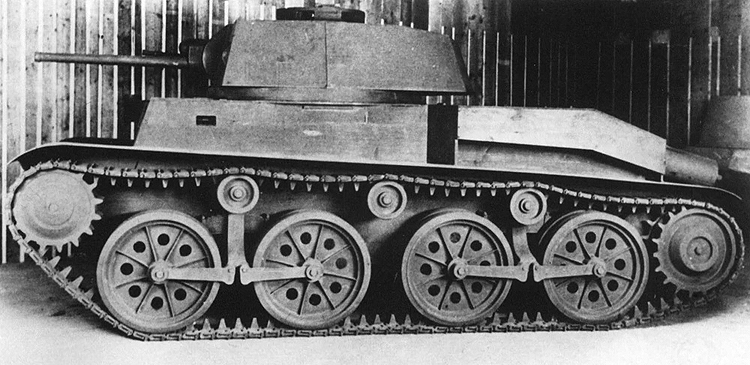
The wooden tank mock-up clearly had a very detailed running gear: Flickr.com with permission of the publishing user, edited
After the first phase of testing, the T-15 prototype was returned to the Škoda works for the identified deficiencies to be rectified – as were the prototypes of the other manufacturers. In October 1942 the final comparative trials took place. The ultimate verdict declared the MAN prototype the winner of the competition. The victorious tank subsequently entered history as the PzKpfw II Ausf. L, better known as the Luchs. The T-15 project was thereby consigned to oblivion.
Construction of the final prototype continued at low priority, dragging on until it was halted in October 1944. In January 1945, however, an order was issued for its urgent completion and despatch to the tank sub-office in Olomouc – the Germans were evidently by that point searching for every available tank that could be thrown into the fighting. The last example was not completed before the end of the war.
After the War
After the war, Škoda attempted to market its design to the restored Czechoslovak Army. A prototype was provisionally fitted with the turret from the LT vz. 35 tank and demonstrated to military representatives. The Army, however, showed no interest. After 1946, further development continued only on paper. Modified variants designated T-15A, T-15S, and T-16 were drawn up, incorporating significant changes to the hull design, armament, and powerplant. None of them was ever built. In the 1950s, the last surviving T-15 prototype was scrapped.
ARTICLE
CONTENTS:
Reproducing text from the Panzernet website without the written consent of the operator is prohibited.