7,5 cm Pak 97/38 auf T-26
tank destroyer on a Soviet tank chassis
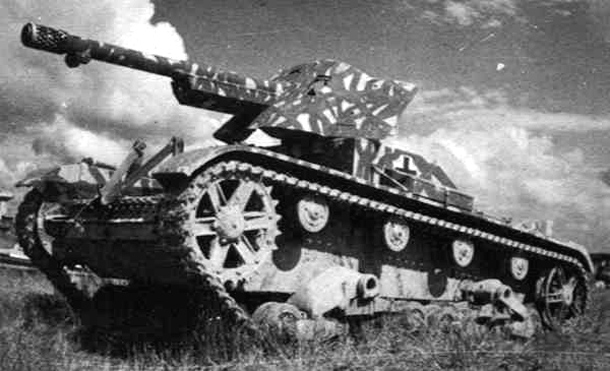
this improvised tank destroyer combining a Russian chassis with a French gun was produced in only ten examples, source: Flickr.com with the permission of the publishing user, edited
The Soviet T-26 Tank
At the time of the German attack on the Soviet Union, the backbone of the Soviet armoured forces was the light tank T-26, of which more than 10,000 examples had been built in several variants. It is therefore unsurprising that a significant number of these tanks fell into German hands during the early phases of Operation Barbarossa. The Wehrmacht put serviceable vehicles into service under various designations depending on the specific production model: the twin-turreted 1931 pattern was designated Panzerkampfwagen T26A 737(r), the single-turreted 1933 pattern became the Panzerkampfwagen T26B 738(r), and the 1938 and 1939 models (and any later versions) were designated Panzerkampfwagen T26C 740(r).
Conversion to a Tank Destroyer
The Germans did not use their captured T-26 tanks as front-line vehicles but rather for various "support" tasks such as policing already-occupied territory. By early 1943, however, these tanks were hopelessly obsolete and of negligible combat value. As with other outdated machines, the Germans attempted to make use of the light tank by converting it into a self-propelled gun – in this case an anti-tank gun. This was not a sophisticated conversion involving extensive planning and preparation; it was a straightforward improvisation aimed at producing, using available equipment, a vehicle of at least somewhat greater combat value than the original T-26.
The "available equipment" in question was, besides the tank itself, the 75 mm Pak 97/38 gun. This too was not an original German weapon but captured materiel taken from the Polish and French armies in 1939 and 1940. Its ultimate origins lay in the French field gun Canon de 75 modèle 1897, developed between 1891 and 1896 and manufactured in large quantities from 1897 onwards. No, this is not a misprint – we really are talking about a gun that predates the First World War and saw extensive service throughout it. The career of this weapon continued well beyond the Great War, however, and so it came to pass that in 1939 the Polish army still had more than 1,300 of these guns in service, and the French army in the same year had approximately 4,500. After the capitulation of both countries, the Germans thus found themselves in possession of several thousand of these weapons. The Wehrmacht decided to introduce them into service in their original role, as field guns intended primarily for engaging infantry and soft targets.
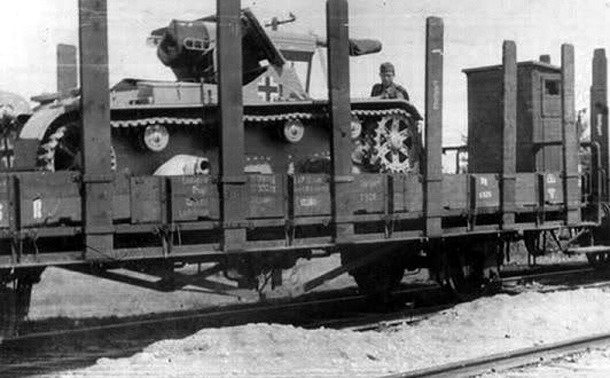
7.5 cm PaK 97/38 auf Pz. 740(r) during rail transport; this photograph clearly shows how little armour protection the gun crew had, source: Flickr.com with the permission of the publishing user, edited
In June 1941, German forces invaded the Soviet Union and were soon confronted with an unprecedented numerical superiority in Russian tanks, as well as the highly resistant T-34 and KV types that German anti-tank guns were wholly unable to cope with. The search began for any means available to stop the Soviet armoured avalanche, and the captured French 75 mm guns were called upon to play their part. Unfortunately they were far from ideal for engaging armoured targets. Armour-piercing ammunition did exist for them, but given the gun's low muzzle velocity it was not particularly effective. The Germans therefore decided to try to "upgrade" the French weapon somewhat. They began by remounting it on a slightly modified carriage from their own Pak 38, which substantially increased its mobility and also gave it a wider arc of traverse when aiming. As part of the remounting on the new carriage, the weapon also received a new German Z.F. 3×8 sight. A new type of ammunition was then developed for it: the armour-piercing shaped-charge round 7.5 cm Gr.Patr. 97/38 Hl/B, capable of penetrating up to 90 mm of armour plate at normal incidence. The final modification was the fitting of a new muzzle brake to reduce the gun's very heavy recoil.
The weapon as thus modernised received the designation 7.5 cm Pak 97/38. According to some sources, more than 3,700 ex-French and ex-Polish guns were converted in this way during 1942 and 1943. The weapon was not, however, popular among the troops. Despite the fitting of the muzzle brake, the gun still had a very heavy recoil, making it quite unstable when fired, and at the same time placing excessive stress on the carriage, which had originally been designed for a 50 mm weapon. The violent jarring also easily knocked the sight out of alignment when firing, making an already inaccurate gun even less precise – not entirely ideal when engaging a moving target.
Anti-Tank Battalion No. 563
Let us return now to early 1943. A year and a half had passed since the launch of Operation Barbarossa; the Russians had by this point largely recovered from their catastrophic initial defeats and their war machine was running at full capacity. The Red Army was throwing ever greater numbers of men and equipment at the front and the Germans could not destroy them fast enough. German anti-tank units were by this time reasonably well equipped with effective domestically-produced Pak 40 guns, but rearmament with self-propelled anti-tank guns – tank destroyers, or Panzerjägers – was at this point still little more than a distant hope for most. This was equally true for Anti-Tank Battalion No. 563, fighting on the Eastern Front as part of the 50th Army Corps of Army Group North. The battalion had been redesignated on 20 January 1943 as a self-propelled gun battalion (Panzerjäger-Abteilung (Sfl.) 563), but it had no self-propelled guns as yet, and the men had a feeling that when the new vehicles eventually arrived there probably would not be enough of them for all three companies of the battalion anyway.
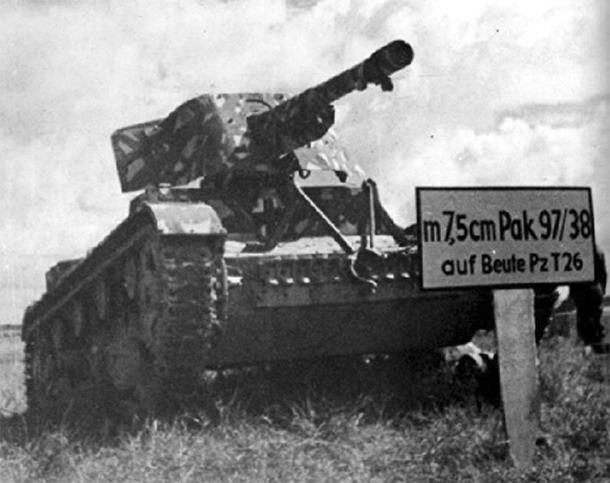
7.5 cm PaK 97/38 auf Pz. 740(r) on "display" at a Panzerjäger-Abteilung (Sfl.) 563 equipment show, source: Flickr.com with the permission of the publishing user, edited
The battalion's workshop commander appears to have been an enterprising man who wanted to do something to help his comrades. The battalion apparently had a supply of the aforementioned 7.5 cm Pak 97/38 anti-tank guns, and had also somehow managed to obtain several obsolete but serviceable ex-Soviet T-26 tanks (which may at that point have been used within the battalion as unarmed cargo tractors). Combining the two was not particularly complicated. The turret was removed from the light tank (if the examples used still had their turrets at all) and the compartment beneath it was stripped of its roof and rear wall. The gun mount was bolted either to the side walls of the original compartment, to its floor, or to both.
Vehicle Description
The gun was installed in the vehicle complete with its shield, which then provided virtually the only protection for the gun crew. Photographs show, however, that at least two vehicles received additional side armour after the fact. In one case this amounted to an extension and raising of the original compartment's side wall (photo HERE); in the second, large plates were fitted to the sides to form a new solid side armour (photo HERE). The vehicle's crew probably consisted of three men. The driver sat inside the hull, protected by the front and side walls of the original tank hull, but with an open fighting compartment behind and above him where the other two crew members were seated. The gunner and commander in one – who occupied the left side of the gun – and the loader on the opposite side of the weapon. Ammunition for the gun was stored in a large wooden or metal box on the right-track fender and probably also inside the fighting compartment itself.
The engine, gearbox, fuel tanks, running gear and other internal components were taken over from the original T-26 tank, meaning the vehicle was powered by the petrol engine known simply as the T-26 engine, with a maximum output of 95 horsepower. The improvised tank destroyer is most commonly referred to in accordance with German nomenclature as the 7.5 cm PaK 97/38 auf Pz. 740(r). Only 10 examples of this fighting vehicle were produced, with the last probably completed in October 1943. All were assigned to the 3rd Company of the aforementioned Panzerjäger-Abteilung (Sfl.) 563, where they served until March 1944, when they were replaced by the full-specification Marder III tank destroyers.
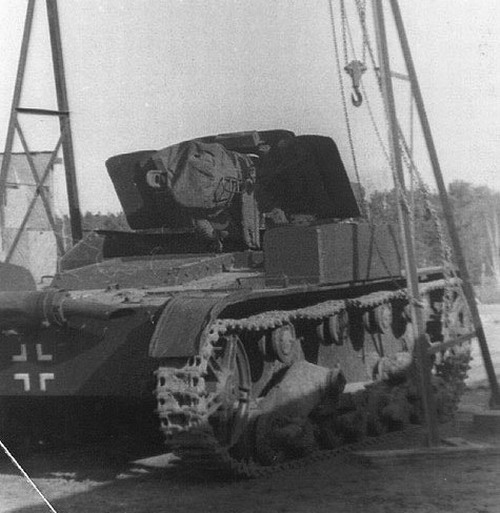
this photograph finally gives a clear view of the large (probably wooden) ammunition box stored on the right-track fender, source: Flickr.com with the permission of the publishing user, edited
Deployment in Estonia
Regarding the combat deployment of these vehicles we have only minimal information – in fact only a single incident is documented, and even that does not concern Panzerjäger-Abteilung (Sfl.) 563 itself. After the battalion rearmed with Marder III tank destroyers in March 1944, it most likely passed its serviceable 7.5 cm PaK 97/38 auf Pz. 740(r) vehicles on to other units. This is how at least one of these machines came to end up on the island of Saaremaa in the Baltic Sea (the island is called Ösel in German, which can sometimes cause considerable confusion). The island, which before the war had belonged to Estonia, was held in September 1944 by elements of the German 23rd Infantry Division.
On 29 September 1944, the Red Army launched an attack on the entire West Estonian Archipelago (also known as Moonsund). During the fighting that followed, an engagement took place near the village of Tehumardi. This village lies at the base of a narrow strip of land connecting the main island of Saaremaa to the small Sõrve Peninsula in the south-west. The remaining German units, retreating before the Red Army, were attempting to reach this peninsula. On 8 October 1944, approximately 750 men of the German 67th Potsdam Grenadier Regiment were also trying to pass through. However, a similar number of soldiers from the Estonian 249th Rifle Division had got there ahead of them. Neither side had any idea of the other's presence, and when the Germans arrived at the location in the night of 8–9 October, the Estonians almost let them pass, thinking they were another Red Army formation. But when it became clear who was who, a very confused close-quarters battle broke out in the darkness.
The Germans lost approximately 200 men (as did their opponents), but managed to push through, and at least some of them may have been evacuated in November. The day after this night battle, however, Estonian soldiers found among the debris on the battlefield one particularly interesting destroyed vehicle: an improvised tank destroyer, the 7.5 cm PaK 97/38 auf Pz. 740(r). The wreck was fairly heavily damaged, yet even in the photographs taken of it the additional side armour on the fighting compartment is clearly visible. As for the fate of the remaining nine vehicles of this type that were built, we unfortunately know nothing. For the sake of completeness it should be noted that the 7.5 cm PaK 97/38 auf Pz. 740(r) on display at the private Vadim Zadorozhny Museum at Arkhangelskoe near Moscow is not a surviving original but a newly built replica.

ARTICLE
CONTENTS:
Reproducing text from the Panzernet website without the written consent of the operator is prohibited.