RUTSCHER
when desperation breeds a tank destroyer
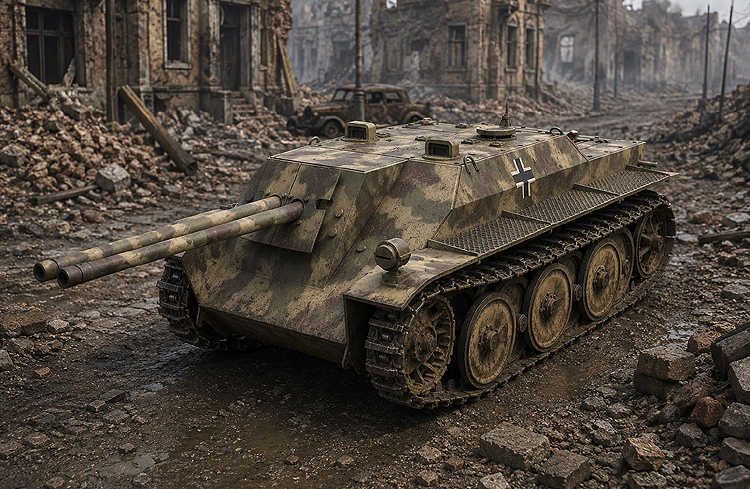
Theoretical appearance of the Rutscher tank destroyer, source: generated by AI
A Project Born of Necessity
The first references to a fighting vehicle called the Rutscher date from late 1943. The Waffenamt approached BMW and Weserhütte with a requirement to develop a small, light and inexpensive tank destroyer. Work on the vehicle was halted again as early as February 1944, however, because the Hetzer tank destroyer project had by then made very promising progress and was considered to adequately fulfil the Army's stated requirements. As for the name Rutscher itself, at least two interpretations of its meaning can be found. Some authors translate it as "grinder" or "sander." Far more commonly, however, the word is translated as "scooter" or "child's push-along toy" – which may well be a reference to the vehicle's very small dimensions.
Whatever the origin of the name, it is certain that in January 1945 the Rutscher project was revived. This was a somewhat desperate attempt to obtain the cheapest possible means of anti-tank combat as quickly as possible. The vehicle was to be only lightly armoured, fast and agile. It was intended for infantry units to destroy enemy tanks at close range – particularly in the defence of German cities against the Red Army.
The specification referred to the vehicle as a Panzerkleinzerstörer – literally "small tank destroyer." The crew was to be just two men: a driver and a commander/gunner. Armour of 20 mm on the front and 14.5 mm on the sides was required. The vehicle's height was not to exceed 1.5 metres and its overall weight was expected to fall between 3,500 and 5,000 kg. The most interesting aspect of the design was probably its main armament: the PAW 600 gun (later redesignated PWK 8H63). The abbreviation PAW stands for Panzerabwehrwerfer, meaning literally "anti-tank thrower." The designation PWK represented the German term Panzer-Wurfkanone, which translates to much the same thing – essentially "tank-throwing cannon." Let us take a closer look at this highly unusual weapon.
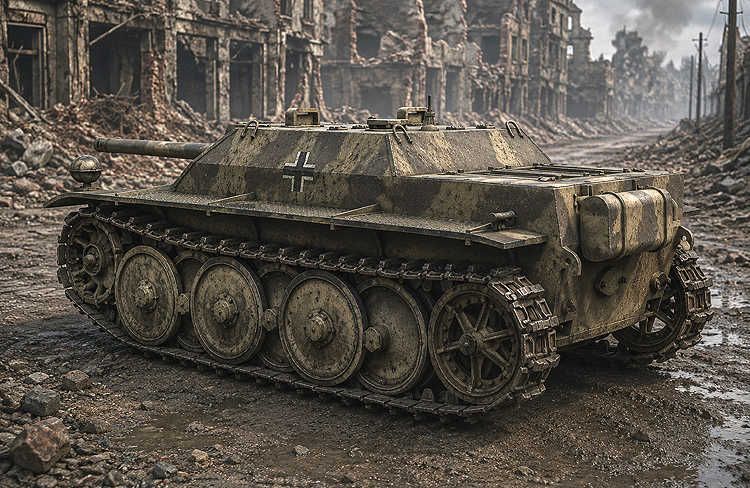
Theoretical appearance of the Rutscher tank destroyer, source: generated by AI
A New Kind of Gun
As tank armour grew thicker over the course of the war, the performance of anti-tank guns had to keep pace. For anti-tank rounds to carry enough energy to defeat increasingly heavy armour, they had to become heavier and faster. Imparting high velocity to a projectile weighing several kilograms required an enormous propellant charge. When such a charge detonated, it naturally generated tremendous pressure inside the cartridge chamber and barrel. The gun barrel therefore had to be robust enough to withstand this pressure without damage. Anti-tank guns thus grew not only in calibre but also in barrel wall thickness, and – to make better use of the propellant energy – in barrel length as well. The combined effect was a substantial increase in both the weight and the cost of anti-tank weapons. By 1943, the standard German anti-tank gun was the 75 mm Pak 40. At close to 1.5 tonnes, it was essentially impossible for its crew to manhandle it even a few metres under their own strength, and at a purchase price of 12,000 Reichsmarks it was certainly no bargain. (This development is neatly illustrated by THIS contemporary diagram.)
There was an alternative of sorts in the form of recoilless guns, but that was not an ideal solution either. A recoilless gun does not require such a robust barrel, because a large proportion of the propellant gases are vented rearward in the opposite direction to the projectile. This reduces the pressure in the barrel and eliminates recoil, but it also introduces a significant inefficiency: a large portion of the propellant burns off uselessly without transferring its energy to the projectile. A recoilless gun was therefore lighter and cheaper than a conventional gun but consumed a disproportionately large amount of propellant – and propellant production in Germany was already close to its manufacturing limits, making this, too, far from an ideal path.
The Army therefore approached the renowned artillery manufacturer Rheinmetall-Borsig in 1943 to develop an entirely new anti-tank gun of low weight that would be inexpensive and capable of hitting a 1×1 metre target at 750 metres using a modest propellant charge. The aim was a weapon that could be moved, at least to a limited extent, without special equipment and by the strength of its crew alone, and that could be produced in large numbers thanks to its low cost – because, as the saying went, there were plenty of Russian tanks. The designers at Rheinmetall, working from this brief, devised an innovative weapon operating on the principle of different pressures in the cartridge chamber and the barrel. The German designation for this system was Hoch-Niederdruck System – literally the high-low pressure system.
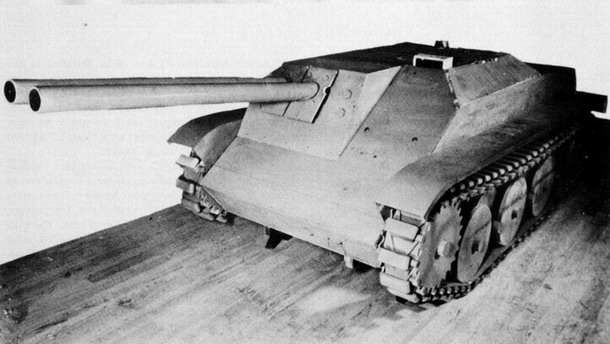
Wooden mock-up of the planned Rutscher tank destroyer, from the workshops of BMW. Source: Flickr.com, with the permission of the publishing user, edited.
The high pressure generated by the exploding propellant charge was contained together with the cartridge case inside the chamber. Only a portion of this pressure was admitted into the barrel, which housed the projectile itself. The chamber was therefore the only part of the weapon that had to withstand high pressure and thus required thick walls. The barrel, by contrast, could have relatively thin walls.
For there to be different pressures in the chamber and the barrel, the two naturally had to be separated in some way. This separation was provided by the ammunition itself, which therefore had to be specially developed for this new weapon. The need to develop and produce special ammunition would in principle have offset some of the savings from a cheaper gun – but costs were kept down by making maximum use of existing components. As the basis for the new round, designers used the cartridge case of the 10.5 cm leFH 18 light field howitzer. The projectile itself was essentially a modified version of the mortar bomb used in the 81.4 mm Granatewerfer 34 mortar. The bomb was converted into a shaped-charge warhead, giving it the ability to burn through the armour of an enemy vehicle.
The top of the cartridge case was sealed by a metal plate with drilled holes, forming a kind of partition between the chamber and the gun barrel. At the centre of this plate was a short spigot on which the mortar bomb with its shaped-charge warhead was mounted. The enormous pressure generated in the cartridge case (and thus in the chamber) after firing bled "slowly" through the holes in the partition into the barrel (all of this of course happened in fractions of a second), where it accumulated in the space between the partition and the body of the projectile – the annular space where the bomb's narrow waist did not fill the full diameter of the bore. The pressure in this space gradually built up until it reached the level at which the bomb was freed from the spigot and began to travel toward the muzzle. At that moment the pressure in the barrel naturally began to fall, and once the projectile left the muzzle the remaining excess pressure from both chamber and barrel simply vented to atmosphere. The pressure in the barrel during firing was thus held in check, limited by the strength of the bond between the bomb and the spigot – which was deliberately much weaker than the barrel itself, so the barrel could never be damaged.
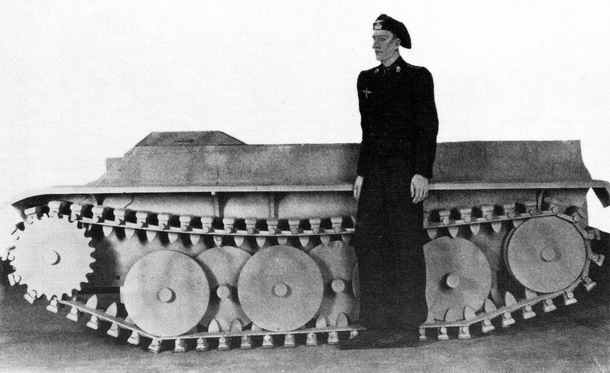
Wooden mock-up of the planned Rutscher tank destroyer from the BMW workshops – this photograph beautifully demonstrates the vehicle's remarkably low profile. Source: Flickr.com, with the permission of the publishing user, edited.
Thanks to this operating principle, the resulting gun could have a very light barrel with thin walls. Recoil was also considerably lower than in a conventional anti-tank gun, which allowed further weight savings in the mounting and the wheeled carriage. As a result, the PAW 600 (or PWK 8H63) weighed only around 600 kilograms – less than half the weight of the Pak 40. The trade-off was naturally a reduced effective range: the lower pressure meant lower energy, which meant a lower muzzle velocity and therefore a shorter range. The resulting effective range of 750 metres was, however, fully in line with the Army's expectations.
The primary ammunition type for the PAW 600 was the 8 cm Werfer Granate Patrone Hl 4462 – the 81.4 mm mortar bomb fitted with a shaped charge, as already described. The round weighed 2.7 kg, of which 360 grams was the warhead charge. The projectile left the muzzle at approximately 520 m/s and its warhead could burn through (more precisely, jet through) 140 mm of perpendicular homogeneous armour, regardless of range. Because shaped charges achieve better penetration without spin, the new gun had a smoothbore barrel. It is worth adding that although the PAW 600 was developed primarily as an anti-tank weapon, a high-explosive fragmentation round also existed for it. This projectile, designated 8 cm Werfer Granate Patrone 5071, weighed 4.46 kg and could be fired with either a reduced or a full propellant charge, giving a range of either 3,400 or 5,600 metres. The PAW 600 was an ideal choice for the small tank destroyer project: a light weapon with modest recoil required no heavy mounting and placed minimal stress on the fighting compartment structure and chassis during firing.
Let us now return from the gun itself to the Rutscher tank destroyer. The requirements for the vehicle and its armament were clear. In January 1945, however, the Army evaluation committee faced a decision: should the desired vehicle be developed from scratch properly, or should it be an assembly using as many already available components from other vehicles as possible? The first path would naturally promise a better result, but would take longer. The soldiers decided that both options should first be analysed, and the subsequent course of action determined based on the findings.
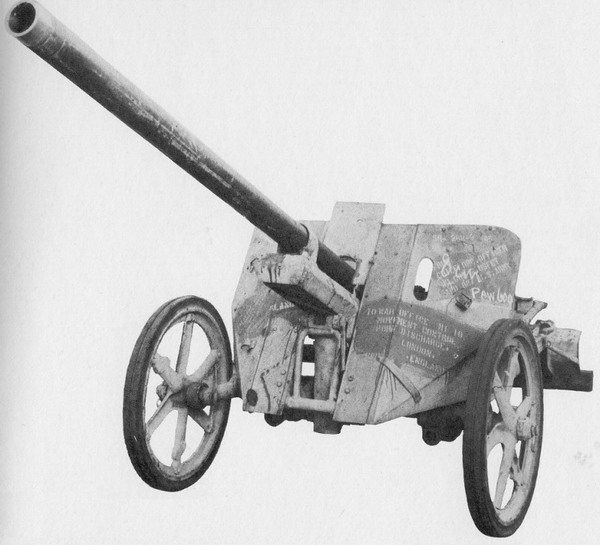
The Rutscher tank destroyer was to be armed with a pair of PAW 600 (or PWK 8H63) guns – a light weapon operating on the high-low pressure principle. Source: internet, public domain, edited.
The Wooden Mock-Up
One Rutscher design is documented photographically in the form of a full-scale wooden mock-up. According to available information, the design and the mock-up both originated in BMW's workshops and clearly represent a completely new vehicle rather than an assembly of existing parts. The sources do not make clear whether this design was produced during the first "round" of Rutscher development – at the turn of 1943–44 – or only after the project was revived in 1945. Either way, the photographs beautifully show a vehicle with an extremely low profile, riding on a chassis with overlapping road wheels and tracks fitted with rubber pads. The use of this type of track suggests that fast movement on hard surfaces – city streets – was anticipated. The front wall of the fighting compartment in the mock-up is sharply angled, with the weapon bay projecting forward in its right half. Particularly interesting is the use of a pair of PAW 600 guns mounted side by side.
Given the intended tactical use of the light tank destroyer, the choice of two guns makes clear sense. The Panzerkleinzerstörer Rutscher's principal tactical advantage was to be its minimal size and its mobility. The vehicle would wait, well concealed in a suitable firing position, and when enemy tanks approached to within effective range it would strike without warning, fire several rapid salvoes and withdraw at speed – then find another suitable position and ambush again from a different direction. Two guns allowed two rounds to be fired in that critical first salvo. It is in the first salvo that the element of surprise is at its greatest and the probability of a hit is highest, because the crew have had time to aim carefully. Firing two rounds almost simultaneously therefore gave the crew the best possible chance of making the most of that first moment of engagement. The wooden mock-up made no provision for integral machine gun armament (a roof-mounted machine gun operated from inside, similar to the Hetzer, may have been considered for a later stage).
Cancellation
On 19 March 1945, the Army evaluation committee received the results of the analysis of the two options under consideration. The document concluded that if the new fighting vehicle was to weigh between 3.5 and 5 tonnes, it could not be assembled from existing components of other vehicles but would have to be a newly designed machine. The estimated development time for such a vehicle was one and a half to two years. That figure was enough for the Army committee to reject this option outright – Germany simply no longer had that much time. A vehicle assembled from available components could be ready far more quickly. It would, however, be largely an improvisation, and the resulting vehicle would consequently be larger than the Army required, with an estimated weight of between 7 and 9 tonnes. The committee weighed this option and reached the following conclusion: at this weight, the new tank destroyer would not be sufficiently fast or agile. Its larger dimensions would also make it a much easier target. The vehicle would thus lose its primary – indeed its only – tactical advantage, and its very existence would become pointless. On the basis of these findings, the entire Rutscher project was definitively cancelled.
ARTICLE
CONTENTS:
Reproducing text from the Panzernet website without the written consent of the operator is prohibited.