7.5 cm Pak 38 auf VK 3.02
tank destroyer on an ammunition carrier chassis
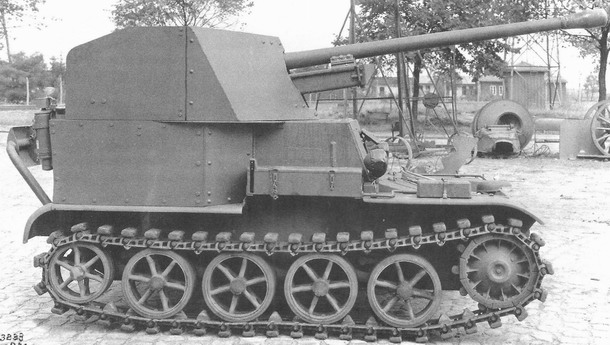
One of the two prototypes of the Panzerselbstfahrlafette Ia 5 cm Pak 38 auf Gepanzerter Munitionsschlepper tank destroyer. Source: Flickr.com, with permission of the publishing user, edited
The VK 3.02 Ammunition Carrier
The full official name of the vehicle discussed here was Panzerselbstfahrlafette Ia 5 cm Pak 38 auf Gepanzerter Munitionsschlepper. The informed reader will immediately recognise that this was a vehicle based on the chassis of an armoured ammunition carrier (Gepanzerter Munitions-Schlepper) -- specifically the Borgward ammunition carrier coded VK 3.02. Development of this "ammunition vehicle" had been underway since September 1937. According to the Weapons Office specification, it was to be a fully tracked vehicle capable of carrying up to 1,000 kg of cargo. The vehicle was intended to deliver ammunition right up to the front line, where it would be exposed to enemy fire -- it therefore had to be armoured, with frontal armour strong enough to withstand fire from a 7.92 mm infantry rifle. The first production version of the vehicle was designated VK 3.01. What concerns us here is the second-generation chassis, designated VK 3.02 (VK stood for Vollketten Kraftfahrzeug -- fully tracked vehicle; the number before the dot indicated the vehicle's expected weight in tonnes, and the number after the dot the project sequence number).
The Weapons Office assigned development of the ammunition carrier to Borgward of Bremen in northern Germany. An evaluation batch of 20 vehicles was ordered. The project was apparently not given high priority, and delivery of the first examples was not planned until December 1939. Even this deadline was probably not met -- judging by the fact that, according to Weapons Office records, the first trials of the new vehicle did not take place until April 1940.
The trials of the VK 3.01 were evidently satisfactory overall. Weapons Office representatives were generally pleased with the vehicle but requested a number of minor and more substantial engineering improvements. Production of the VK 3.01 in its existing form therefore did not continue; instead, work began on a new, modified version. The requested changes included enlarging the crew compartment by widening the entire vehicle by 50 mm and increasing its height by 50 mm. The modified ammunition carrier received the designation VK 3.02, and an order for 400 units was placed with Borgward.
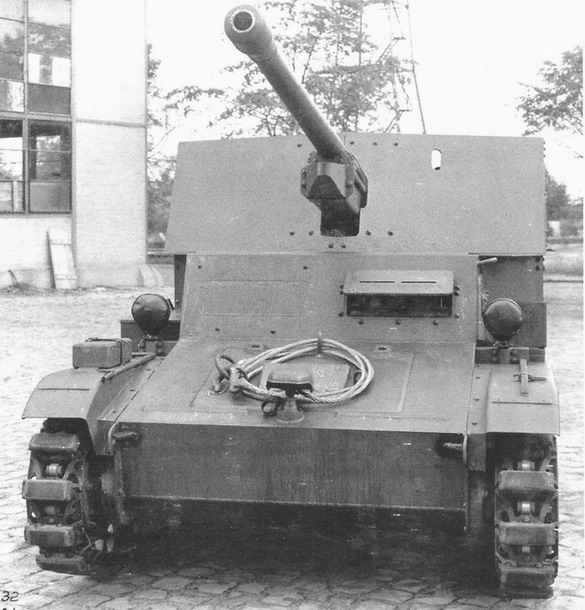
Panzerselbstfahrlafette Ia 5 cm Pak 38 auf Gepanzerter Munitionsschlepper. Note the blanked-off right vision port. Source: Flickr.com, with permission of the publishing user, edited
Series production began in October 1941 with the completion of the first 4 vehicles. Fourteen followed in November, just 4 in December, another 4 in January 1942, and the last 2 in February of that year. It is therefore clear that production was terminated far earlier than planned -- instead of the 400 ordered carriers, only 28 were delivered. The reason? In December 1941 the German army assessed its initial operational experience with the new vehicle and made plain in its report that it did not meet expectations. The Weapons Office consequently cancelled the original order and agreed with the manufacturer that the ammunition carrier's basis would instead be used for a different vehicle -- the remote-controlled demolition carrier known as the Sprengladungsträger B IV (covered elsewhere).
Conversion to a Tank Destroyer
The 26 completed VK 3.02 vehicles, together with 19 VK 3.01 units, were used to form the specialist Gepanzerter Munitions-Schlepper Kompanie 801, which was deployed on the Eastern Front as part of the 1st Infantry Division. The remaining two VK 3.02 chassis were put to an entirely different use. The story of these two vehicles had begun on 5 July 1940, when the Weapons Office formulated requirements for a light tank destroyer that could be transported by air, among other means. The vehicle was intended primarily for airborne units but also for selected infantry divisions that lacked mechanisation. To accelerate development, the Weapons Office specification stipulated that the new tank destroyer was to be built on the chassis of the VK 3.02 ammunition carrier -- which was, incidentally, still in development at the time. The main armament was specified as the 50 mm Pak 38 L/60 gun.
Development of the tank destroyer was assigned to Rheinmetall-Borsig. Rheinmetall designed the necessary modifications to the VK 3.02 hull, the new fighting superstructure, and the gun installation -- but had to wait for Borgward to supply the finished chassis before production could begin. The first two evaluation tank destroyers were therefore not completed and handed over for trials until July 1942. By the time the first two prototypes appeared, the vehicle was essentially already doomed to rejection. Why? By July 1942, production of the VK 3.02 ammunition carrier had already ended, meaning new chassis would have to be manufactured solely for this tank destroyer -- significantly increasing its production cost. Moreover, the Pak 38 itself was no longer considered a sufficiently capable weapon by mid-1942, and wherever possible the more powerful 75 mm Pak 40 was being adopted. Despite this, both prototypes completed army trials under the unwieldy designation Panzerselbstfahrlafette Ia 5 cm Pak 38 auf Gepanzerter Munitionsschlepper (or abbreviated as Pz.Sfl. Ia 5 cm Pak 38 auf gp.Mun.Schlepper).
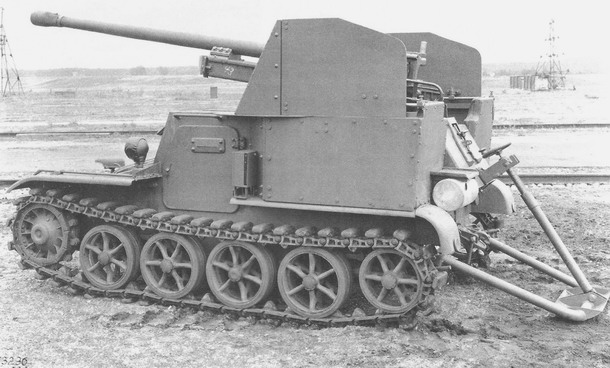
Panzerselbstfahrlafette Ia 5 cm Pak 38 auf Gepanzerter Munitionsschlepper. Note the driver's side entry door and the folded rear support leg. Source: Flickr.com, with permission of the publishing user, edited
Vehicle Description
The running gear inherited from the VK 3.02 consisted of four road wheels on each side. These were spoked wheels with a massive rubber tyre around the circumference. Each wheel was suspended on its own swinging arm and sprung by a torsion bar. At the very rear was an idler wheel closely resembling the road wheels in design but smaller in diameter. Both the road wheels and the idler were double -- formed from a pair of discs -- with the track's guide horn passing through the gap between the discs. The drive sprocket was at the front. The tracks were 200 mm wide and fitted with rubber pads for smoother travel on hard surfaces. The vehicle was powered by a Borgward 6M 2.3 RTBV petrol six-cylinder of 2.247 litres displacement, producing a maximum of 49 horsepower.
The original crew compartment from the VK 3.02 was retained with certain modifications. Only the driver's station on the left was kept, however. The position of the second crew member from the original VK 3.02 was eliminated and the space used for gun ammunition storage -- which also made it possible to blank off the right-hand vision port in the front wall of the cab. The original roof hatches in the cab likewise had to be removed: the right one was no longer needed at all, and the left one -- used by the driver -- was replaced by a door in the left side wall. The roof hatches could not remain because the gun's front shield now rested there, which would have prevented them from opening. Behind the cab, a new fighting compartment was created for the gun crew. Its lower portion was protected by a fixed surround of armour plate reaching to the height of the driver's cab roof. Above this fixed surround, a moveable armour shield that traversed laterally with the gun barrel provided protection. This shield covered the front and sides only -- the rear and top of the fighting compartment remained open.
The raised engine cover ran along the centre of the fighting compartment, dividing it -- together with the gun itself -- into two halves, each containing a seat for one soldier. To give both men sufficient room, the fighting compartment armour was widened to the outer edge of the track mudguards. The gunner, who also served as vehicle commander, sat to the left of the engine and gun. The loader sat to the right of the weapon. The gun mounting allowed horizontal traverse of 20 degrees to each side. Vertical elevation ranged from -10 to +20 degrees.
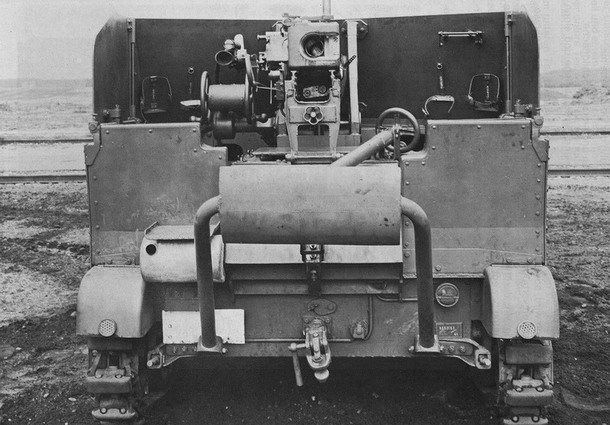
Panzerselbstfahrlafette Ia 5 cm Pak 38 auf Gepanzerter Munitionsschlepper. Source: Flickr.com, with permission of the publishing user, edited
A critical constraint for the designers of the new tank destroyer was the vehicle's total weight. The original VK 3.02 ammunition carrier weighed only 3.7 tonnes, and the new vehicle could not be significantly heavier without overloading the running gear. Since the weight of the gun itself could not be meaningfully reduced, savings had to come from the armour. The armour of the new fighting compartment therefore consisted of double plates -- just 3 mm thick on the sides and 4 mm on the front. To be precise: the sides had 3 + 3 mm and the front 4 + 4 mm (two steel plates with a small gap between them). According to some authors, frontal armour of this thickness was intended to withstand armour-piercing fire from a 7.92 mm infantry rifle -- though the author personally would not stake too much on that claim. The most heavily armoured parts of the vehicle were the hull nose and driver's cab front, which inherited 14.5 mm armour from the VK 3.02.
The designers nonetheless managed to keep the vehicle's total weight to 4.5 tonnes, which was apparently an acceptable figure. Maximum speed was around 30 km/h. The crew, as already indicated, consisted of three men. The driver sat alone inside the hull and observed through his main vision port in the wall in front of him and through a side port in his entry door. The other two crew members sat in the open fighting compartment, which they entered over its lowered rear wall -- assisted by a step positioned above the exhaust silencer.
As has already been stated, the main armament was the 50 mm Pak 38 gun with a barrel approximately 60 calibres long. Several types of ammunition were used with the gun, but the two primary anti-armour rounds were the Panzergranate 39 and the sub-calibre Panzergranate 40. The Panzergranate 39 projectile weighed 2.06 kg and left the muzzle at 835 m/s. At 500 metres it could penetrate 57 mm of sloped homogeneous armour (59 mm is also cited), and at 1,000 metres 44 mm (48 mm is also given). The sub-calibre Panzergranate 40 had a hard tungsten carbide core and could defeat armour up to 72 mm thick at 500 metres. At 1,000 metres, however, its energy fell off and it could manage only 38 mm of armour.
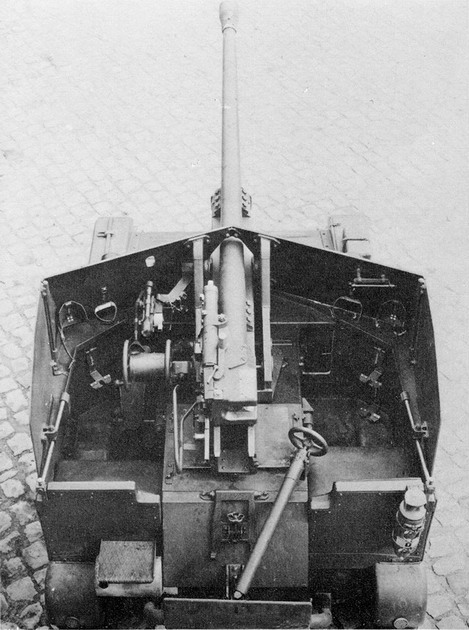
A view into the fighting compartment of the Panzerselbstfahrlafette Ia 5 cm Pak 38 auf Gepanzerter Munitionsschlepper tank destroyer. Source: Flickr.com, with permission of the publishing user, edited
The energy generated by firing the gun placed considerable strain on the chassis. To relieve this stress and to stabilise the vehicle during firing, the designers fitted a support leg at the rear of the hull that was folded down and braced against the ground before firing began. None of the sources mention any communications equipment, and no radio aerial is visible in any of the photographs. If the tank destroyer was indeed not fitted with a radio, this would have been a fairly serious handicap.
End of the Project
As will be fairly clear from the above, the tank destroyer on the VK 3.02 ammunition carrier chassis never entered series production. The two prototypes built were the first and last vehicles of their kind. They did, however, see operational evaluation at the front -- with the 19th Tank Destroyer Battalion (Panzerjäger Abteilung 19). Unfortunately, the battalion's report on its experience with the vehicles has not survived.
ARTICLE
CONTENTS:
Reproducing text from the Panzernet website without the written consent of the operator is prohibited.