MARDER I
tank destroyers on captured French chassis
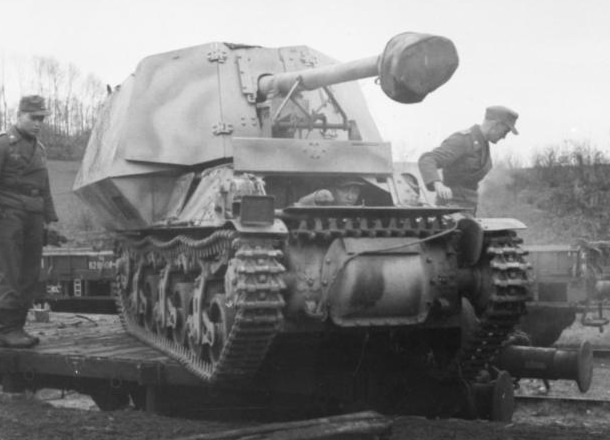
Marder I on the Lorraine 37L artillery tractor chassis, source: Bundesarchiv_Bild_101I-297-1701-20, Wikimedia, Creative Commons, edited
The combat name Marder (marten) covers an entire family of tank destroyers that the Germans built on the basis of both their own and captured tank chassis as a stopgap solution to the urgent shortage of sufficiently powerful self-propelled anti-tank weapons. Three main series were produced in total, distinguished by the Roman numerals I, II and III. Within each of these series, however, there were vehicles of multiple variants (three variants of the Marder I, two of the Marder II and three of the Marder III). When it comes to the Marder I series specifically, not all authors follow the same classification. Some sources describe all three variants (the Lorraine 37L, Hotchkiss 38H and FCM 36 chassis), while others list as the Marder I only the tank destroyer built on the Lorraine 37L tractor chassis, with the remaining two described as independent vehicles to which the combat name Marder was never officially applied. I will follow the first approach and describe all three of these tank destroyers — built on captured French chassis — as Marder I.
Origins of the Tank Destroyer
Following the invasion of the Soviet Union in the summer of 1941, the Germans were caught off guard by the sheer number of Red Army tanks. On top of that, they came face to face with advanced tank types such as the T-34 and the KV, against which their own tanks and their guns were largely ineffective. The proper solution was clearly the rearming of existing tanks with more powerful guns and the development of entirely new tank and self-propelled gun designs. In the face of overwhelming enemy numbers, however, any fighting vehicle — even an improvised one — was welcome. And the easiest answer was naturally the combination of already existing anti-tank guns with already existing chassis, from which a significant number of vehicles could be assembled cheaply and quickly. That is how the Marder I tank destroyers came to be.
The Lorraine 37L Chassis
The first vehicle in this series was built on the chassis of the French armoured artillery tractor Tracteur Blindé 37L, also known as the Lorraine 37L. The original tractor had been in production since 1937 and was designed for transporting troops and supplies. During the campaign in France, the Germans captured roughly 315 of these vehicles. The decision to use them as the basis for a self-propelled anti-tank gun was made in May 1942 — by which point the Germans were beginning to have a relatively sufficient supply of the new 75 mm anti-tank guns they intended to fit to their new tank destroyers.
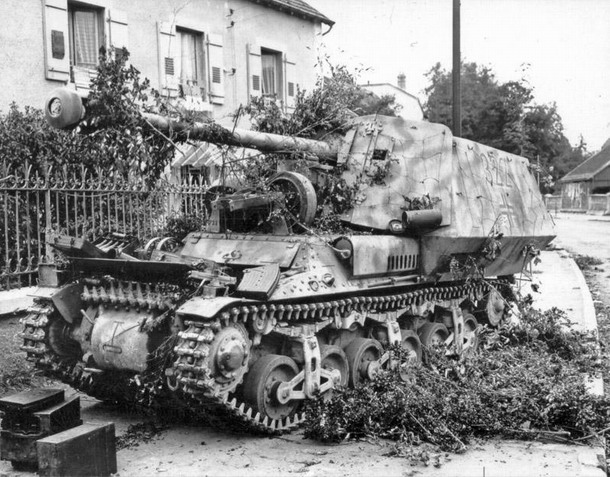
This abandoned Marder I on the Lorraine 37L chassis fell into Allied hands, source: Flickr.com, Public domain, edited
The captured French chassis featured six road wheels on each side, 44 cm in diameter, fitted with rubber tyres. The wheels were suspended and sprung in pairs using leaf springs. At the front was a toothed drive sprocket 50 cm in diameter, at the rear an idler wheel 38.5 cm in diameter, and the upper run of the track was supported by four return rollers. Each track consisted of 110 links, 230 mm wide (some sources give 220 mm).
The conversion design was developed by Baukommando Becker in cooperation with the firm Alkett. The original Lorraine 37L tractor had a two-man crew with their stations in the front of the hull. The engine, fuel tanks and other components were located in the middle of the hull, while the rear section served as a cargo compartment. It was over this rear half of the hull that a new welded fighting compartment was built, protecting the gun and its crew. The armour thickness of its walls ranged from 5 to 12 millimetres, making it clear that it could only withstand small arms fire and light shell fragments. The compartment was also open at the top and partly at the rear, to keep overall weight down. The crew consisted of four to five men, fulfilling the roles of driver, commander, radio operator, gunner and loader. When only four men were aboard, one of them doubled as both radio operator and loader. The driver was the only crew member seated inside the hull, at the front on the left side. The rest of the crew were stationed in the fighting compartment.
The Marder I was armed with the 75 mm Pak 40/1 L/46 anti-tank gun, with a barrel length of 46 calibres. At a range of 1,000 metres the gun could penetrate armour up to 97 mm thick at an angle of 30°. The front wall of the fighting compartment was movable and connected to the gun barrel, allowing a horizontal traverse of 32° to each side. Vertical elevation ranged from -5° to +22°. Gun laying was manual throughout. The gunner used a ZF 3x8 (Pak Zielfernrohr) sight for aiming. The maximum rate of fire was around 14 to 15 rounds per minute, and maximum range approached eight kilometres. Ammunition stowage for the gun amounted to 37 rounds (some sources state 40). In addition to the main gun, the Marder I carried an MG 34 machine gun, fired over the upper edge of the fighting compartment (though there is also a photograph showing the machine gun mounted directly on the gun barrel). 600 rounds of machine gun ammunition were carried. The crew also had at their disposal personal sidearms, the MP 38 or MP 40 submachine gun, and a signal pistol.
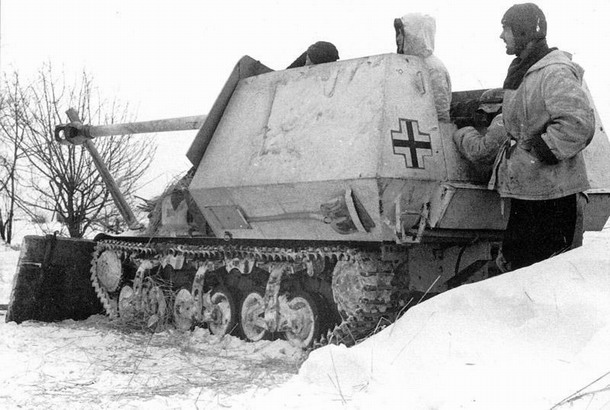
Marder I on the Lorraine 37L artillery tractor chassis, source: Flickr.com, with permission of the publishing user, edited
The Marder's powerplant was the six-cylinder Delahaye 135 engine with a displacement of 3.556 litres, retained along with the chassis from the original French tractor. It produced a maximum output of 70 horsepower at 2,800 rpm. The gearbox offered five forward and one reverse gear. Fuel was stored in three tanks with a combined capacity of 112 litres, giving a range of approximately 135 km. The maximum road speed of the Marder I on the Lorraine 37L chassis was around 35 km/h.
The tank destroyer's official designation was 7.5cm Pak 40/1 auf Geschützwagen Lorraine Schlepper (f). According to some sources, however, the official name was changed several times and also appeared as Panzerjäger Lr.S. für 7,5 cm Pak 40/1, or 7,5 cm Pak 40 auf Selbstfahrlafette Lr.S. (f), or even 7,5 cm Pak 40/1 auf Panzerjäger Lr.S. In any case, the vehicle's ordnance designation was Sd.Kfz. 135. The combat name Marder was only assigned retroactively, in 1944 — which further explains the confusion mentioned earlier about what was and was not part of the Marder I series.
In May 1942 an order was placed for 170 units. Production took place in the workshops of Baukommando Becker in Paris. The first 104 vehicles were completed in July and the remaining 66 in August 1942. However, the total number of units produced is sometimes quoted as 184. Although the vehicle was developed in response to the needs of the Eastern Front, only a portion of the production actually served there. The main theatre of operations for the Marder I ultimately proved to be the Western Front, where they were deployed against Allied forces from 1944 onwards.
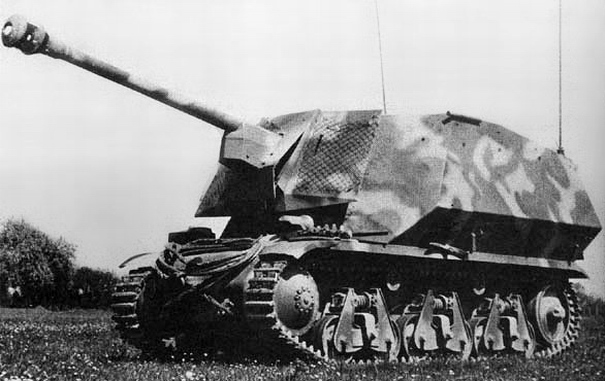
Marder I on the chassis of the French light tank Hotchkiss 38 H, source: Flickr.com, with permission of the publishing user, edited
The Hotchkiss 39H Chassis
The second variant of the Marder I was built on the chassis of the Hotchkiss 39H light tank (or its earlier version, the 38H), of which the German army had also captured a considerable number. Some of these vehicles were used in their standard form for secondary combat duties such as airfield and depot security or anti-partisan operations. However, sixty of them were also used to build yet another variant of the Marder. This received the official designation 7.5cm Pak40(Sf) auf Geschützwagen 39H(f).
The running gear of this variant again consisted of six rubber-tyred road wheels on each side, suspended and sprung in pairs by a shared horizontally-mounted coil spring. At the front of the track assembly was the drive sprocket, at the rear the idler wheel, and the upper run of the track rested on two return rollers. The driver's compartment was located at the front of the hull, behind it the fighting compartment with the turret, and the engine was situated at the rear.
During 1942, Baukommando Becker's workshops stripped the selected tanks of their turrets and part of their superstructure, replacing them with a large fighting compartment welded from flat armour plates. Armour thickness on this compartment ranged from 10 mm on the sides and rear up to 20 mm on the front plate. The rear wall featured a two-part access door for the crew. The roof of the fighting compartment was left open and covered with a waterproofed tarpaulin in bad weather.
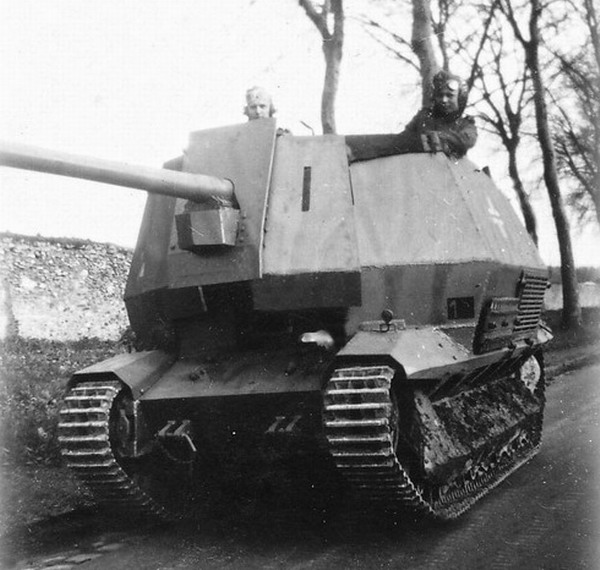
Marder I on the chassis of the French tank FCM 36, source: Tumblr.com, edited
These converted chassis were then fitted with the 75 mm Pak 40 L/46 anti-tank gun and an MG 34 machine gun as secondary armament. The gun barrel was mounted in a movable gun shield in the front wall, which covered the interior even when the gun was traversed. The horizontal traverse of the gun was 30° to each side; beyond that, the entire vehicle had to be turned. The MG 34 machine gun was again carried as supplementary armament, mounted on a bracket on the upper edge of the fighting compartment's armour, at its right front corner.
The vehicles retained their original Hotchkiss 616 engine, producing a maximum of 120 horsepower, which allowed the 12.5-tonne vehicle to reach a top road speed of 36 km/h with an operational range of around 150 km. The gearbox was a five-speed unit. The crew of the tank destroyer consisted of four men in the standard configuration — driver, commander, gunner and loader. Marder Is of this variant were assigned to units stationed in France and, following the Normandy landings, were deployed against Allied forces. The unused turrets from the original tanks are believed to have been repurposed for fixed fortifications and bunkers.
The FCM 36 Chassis
In 1940 the Germans also captured several dozen French FCM 36 medium tanks (Forges et Chantiers de la Méditerranée). During 1943, 48 of them (some sources cite the figure of 10) were converted into tank hunters, becoming the third in the series of vehicles generally referred to as Marder I. This variant received the official designation 7.5cm Pak40(Sf) auf Geschützwagen FCM(f). The main armament was again the 75 mm Pak 40 L/46 anti-tank gun. Against infantry, an MG 34 machine gun was again provided, mountable in the right front corner of the fighting compartment's armour wall. The crew consisted of four men, protected — as one might expect — by an open-topped superstructure welded from flat steel plates 20 mm thick.
The running gear consisted of nine small road wheels on each side. The first of these was raised above the level of the others and independently suspended; the remaining eight were linked in pairs. Coil springs were used for suspension. Unlike the two previous chassis, the FCM had its drive sprocket at the rear and the idler wheel at the front. The track assembly was protected on the sides by a folded armour skirt. This final Marder I was powered by a Berliet V-4 diesel four-cylinder engine producing a maximum of 91 horsepower. Its range was up to 225 km, though its top speed was a modest 23 km/h. The gearbox had five forward gears and one reverse. The combat weight of this Marder I was 12.8 tonnes.
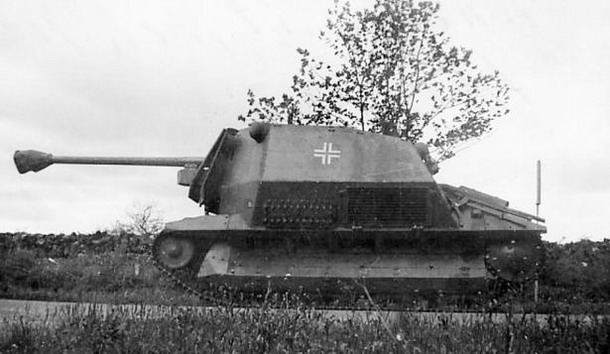
Marder I on the chassis of the French tank FCM 36, source: Flickr.com, with permission of the publishing user, edited
Overall Assessment
All three variants of the Marder I suffered above all from a high silhouette, which gave enemy gunners a generous target. This disadvantage was further compounded by thin armour that was, moreover, open at the top. The FCM 36-based variant was more limited than its two companions in terms of mobility and cross-country performance. Despite this, these tank destroyers proved reasonably effective in combat against enemy armour, thanks primarily to their powerful main gun.
Although by the end of the war they had been technically superseded by more modern designs, Marder I vehicles remained in service right up until the surrender of the Third Reich in 1945. It is also worth noting that in addition to the tank destroyer conversions, the Germans made use of all three French chassis mentioned here to build self-propelled howitzers of various calibres. These vehicles are described in the Self-Propelled Guns section.
Technical Data
|
|
Lorraine 37L |
Hotchkiss 38 H |
FCM36 |
|
weight: |
8.03 t |
12.5 t |
12.8 t |
|
length: |
? |
6.12 m |
6.35 m |
|
width: |
1.87 m |
1.85 m |
2.10 m |
|
height: |
2.21 m |
2.14 m |
2.23 m |
|
engine: |
De laHaye 103 T 5 |
Hotchkiss 616 |
Berliet V-4 |
|
engine power: |
70 hp |
120 hp |
91 hp |
|
max. speed: |
35 km/h |
36 km/h |
23 km/h |
|
range: |
135 km |
150 km |
225 km |
|
hull armour: |
|
|
|
|
- front: |
12 mm |
34 mm |
40 mm |
|
- sides: |
12 mm |
34 mm |
40 mm |
|
- rear: |
12 mm |
22 mm |
40 mm |
|
superstructure armour: |
|
|
|
|
- front: |
10 mm |
20 mm |
20 mm |
|
- sides: |
9 mm |
20 mm |
20 mm |
|
- rear: |
|
10 mm |
20 mm |
|
crew: |
4–5 men |
4 men |
4 men |
|
armament: |
75 mm Pak 40 gun 1x MG 34 machine gun, 7.92 mm |
75 mm Pak 40 gun 1x MG 34 machine gun, 7.92 mm |
75 mm Pak 40 gun |
ARTICLE
CONTENTS:
Reproducing text from the Panzernet website without the written consent of the operator is prohibited.