JAGDPANTHER
tank destroyer on the Panther chassis
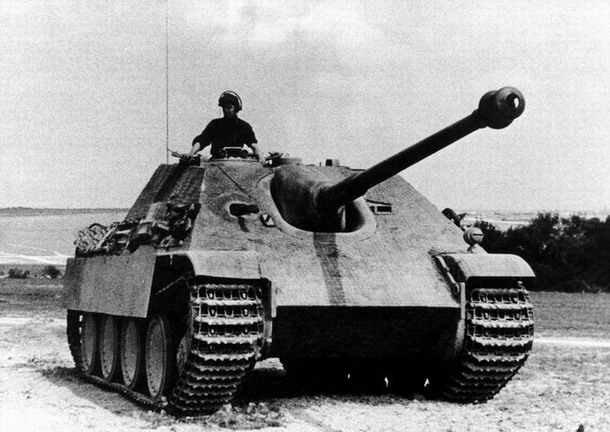
Jagdpanther heavy tank destroyer, source: Flickr.com with the permission of the publishing user, modified
Among the legendary weapons of Nazi Germany were, without question, the so-called "eighty-eights" — the 88 mm guns. The first of this weapon family was the Flak 18, developed at the turn of the 1920s and 1930s as an anti-aircraft gun (Flak = Flugzeugabwehrkanone = anti-aircraft gun). Already during its combat debut in the Spanish Civil War in 1936, however, the gun proved extraordinarily effective against ground targets as well — both tanks and fortifications. Subsequent refinements of the successful design led to the Flak 36 and Flak 37, and it was entirely natural to begin planning for these guns to take part in ground combat against tanks too.
At the time, the 88 mm Flak guns were by far the most effective anti-tank weapon available to the German army. It was therefore entirely logical that officers began exploring how this excellent gun might be used in a self-propelled fighting vehicle — the contemporary brief described it as an assault gun, but in practical terms it amounted to a tank destroyer. The first theoretical proposals appeared as early as 1939, at which point the design was based on the chassis of the medium tank Panzer IV. Krupp was tasked with the design work but treated it as a secondary priority, and progress was therefore extremely slow, confined to the drawing board.
Origins of the Tank Destroyer
The project received fresh impetus only in 1942. In May of that year the prototype of the new medium tank Panther was approved and preparations for series production began. As early as August, the arms procurement office decided that Krupp should abandon the Panzer IV chassis for its assault gun work and instead base the vehicle on the entirely new Panther. The main armament was simultaneously specified as an anti-tank gun with a barrel length of 71 calibres — a weapon not yet in production, but already under development by Krupp. This gun entered service the following year, in 1943, under the designation Pak 43 L/71, and represented the undisputed pinnacle of 88 mm anti-tank gun development — but more on that shortly.
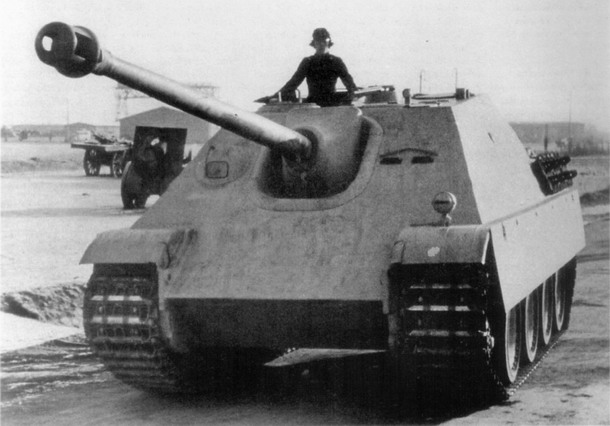
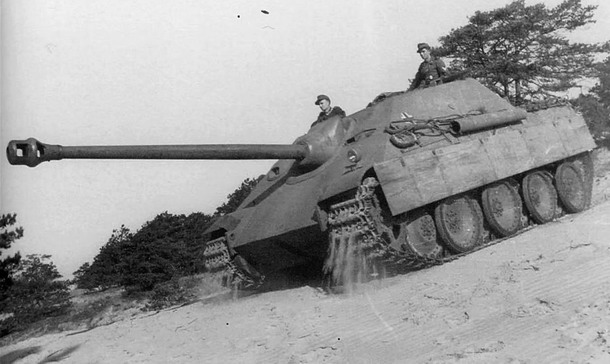
the first Jagdpanther prototype was completed in October 1943, source: Flickr.com with the permission of the publishing user, modified
Krupp was therefore to produce drawings and a full-scale wooden mock-up by 10 November 1942. The first sketches were submitted to the arms office on 9 September 1942. Adolf Hitler reviewed them at the end of September and was reportedly satisfied with the design, confirming the continuation of the project. On 15 October, for reasons that remain unclear, it was decided that once Krupp had finished the drawings and mock-up, further development would be handed over to Daimler-Benz. Krupp retained responsibility for the gun and its mounting within the fighting compartment.
The full-scale wooden mock-up was presented to representatives of the arms office in November 1942. A widely debated aspect of the design was the method of installing the gun in the front wall of the fighting compartment. The front plate was angled quite steeply to maximise protection, and the designers had to determine what form the gun mantlet should take in order to integrate as seamlessly as possible with the front wall without creating any vulnerable weak point. The gun aperture also had to be large enough to allow not only the weapon itself to be removed, but also the entire gearbox housed in the front of the hull — which in turn meant that the armoured fighting compartment could be permanently welded to the hull, since it would never need to be lifted for gearbox servicing.
Following their review of the documentation and mock-up, representatives of the arms office indicated they expected production to begin no later than December 1943, with Daimler-Benz as the designated manufacturer. Armour plate was to be supplied by Brandenburger Eisenwerke. In December 1942, however, another change of manufacturer was decided upon. While Daimler-Benz was to complete the vehicle's development, series production would take place at the MIAG plant in Braunschweig.
the second prototype still retained pistol ports in the rear and side walls of the fighting compartment, source: Worldwarphotos.info with the permission of the site operator, modified
The arms office's original plan apparently called for the new tank destroyer to be based on the hull and chassis of the second-generation Panther, the so-called Panther II. That tank did not yet exist in any meaningful sense, and MAN was only beginning its development. The Panther II project was also falling behind schedule from the outset and its requirements kept changing. It was therefore reportedly decided in May 1943 that the new tank destroyer would instead be based on the already-produced first-generation Panther. It appears, however, that the tank destroyer did incorporate at least some features planned for the Panther II — for example, the straight upper edge of the hull side above the tracks. The technical specifications of June 1943 stated that the vehicle would have a crew of six: driver, commander, gunner, radio operator and two loaders. Before the first prototype was even built, however, the decision was made to drop the second loader, reducing the crew to a more standard five men and using the freed space to increase the ammunition stowage from the originally planned 50 to 60 rounds.
First Prototypes
In October 1943, MIAG delivered the first evaluation prototype, designated V101 (V = Versuchsfahrzeug = experimental vehicle). The second prototype, V102, followed in November. Both vehicles were used for trials. They differed from the later early-production machines in only a few details, identifiable in photographs by essentially two features: the absence of the anti-magnetic Zimmerit paste (applied to production vehicles but not to the prototypes), and the pistol ports for crew small arms in both side walls and the rear wall of the fighting compartment. The prototypes had one such port in the left side wall, two in the right side wall, and two more in the rear wall (the plug of a side pistol port is clearly visible, for example, in the photograph HERE (source: Flickr.com)). On production vehicles these ports were eliminated entirely. The first series-production Jagdpanthers began rolling off MIAG's assembly line in January 1944.
As for the vehicle's name, the documents from its development and production period contain an almost bewildering variety of designations, including some genuinely unwieldy ones such as schweren Panzerjägers 8,8 cm KwK L/71 mit Bauelementen des PzKpfw Panther. The most commonly used official designation was apparently Panzerjäger Panther (8,8 cm) (Sd.Kfz. 173), but the vehicle entered history under the short combat name Jagdpanther — meaning, essentially, a hunting or pursuit panther.
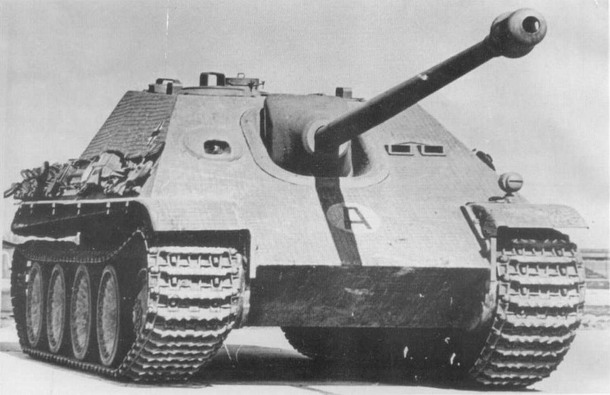
early production Jagdpanthers had two driver's vision ports and a one-piece gun barrel, source: Flickr.com with the permission of the publishing user, modified
Vehicle Description
The first series-production Jagdpanthers were based on the chassis of the Panther Ausf. A. The road wheels on each side of the suspension were arranged on eight axles. Each wheel consisted of two discs, and by alternating the disc arrangement on even and odd axles, the wheels partially overlapped one another. At the very front was the toothed drive sprocket, and at the rear the idler wheel. Immediately behind the drive sprocket was a small return roller that helped lift the upper run of the track before it engaged the sprocket teeth. The road wheels were sprung by double torsion bars. Their diameter was 860 mm and, for a smoother ride, they were fitted with solid rubber tyres around their circumference. The tracks were 660 mm wide.
The hull nose was formed by the sharp junction of two frontal plates. The lower plate was 50 mm thick and angled at 55 degrees. The upper plate, 80 mm thick, ran from the nose directly into the front wall of the fighting compartment. In the upper portion of this plate, slightly to the right of centre, was the gun. Into the aperture in the front wall was fitted a cast gun cradle, which formed a recess set back into the fighting compartment. Onto the gun barrel itself was fixed a cast conical mantlet — similar to the well-known Saukopfblende of the StuG III — which filled most of the recess in the front wall. This arrangement allowed the gun the movement necessary for aiming while avoiding any significant weak point in the front plate. To the right of the gun was a hemispherical ball mount for an MG 34 machine gun. To the left of the gun were two rectangular vision ports for the driver.
The side walls of the fighting compartment were continuous with the hull sides and were 50 mm thick. It is worth emphasising that the armoured body of the Jagdpanther was not produced simply by welding a new fighting compartment onto the hull of an existing Panther tank. On the contrary, most of the armour plates were manufactured specifically for the Jagdpanther. This is precisely why the tank destroyer could have straight upper edges to its hull sides above the tracks, while the Panther Ausf. A had stepped ones — as can be seen HERE (source: Flickr.com). Even the lower nose plate differed from the standard tank: while on the Panther Ausf. A it was 60 mm thick, on the Jagdpanther it was reduced to 50 mm to save weight. In practice, the only section of the hull carried over essentially unchanged from the original tank was the engine compartment.
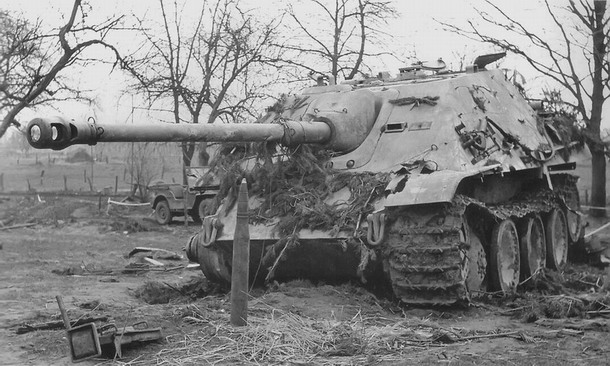
this Jagdpanther knocked out on the Western Front has only one driver's vision port. The hole drilled in the armour for the second port has been blanked off with a plate, which is clearly visible here. Also worth noting are the shell casing in front of the vehicle and the small lifting eyes on the gun mantlet and muzzle brake, used to attach foliage for camouflage, source: Worldwarphotos.info with the permission of the site operator, modified
The roof of the Jagdpanther's fighting compartment was literally covered with openings. In the left front section was a crescent-shaped slot for the gun sight. The cover for this slot moved with the sight during aiming, so the roof remained fully closed at all times. Behind this slot was the opening for the Nahverteidigungswaffe — the close-defence weapon against infantry, which we will return to shortly. Remaining in the left half of the roof and moving further back, there was a fixed observation periscope for the loader, and in the far left rear corner a circular entry/exit hatch with a two-part cover. In the right front corner of the roof was a raised rotating periscope for the vehicle commander, effectively replacing the commander's cupola found on tanks. Behind it was another circular hatch, again with a two-part cover, and in the right rear corner one more rotating observation periscope, apparently serving the loader. Two ventilation fans for the interior were also set into the roof. In the centre of the rear wall of the fighting compartment was a large rectangular opening used for loading ammunition and as an emergency escape hatch. In the right portion of the rear wall was a small circular port for ejecting spent cartridge cases, and immediately above it was the mounting bracket for the radio antenna.
The engine compartment occupied the very rear of the hull. In its centre sat the Maybach HL 230 P30, a petrol-fuelled twelve-cylinder engine with a displacement of 23 litres producing a maximum output of 700 horsepower at 3,000 rpm. The radiators and their cooling fans were positioned on either side of the engine. Fuel capacity was 700 litres, sufficient for approximately 160 km on roads and a mere 80 km cross-country. The gearbox was located at the front of the hull and connected to the engine by a driveshaft. It was of the Zahnradfabrik AK 7-200 type with seven forward gears and one reverse. The Jagdpanther weighed 45.6 tonnes and was capable of reaching a top speed of around 45 km/h on roads and 25 km/h cross-country.
The Jagdpanther was armed with an 88 mm Pak 43/3 L/71 gun — a modified version of the towed Pak 43 anti-tank gun. The modifications concerned only its installation in the vehicle, not the weapon itself, so in terms of ballistic performance the Pak 43/3 was identical to the standard towed Pak 43. The barrel was 6,298 mm long, approximately 71 times the calibre. The gun mount permitted only limited traverse for aiming: 12 degrees to each side, beyond which the entire vehicle had to be turned. While this might appear a serious handicap at first glance, in practice the gun's enormous effective range meant that this traverse was usually more than sufficient. Vertical elevation ranged from -8 to +14 degrees. Aiming was carried out using a Sfl ZF 1a periscopic sight (Selbstfahrlafetten-Zielfernrohr), which projected through an aperture in the roof of the fighting compartment. The Jagdpanther carried 60 rounds of 88 mm ammunition.
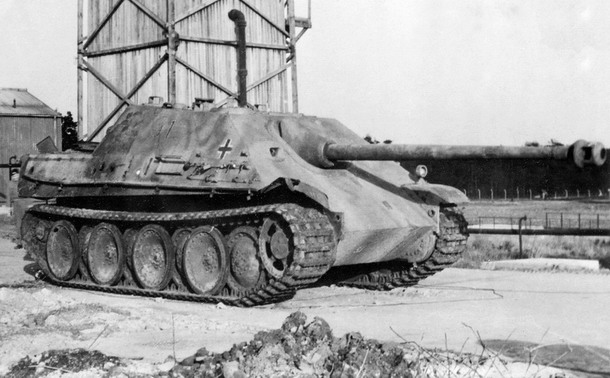
a Jagdpanther captured by the Allies, source: Flickr.com with the permission of the publishing user, modified
The 8.8 cm Pak 43 Gun
The Pak 43 was designed from the outset as a highly effective anti-tank weapon suitable for installation in armoured fighting vehicles. The engineers at Krupp, who developed the gun, therefore paid particular attention to the dimensions of the ammunition and the chamber. The rounds had to be large enough to guarantee their power — requiring a substantial propellant charge — but at the same time could not be too long, or they would be unmanageable inside a fighting compartment. By using shorter but wider cartridge cases, the designers produced a gun with a reasonably sized chamber and outstanding armour-piercing performance.
Four types of ammunition were used with the Pak 43. The primary round for destroying enemy armour was the Pzgr. 39/43 (Pzgr. = Panzergranate). This was an armour-piercing shell weighing 10.2 kg with a small bursting charge, leaving the muzzle at approximately 1,000 m/s. At a range of one kilometre it could penetrate 165 mm of sloped homogeneous armour, and at two kilometres it was still capable of piercing an astonishing 132 mm. Beyond its raw hitting power, the Pak 43 was also renowned for its accuracy. Accuracy figures are typically expressed as the probability of hitting a target 2.5 metres wide and 2 metres tall — roughly the frontal dimensions of a tank — and are usually given separately for range practice and actual combat conditions, the latter being somewhat lower due to the greater stress and time pressure involved in real fighting. For the Pak 43 firing the standard Pzgr. 39/43 round, the probability of a hit at one kilometre was 100% on the range and 85% in combat. At two kilometres these figures fell to 85% on the range and 43% in combat.
The second anti-tank round available was the Pzgr. 40/43, a tungsten-cored shot. This projectile weighed only 7.3 kg and left the muzzle at 1,130 m/s. At 1,000 metres it could defeat 193 mm of sloped armour, and at 2,000 metres it still managed 153 mm. It was also marginally more accurate than the Pzgr. 39/43. However, the Pzgr. 40/43 was scarce, as tungsten was in short supply for Germany. Crews therefore carried only a handful of these rounds — if any at all — reserving them for engagements with the heaviest Soviet armour. Unlike the Pzgr. 39/43, the Pzgr. 40/43 contained no explosive filler, which reduced its destructive effect after penetrating an enemy vehicle. However, a hit on the ammunition stowage — of which every tank carried a considerable quantity — would usually cause catastrophic results regardless.
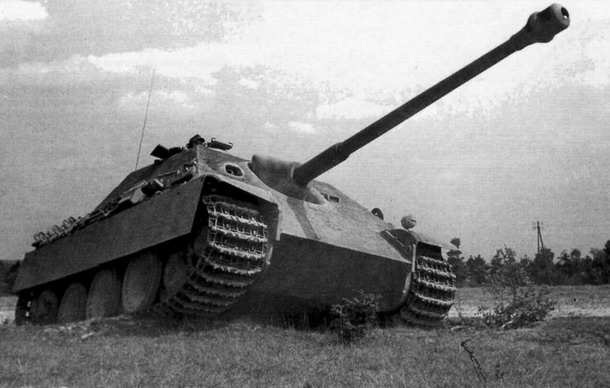
the Jagdpanther's decisive asset was its devastating long-barrelled gun, source: Flickr.com with the permission of the publishing user, modified
Another available round was the Gr. 39/3 HL, a shaped-charge anti-tank projectile. It weighed 7.65 kg and had a muzzle velocity of only around 600 m/s. For a shaped-charge round, however, impact velocity is irrelevant, as it does not rely on kinetic energy to penetrate armour but on the chemical energy of its explosive jet. Its penetration therefore does not diminish with increasing range. The Gr. 39/3 HL could burn through 90 mm of armour — significantly less than the conventional armour-piercing rounds — and was also less accurate. Crews therefore rarely bothered to carry it at all. The fourth and final ammunition type for the Pak 43 was the high-explosive fragmentation shell Sprgr. 43 (Sprgr. = Sprenggranate), used against unarmoured, so-called soft targets, including enemy infantry.
Series Production
As already mentioned, MIAG managed to deliver the first five series-production Jagdpanthers in January 1944. Even after production had begun, however, a number of design problems had to be addressed, most notably reinforcing the troublesome final drives — the components that transfer power from the gearbox to the drive sprockets and also contribute to steering. Output consequently failed to ramp up at the pace the army had envisaged. Only 7 vehicles left the factory in February 1944, 8 in March, and 10 each in April and May. In June 1944, production actually fell to just 6 machines following an Allied air raid on the Braunschweig area.
As a result of these difficulties, only 46 of the planned 160 Jagdpanthers had been delivered by the end of June 1944. The Germans quickly realised they could not rely on a single assembly plant and brought two further manufacturers into the programme: Maschinenfabrik Niedersachsen Hannover (MNH) in Hanover and Maschinenbau und Bahnbedarf A.G. (MBA) in Berlin.
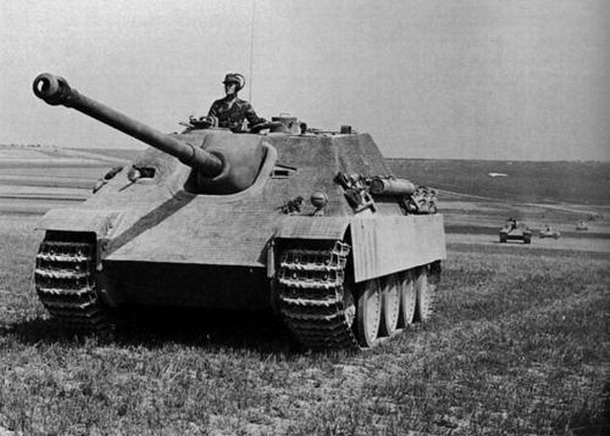
the ideal terrain for the Jagdpanther was open, clear country where it could make full use of its range and accuracy — a pity that it ended up fighting mainly in the West rather than in Russia, source: Flickr.com with the permission of the publishing user, modified
Jagdpanther production continued until April 1945, right up to the end of the war. A total of 415 vehicles were completed, including the two prototypes from late 1943 — though this figure may not be entirely accurate as some records from the final months of the war are missing. The great majority, probably 268 vehicles, came from MIAG's plant. The peak production month was January 1945, when 72 Jagdpanthers were completed. It should be noted that total output fell far short of the army's requirements. The initial plans from January 1943 had envisaged a target monthly production rate of up to 150 vehicles. Progressively revised and therefore more realistic plans set a total production target of 736. The reasons these ambitions were never met were the generally deteriorating German war situation and, above all, Allied air raids on production plants, railways, roads and other infrastructure. Between February and October 1944, the MIAG factory in Braunschweig was bombed no fewer than ten times, with up to 60% of the plant's floor space destroyed or damaged.
Running Modifications
As already noted, the pistol ports for crew small arms were eliminated entirely on production vehicles. Drilling the ports into the side walls was labour-intensive and the openings also reduced the overall integrity of the armour. Rather than side pistol ports, a different weapon was installed in the roof of the fighting compartment to deal with enemy infantry at close quarters — a grenade and smoke launcher known as the Nahverteidigungswaffe (literally "close-defence weapon"). The launcher itself was mounted inside the fighting compartment, beneath the roof, with its barrel opening through the roof plate. As well as anti-personnel fragmentation grenades, it could fire smoke grenades, and the barrel could even be used to discharge signal flares. In practice, deliveries of the Nahverteidigungswaffe were delayed and the first production Jagdpanthers had to be completed without it; the prepared roof aperture was simply covered with an armour plate. The crews of these early vehicles therefore had only the hull machine gun for dealing with enemy infantry.
Jagdpanthers produced before June 1944 had two small rectangular vision ports for the driver in the front wall of the fighting compartment. From June 1944 onwards, as a production simplification, only one port was fitted — the right-hand one of the original pair. On newly manufactured front plates the aperture for the left port was no longer cut, though existing stocks of plates with both apertures continued to be used, with the left aperture simply blanked off with a welded armour patch. According to some sources this patch was only 5 mm thick — rather thin, though perhaps it offered much the same level of protection as the block of bulletproof glass that had originally filled the opening, and in any case a direct hit on such a small spot was a remote prospect. A comparison photograph of a Jagdpanther with two ports and one with a single port can be viewed HERE.
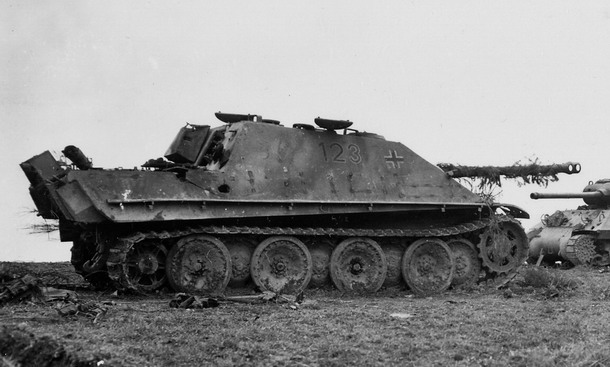
Western Front — two enemy rounds have penetrated the side armour of this Jagdpanther and destroyed the engine; the crew appear to have escaped, source: Wordwarphotos.info with the permission of the site operator, modified
From around April 1944, a newer version of the PaK 43/3 gun began to be fitted. The guns on the earliest vehicles had a one-piece barrel of uniform external diameter along its entire length. The later version had a stepped barrel, with the first section having a greater wall thickness and therefore a larger outer diameter. The reason for this change was again production simplification: the two sections of the new barrel were manufactured separately, which was less demanding than producing such a long barrel in a single piece. Given existing stocks, original one-piece barrels continued to be fitted to new vehicles until around October 1944. From June 1944, the Pak 43/3 also received a new muzzle brake, considerably smaller than the original and weighing only 35 kg compared to 60 kg for the earlier type.
Another less visible running change was the thickening of the fighting compartment roof plate. On the first 50 production Jagdpanthers the roof was a mere 16 mm thick. Starting with the vehicle bearing production number 300051, a 25 mm roof plate was used instead. This change was accompanied by several further minor modifications to the roof periscopes and hatches.
From August 1944, Jagdpanthers received a redesigned gun cradle for mounting the gun in the front wall. The original cradle was bolted to the front plate from inside the fighting compartment. In the new design, the connecting bolts passed through an external flange on the cradle — eight bolts in total, four in the upper and four in the lower part of the flange. In October 1944 the flange was modified again, with its lower edge strengthened and extended downwards to ensure a better fit in the front wall aperture. A comparison of all three flange variants can be seen HERE.
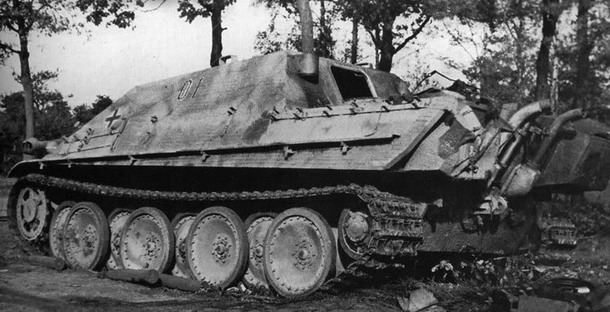
a command Jagdpanther knocked out on the Western Front, source: Flickr.com with the permission of the publishing user, modified
In addition to the more significant changes described above, a whole series of smaller modifications and improvements were introduced during the production run, covering items such as exhaust pipe cooling, the design of the stowage boxes on the rear wall of the engine compartment, the type and mounting of the jack and other tools, the deletion of shock absorbers on the rear road wheels, the discontinuation of Zimmerit anti-magnetic paste, and similar details. The last change worth mentioning was the switch from the Panther Ausf. A chassis to the Panther Ausf. G chassis. The first vehicle with the new chassis was the Jagdpanther bearing production number 300301. In practice, however, the impact of this change was not as great as might be expected. As noted earlier, the tank's original hull had been modified so extensively for the tank destroyer role that in essence the only part carried over from the original tank was the engine compartment.
As already mentioned, the crew was originally intended to number six, but one of the two loaders was dropped before a single prototype had been built. The crew therefore consisted of the standard five: driver, loader, gunner, commander and radio operator. The driver sat in the left front section of the hull, observing through two (later one) vision ports in the front plate. Behind the driver and to the left of the gun sat the gunner. The remaining three crew members were positioned to the right of the gun, and their arrangement changed slightly during the production run. On early vehicles, the commander sat first, with the radio operator behind him and the loader at the rear.
The logic of this arrangement followed from the already-mentioned elimination of the second loader. Once that decision was made, there was genuine concern that a single loader might not be able to keep up with the demands of combat — bearing in mind that a Pzgr. 39/43 round weighed more than 23 kilograms. The radio operator was therefore placed close to the loader so he could assist when needed, which made sense in principle but meant that the hull machine gun fell to the commander, who was nearest to it — an arrangement that quickly proved unsatisfactory. The commander could either direct the crew or operate the machine gun; doing both simultaneously was simply not feasible. Combat experience also showed that a single loader could manage perfectly well even in intense fighting. In December 1944 the positions of commander and radio operator were therefore swapped. The commander could now focus solely on his primary duties, while the radio operator took responsibility for both radio communications and the hull machine gun. It is worth noting that the arrangement of the periscopes and hatches in the roof was not altered when the commander and radio operator switched positions.
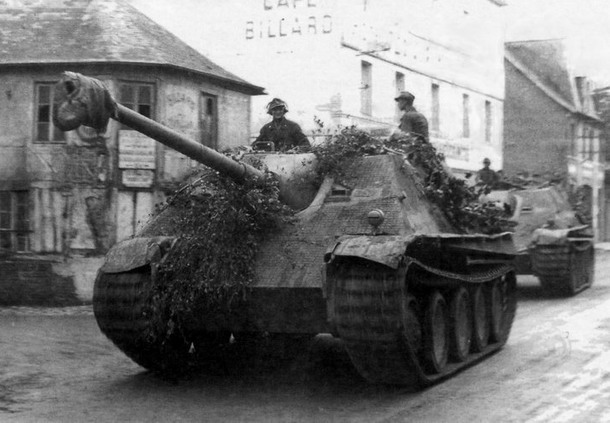
Jagdpanthers of sPzJgAbt 654 in France, source: Worldwarphotos.info with the permission of the site operator, modified
Organisation
Jagdpanthers were organised into so-called heavy tank destroyer battalions (schwere Panzerjäger Abteilung, or sPzJgAbt). Each such battalion consisted of three companies (Kompanie), each subdivided into three platoons (Zug), with each platoon equipped with four tank destroyers plus supporting vehicles. Each company also had its own command section with two additional Jagdpanthers. A company at full strength therefore fielded 14 tank destroyers (3 × 4 plus 2). The battalion also had its own headquarters company (Stabkompanie) with a further three vehicles. The full battalion thus had 45 Jagdpanthers: three combat companies of 14 each, plus the battalion headquarters company with 3.
Command Version
The standard combat Jagdpanther carried a single Fu 5 radio set. Each platoon commander's vehicle, however, carried an additional Fu 2 receiver. The two vehicles used by the company command also had extended radio equipment — a combination of Fu 5 and Fu 8 sets. The Stabkompanie commanding the entire battalion had three command vehicles: two fitted with Fu 5 and Fu 8 sets, and one with Fu 5 and Fu 7.
The Fu 8 radio was used for ground-to-ground communication, with a voice range of up to around 20 kilometres and a Morse range of up to 40 km. The Fu 7 served for communication with the Luftwaffe. The second radio set was mounted beneath the roof of the fighting compartment in its left rear corner. To accommodate the extra radio, the ammunition stowage on command vehicles had to be reduced from 60 to 50 rounds. Command vehicles — generally referred to as Befehls-Jagdpanther — can be identified in photographs by the second antenna mounted on the upper left of the rear wall of the fighting compartment. Those equipped with the Fu 8 are particularly easy to spot, as their additional antenna had a distinctive star-shaped branching end, known as the Sternantenne D.
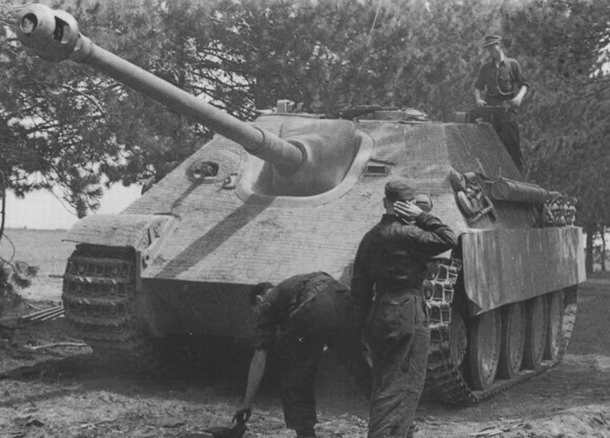
the Western Front became the Jagdpanther's main battlefield, where it had to contend with the enemy's air superiority — here a crew has hidden their vehicle at the edge of a wood, apparently waiting for nightfall before continuing their march, source: Flickr.com with the permission of the publishing user, modified
A clear tactical doctrine was defined for the Jagdpanther, designed to exploit its main strength — a powerful gun capable of accurate fire at long range — while accounting for its primary weakness: the absence of a rotating turret. Jagdpanthers were to be committed to battle ideally at full battalion strength. If only a single company had to be deployed for any reason, it was always to fight alongside a larger friendly formation. The deployment of individual vehicles was strictly prohibited. Without a rotating turret the Jagdpanther was quite vulnerable to attack from multiple directions simultaneously, so as many vehicles as possible were to operate together to provide mutual support. Ideal was an escort of tanks or at least infantry.
Jagdpanthers were also to make full use of their considerable mobility. Crews were expected to change position frequently — fire two or three well-aimed rounds and then quickly relocate. Engagements with enemy tanks were to be opened at the greatest possible distance, from 2,500 metres if the situation allowed. Deploying Jagdpanthers on static guard duty was strictly forbidden. They were to be directed against the main axis of an enemy armoured attack and break it up with intense, accurate long-range fire. Open, flat terrain was therefore the ideal battlefield; operations in woodland or urban areas were strongly discouraged.
Combat Deployment
The first unit to receive the new Jagdpanther tank destroyers was schwere Panzerjäger Abteilung 654 (sPzJgAbt 654). The battalion had previously been equipped with the heavy tank destroyer Ferdinand. During the fighting in the Kursk salient in July 1943 it suffered severe losses and was accordingly withdrawn from the Eastern Front back to Germany in August 1943. The command gave the men a comparatively long rest, as the decision to reorganise and re-equip with the brand-new Jagdpanther did not come until February 1944. Since the first production vehicles had only just begun to leave the factory, sPzJgAbt 654 was issued five standard Panther tanks in the meantime so that the drivers could begin training.
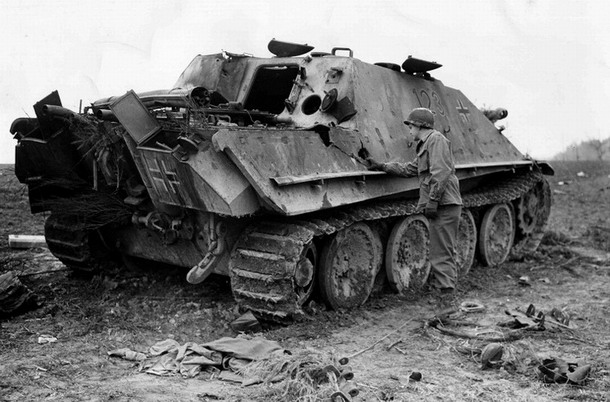
the Jagdpanther was most vulnerable when attacked from the flanks and rear, as happened to this vehicle on the Western Front, source: Flickr.com, Public domain, modified
The first eight Jagdpanthers reached the battalion only on 4 May 1944. In June 1944 the Allied landings in Normandy opened the Western Front. At that moment the battalion still had only those eight Jagdpanthers. Headquarters was therefore reluctant to send it to France and wanted to wait for more vehicles to arrive, but deliveries were delayed and there was no time left to wait. At ten minutes past midnight on 15 June 1944, the battalion's 2nd Company, with all available — that is, just eight — Jagdpanthers, was loaded onto railway wagons and departed for the front.
As with any new vehicle, the men of the 654th battalion had to contend with very frequent breakdowns. Of the total of eight vehicles, no more than five were operational at any given time. The first combat action of the new tank destroyers apparently took place on 11 July 1944. Four Jagdpanthers that day covered the left flank of an attack by tanks of the 2nd Panzer Division. The Jagdpanthers managed to destroy one enemy anti-tank gun and one Sherman tank. One German vehicle was hit by a British anti-tank gun, however: the round passed through the rear wall of the fighting compartment, killed the loader and wounded most of the other crew members, though the driver still managed to bring the damaged vehicle to safety. Another Jagdpanther was hit during the same action by friendly fire — the gunner of a Panzer IV from the 2nd Panzer Division, apparently with no idea what Germany's latest tank destroyer looked like, spotted an unfamiliar silhouette in his sight and took it for the enemy. The round pierced the side armour of the fighting compartment and wounded three crew members.
At the turn of June and July 1944, the 654th battalion — specifically the portion still waiting in Germany — received a further 17 brand-new Jagdpanthers. These were assigned to the 3rd Company and immediately sent to France. The 2nd and 3rd Companies were now operating on the Western Front with 25 Jagdpanthers between them. On 28 July the unit reported 21 vehicles fit for combat and 4 under repair — meaning that not a single vehicle had been written off entirely up to that point. That changed on 31 July 1944, when one crew was forced to blow up their vehicle due to a mechanical failure. The following days brought worse: the number of operational machines fell rapidly, until on 13 August only one remained. By the end of August, nineteen Jagdpanthers had been written off completely. In early September 1944, the remnants of sPzJgAbt 654 were withdrawn back to Germany.
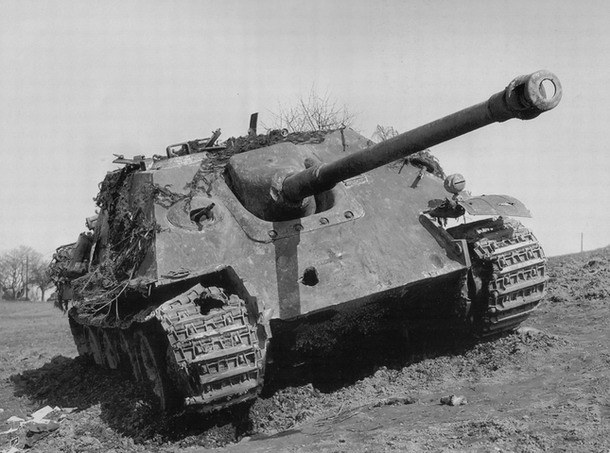
again the Western Front — a penetration through the frontal armour demonstrating that the Jagdpanther was not invulnerable even when attacked head-on, source: Flickr.com, Public domain, modified
During October and November sPzJgAbt 654 was brought back to full establishment (45 Jagdpanthers), and on 18 November 1944 it returned to the Western Front, arriving on the 20th and being thrown into action immediately. Between 20 and 30 November, the unit destroyed 52 enemy tanks and 10 anti-tank guns, though its own losses were also considerable — 18 Jagdpanthers over the same period. On 1 December 1944 the battalion reported a total strength of 25 Jagdpanthers, all combat-ready. Given the slow pace of new vehicle production, sPzJgAbt 654 ultimately remained the only battalion fully equipped with Jagdpanthers. All other battalions had to make do with a mixed complement combining Jagdpanthers with Jagdpanzer IV and StuG III vehicles.
In December 1944 the Germans launched their famous winter offensive in the Ardennes. Jagdpanthers from five different battalions took part in the operation: in addition to sPzJgAbt 654 already discussed, these were sPzJgAbt 559, sPzJgAbt 519, sPzJgAbt 560 and sPzJgAbt 655. On the day the German attack began — 16 December 1944 — the Jagdpanther strengths in these units were as follows: sPzJgAbt 559 had 5 operational vehicles, sPzJgAbt 519 went into action with 9, sPzJgAbt 560 could deploy 13 Jagdpanthers, and sPzJgAbt 654 had 26 operational vehicles. The last battalion, sPzJgAbt 655, was not ready on the opening day as its re-equipment was still in progress and it therefore did not take part in the Ardennes offensive. The total number of Jagdpanthers available on the first day of the offensive was thus 53.
While the Western Front was undoubtedly the Jagdpanther's main battlefield, it also saw service in the East. The first units fighting on the Eastern Front to receive these vehicles were sPzJgAbt 563 and sPzJgAbt 616, both in January 1945. Again these were units with mixed complements — in sPzJgAbt 563, for example, only one company was equipped with Jagdpanthers while the remaining two companies had Jagdpanzer IV tank destroyers.
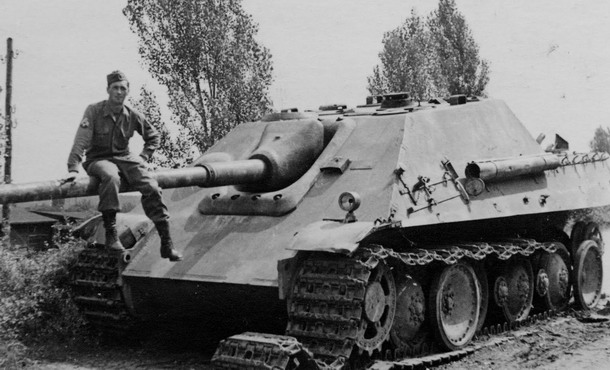
an American soldier poses beside a knocked-out Jagdpanther: Flickr.com, Public domain, modified
In January 1945 it was decided that newly produced Jagdpanthers no longer had to be assigned exclusively to heavy tank destroyer battalions but could also be allocated to Panzer divisions. Varying numbers of Jagdpanthers thus found their way to, among others, the 4th and 8th Panzer Divisions, the 2nd, 9th and 10th SS Panzer Divisions, and several other formations.
Overall Assessment
The Jagdpanther is generally regarded as a successful fighting vehicle. It struck a very sensible balance between mobility, firepower and armour protection. Early production examples suffered from a number of mechanical problems, but over time at least some of these were resolved or mitigated and reliability gradually improved. In combat it was an extremely effective tank killer. A large proportion of Jagdpanthers that were permanently lost were not destroyed by enemy fire but had to be blown up by their own crews to prevent capture. It must be remembered that the Jagdpanther entered Wehrmacht service practically only in mid-1944, at a time when the Germans had long been on the defensive and were almost continuously retreating. Fuel and spare parts were in ever-shorter supply. Recovery and towing vehicles capable of handling such heavy machines were equally scarce. It is therefore no surprise that crews frequently had to abandon and destroy vehicles that had simply run out of fuel, become bogged in soft ground, or suffered only minor mechanical failures.
One alarming example among many: schwere Panzerjäger Abteilung 563, operating on the Eastern Front, destroyed a total of 58 Soviet tanks in just 10 days of fighting in January 1945. Its own combat losses amounted to a single Jagdpanther and four Jagdpanzer IV. Yet in the same period a further 12 Jagdpanthers and 17 Jagdpanzer IV were blown up by their own crews — because they had become stuck, run dry, or broken down. The battalion was effectively decimated without the Russians having to fire a single round.
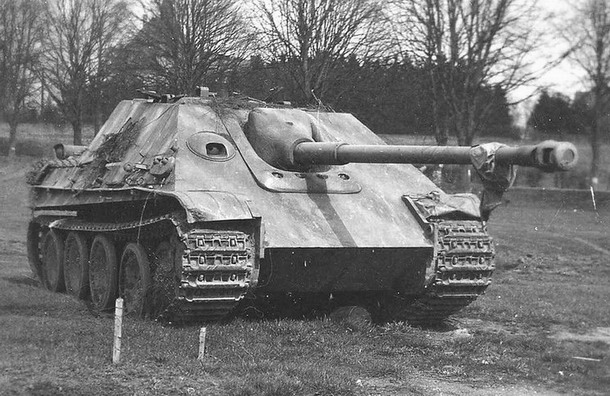
the Jagdpanther is considered by many to be the finest tank destroyer of the entire Second World War: Flickr.com, modified
However effective a fighter it was, the Jagdpanther arrived too late and in too small numbers to do anything to alter the fortunes of the Third Reich — as was the case with most German heavy fighting equipment. Moreover, circumstances meant the Jagdpanther never really had a proper opportunity to demonstrate its qualities to the full. Recall what its combat doctrine called for: deployment ideally at full battalion strength, with engagements opened at the greatest possible range. What was the reality? Only a single battalion was ever fully equipped with Jagdpanthers, and even that was rarely committed as a complete unit. And the Jagdpanther's main battlefield was the Western Front, which offered far fewer opportunities for engagements at over two kilometres than the wide open expanses of Russia that the designers had presumably had in mind when they first began work on the vehicle back in 1942.
Technical Data
|
weight: |
45.6 t |
|
length: |
9.65 m |
|
width: |
3.42 m |
|
height: |
2.72 m |
|
engine: |
Maybach HL 230 P 30 |
|
engine output: |
700 hp |
|
max. speed: |
45 km/h |
|
fuel capacity: |
700 l |
|
fuel consumption – road: |
440 l / 100 km |
|
fuel consumption – cross-country: |
875 l / 100 km |
|
range – road: |
160 km |
|
range – cross-country: |
80 km |
|
hull armour: |
|
|
– front: |
50 mm |
|
– sides: |
40 mm |
|
– rear: |
40 mm |
|
– floor: |
16 – 25 mm |
|
fighting compartment armour: |
|
|
– front: |
80 mm |
|
– sides: |
50 mm |
|
– rear: |
40 mm |
|
– roof: |
16 / 25 mm |
|
crew: |
5 men |
|
armament: |
88 mm Pak 43 L/71 gun 1 × 7.92 mm MG 34 machine gun |
|
ammunition stowage: |
60 rounds for the gun, 2,550 for the machine gun |
ARTICLE
CONTENTS:
Reproducing text from the Panzernet website without the written consent of the operator is prohibited.