HUMMEL-WESPE
a light howitzer on a heavy chassis
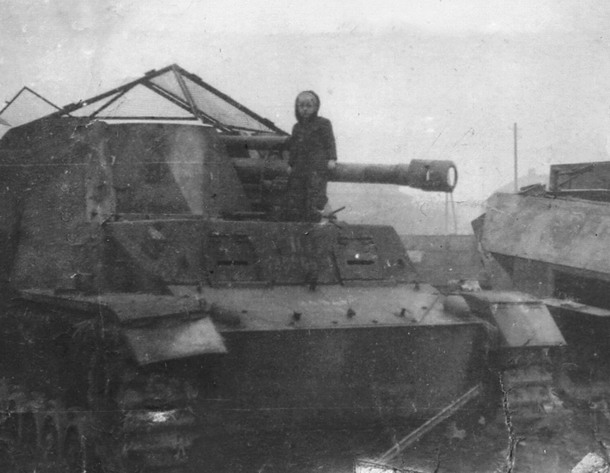
probably the only known photograph of the Hummel-Wespe self-propelled gun; source: Flickr.com, published with the permission of the original contributor, edited
Production of the Wespe comes to an end
In June 1944, production of the light self-propelled howitzer Wespe was definitively discontinued. The Germans took this step despite having no real successor ready to replace it. A successor was supposed to emerge from the Heuschrecke / Grille development programme, which had ended in failure. It is true that Wespe production was economically inefficient, as the vehicle was based on the chassis of the long-obsolete Panzer II tank, which by that point was being manufactured solely for this purpose. But was that a sufficient reason to discontinue production of such a badly needed weapon? Some sources suggest the decision was triggered by the Red Army's capture of Polish factories. This, however, is almost certainly not true — in June 1944, the Russians were still more than half a year away from reaching Breslau.
The need for a light self-propelled howitzer
Whatever the reasons behind discontinuing the Wespe, the army very quickly made it clear that it still needed a light self-propelled howitzer of 105 mm calibre. As early as October 1944, discussions were underway about the possibility of building a „leichte Panzerhaubitze" on the chassis of a „schwere Panzerhaubitze". In plain terms, the idea was to take the Hummel self-propelled gun and replace its heavy 150 mm howitzer with the lighter leFH18/40 of 105 mm. On one hand, this was admittedly something of an underuse of the Hummel's chassis potential. On the other hand, it meant making use of a vehicle already in production — which was ultimately more practical than keeping the obsolete Wespe chassis in production for its own sake.
The vehicle design was completed in December 1944 and series production was ordered immediately. Initial plans called for delivery of 60 vehicles in February 1945; a revised schedule envisaged 40 units in February, 50 in March, and 80 in April 1945. The new self-propelled gun received the straightforward designation Hummel-Wespe. Production was assigned to Deutsche Eisenwerke (D.E.W.), specifically its Werk Stahlindustrie plant in Duisburg. Due to heavy Allied bombing, however, it was eventually decided to relocate production to the Werk Teplitz-Schönau plant in Teplice, in the Czech lands.
A hybrid
The Hummel-Wespe was essentially a late-production Hummel — featuring the wider driver's and commander's cab — that underwent only minor modifications. The front wall of the fighting compartment was altered to match the mantlet of the new gun, and the gun mount itself naturally required adaptation as well. Despite the desperate conditions of the war's final months, production did manage to get underway. In total, however, only 11 vehicles were completed: the first in December 1944, nine more in January 1945, and the last apparently just before the end of the war. The low production numbers were of course a direct consequence of the collapsing industrial and transport infrastructure, which severely disrupted the supply of necessary components.
The only known photograph of the Hummel-Wespe is said to have been taken around the turn of 1945/46, apparently in the village of Košťany near Teplice. The wreck in the image has a frame mounted above the open fighting compartment, presumably intended to support wire mesh as protection against grenades being thrown in.

ARTICLE
CONTENTS:
Reproducing text from the Panzernet website without the written consent of the operator is prohibited.