"BISON"
the self-propelled gun that got the wrong name
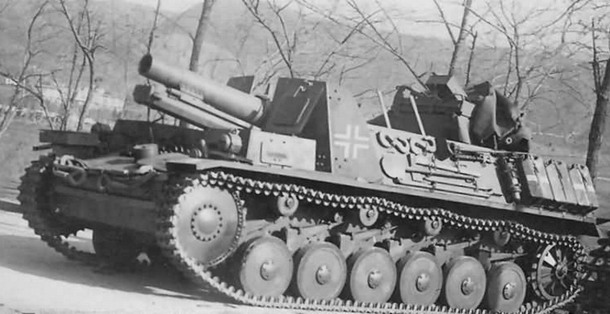
the sIG 33 self-propelled gun on the modified Panzer II chassis — also known as the Sturmpanzer II or Bison II, source: Worldwarphotos.info with permission of the site operator, edited
First, it must be said at the outset that neither "Sturmpanzer II" nor "Bison II" were ever official designations for the self-propelled gun described in the following article. For the sake of simplicity, however, we will occasionally use these names in our text. As for the actual official designations, no fewer than three variants can be found in the sources, all equally unwieldy. Some authors refer to this vehicle as the 15cm sIG 33 auf Fahrgestell PzKpfw II, while it is also found under the name 15cm s.I.G.33 B Selbstfahrlafette, or even s.I.G auf verstärktem Pz.Kpfw II Fahrgestell.
The sIG 33 Gun
Let us begin by saying something about the gun itself, which formed the vehicle's main armament. This was the heavy infantry gun sIG 33 of 150 mm calibre (sIG = schwere Infanterie Geschütz — heavy infantry gun). As the name suggests, it was a weapon intended to provide fire support for infantry. The requirement for such a gun grew out of the experience of the First World War, in which the infantry lacked an artillery piece capable of moving across the battlefield close behind them and delivering rapid, accurate fire support. Infantry guns were therefore to be of low weight, easily and quickly moved even across rough terrain. They needed only modest range, since they were not to stay far behind the front line but to keep close to "their" infantrymen. At the same time, an infantry gun had to be capable of firing at high elevation angles (to destroy trenches) as well as at nearly direct fire angles (to destroy bunkers).
In the late 1920s, Rheinmetall developed two new infantry guns to these requirements for the German Army — at that time still the Reichswehr. The heavier of the two was the schwere Infanterie Geschütz 33 of 150 mm calibre. For an infantry gun, this was a truly unusual weight of weapon. The large calibre gave it enormous destructive power, but a weight of around 1.8 tonnes was really quite a lot for the intended purpose. The German Army adopted the new gun in 1933 in two variants differing only in their wheeled carriage — one designed for horse towing, the other for motorised haulage. The weapon's full official designation was 15cm sIG 33 L/11.4. The barrel was only 170 cm long, or approximately 11.4 calibres — the figure given after the slash in the weapon's designation.

the prototype self-propelled gun from October 1940, still built on the original chassis with five road wheels on each side, source: Flickr.com with permission of the publishing user, edited
A Chassis for the Gun
In September 1939, the Wehrmacht had 410 sIG 33 guns at its disposal. They performed reasonably well in the Polish campaign, but it became clear that for modern fast-moving warfare they were not sufficiently mobile. The maximum range of the sIG 33 was 4.7 km — not a lot. The pace of the German advance in Poland was tremendous, and guns with limited range therefore had to change positions frequently in order to keep pace with the moving front. This meant limbering the gun each time (behind a half-track prime mover or a six-horse team), driving to a new location, unlimbering again, and preparing for action. This method of displacement was not only time-consuming but also complicated deployment in more broken terrain.
This was a pity, because in other respects the sIG 33 was a tough and highly effective weapon. It is therefore no surprise that the Germans began considering how to improve its mobility — in other words, how to make it self-propelled. A wheeled chassis was clearly out of the question, as it would not meet the required cross-country performance. A suitable tracked chassis had to be found. The list of realistic options was not long. The Germans had very few Panzer III and Panzer IV tanks and needed every single one. By contrast, the light tanks Panzer I and Panzer II were already earmarked for gradual replacement and withdrawal from front-line units. The designers first reached for the Panzer I chassis and built the vehicle incorrectly known as the Sturmpanzer I. However, the chassis proved too weak for the purpose, and the designers therefore moved on to the somewhat more robust Panzer II chassis.
The First Prototype
Up to this point the sources are broadly in agreement. Once we reach the question of the first prototype's construction, however, the various accounts begin to diverge quite significantly. The very first experimental mounting of the sIG 33 gun on a Panzer II chassis apparently took place in the first half of 1940. The turret and armoured superstructure were probably removed from the original tank, and the gun was simply placed in the open space — wheels and all. This was therefore not a proper prototype of the future vehicle but merely a quick test to establish whether the gun would fit on the chassis and whether the chassis could bear its weight. This hastily assembled vehicle underwent limited firing trials, but the results were unsatisfactory. With the gun installed complete with its wheels, it had to be positioned closer to the rear of the chassis. When fired, the vehicle tilted noticeably rearward and the rearmost pair of road wheels was subjected to extreme overloading. Destruction of the rear road wheel suspension would evidently have been a matter of only a few dozen rounds from a gun mounted in this position.
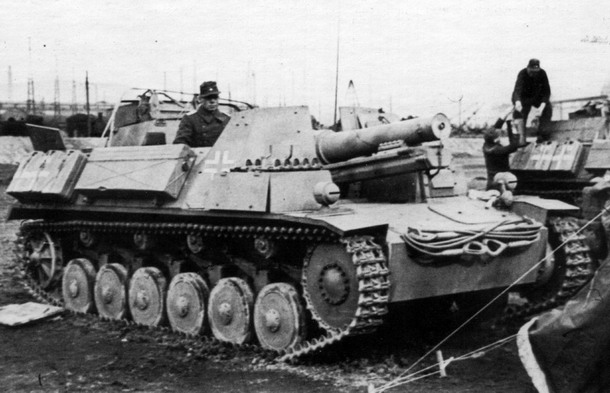
"series" Sturmpanzer II, here apparently already on African soil, source: Flickr.com with permission of the publishing user, edited
In June 1940, a second attempt was made. This time the gun was mounted without its wheels and could therefore be placed further forward. Even this was not a proper prototype but again only a hastily assembled vehicle for basic verification of the overall concept. Firing trials were conducted on 13 June 1940 and the results were this time positive. A total of 120 rounds were fired at all possible elevation angles (from -1.5° to +70°) and traverse angles (apparently 7 degrees in each direction). Firing with the maximum propellant charge (charge No. 6, muzzle velocity 240 m/s, range 4.7 km) was tested, as was "rapid fire" (i.e., 3 rounds per minute). All was without problems.
It therefore appeared that a self-propelled gun combining the Panzer II chassis with the sIG 33 gun was feasible, and Alkett was tasked with building the first full-standard prototype. This was completed in October 1940 and underwent troop trials. In February 1941, the Army summarised its findings in an evaluation report. The troops were far from enthusiastic about the new vehicle — the main deficiencies identified were the weak engine and the very limited space inside the fighting compartment. On the basis of these comments, Alkett was contracted to develop a modified version of the vehicle.
Creating more space in the superstructure was not straightforward. The gun itself could not be reduced in size, which left only one option: enlarging the superstructure — and that in turn meant enlarging the entire chassis. Alkett therefore undertook a fairly demanding redesign of the entire tank base. The resulting modified chassis was 670 mm longer and 320 mm wider than the original. An extra road wheel was also added on each side, bringing the total to six per side. But the modifications did not end with the enlarged chassis. The vehicle also received a new powerplant. The standard tank engine Maybach HL62 TRM developing 140 horsepower was replaced by a Büssing NAG L8V eight-cylinder unit developing 150 horsepower. Not only was this engine slightly more powerful, but — crucially — the designers managed to install it transversely rather than longitudinally. This freed up additional space for the fighting compartment. A driveshaft running along the right side of the superstructure connected the engine to the gearbox housed in the front of the hull. Of the original Panzer II chassis, relatively few components remained.
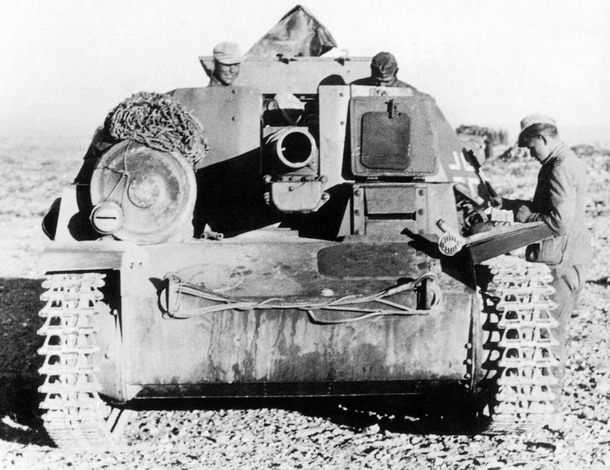
Sturmpanzer II in Africa; the open driver's hatch reveals the padding above the driver's head, source: Flickr.com with permission of the publishing user, edited
The modified vehicle differed from the first prototype in other details too. For example, the side portions of the gun shield, which on the prototype had been rounded and curved rearward, were now angled sharply. The driver also received a new-pattern front vision port, and various other details were changed.
Series Production
The Army ordered the production of 12 self-propelled guns on this modified basis. The first 7 were completed in December 1941 and the remaining 5 in January 1942. The running gear of the new vehicle consisted of six road wheels on each side, taken from the Panzer II. Each wheel was independently suspended and sprung by a quarter-elliptic leaf spring. At the front was the toothed drive sprocket and at the rear the idler wheel; four return rollers supported the upper run of the track. The 300 mm wide tracks were also taken from the Panzer II. The hull's front armour was 30 mm thick. At the front left was the driver's station, protected by its own separate armoured cab, whose front wall carried a heavy armoured vision port. A second, smaller vision port with a hinged cover was provided in the left side wall of the cab. Directly above the driver's head was his entry and exit hatch, closed by a single-piece flap. A similar separate armoured box was located on the right side of the hull, serving as a storage compartment accessible from the right.
Most of the front wall of the fighting compartment was formed by a large shield attached directly to the gun, which therefore traversed with the barrel during horizontal aiming while remaining stationary during vertical elevation adjustments. Although relatively low, the gun shield was the highest point of the entire compartment's armour. Its thickness was only 14.5 mm. The fixed side walls of the compartment joined the gun shield on each side. These walls were extremely low and served less as crew protection than as a convenient place to hang all manner of equipment. On the left side hung three jerrycans, a fire extinguisher, a spade, pliers, and other tools. On the right were three more jerrycans and a large storage box. The fighting compartment had no roof, though three metal supports could be erected over it and a waterproof tarpaulin stretched across them. Behind the fighting compartment was the engine compartment, on whose deck a large wooden ammunition box was mounted — and frequently other items besides.
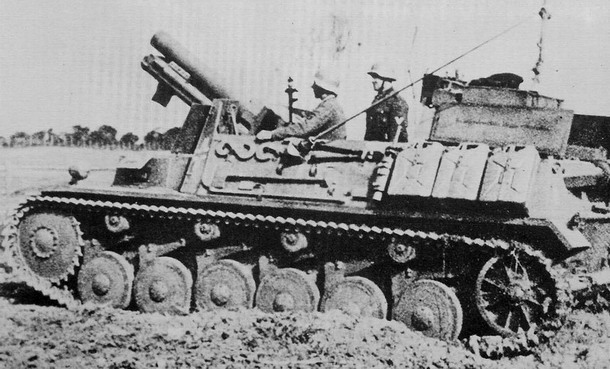
Sturmpanzer II, source: Flickr.com with permission of the publishing user, edited
The vehicle's armament was, as we know, the 150 mm heavy infantry gun sIG 33. The weapon could be elevated from -3° to +73°. Lateral traverse was 7 degrees in each direction (sometimes quoted as 10). The gun used separate-loading ammunition — the shell and the propellant cartridge were loaded independently. Six different propellant charges could be used: with the smallest, charge No. 1, the shell left the barrel at 122 m/s and reached a maximum range of 1,475 metres. Charge No. 2 gave a projectile velocity of 152 m/s and a range of 2,125 metres. Charge No. 3 propelled the shell at 186 m/s to a distance of up to 3,000 metres; charge No. 4 gave 210 m/s and 3,750 metres; charge No. 5 imparted 220 m/s and 4,375 metres; and with the maximum charge No. 6, the gun could fire a shell at 240 m/s to a range of 4,700 metres. The onboard ammunition supply was probably only 10 rounds of 150 mm ammunition (though 30 is sometimes quoted), with additional ammunition supplied by accompanying vehicles. Crews most likely also carried an MG 34 machine gun for close-range protection against enemy infantry.
Loaded with its crew and 10 rounds of ammunition, the Sturmpanzer II weighed around 12 tonnes. Its powerplant was the already-mentioned Büssing NAG L8V petrol engine with a maximum output of 150 horsepower. The gearbox was a Zahnradfabrik Aphon SSG 46 with six forward speeds and one reverse. The fuel supply amounted to 200 litres stored in two tanks. So equipped, the vehicle could reach a maximum road speed of 40 km/h (sometimes quoted as 45 km/h) and travel up to 100 km. The crew probably consisted of 4 men (though 5 is sometimes cited) — the driver plus two loaders and the commander, who also served as gunner. According to most sources the Sturmpanzer II was not fitted with a radio set, but photographs clearly showing a rod antenna on at least some vehicles suggest that at least a proportion were indeed so equipped.
Organisation and Deployment
In September 1941, two independent companies were formed to receive the new self-propelled guns: s.I.G.Kp (mot. S) 707 and s.I.G.Kp. (mot. S) 708 (schwere Infanterie Geschütz Kompanie, motorisiert — motorised heavy infantry gun company). Each company consisted of three platoons of two self-propelled guns. Each company thus had six vehicles in total, plus a range of supporting transport (motorcycles, lorries, and staff cars). The twelve vehicles produced were divided equally between the two companies, which were then dispatched to Libya to join Rommel's Panzer-Armee Afrika. The 708th company arrived at the port of Tripoli in instalments during February 1942. The vehicles of the 707th company arrived similarly in stages during April 1942 — some to Tripoli and some to Benghazi. Both companies were subsequently assigned to the 90th Light African Division (90. leichte Afrika-Division), specifically to the division's 155th and 200th regiments. The units immediately began moving eastward to take part in the planned assault on Gazala and the port of Tobruk.
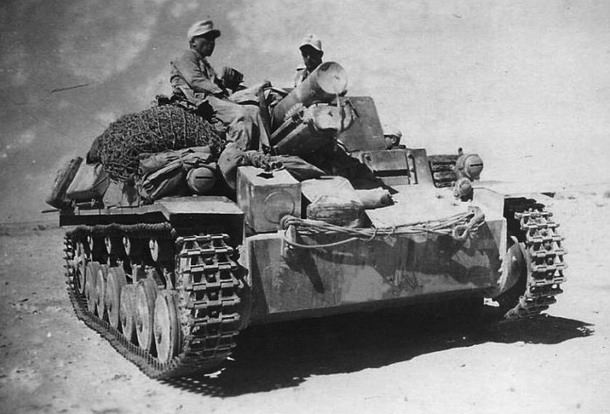
Sturmpanzer II, source: Flickr.com with permission of the publishing user, edited
On 16 May 1942, Major Littmann reported to the commander of the 90th Light African Division that the new sIG 33 self-propelled guns on the reinforced Panzer II chassis had so far proved essentially unusable. During the first road marches under their own power, it became clear that the vehicles were unable to cope with the African heat. Sometimes just 15 minutes of driving was enough to cause the engine to overheat. In Major Littmann's view, the overheating had several causes. The 150 horsepower engine was, in his opinion, too weak to propel a 12-tonne vehicle across terrain. The radiator was too small for African conditions, and in the dusty environment typical of that theatre, it became clogged during travel. On 20 May 1942, the Panzer-Armee Afrika command therefore sent a request to Berlin for a specialist from Alkett to be sent out to assess options for improving the cooling.
On 30 August 1942 — after the conclusion of the battle for Tobruk — a further report was drawn up summarising combat experience with the new vehicles. The crews spoke highly of the weapon's great destructive power but complained about its limited range. The heaviest criticism was again directed at the chassis, which they considered entirely unsuitable not only for African conditions but also generally too weak for such a heavy weapon. Due to limited mobility and range, the Sturmpanzer II played only a minimal part in the German assault on Tobruk. According to a report dated 23 October 1942, the Panzer-Armee Afrika still had 8 of the 15cm s.I.G.33 B Selbstfahrlafette self-propelled guns on hand. In the report of 2 December of the same year, not a single one is listed.
The Sturmpanzer II was decidedly not a successful fighting vehicle. It suffered from the same deficiencies as its older relative the Sturmpanzer I — the chassis and engine were simply too weak to carry such a heavy weapon. Moreover, the need for extensive modification of the entire tank chassis made production disproportionately expensive, as did subsequent maintenance (since standard Panzer II spare parts could not be used). It is therefore no surprise that only 12 examples were ever built.
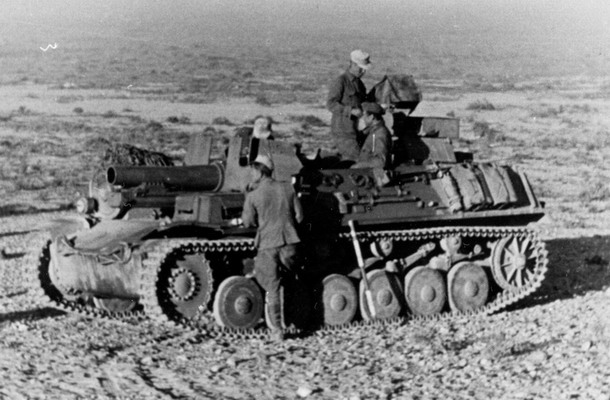
Sturmpanzer II, source: Worldwarphotos.info with permission of the site operator, edited
Let us close with a brief return to the two incorrect but widely used names for this vehicle. Neither Sturmpanzer II nor Bison (or Bison II) were ever official designations — and it appears the Germans never used them even as informal nicknames during the war. The Sturmpanzer designation is inappropriate because it was used for types of self-propelled gun with a fully enclosed fighting compartment (such as the Brummbär). The name Sturmpanzer II was apparently invented by post-war historians looking for a reasonably short and memorable label for these vehicles. As for the battle name Bison (or Bison II), two accounts of its origin circulate. According to one, the name was given by British soldiers when they first encountered the vehicle on the battlefield and needed something to call this unfamiliar enemy machine. According to another version, the name was invented after the war by a model kit manufacturer, since the vehicle's long and tongue-twisting official designation was not sufficiently appealing — and the new name caught on among enthusiasts.
Technical Specifications
|
weight: |
12 t |
|
length: |
5.48 m |
|
width: |
2.60 m |
|
height: |
1.98 m |
|
engine: |
Büssing NAG L8V |
|
engine output: |
150 hp |
|
gearbox: |
Zahnradfabrik Aphon SSG 46 |
|
max. speed: |
40 km/h |
|
fuel capacity: |
200 l |
|
hull front armour: |
30 mm |
|
superstructure front armour: |
14.5 mm |
|
crew: |
4 men |
|
armament: |
1 x 150 mm sIG 33 gun 1 x 7.92 mm MG 34 machine gun |
ARTICLE
CONTENTS:
Reproducing text from the Panzernet website without the written consent of the operator is prohibited.