10,5 cm leFH auf H-39
self-propelled guns on a French tank chassis
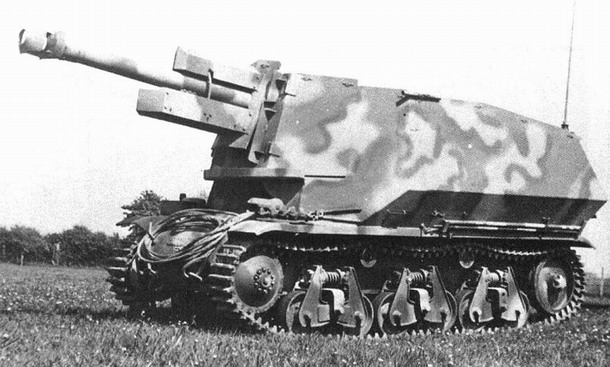
The leFH 18 self-propelled gun on the chassis of the captured French Hotchkiss tank, source: Flickr.com, with permission of the publishing user, edited
Origins of the Vehicle
Among the war booty taken following the defeat of France in 1940 were approximately 550 Hotchkiss tanks of the H-35, H-38 and H-39 types. The vast majority were used by the Germans in their original form with only minor modifications (new radios, commander's cupolas and the like). The combat value of these tanks, armed with a gun of only 37 mm calibre, declined rapidly however, and the Germans began considering whether they might be converted into a fighting vehicle of a different kind that would be of greater use to the Wehrmacht. Studies confirmed that the chassis of this tank was capable of carrying a far more powerful armament — not in a rotating turret, but in a fixed lightly armoured fighting compartment, which was in any case the standard design solution for early German tank destroyers and self-propelled guns.
What concerns us in the following paragraphs is the conversion of this tank into a carrier for a 105 mm light howitzer. This self-propelled weapon was one of the creations of the so-called Baukommando Becker, a specialist unit whose task was to make the fullest possible use of captured French equipment for the benefit of the German army. The unit was headed by a man named Alfred Becker — a qualified engineer, an artillery officer, and at one time battery commander in the 227th Artillery Regiment of the 227th Infantry Division. Becker's unit spent the second half of 1940 on garrison duty along the coast of occupied France. Military equipment left behind by the evacuated British forces was literally lying around everywhere, and the resourceful Becker hit upon the idea of using it as the basis for improvised self-propelled guns that would make life easier for himself and his men.
By combining captured British Vickers Mk. VI tanks with old German leFH 16 howitzers, 12 self-propelled guns were built, which Becker's battery took with them to northern Russia in September 1941 and used successfully in combat. Representatives of the Ordnance Office and the Wehrmacht High Command took note of this success, and so it was that early in 1942 Becker was withdrawn from the Eastern Front to Berlin and assigned to the Alkett company, to investigate together with its engineers the possibility of mounting various artillery weapons on the chassis of the French Lorraine 37L cargo tractor. Since that effort bore the desired fruit, Becker was soon tasked with continuing the production of further self-propelled weapons under the banner of Baukommando Becker, directly in France at the Matford, Talbot and Hotchkiss factories.
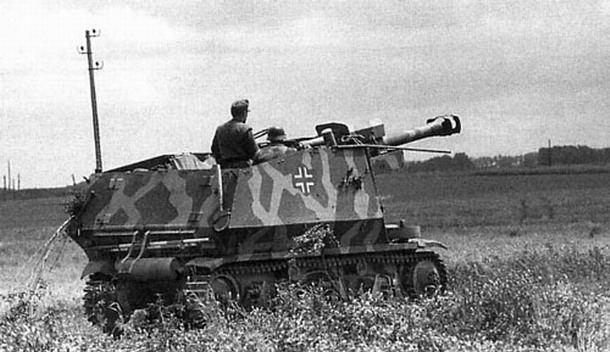
The 10.5 cm leFH 18 on the Hotchkiss tank chassis — the large unbroken expanse of the fighting compartment's armour made a conspicuous target, so it was worth breaking it up with a suitable camouflage pattern, source: Flickr.com, with permission of the publishing user, edited
The Baukommando converted all manner of fully tracked, half-tracked and wheeled vehicles, obtained quite literally wherever they could be found (including pulling wrecks out of ditches and ponds). Exactly where the Hotchkiss H-35, H-38 and H-39 chassis came from is not clear from the sources, but since the Wehrmacht had been using these tanks for quite some time (355 were still on strength with various units as late as 31 May 1943), they may well have been chassis from broken-down tanks that were no longer worth repairing in their original form — for example those with damaged turrets or guns.
Design
The running gear of the original French tank consisted on each side of six road wheels 400 mm in diameter, suspended in pairs and sprung by horizontally-mounted coil springs. At the front was the drive sprocket, at the rear the idler wheel, and the upper run of the track was supported by three small return rollers. The hull's frontal armour was 34 mm thick. The rotating turret and virtually the entire crew compartment were removed from the original tank, leaving only the central section of the front plate with the driver's entry hatch and vision port. The new fighting space created in place of the original crew compartment and turret was enclosed by a tall shield welded from flat armour plates. No source gives their thickness. In theory the designers were not forced to be overly conservative here, since removing almost the entire tank superstructure and turret — which had 40 mm armour — must have saved a very considerable amount of weight. It is therefore possible that the armour around the new fighting compartment was at least 14.5 mm thick, which was generally considered the minimum capable of stopping armour-piercing rifle and machine gun rounds of 7.92 mm calibre.
Two Howitzers
The front wall of the fighting compartment had an opening through which the howitzer barrel passed. On the outside this opening was covered by a wide gun shield that traversed laterally together with the barrel. We have said the vehicle was armed with a 105 mm howitzer — but we have not said which type, because there were in fact two. The majority of vehicles (judging at least by the relative frequency of photographs) received the leFH 18 howitzer (leFH = leichte Feldhaubitze), while some carried the considerably older leFH 16. Distinguishing between them is straightforward: the older leFH 16 had a single-piece recoil mechanism with its cylinder located below the barrel only, whereas the newer and more capable leFH 18 had recoil cylinders both below and above the barrel (comparative photo HERE). Both weapons used the same shells, the most common high-explosive fragmentation round weighing 14.81 kg. The older leFH could send this shell to a maximum range of 9,225 metres; the leFH 18's maximum range was nearly 1.5 kilometres greater. It is nonetheless probable that when the gun was installed on the relatively light Hotchkiss chassis, the use of the heaviest propellant charge was prohibited, meaning the self-propelled gun's effective range was in practice somewhat less than the figures quoted above.
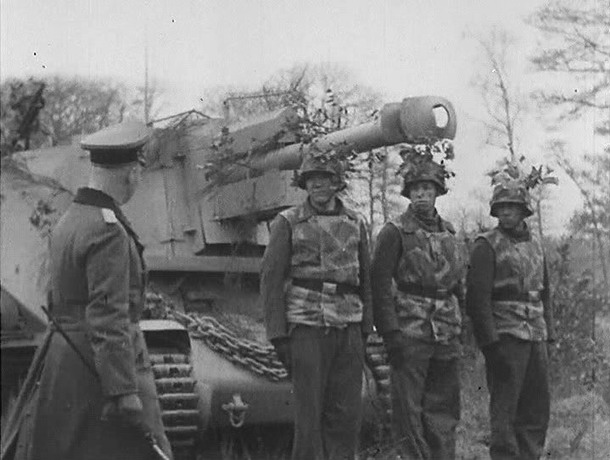
Field Marshal Rommel inspecting this 10.5 cm leFH 18 on the Hotchkiss tank chassis during a visit to the 21st Panzer Division, source: Flickr.com, with permission of the publishing user, edited
The sources unfortunately give no information at all on the gun's traverse or elevation range, in either the horizontal or vertical plane. A total of 36 rounds of artillery ammunition were stowed inside the fighting compartment: shells in racks in the right rear section of the fighting space, and propellant cartridges in the left rear section. Secondary armament consisted of one MP 40 submachine gun and one MG 34 machine gun, which could be mounted on a bracket in the right front corner of the fighting compartment and fired over the top of the armour.
The crew of the self-propelled gun consisted, according to some historians, of four men, and according to others of five. It is possible, however, that there were indeed only 4 men aboard, with the driver fulfilling two different roles: when preparing to fire he would move from his station at the front of the hull into the fighting compartment to assist with loading the howitzer. The roles of the remaining crew were straightforward: the gunner sat to the left of the gun, the vehicle commander behind him, and the loader to the right of the weapon. Directly beside the gunner's seat, a Fu.Spr.Ger. radio set was mounted on the side wall of the compartment, connected to a whip antenna in the left rear corner of the fighting space; it was operated by either the gunner or the commander. Large doors in the rear armour plate served as the crew's entry and exit point. The roof of the fighting compartment was left open and could be covered with a waterproof tarpaulin in bad weather.
The self-propelled gun received the official designation 10.5 cm leFH 16 (or 18) auf Pz.38H. Its weight was probably around 13 tonnes — barely a tonne more than the original Hotchkiss H-38 tank. The engine was of course inherited along with the chassis from the French tank: a liquid-cooled six-cylinder Hotchkiss unit with a displacement of 5.97 litres producing 120 horsepower. The front-mounted gearbox offered five forward gears and one reverse. Maximum speed appears to have remained the same as the original tank's, at approximately 36 km/h. With 207 litres of petrol in the tanks the self-propelled gun had a road range of around 180 km and approximately 95 km cross-country.
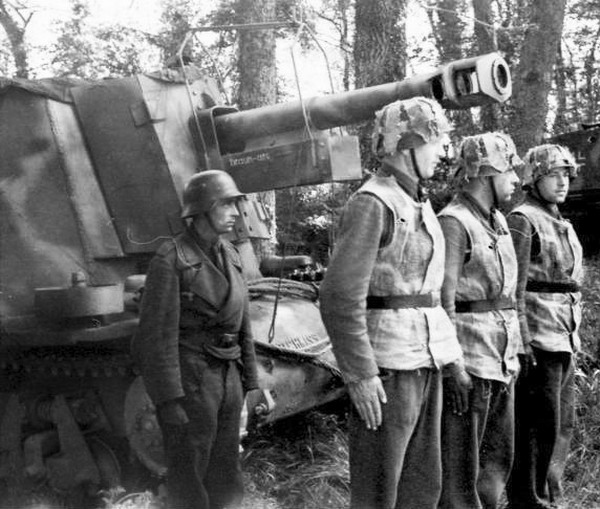
This vehicle carries the older leFH 16 howitzer version — note that the recoil mechanism is located below the barrel only. This photograph was also taken during Rommel's inspection of the 21st Panzer Division, source: Bundesarchiv Bild 101I-300-1865-06, Wikimedia, Creative Commons, edited
The first batch of twelve of these fighting vehicles was completed in September 1943 and a second batch of the same size followed in February 1944. A further 24 vehicles were probably built at a later date, bringing the total production to 48 examples.
Organisation and Deployment
The vehicles produced were incorporated (at least in their majority) into the Sturmgeschütz Abteilung 200, the command of which was entrusted directly to Captain Becker. In June 1944 the battalion had five batteries in total, each consisting of four 75 mm tank destroyers and six 105 mm self-propelled howitzers — the latter almost certainly all on Hotchkiss chassis.
On 6 June 1944, as we know, the Allied landings in Normandy took place. Due to initial confusion, Becker's battalion did not enter the fighting until 9 June, when it provided fire support to the 125th Panzergrenadier Regiment of its parent 21st Panzer Division. The battalion's finest hour, however, came more than a month later and some 200 kilometres to the northeast, during the Allied Operation Goodwood. At that time Becker's unit formed part of the so-called Kampfgruppe Luck, alongside the 125th Panzergrenadier Regiment, a battalion of Panzer IV tanks and several Tigers from the 503rd Heavy Battalion. The five batteries of Becker's battalion were deployed across an area of roughly 3×3 kilometres in the villages and hamlets east of Caen, positioned to control from both sides the road running northeast out of the city. On the morning of 18 July 1944, Allied bombers began saturating the entire area with bombs. Their raids lasted the best part of two hours. Barely had the last bombs finished falling when artillery shells from warships offshore began landing in the area, continuing for a further approximately 30 minutes.
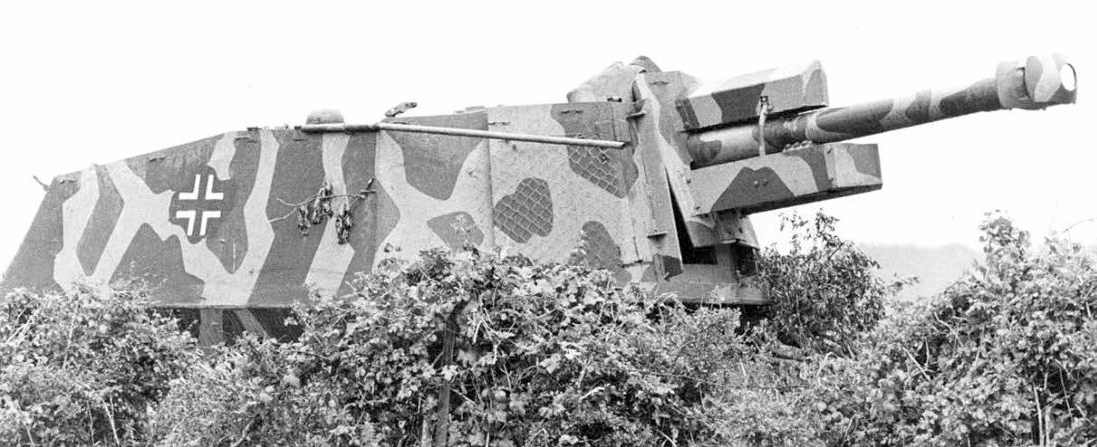
A 10.5 cm leFH 18 on the Hotchkiss tank chassis "hidden" in tall vegetation, source: Flickr.com, with permission of the publishing user, edited
When Becker managed to re-establish radio contact with his battery commanders, he received the following reports. All ten self-propelled guns of the 1st Battery, deployed in the village of Démouville, had been destroyed. The 2nd Battery had suffered some losses but remained essentially fully combat-capable. The remaining three batteries had not been hit by the Allied bombardment at all. After this thorough preparatory barrage, tanks of the British 11th Armoured Division advanced from the north toward the village of Hubert-Folie. As soon as they came within range, the British found themselves under fire from the 3rd, 4th and 5th batteries of Becker's Sturmgeschütz Abteilung 200. Becker's men, firing from well-concealed positions, succeeded in destroying several British tanks and halting their advance. The 2nd, 4th and 5th batteries then repositioned to engage further approaching British units, and again achieved success. Together with 88 mm Luftwaffe guns deployed in the village of Cagny, the 200th battalion thus managed to hold up the British advance for the rest of the morning until German reinforcements arrived. By afternoon the British assault had definitively run out of steam. The British ultimately lost more than 200 tanks during Operation Goodwood. The remnants of Sturmgeschütz Abteilung 200 were encircled and destroyed in the Falaise Pocket in August 1944.
Technical Data
|
weight: |
13 t |
|
length: |
? m |
|
width: |
1.85 m |
|
height: |
2.02 m |
|
engine: |
Hotchkiss 6l |
|
engine power: |
120 hp |
|
max. speed: |
35 km/h |
|
fuel capacity: |
207 l |
|
road range: |
180 km |
|
cross-country range: |
95 km |
|
crew: |
4 men |
|
armament: |
10.5 cm leFH 16 or 18 |
ARTICLE
CONTENTS:
Reproducing text from the Panzernet website without the written consent of the operator is prohibited.