TANK CREW DECORATIONS
awards designed for (but not only) German tank crews
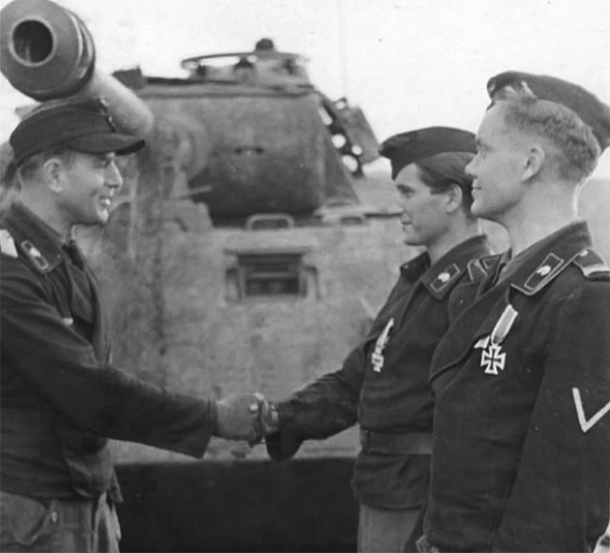
Two (evidently very young) Panther tank crew members receiving Iron Crosses 2nd Class, source: Flickr.com with permission of the publishing user, edited
The First World War
The first German tank crew decoration was introduced in July 1921 by the Defence Minister of the Weimar Republic, Dr. Otto Gessler, under the official name Erinnerungsabzeichen für die ehemaligen Besatzungen deutscher Kampfwagen – the commemorative badge for former crews of German fighting vehicles. It was commonly known in abbreviated form as the Kampfwagen-Erinnerungsabzeichen. As the official justification stated, the purpose of this decoration was to preserve the memory of the achievements of Germany's former tank units, which by that point effectively no longer existed. The decoration was intended for former crew members of the German A7V tanks and of other captured types that the German Army had also used. The conditions for award were participation in at least three tank attacks, or being wounded during a tank attack.
The Army's approach to distributing these decorations was, however, rather passive. Former tank men who met the stated conditions were expected to present themselves at the Inspectorate of Motorised Units, which would then issue an official certificate – but the recipient had to purchase the actual badge at his own expense. It is no surprise that only 99 were officially awarded. One of the recipients was the later LSSAH divisional commander Sepp Dietrich. A Berlin firm, C. E. Junker, was initially approved as the sole authorised manufacturer, but the badge was apparently eventually purchasable from other makers as well, leading to minor variations in detail. The decoration depicted a German A7V tank within a wreath of foliage – oak branches on the left and laurel on the right. Above the tank were three exploding shrapnel shells, and at the very top was a skull and crossbones – the emblem of the Prussian hussars, which German tank crews had also used during the First World War. The decoration can be viewed HERE.
The Condor Legion
The next German tank crew decoration also appeared before the Second World War, awarded to members of the Condor Legion who served in Spain during the Civil War from 1936 to 1939. German tank men in the Condor Legion were officially not supposed to engage in direct combat but only to train and instruct Spanish – more precisely, Nationalist – tank crews fighting for General Franco. The decoration, named Panzertruppenabzeichen der Legion Condor, was created in September 1936 at the direct initiative of the Legion's commander, Colonel Wilhelm Ritter von Thoma, and was only officially recognised retroactively by the German Army in July 1939. The condition for receiving it was service on the Spanish battlefield for at least three months.
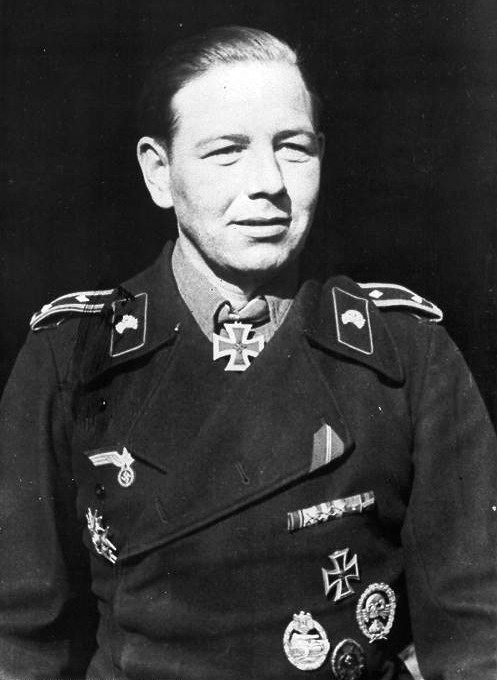
Tank crew member Heinrich Becker and his collection of decorations, including the Condor Legion tank badge, the Panzerkampfabzeichen, wound badge, Spanish Cross, Iron Cross 2nd and 1st Class, Knight's Cross, and others, source: Flickr.com with permission of the publishing user, edited
The decoration consisted of an oak wreath with a large skull-and-crossbones motif and a tank in the lower portion. The tank depicted was presumably intended to be the German Panzer I, though it resembled it only very remotely (it can be viewed HERE). The standard decoration was finished in silver or bronze – most likely not two distinct grades but simply two different finishes of the same award. A total of 415 of these badges were awarded between 1936 and 1939. One example was produced in gold and was received – naturally – by the Legion's commander Wilhelm Ritter von Thoma himself, presented during the victory parade in Madrid after the end of the Civil War. Neither of the two decorations described so far was considered a National Socialist decoration (neither bore the swastika or even the German eagle), which is why their wearing was not prohibited after the Second World War – or was later re-permitted in their original form.
Panzerkampfabzeichen
By far the most well-known German tank crew decoration, however, was the badge known as the Panzerkampfabzeichen – the Panzer Assault Badge. It was introduced after the outbreak of the Second World War, on 20 December 1939, at the proposal of the Commander-in-Chief of the Army, Walter von Brauchitsch. The badge's design was created by the graphic artist Wilhelm Ernst Peekhaus. It consisted of the customary oak wreath through which drove a tank broadly resembling the Panzer IV, crowned in the upper section by the Reich eagle holding a swastika. One detail worth noting is the direction of travel: on the decorations for First World War tank crews and for the Condor Legion, the tank travelled geographically from east to west (roughly from Germany towards France), whereas on the new badge the tank drives from west to east. This was most likely coincidental, but it is an interesting observation. The badge can be viewed HERE.
The Panzer Assault Badge measured approximately 62 mm in height and 42 mm in width. A vertically mounted pin on the reverse served for attachment to the uniform. It was most commonly manufactured from zinc with a silver-plated finish; later, to reduce production costs, it was apparently pressed from brass, again silver-plated. This silver badge was awarded to tank crew members who had participated in at least three combat engagements on three different days from 1 January 1940 onwards, provided the crew had actively participated in the fighting. According to some sources, the badge could also be awarded for wounds sustained during a tank battle, or for sustained conscientious frontline service over an extended period. Keeping combat records for individual crews was the responsibility of the relevant tank company commander. Approximately 22,000 silver Panzer Assault Badges were awarded during the war.
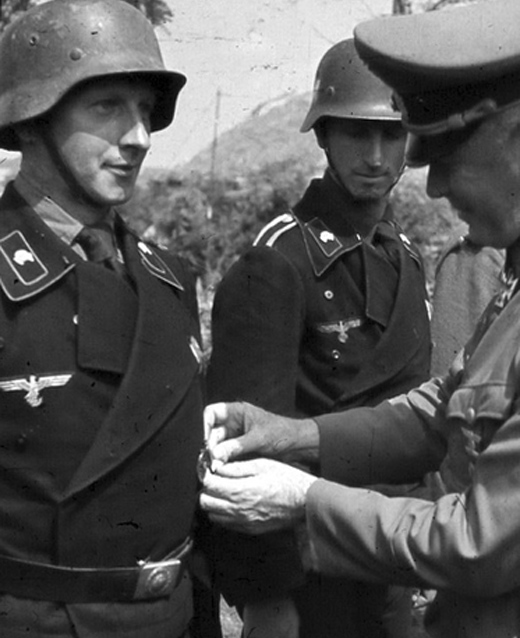
A German tank crew member receiving a wound badge from his superior, source: Flickr.com with permission of the publishing user, edited
On 1 June 1940, at Hitler's own instigation, a bronze variant of the Panzer Assault Badge was introduced, intended for members of Panzergrenadier units equipped with armoured vehicles, as well as for reconnaissance, signals, and medical units of tank divisions and other armoured formations. For Panzergrenadiers, the condition for receiving the bronze badge was participation in three assaults in the front line with weapons in hand, on three different days. Apart from the colour, the bronze badge was identical to the silver one, and approximately 12,600 were awarded by the war's end.
Panzerkampfabzeichen 25, 50, 75, and 100
As the lightning campaign against the Soviet Union turned into a protracted war, the number of engagements completed by many crews climbed far above the threshold for the Panzer Assault Badge. Suddenly there were tank men with dozens of actions behind them, yet wearing the same badge as newcomers with only three engagements. The need arose for a better means of distinguishing between different levels of achievement. Symbolically on the second anniversary of the invasion of the USSR, 22 June 1943, Hitler officially established four additional grades of the Panzer Assault Badge, numbered 25, 50, 75, and 100.
The Panzerkampfabzeichen 25 and 50 were essentially identical to each other, differing only in the numeral in the lower section. The basic motif was the same as on the older badge of December 1939, but the detailed execution was different: the tank itself, the oak wreath around the edge, and even the Reich eagle with swastika all looked different. The depicted tank now drove not over grass but over what appeared to be terrain reinforced with log corduroy (photo HERE). The new badges were approximately 6 mm wider than the old ones. Unlike the original badges, the new ones were not cast (or pressed) as a single piece. Sources state that each badge consisted of three components (wreath with eagle, tank, and number plate showing 25 or 50) joined together by three rivets, though from photographs it appears there were in fact only two parts (the tank, and the wreath with eagle and numeral).
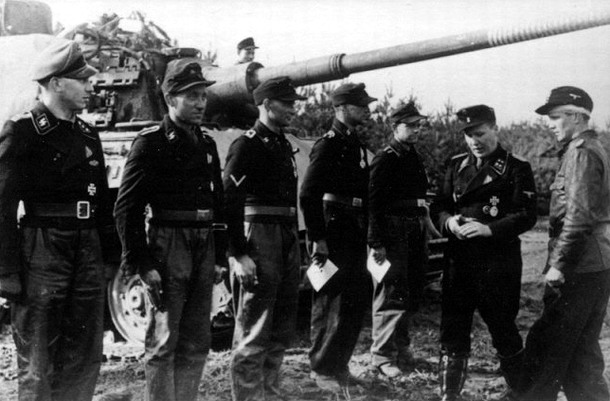
A crew of a Tiger II from the 103rd SS Heavy Tank Battalion receiving decorations (some soldiers hold award certificates in their hands), source: Flickr.com with permission of the publishing user, edited
The condition for the Panzerkampfabzeichen 25 was participation in 25 direct combat engagements on different days (though some less stringent criteria are also cited). For the Panzerkampfabzeichen 50, the tank crew member had to have completed 50 combat engagements on different days, or 15 months of continuous frontline service.
The Panzerkampfabzeichen 75 and 100 had a somewhat different design. The depicted tank now drove not over logs but over some unspecified terrain. The oak wreath was also different, with two additional oak leaves flanking the numbered plate. Both these badges were shorter and wider than the variants described above (approximately 60 mm tall and 51 mm wide). They were evidently genuinely assembled from three parts: wreath with eagle, tank, and numbered plate. Both the wreath and the plate were gilded. The condition for the badge numbered 75 was – somewhat surprisingly – participation in at least 60 combat engagements on different days, though it could reportedly also be awarded for serious wounds sustained in combat. A tank crew member who had participated in 76 or more armoured combat engagements was entitled to the badge numbered 100.
Upon receiving a Panzer Assault Badge, the recipient also received an award certificate and a 16 mm miniature (either pin-backed or as a pendant on a ring) which he was entitled to wear when not in uniform, pinned to formal civilian dress. A successful tank crew member thus typically received progressively higher grades of the badge over his combat career, though he was logically to wear only the highest grade on his uniform at any one time. Immediately after the war, wearing the Panzer Assault Badges was prohibited as part of Germany's denazification. In 1957, however, their wearing was again permitted in West Germany, but in a modified version without the eagle and swastika (photo HERE).
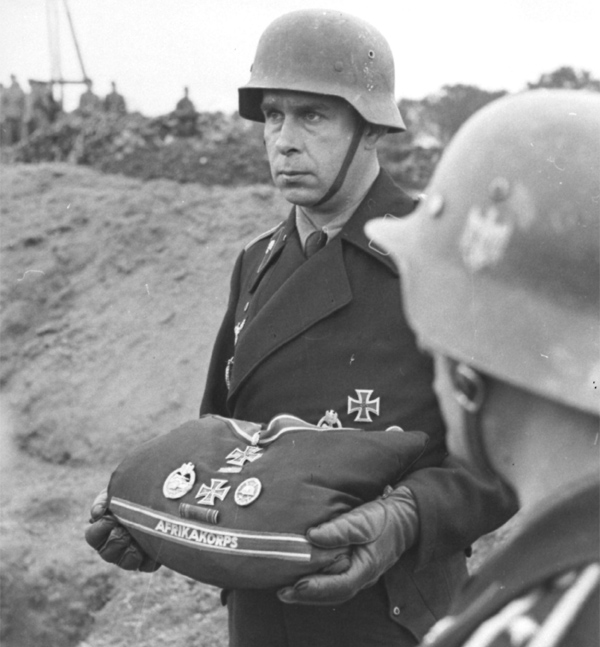
Panzer Assault Badge, wound badge, Iron Cross 1st Class, Knight's Cross... such was the collection of decorations left behind by the tank crew member whose funeral is pictured here, source: Bundesarchiv_Bild_101I-311-0927-26, Wikimedia, Creative Commons, edited
Destroying a Tank Single-Handedly
From the very start of the attack on the Soviet Union, German units faced the enormous numerical superiority of Russian tanks. Countering them could not rely on German tanks and anti-tank artillery alone; infantry also had to be trained and equipped to destroy tanks using grenades, Panzerfausts, magnetic charges, and similar means. To give some sense of scale: when a manual for infantry anti-tank techniques entitled Panzerknacker was issued in May 1944, it stated that German soldiers had by that point destroyed 10,000 Soviet tanks using hand-held weapons of various kinds alone. To recognise and encourage such bravery, Hitler approved the introduction of a special badge for single-handed tank destruction as early as March 1942 – known in German as the Sonderabzeichen für das Niederkämpfen von Panzerkampfwagen durch Einzelkämpfer, or Panzervernichtungsabzeichen for short.
The badge consisted of a cloth backing strip approximately 90 × 32 mm, onto which a metal motif of a Panzer IV tank in side profile was pinned. The backing cloth was silver with black stripes along the upper and lower edges, and the metal tank was finished in a dark colour. The badge was awarded to soldiers who had destroyed an enemy tank or other armoured vehicle in close combat without the support of other military units. Although it was only introduced in March 1942, it was awarded retroactively from 22 June 1941 (i.e. for tank destructions carried out at any point from that date). In December 1943, Hitler established a gold grade of the badge. The gold was originally intended only for the backing cloth, though examples are documented in which the tank motif was also rendered in gold. A soldier who had destroyed five enemy tanks or other armoured vehicles was entitled to the gold badge – in other words, once a man had earned four silver badges, instead of a fifth silver he received a single gold one and removed the four silver ones from his sleeve, wearing only the gold.
The badge for single-handed tank destruction was awarded by the battalion commander on the recommendation of the recipient's immediate superior, typically his company commander. According to some sources, no official award certificate existed for this badge, and the recipient was to receive only a copy of the battalion commander's order. In practice, however, direct commanders apparently often had an unofficial certificate produced to lend the presentation appropriate solemnity. A total of approximately 18,500 badges in silver were awarded by the end of the war (many to the same man more than once) and just 421 in gold. Particularly prolific tank destroyers could wear several badges stacked one above another on their sleeve. The record holder was Captain Günther Viezenz, who personally destroyed 21 enemy armoured vehicles using various infantry weapons, grenades, and charges.

The soldier in this photograph is not a tank crew member, but that arguably makes the courage he must have shown all the greater – he is receiving the Panzervernichtungsabzeichen, the badge for single-handed tank destruction, source: Bundesarchiv_Bild_101I-712-0472-02, Wikimedia, Creative Commons, edited
Other Decorations
In addition to those described above, a German tank crew member could – at least in theory – receive any number of other decorations, both general ones and those intended for other branches of service. For the general decorations this is no great surprise: wound badges in all their variants, the German Cross in Gold, the Iron Cross 1st and 2nd Class, and the Knight's Cross were all commonly seen on black tank uniforms. Somewhat more interesting was when a tank crew member also wore the Infantry Assault Badge or the Close Combat Clasp. But this happened too. Either the man had previously served in the infantry, where he earned these awards, and had subsequently become a tank crew member, or it was a case of a tank crew member being temporarily attached to an infantry unit after losing his vehicle while waiting for a replacement, and earning one of the mentioned decorations in that interim. Similarly, if such a soldier was temporarily attached to, say, an artillery or anti-tank unit, he might well have come away from that posting with the General Assault Badge. On the uniforms of older armoured troops, pre-war sports badges or medals connected with their First World War service were also frequently seen – typically the clasps to the 1914 Iron Crosses.
Marksmanship Lanyards
In photographs of German soldiers (including tank crew members), one occasionally notices decorative cords slung between the right shoulder strap and the tunic buttons. It is necessary to distinguish whether these are dress uniform service or parade lanyards with a purely decorative purpose, or marksmanship lanyards (Schützenschnur), awarded as a mark of the wearer's exceptional shooting skills.
In the Wehrmacht, marksmanship lanyards were introduced by a decree of the Führer and Reich Chancellor Adolf Hitler dated 29 June 1936. They were awarded for outstanding results in firing various types of weapons, including the tank gun. They existed in a variant for the army (essentially for infantry), and separately for the Luftwaffe, the Navy, and the armoured forces (in 1944 special lanyards for snipers were also introduced).
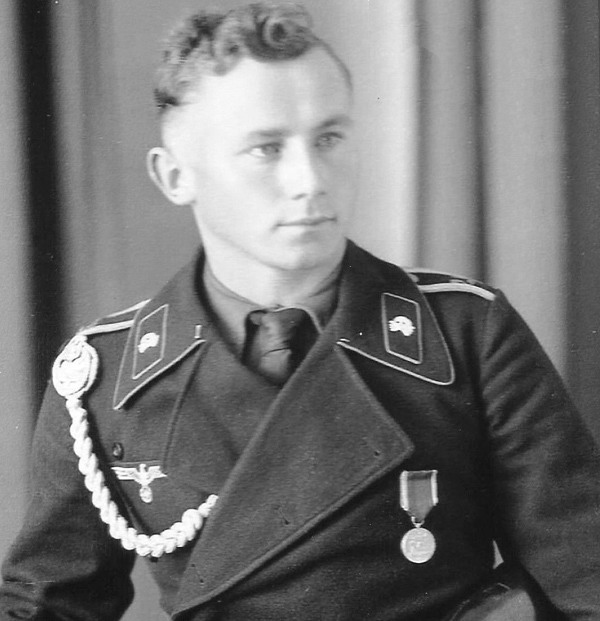
In the pre-war period, when there was still time for very thorough crew training, an outstanding tank gunner could receive the so-called marksmanship lanyard, or Schützenschnur (the round badge on the left side of this soldier's tunic is the medal for the Anschluss of Austria), source: Flickr.com with permission of the publishing user, edited
The marksmanship lanyards for the armoured forces were intended for outstanding gunners on tank and presumably also anti-tank guns, as well as on vehicle machine guns (for the earliest tank men serving on the Panzer I, there was no other option). Twelve proficiency grades were distinguished. The individual grey-silver cords were interwoven with thin aluminium wires and braided together into a "plait." At the upper end of the plait was an oval metal badge, the design of which varied according to the specific grade. Common to all grades were the Reich eagle with swastika and the motif of a Panzer I tank (travelling from right to left). On grades 1 to 4, the badge's circumference featured a zigzag pattern representing a tank track. The badge for grades 5 to 8 had a silver-coloured oak wreath around its edge, and the badge for grades 9 to 12 was framed by a gilded oak wreath. At the opposite end of the cords, one, two, or three pendants in the shape of artillery shells could be hung (a badge with the track pattern and no shell pendant = grade 1; with the track pattern and one pendant = grade 2; and so on; a badge with the silver wreath and no pendant = grade 5; with the silver wreath and three pendants = grade 8).
Distinguishing 12 different marksmanship levels was naturally only possible with truly thorough and sustained training, something the Germans could afford only before the war and in its early stages. As tank crew training inevitably had to be shortened and simplified, the award of marksmanship lanyards was discontinued. They are therefore encountered far more frequently in pre-war photographs than in wartime ones – though this is not an absolute rule.
The Schützenschnur was also worn on the black field uniform, slung between the right shoulder strap and the tunic's fastening button. From the perspective of serving in a fighting vehicle, it was not a particularly practical ornament, as there was a risk of it catching on some projection or lever. Soldiers were presumably well aware of this, so the lanyards were worn primarily off-duty as a semi-ceremonial accessory – they are typically seen in portrait photographs taken by soldiers at commercial studios. Occasionally, however, one encounters a photograph of a soldier who genuinely wore his lanyards in the field (e.g. HERE or HERE).
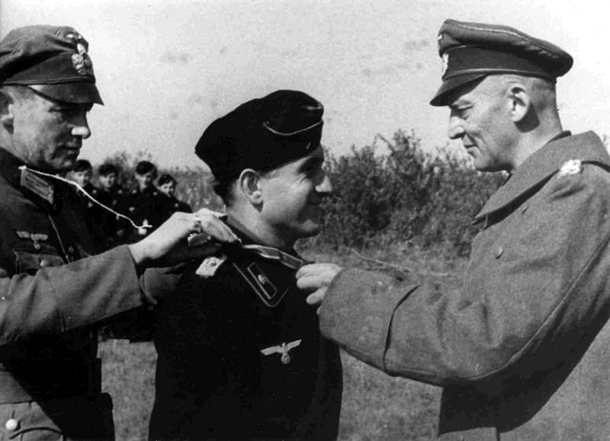
Oberleutnant Hans Lex of the Grossdeutschland regiment receiving the Knight's Cross from his superior (10 September 1943), source: Flickr.com with permission of the publishing user, edited
Nowhere in the literature studied is it explicitly stated, but if lanyards were awarded for marksmanship skills, then logically – of all the men making up a tank crew – only the gunners should have received them. If this assumption holds and you nonetheless encounter a photograph of a tank commander wearing these lanyards, it can be assumed that the individual previously served as a gunner and only later became a vehicle commander – which was not at all unusual; this is exactly how the career of Wittmann's former gunner Balthasar Woll progressed, for instance. It is also possible that the tank crew member in question is not wearing armoured forces lanyards at all, but army (i.e. infantry) lanyards earned during rifle marksmanship training – something that could certainly have happened as well.
Luftwaffe Tank Crews
The German Air Force surprisingly also encompassed a considerable number of ground units. These were primarily infantry formations, but by a quirk of history the Luftwaffe also fielded one Panzergrenadier division (Fallschirm-Panzergrenadier Division 2 Hermann Göring) and even a full tank division (Fallschirm-Panzer Division 1 Hermann Göring). And since he had his "own" tanks and tank destroyers, it would not have been Göring if he had not also wanted his "own" special decorations for them. These were introduced by a decree dated 3 November 1944 under the name Panzerkampfabzeichen der Luftwaffe. The decree's justification stated that Luftwaffe soldiers were increasingly taking part in decisive battles alongside ground forces and therefore deserved appropriate recognition – hence this decoration for tank crew members and Panzergrenadiers of the Luftwaffe.
In its overall layout the badge closely resembled its older Army counterpart. Again there was an oak leaf wreath through which a tank drove, crowned at the top by an eagle with swastika. In its details, however, it was an entirely different design. The eagle was depicted in the style of the general Luftwaffe emblem – flying with wings spread and one talon ready to seize prey; the tank broadly corresponded to the Panzer IV type but looked different from the one on the Army badge, as did the detailing of the oak branches (photo HERE). The badge existed in two versions: the silver version for tank crews, motorised reconnaissance, and also for example medical personnel serving with tank divisions who met the required criteria. The black version was intended for Luftwaffe Panzergrenadiers.
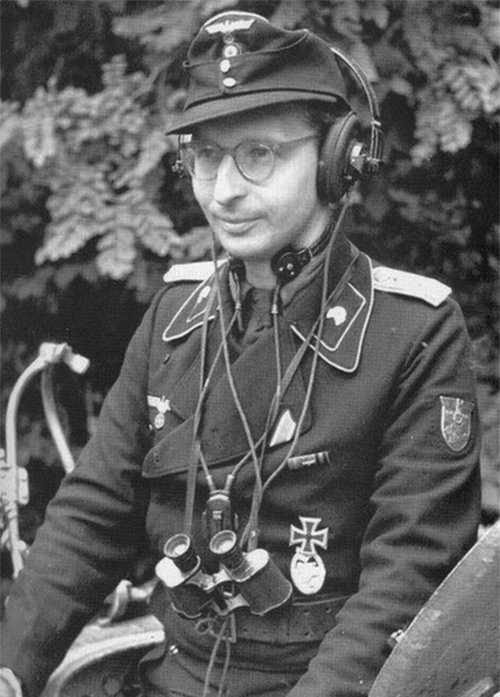
Among his other decorations, this tank crew member also wears the Crimea Shield, clearly visible on his left sleeve, source: Flickr.com with permission of the publishing user, edited
On 10 November 1944 – just one day later – four further grades of the Luftwaffe Panzer badge were introduced for higher numbers of combat actions completed, graded in the same way as the Army badges and carrying the numbers 25, 50, 75, and 100. The count of missions was to begin from 11 November 1944, so previous combat actions were not counted. Largely for this reason, according to most sources, not a single one of these numbered Luftwaffe Panzer badges was awarded before the end of the war.
Sleeve Shields
Among the general German decorations that tank crew members could also receive were the so-called shields, awarded to participants of specific campaigns. Setting aside the Narvik Shield (Narvikschild) of 1940 – German tanks took no part in the fighting for the Norwegian port of Narvik – there were three further shields awarded to participants of specific campaigns on the Eastern Front: the Crimea Shield (Krimschild), the Demyansk Shield (Demjanskschild), and the Kuban Shield (Kubanschild). The first was awarded to soldiers who took part in the conquest of the Crimean peninsula in 1941 and 1942. The Demyansk Shield was introduced in 1943 to honour soldiers who had endured the defensive fighting and two-month encirclement near the town of Demyansk between February and April 1942. And finally the Kuban Shield, introduced in September 1943, was awarded to soldiers who took part in the defence of the so-called Kuban bridgehead on the Taman Peninsula, covering the German withdrawal from the Caucasus. These shields can occasionally be seen on the left sleeve of tank crew tunics in period photographs.
ARTICLE
CONTENTS:
Reproducing text from the Panzernet website without the written consent of the operator is prohibited.