FLAKWAGEN HORCH 108
2 cm Flak on a cross-country vehicle chassis
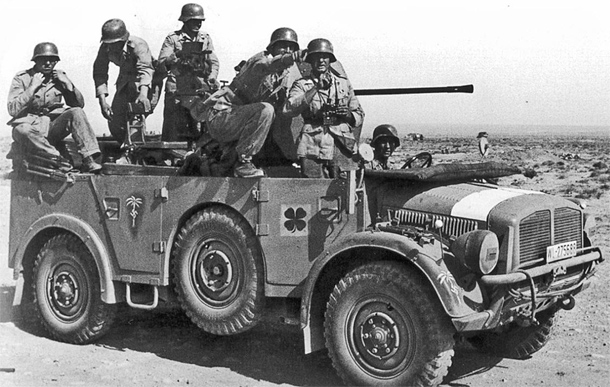
a Flak 38 cannon on a Horch 108 chassis — in this case an unofficial conversion; the insignia on the front door most likely belongs to the 19. Flak-Division, source: Flickr.com with the permission of the publishing user, edited
A New Cross-Country Vehicle
When it came to passenger and light transport vehicles, the German Army had to make do until the mid-1930s with more or less modified versions of standard civilian vehicles — a situation that was far from ideal. Civilian automobiles could not fully meet the army's requirements by design, and the large number of different types from different manufacturers greatly complicated and inflated the cost of maintenance and servicing. It is therefore no surprise that shortly after Adolf Hitler came to power and open German rearmament began, this area too received attention. As early as the turn of 1934 and 1935, a programme took shape to replace the army's entire fleet of originally civilian vehicles with purpose-built cross-country vehicles in several weight classes. The new vehicles were to be designed from the outset to meet military requirements, while standardisation was to bring savings in servicing costs.
The programme, designated Einheits-Pkw der Wehrmacht (unified passenger vehicle for the Wehrmacht), covered the development of vehicles in three classes: light cross-country passenger car (Leichter geländegängiger Pkw), medium cross-country passenger car (Mittelschwerer geländegängiger Pkw), and heavy cross-country passenger car (Schwerer geländegängiger Pkw) — with Pkw being the abbreviation for Personenkraftwagen. It is the last of these three types, the heavy variant, that concerns us in this article. From 1937 it was produced at the Horch factory in Zwickau (part of the Auto Union consortium) under the designation Horch 108.
Vehicle Description
The vehicle had a four-wheel-drive chassis with all wheels powered. The engine and gearbox were positioned at the front, with the cargo area at the rear. An interesting feature was a pair of spare wheels mounted on the sides in such a way as to help the vehicle cross large ground obstacles, preventing it from becoming high-centred. Horch produced two variants simultaneously: the Horch 108 Typ a, with steerable front and rear wheels, and the Horch 108 Typ b, with only the front wheels steerable. On the Typ a, however, the rear-wheel steering could be locked — which was recommended for travel at higher speeds.
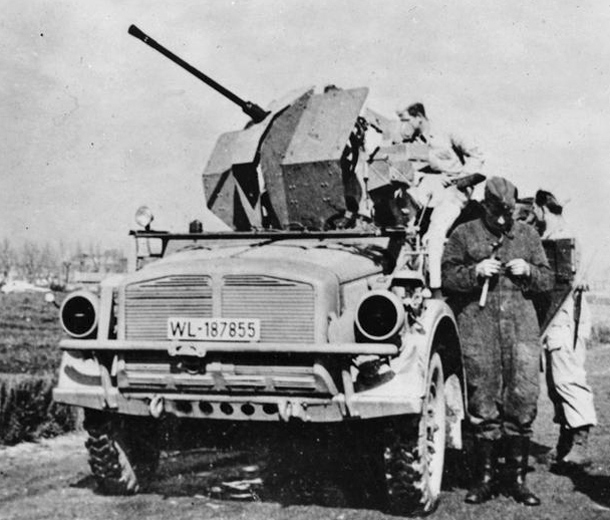
another unofficial Flak 38 installation on a Horch 108 chassis — here most likely not the African theatre but the Eastern Front, source: Flickr.com with the permission of the publishing user, edited
In 1937 and 1938, Horch fitted the vehicle with an in-house eight-cylinder engine of 3.5 litres displacement. From 1939 onwards, however, they switched to a more powerful unit of 3.8 litres and 90 horsepower. With the new powertrain the vehicle also received a new designation: Horch 108 Typ 1a (with steerable rear wheels) and Horch 108 Typ 1b respectively. In 1939, Ford-Werke in Cologne — formerly a subsidiary of the American Ford company — also began producing the heavy cross-country vehicle alongside Horch. At Ford, however, their own eight-cylinder engine of 3.6 litres was fitted, and the vehicle was designated Ford Typ EGa (all-wheel steering) and Ford Typ EGb (front-wheel steering only).
In 1940 a further update brought a general simplification of the design. The spare wheels were moved from the outer sides to inside the cargo area, removing the need for the previously necessary recesses in the side walls. Rear-wheel steering was abandoned entirely. And finally — at least according to some sources — the vehicle received a new gearbox. This simplified vehicle was produced under the designations Horch 108 Typ 40 and Ford EG Typ 40, with Ford's production continuing until 1941 and Horch's for a further year. A total of 10,036 examples of the heavy cross-country vehicle were built: 8,135 at Horch and 1,901 at Ford.
In the all-wheel-steering version the vehicle weighed approximately 3.3 tonnes; the simpler front-wheel-steering variant was roughly 100 kg lighter. Even so, it was still too heavy. The vehicle's considerable weight was one of its main drawbacks, particularly evident on the unpaved tracks of the Eastern Front. The vehicle's own mass also reduced its payload to a "mere" 1 tonne — not particularly generous for such a robust vehicle. It was, however, still enough for the installation of a light anti-aircraft cannon, and someone clearly decided to take advantage of this.
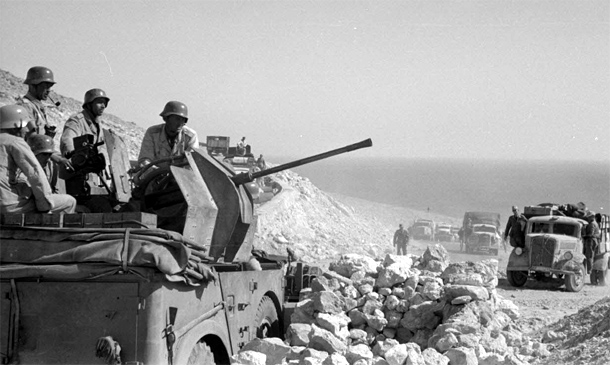
the role of the improvised Flakwagen was to escort supply columns, exactly as seen in this photograph from North Africa, source: Flickr.com with the permission of the publishing user, edited
Unofficial Conversions
Modern warfare — and World War II certainly qualifies — depends on logistics. Supplying a vast army with ammunition, fuel and lubricants, spare parts, clothing, food and medical supplies means thousands upon thousands of tonnes of cargo that must be moved over enormous distances. That means columns of dozens and hundreds of trucks grinding along roads, often through areas threatened by enemy fighter-bombers and ground-attack aircraft. Such supply columns need anti-aircraft defence no less urgently than columns of combat vehicles on the move. The difference is simply that while tanks, for instance, can travel almost anywhere and their escort must be able to do the same, supply trucks must stay on roads — which means wheeled vehicles are perfectly adequate as their protective escort.
And so it came about that an unknown number of Horch 108 (and Ford EG) heavy cross-country vehicles were converted for precisely this air-defence role. These conversions were evidently of two kinds — let us call them official and improvised. The improvised version was most likely carried out directly in field workshops by frontline units. No modifications were made to the vehicle's structure as such. The seats were simply removed from the cargo area and a new raised floor installed, reaching almost to the top of the side walls (making the rear entry doors unusable). On this new floor a tripod mount with a 20 mm cannon was then placed. Photographs show vehicles fitted with both the Flak 30 and the more modern Flak 38 — with the latter clearly predominating.
The principal difference between the two weapons was their rate of fire. The Flak 30 achieved approximately 280 rounds per minute theoretically and 120 practically, while the Flak 38 offered up to 480 theoretically and 220 practically. The effective ceiling of both versions was approximately 2 km. In both cases the weapon was installed complete with its gun shield — something the crew may have appreciated, though it also unhelpfully increased the vehicle's silhouette. The space beneath the new fighting compartment floor was most likely used for ammunition stowage, certainly at the rear and possibly at the sides as well. The Flak 30 with its mount weighed 483 kg, consuming roughly half the vehicle's available payload. The Flak 38 was about 80 kg lighter, theoretically allowing a somewhat larger ammunition load to be carried.
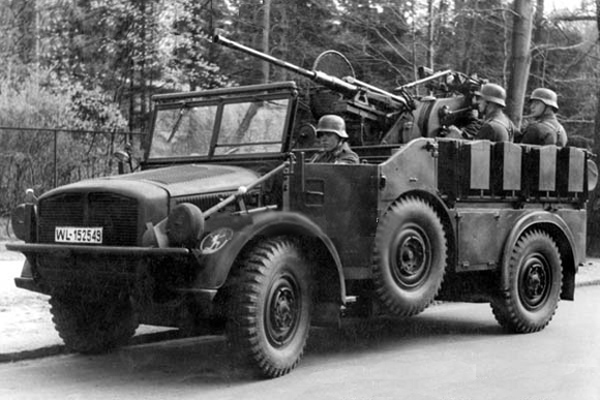
here we have the official Flak 38 installation on a Horch 108 chassis; note the wire-mesh side panels with ammunition boxes attached — this vehicle carries the insignia of the 1st battalion of anti-aircraft regiment Flak-Regiment 42 (mot.) from Berlin on its mudguard, source: Flickr.com with the permission of the publishing user, edited
Most surviving photographs of these improvised Flakwagens come from North Africa, which is not very surprising. The African theatre was generally very fertile ground for improvisation and self-help modifications of all kinds of vehicles — the old soldier's saying "if you need it, find a way" certainly applied there. One of the vehicles captured in photographs bears a four-leaf clover emblem, which according to some sources was the symbol used by the 19. Flak-Division. If so, this would place the photographs of that vehicle in the period between August 1942 and May 1943, when the division was operating in Africa. There are, however, also photographs of a similarly modified vehicle that appear to have been taken on the Eastern Front, suggesting that soldiers in both theatres independently arrived at the same idea.
The Official Flakwagen
And then there is the second type of conversion mentioned — the official version, which was most likely produced on an order from the Luftwaffe. Unlike the improvised type, the official conversion involved quite visible modifications to the vehicle's cab structure. The designers were clearly inspired by the way the same cannon was installed on the half-tracked tractor Sd.Kfz. 10. In the rear of the Horch 108 (or Ford EG) a relatively low-set platform was created. The original side walls around this platform were removed and replaced by folding panels filled with dense wire mesh. Before firing, these panels were folded down to a horizontal position, extending the floor area of the fighting compartment — as was also done with the original rear wall. Ammunition magazine boxes were mounted on the panels. The original rear entry doors were removed entirely. Interestingly, most photographs of official conversions show the cannon without its gun shield.
Unfortunately, the literature provides few further details, so the crew size, for instance, can only be estimated from available photographs — which suggest it was most likely 5 or 6 men. Nor is it known how much ammunition could be carried on board, though some photographs show a trailer in tow carrying additional rounds.
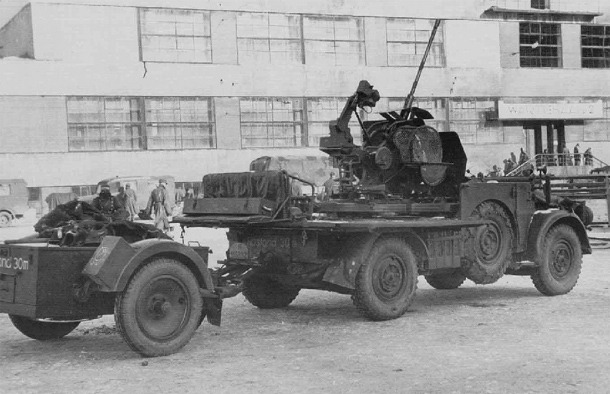
another official Flakwagen, this one belonging to the Leibstandarte division; the fighting compartment side panels are folded down to the horizontal position and the vehicle has an ammunition trailer in tow, source: Flickr.com with the permission of the publishing user, edited
At least some of the vehicles produced on an official Luftwaffe order were assigned to the 1st battalion (Abteilung) of anti-aircraft regiment Flak-Regiment 42 (mot.) from Berlin (mot. = motorised). The Flakwagens described here served in this unit as protection for heavy self-propelled 88 mm cannon on VOMAG 7 OR 660 bus chassis. There is also, however, a photograph showing a vehicle belonging to the Leibstandarte SS Adolf Hitler division, parked on a street in the Ukrainian city of Kharkov in the winter of 1943.
ARTICLE
CONTENTS:
Reproducing text from the Panzernet website without the written consent of the operator is prohibited.