"FLAKPANZER" BREN
an improvised Flakpanzer on a captured chassis
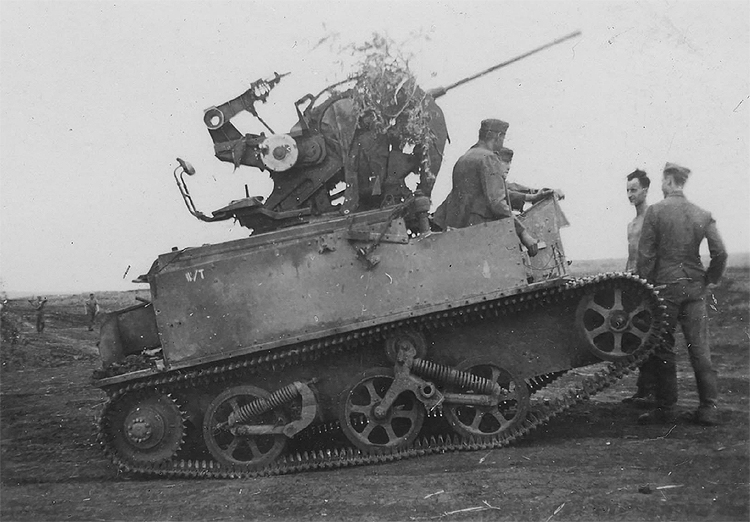
the improvised Flakpanzer on the chassis of the captured Universal Carrier, armed with a 20 mm Flak 30 cannon, source: Flickr.com with permission of the publishing user, edited
Unknown when, unknown where, unknown by whom, and unknown in what numbers — that, in a nutshell, is just about everything that is known about this improvised Flakpanzer mounting a 20 mm cannon on the chassis of a captured Universal Carrier. Even so, it would be a shame to leave it out entirely, so we will at least summarise the generally established facts and accept that the finer details will have to go unrecorded.
The basis of the vehicle was the originally British light carrier, the Universal Carrier. The Germans captured a considerable number of these machines, first in 1940 in France where the British expeditionary forces had left them behind, and later they acquired further examples in North Africa. The German army put them into service under the official designation Gepanzerter MG-Träger Bren 731(e). Despite their new German designation, these tracked carriers continued to live up to their original name — Universal Carrier — in every sense of the word. Beyond transporting soldiers and equipment they were perfectly capable of carrying lighter artillery weapons, which proved very convenient for their new operators.
Modern warfare runs on logistics, which means a practically endless stream of trucks crawling along dusty roads, often through areas where an attack by enemy aircraft is a real threat. Such a convoy therefore needs anti-aircraft protection, and since it is on the move, self-propelled weapons are far better suited to the task than guns in fixed positions. It occurred to someone that the captured Gepanzerter MG-Träger Bren 731(e) might serve this purpose rather well.
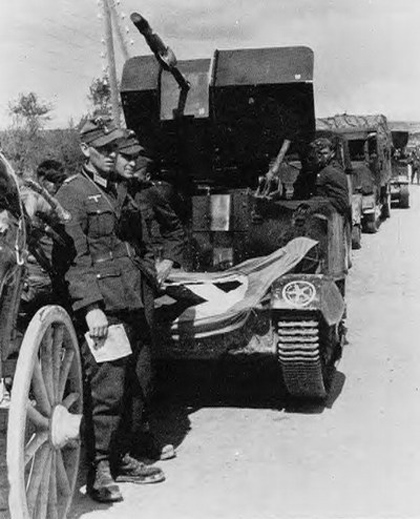
the improvised Flakpanzer on the chassis of the captured Universal Carrier, armed with a 20 mm Flak 30 cannon, source: worldwarphotos.info with permission of the publisher, edited
The chassis had three road wheels on each side, sprung by coil springs. At the front was a spoked idler wheel and at the rear a solid, toothed drive sprocket. Approximately in the centre was a single return roller supporting the upper run of the track. Power was provided by a Ford V-8 air-cooled eight-cylinder petrol engine of 3.6 litres displacement, producing 85 horsepower at 3,500 rpm. The Universal Carrier had light armour of 7 to 10 mm, weighed 3.2 tonnes, and had a top speed of around 48 km/h. As an originally British vehicle, the driver sat on the right-hand side.
As part of the German conversion to a combat vehicle, a mount carrying a 20 mm Flak 30 anti-aircraft cannon was installed in the cargo compartment. The theoretical rate of fire of this weapon was up to 280 rounds per minute, though in practice it was closer to 120 rounds per minute. The effective ceiling was around 2 km. The cannon was installed complete with its gun shield, which may have given the crew some psychological comfort but at the same time considerably increased the vehicle's silhouette and made it far more conspicuous.
Most of the available photographs of this "Flakpanzer" were apparently taken in quick succession and show the vehicle or vehicles described here escorting a column of trucks and cars. The photographs appear to depict two distinct examples: one has a prominent unit marking on the left front mudguard, while the other does not. One of the images may even show both vehicles together. Both carry swastika flags spread across the front of the cargo compartment, and a Nazi flag is also visible on the bonnet of at least one of the accompanying lorries. This suggests the convoy was passing through an area where air activity was intense and the soldiers were doing their best to leave the Luftwaffe in no doubt that this was a German supply column. According to I. Pejčoch, the vehicles were deployed in the Balkans in 1941.
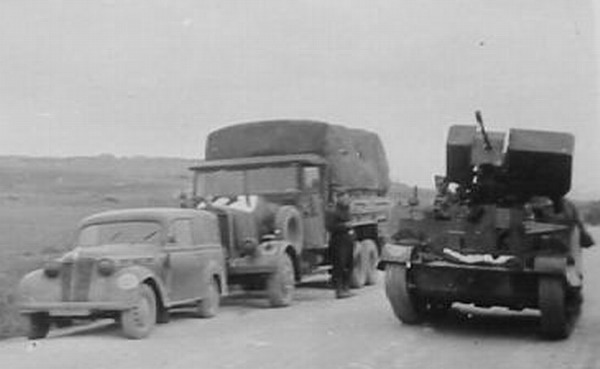
most of the available photographs of this vehicle apparently originate from the same occasion and show the Flakpanzer(s) escorting a supply column, most likely somewhere in the Balkans or the USSR, source: worldwarphotos.info with permission of the publisher, edited
In an attempt to find out more about the Flakpanzer based on the Universal Carrier, we showed the three photographs available to us to an artificial intelligence and asked it to identify the unit to which the marking on the left mudguard belonged. Unfortunately, not even ChatGPT was able to provide a credible answer to that question. At least when asked where the photographs were taken, the AI agreed with I. Pejčoch, concluding that judging by the surrounding landscape it could have been somewhere in the Balkans or the USSR.

Reproducing text from the Panzernet website without the written consent of the operator is prohibited.