SAURER RK-9
neither a car, nor a tank
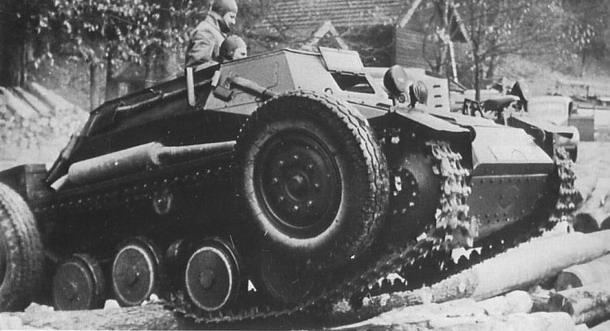
first prototype of the RK-9 without roof or turret during driving trials, source: Flickr.com with permission of the publishing user, edited
Contract for Saurer
Following the annexation in March 1938, the German army placed an order with the Austrian firm Saurer for the development and production of the half-track reconnaissance vehicle Sd.Kfz. 254. In mid-1938, a further order followed — this time for the development of a next-generation version of the vehicle, one that would carry its own integral armament. The designers decided against the simple approach of modifying the armoured superstructure to accommodate weapons, and instead embarked on a complete redesign, including the complex running gear system.
Perhaps for this very reason, work on the new armoured vehicle crawled along at a snail's pace. The first two prototypes were not completed until June 1942 — a full four years after the original commission. The project, which received the factory designation RK-9, was evidently no great priority for the army. The first prototype was incomplete, lacking both the roof of the fighting compartment and the turret to carry the armament. Even so, it was sufficient as a verification vehicle for conducting driving trials.
Design and Construction
Like its predecessor the RK-7 — or the Sd.Kfz. 254, as it is better known — the new RK-9 was built around two interchangeable running systems. For road travel, the vehicle rode on four conventional wheels fitted with rubber tyres. For cross-country movement, it was equipped with a full tracked system. When switching from road to rough terrain, the wheels were raised and left hanging at the sides of the hull. The rear road wheels were driven, while the front ones were steerable. The track unit on each side consisted of four road wheels of relatively small diameter. These were solid wheels, fitted with rubber rims to absorb vibration. In their design they closely resembled the road wheels of the Panzer II tank. The drive sprocket was positioned at the front and the idler wheel at the rear of the track section. Three return rollers supported the upper run of the track.
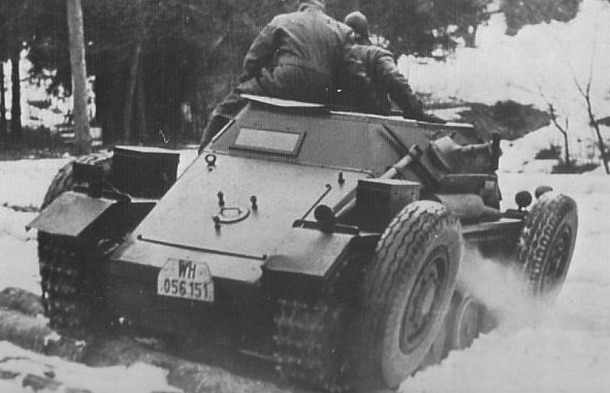
first prototype of the RK-9 without roof or turret during driving trials, source: Flickr.com with permission of the publishing user, edited
A sheet-metal mudguard ran the full length of the track, and along the right-hand side of the vehicle the exhaust pipe was routed on top of it. The hull was welded from flat plates which, particularly at the front and rear, were steeply angled — a feature that improved their resistance to enemy fire. Armour thickness was 14.5 mm on the front face and 5.5 mm on the remaining surfaces. The extent of the armour protection was limited by the load-bearing capacity of the running gear, particularly the wheeled section, meaning the plating offered at best protection against small-arms fire and light shell fragments.
Rising from the front plate was an elevated crew cab, with vision provided by the standard closeable vision ports. On the first prototype the cab roof was left open; the second prototype already had a turret installed. The turret was a relatively modern design, with a low silhouette and a commander's cupola. The cupola roof incorporated a hatch closed by a single-piece lid. Two gun barrels protruded from the turret's front face: the shorter one belonged to the MG 34 machine gun, and the longer one to the EW 141. Both weapons were chambered for the 7.92 mm cartridge. The EW 141 fired ammunition developed for the Panzerbüchse 39 anti-tank rifle, which gave a higher muzzle velocity and greater projectile hardness than standard rounds of the same calibre — qualities that made it effective in an anti-armour role.
The vehicle was powered by a petrol engine, the Saurer OKD, which produced a maximum output of 100 horsepower. It is commonly stated that the engine was mounted at the rear of the hull, but the routing of the exhaust pipe — which exits from the forward half of the hull — does not support this. Moreover, the rather poor quality photographs available appear to show a louvred opening in the front plate, which would clearly suggest an air intake for the powerplant. The rear wall also featured a large opening, though this was covered by an unperforated panel which, judging by the photographs, was designed to carry a fifth, spare wheel.
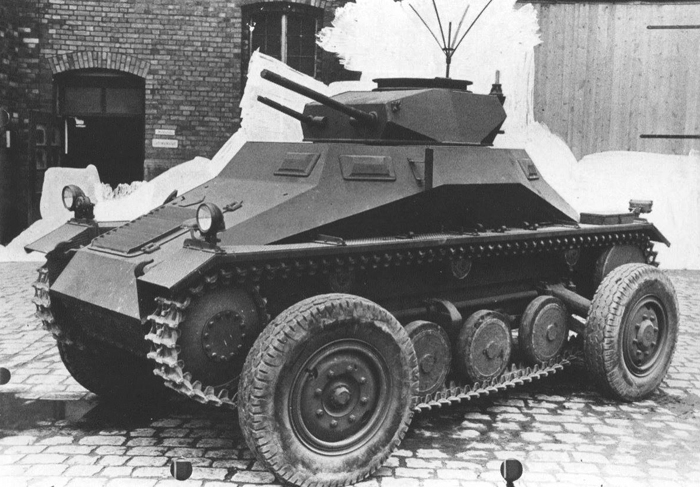
second prototype of the RK-9, complete with turret and armament, shown here in a retouched factory photograph, source: Flickr.com with permission of the publishing user, edited
The vehicle's combat weight was most likely in the region of 8.5 tonnes. On roads — that is, running on wheels — the RK-9 could reach a top speed of 80 km/h. On tracks across country, a respectable 30 km/h was achievable. Road range stood at approximately 250 km.
Cancellation of the Project
Although the prototypes performed well in testing and met expectations, series production of the RK-9 was ultimately never authorised. The reason was a reassessment of what the army actually required from a modern reconnaissance vehicle. The ability to switch to wheeled drive and achieve high road speeds is entirely meaningless without a network of metalled roads to drive on — and that was something the Germans could only dream of on the Eastern Front. It would therefore have been wasteful to pay the additional manufacturing costs for a capability that would see almost no practical use. On top of this, the RK-9's armour was considered inadequate, and once again it was the running gear — specifically its load-bearing capacity — that ruled out any further strengthening of the protection. The final nail in the coffin was almost certainly the demands the complex running gear placed on maintenance under field conditions. The RK-9 thus remained at the prototype stage.
ARTICLE
CONTENTS:
Reproducing text from the Panzernet website without the written consent of the operator is prohibited.