Sd.Kfz. 254
wheels on the road, tracks off it
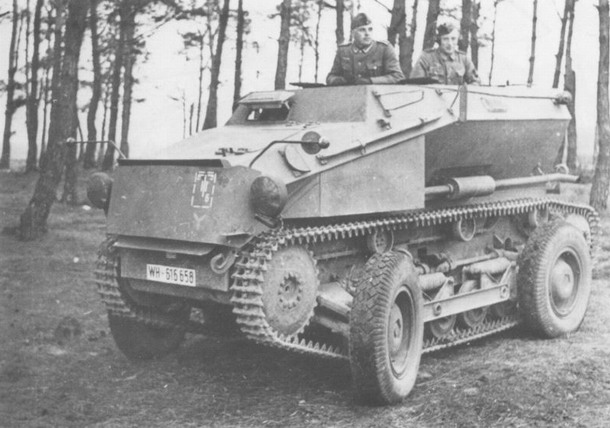
Sd.Kfz. 254, here running on wheels. Source: Flickr.com, used with permission of the publishing user, edited
Origins of the Vehicle
The origins of this remarkable armoured vehicle lie in a project by the Austrian firm Saurer, designated RR-6 (Räder-Raupen). This was an artillery tractor developed for the Austrian army, of which a single prototype was completed in 1935. The tractor's distinguishing feature was its convertible wheel-and-track running gear — hence the two words in its name: Räder = wheels and Raupen = tracked (Raupenkette = track). The combined wheel-and-track chassis was intended to give the vehicle the advantages of both systems: on road it could travel on wheels and achieve high speeds, while off road it could switch to tracks and cope with soft or broken terrain.
Convertible wheel-and-track running gear became something of a design fashion in the 1930s, though in most countries the trend faded fairly quickly. Practice showed that the advantages were generally outweighed by the drawbacks of a complex mechanism. One notable exception was the Soviet BT series of convertible tanks, which achieved enormous proliferation — though in their case the tracks were simply fitted over road wheels that were themselves rubber-tyred and capable of running on roads in their own right. The Austrian vehicle used a technically far more demanding concept of two separate, interchangeable running gear systems.
The 1935 RR-6 prototype suffered from many shortcomings, and so as early as 1936 development began on an improved variant designated RR-7. Five evaluation examples were completed the following year. During trials the RR-7 proved itself and the Austrian army placed an order for an initial production run of 160 vehicles (other figures are also cited). Like the RR-6, the RR-7 was an unarmoured cargo vehicle with no weapon, intended primarily for towing loads and artillery pieces.
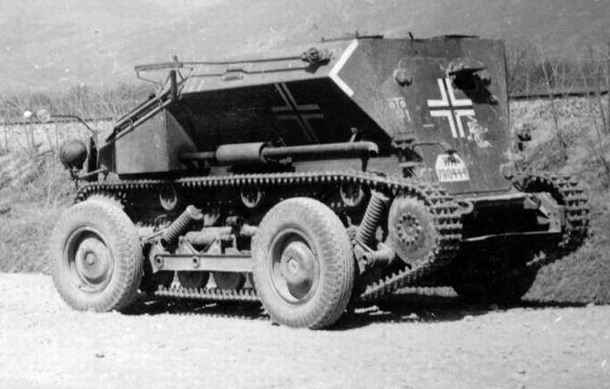
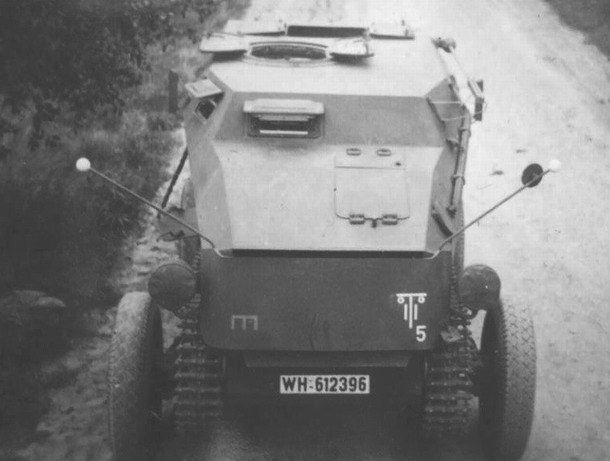
Rear view of the Sd.Kfz. 254 — the ghost image indicates belonging to the 11th Panzer Division. Source: Flickr.com, used with permission of the publishing user, edited
By the time of the Anschluss of Austria in March 1938, only 15 RR-7 vehicles had been completed (other figures are sometimes cited). Production was then halted amid uncertainty over whether the army would still want the tractor. The German Army Weapons Office eventually decided to resume production — but no longer in the original form or for the original purpose. Instead, an armoured variant was ordered, intended for reconnaissance and artillery observation duties. The armoured vehicle received the new designation RR-7/2 and the standard German army code Sd.Kfz. 254. Its official German name was Mittlere Gepanzerte Beobachtungskraftwagen SdKfz 254 — literally "medium armoured observation vehicle".
Design Description
The tracked portion of the Sd.Kfz. 254's running gear consisted of six fairly small road wheels on each side. The first and last of these were each independently sprung by a diagonally-mounted coil spring. The remaining four road wheels were paired and shared a single horizontal coil spring. The entire spring system was mounted externally on the hull sides. The first five wheels were spaced at regular close intervals, while the sixth was set further back, separated from the others by the mounting of the rear road wheel. The track assembly was completed by a front drive sprocket and a rear idler wheel, both of the same design, with the upper run of the track supported by three return rollers.
The wheeled portion of the running gear consisted of four conventional pneumatic-tyred wheels. The front wheel was mounted between the drive sprocket and the first track road wheel. The rear wheel was positioned between the already-mentioned fifth and sixth track road wheels. When running on tracks, the road wheels were raised up alongside the hull, clear of the ground. On road, the wheels were lowered until the entire vehicle was lifted on them and the tracks rose above the road surface, allowing the vehicle to proceed. The mechanism for raising and lowering the wheels was driven by the vehicle's engine.

Sd.Kfz. 254 with the marking of the 15th Panzer Division. Source: plaza.rakuten.co.jp
The powerplant was the water-cooled four-cylinder Saurer CRDv diesel, displacing 5.5 litres and producing a maximum of 70 horsepower at 2,000 rpm. The gearbox offered five forward gears and one reverse. On wheels the vehicle could reach up to 60 km/h and cover approximately 500 km on a full tank of 72 litres of diesel. Maximum speed on tracks was around 30 km/h. The Sd.Kfz. 254 weighed 6.4 tonnes.
The armoured hull was vaguely reminiscent of the half-track personnel carrier Sd.Kfz. 251 in its overall form — a traditional German design with the lower and upper sections of the side walls angled in opposite directions, so that the hull widened upward from the floor, then the side wall broke angle and the hull narrowed again toward the roof. At the front was the engine compartment with a flat front plate and a fairly tall bonnet. The front plate was not rigidly connected to the rest of the hull but effectively suspended from it, with a gap between it and the adjoining walls to allow airflow to the engine. The entire front plate could most likely be removed to gain access to the powerplant. A further service opening for engine access was located in the left section of the bonnet's upper plate.
The crew compartment began behind the engine section. In the right section of its front wall was the driver's vision port — traditionally designed as a closable port with a cover fitted with an observation slit, which the driver used in combat areas where opening the full port might be dangerous. A further vision port for the driver was provided in the side wall to his right. The driver entered and exited through a hatch in the lower portion of the right side wall. This hatch had a single-piece cover that opened somewhat unusually downward. Because of the tracks, the cover could not be opened completely flat, and given this and its dimensions, squeezing through it was probably not particularly comfortable.
Sd.Kfz. 254 — the recumbent E marking suggests the 3rd Panzer Division. Source: plaza.rakuten.co.jp
The remainder of the compartment was occupied by the other three crew members. Higher crew numbers are sometimes cited — some sources claim up to seven, which is pure nonsense given the vehicle's dimensions. Unlike most contemporary German armoured vehicles and half-tracks, the Sd.Kfz. 254 had a fully enclosed fighting compartment. Crew entry and exit was provided by two roof hatches and a pair of double doors in the rear wall. The forward roof hatch was circular and the rear one rectangular, both fitted with two-piece covers. The crew's external view was provided by two side wall vision ports, one on each side, and a further port in the right leaf of the rear doors.
A spade and shovel were mounted on the upper section of the left side wall. Additional tools were stowed on the right side wall behind the driver's hatch. The exhaust ran from the engine along the left side of the hull, just above the track, toward the rear of the vehicle. Armour thickness ranged from 15 mm at the front, through 8 or 10 mm on the sides and rear, to 6 mm on the hull floor.
Given its mission, the ability to communicate with other units — and particularly with the artillery it served as the eyes for — was crucial for the Sd.Kfz. 254. The radio on board was most likely a FuG 8 set with a range of up to 50 km using Morse code. A rod aerial at the left rear of the hull served this radio; it could be folded forward, with its end resting in a metal channel that protected it. Some vehicles were probably equipped with additional radio sets and received a second aerial — this time a frame aerial, which ran around the roof of the hull on four supports.
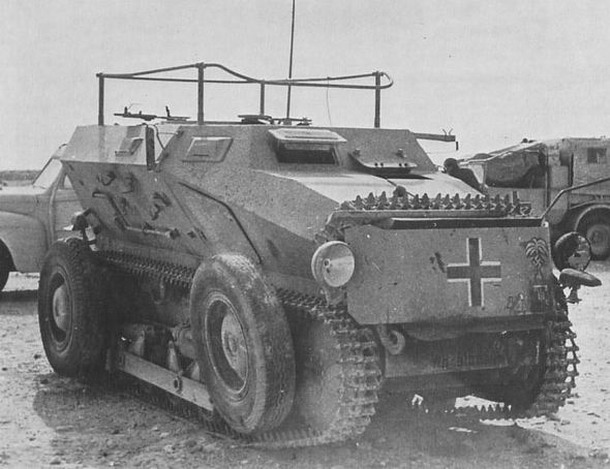
Sd.Kfz. 254 with the unusual frame aerial, captured by the Allies in Africa. Source: Wikimedia, Public domain, edited
Since it was not intended for combat, the Sd.Kfz. 254 had no integral armament. The crew did, however, reportedly carry an MG34 machine gun inside the hull, along with their personal weapons.
Following Austria's incorporation into the German Reich in 1938, production of the armoured vehicle continued, most likely until 1940, yielding a total of 140 Sd.Kfz. 254 examples (128 or 129 is also cited). Some sources place production between 1940 and 1941, which is probably incorrect. In addition, the Germans took possession of the first 15 series-production RR-7 vehicles completed for the Austrian army before the Anschluss. These are said to have been converted into cargo carriers, with a load bed enclosed by a timber frame and covered by a canvas tarpaulin, similar to a standard truck. This rare variant apparently bore the designation mittlerer Instandsetzungskraftwagen (Sd.Kfz. 254).
As with other convertible wheel-and-track projects, the advantages of the dual running gear on the Sd.Kfz. 254 were outweighed by its drawbacks. The running gear was extremely complex and demanding to maintain, particularly under field conditions. The entire spring system was mounted externally on the hull and was therefore relatively vulnerable to damage. The vehicle's purchase cost was also unnecessarily high compared with other types.
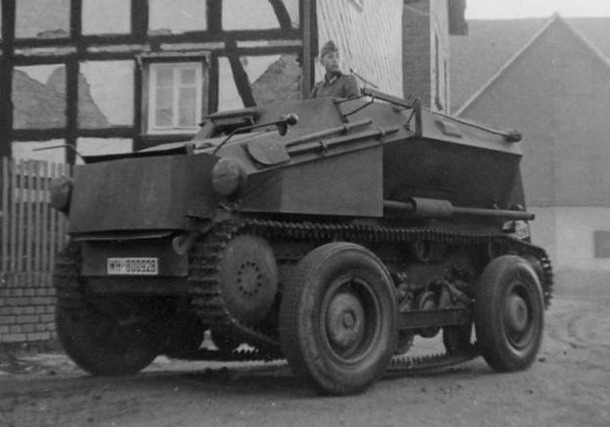
Sd.Kfz. 254. Source: plaza.rakuten.co.jp
Combat Deployment
The Sd.Kfz. 254 was used primarily by motorised artillery units. In this role it saw action in North Africa and the Soviet Union. While all deployed vehicles were eventually lost in Africa, the last examples on the Eastern Front apparently survived until around mid-1944 — though by then these were truly the final few, kept in service largely out of necessity. The Sd.Kfz. 254 had by that point already been gradually withdrawn from active service due to its high maintenance demands and the inefficiency of maintaining spare parts stocks for a vehicle type present in such small numbers.
A Curious Conversion
Long after the war ended, one example of the Sd.Kfz. 254 — or at least part of one — found a most remarkable new purpose. A man named Uhlík, a native of the Šumava region of Bohemia, acquired the running gear from a wreck that had apparently remained somewhere on Czech territory and built a new metal cabin of his own design on top of it. On 25 July 1953 he loaded his two children, his wife, and four other adults into this contraption and drove it through a barbed wire barrier across the border of the Czechoslovak Socialist Republic into Germany. His creation attracted well-deserved interest from journalists, and was apparently later transported to the United States and displayed in some museum. Photographs of this curious conversion can be found HERE and HERE.
Technical Data
|
weight: |
6.4 t |
|
length: |
4.50 m |
|
width: |
2.47 m |
|
height: |
2.02 m |
|
engine: |
Saurer CRDv |
|
engine output: |
70 hp |
|
max. speed: |
60 km/h |
|
armour: |
|
|
- front: |
15 mm |
|
- sides: |
8 or 10 mm |
|
- rear: |
8 or 10 mm |
|
crew: |
4 men |
|
armament: |
crew personal weapons only |

ARTICLE
CONTENTS:
Reproducing text from the Panzernet website without the written consent of the operator is prohibited.