PANZERSPÄHWAGEN L202(H)
from Sweden through the Netherlands to the Eastern Front
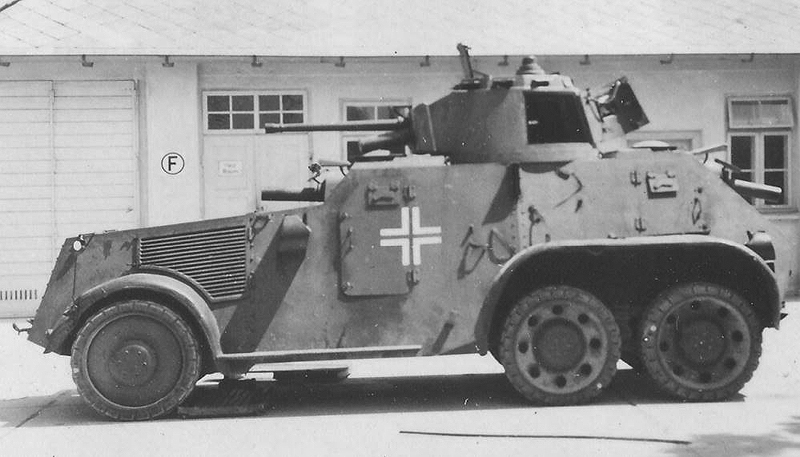
developed by the Swedes as the Landsverk L-180, purchased by the Dutch as the Pantserwagen M-38 and captured by the Germans as the Panzerspähwagen L202(h), source: Flickr.com with the permission of the publishing user, edited
Swedes, Dutch and Germans
Built by the Swedes, bought by the Dutch, and used by the Germans — that, in a very simplified nutshell, is the story of the two types of armoured cars we are going to talk about. It is also why these vehicles appear in history under no fewer than three different names: to the Swedes they were the Landsverk L-181 and L-180, to the Dutch the Pantserwagen M-36 and M-38, and to the Germans — who used the same designation for both types — the Panzerspähwagen L202(h).
Yet a German connection appears right at the very beginning of these vehicles' history. The Landsverk L-181 and L-180 were the products of the Swedish company AB Landsverk, based in the town of Landskrona. Since 1925, however, the firm had been majority-owned by Germans — specifically by the company Gutehoffnungshütte, or GHH. The designer behind both six-wheeled Landsverk armoured cars was also a German: engineer Otto Merker, who joined the firm in 1929. And finally, both the L-181 and the L-180 were built on chassis supplied by German subcontractors.
Landsverk L-181
Despite what its model number might suggest, the Landsverk L-181 was actually the first of the two "siblings" to be completed, entering the world in 1933. To keep the final price within acceptable limits, the armoured car was built on the chassis of a Mercedes-Benz G 3a truck. Along with the 6×4 drivetrain configuration, the vehicle also inherited the Mercedes-Benz G 3a's six-cylinder petrol engine, the Daimler-Benz M09 II, with a displacement of 3.688 litres and an output of 68 horsepower at 2,800 rpm.
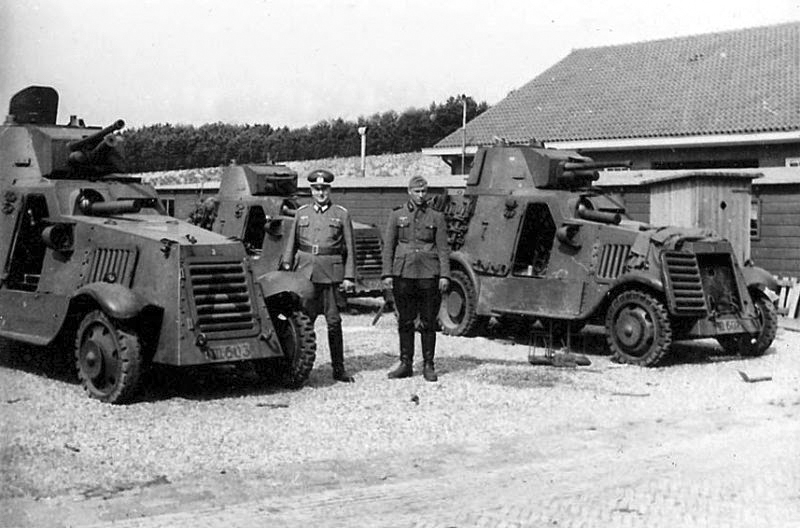
German soldiers with captured Dutch Pantserwagen M-36 armored cars, this older type can be easily distinguished from the newer Pantserwagen M-38 by the shape and grille of the vents, source: Flickr.com with the permission of the publishing user, edited
The truck chassis naturally required a great many modifications for its new role. The most significant of these was the addition of a rear driver's station. On larger armoured cars, this was nothing unusual — reversing such a vehicle is no easy feat, and doubly so when you are under fire and need to back away quickly. Turning the whole vehicle around in such a moment is not a solution: it takes too long, may be impossible in confined spaces, and in doing so you expose the typically thinner side armour to the enemy.
The chassis for the Landsverk L-181 therefore received a fully equipped second driver's position at the rear. The original Mercedes-Benz G 3a gearbox offered four forward and one reverse gear; this was retained but supplemented by a new auxiliary gearbox, bringing the total available ratios to eight forward and five reverse. So equipped, the armoured car could reach a top speed of 65 km/h going forward and 41.5 km/h in reverse. The rear driver naturally had to be careful, as from his perspective steering involved the rear axle — a discipline with its own quirks. Other notable modifications to the chassis included reinforced suspension and the replacement of standard pneumatic tyres with solid rubber ones, which cannot be punctured and are unaffected by bullet hits. The vehicle was also equipped with light tracks that could be fitted to the wheels of the two rear axles to improve cross-country performance.
The engine compartment occupied the front of the vehicle, with air vents in both the front and side panels. To the rear sat the crew compartment, topped by a rotating turret. Armour thickness ranged from 9 mm on the front of the hull and turret, through 7 mm on the sides and rear, to 5 mm on the roof and floor. According to the manufacturer, the armour was designed to withstand armour-piercing rifle and machine-gun fire coming from a 120-degree arc to the vehicle's front at a range of 124 metres or more. Total vehicle weight was 6,500 kg, of which approximately 3,200 kg was attributed to the chassis and running gear, 2,800 kg to the armoured hull, turret and armament, and 500 kg to payload — meaning the crew and ammunition.
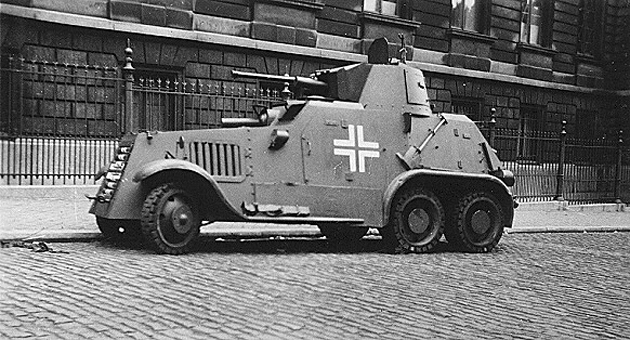
again an older Pantserwagen M-36 captured by the Germans and put into service as the Panzerspähwagen L202(h), source: Flickr.com with the permission of the publishing user, edited
Pantserwagen M-36
The Dutch Army placed an order with Landsverk for twelve of these armoured cars in December 1934. Whereas the standard Swedish configuration included an Oerlikon 1S 20 mm cannon and two machine guns, the Dutch specified a more powerful Bofors m/34 37 mm cannon and three Lewis M.20 machine guns in 7.92 mm — with the third machine gun added to the rear wall of the crew compartment. The Netherlands received the vehicles in batches during January, February and March of 1936, and put them into service under the designation Pantserwagen M-36. The vehicles formed the 1st Armoured Car Squadron (1ste Eskadron Pantserwagens), garrisoned in the city of 's-Hertogenbosch.
In May 1940, anticipating a German invasion, the Dutch deployed these armoured vehicles to defend strategically important airfields. The 1st and 2nd platoons of the squadron were tasked with defending Ypenburg airfield near The Hague, while the 3rd and 4th platoons guarded Schiphol airport near Amsterdam. Between 10 and 14 May 1940, during the German invasion, the Dutch Pantserwagen M-36 vehicles were actively engaged in fighting against the attackers.
Following the Dutch capitulation, all twelve vehicles fell into German hands, some of them lightly damaged. The Germans assigned them the already-mentioned designation Panzerspähwagen L202(h). Some were retained by the army, though they appear to have been used only for training purposes — there is no record of their deployment at the front. Others were handed over to the German police for order-keeping duties in the occupied territories, not only in the Netherlands itself but also further east.
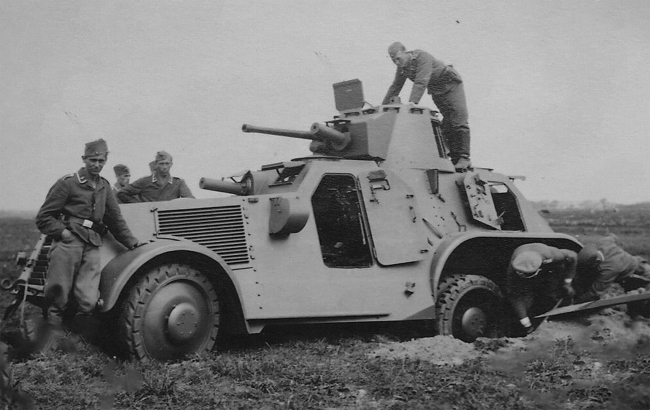
newer type Pantserwagen M-38, the Germans may be just testing the captured vehicle and therefore it is not yet equipped with German insignia, source: Flickr.com with the permission of the publishing user, edited
Landsverk L-180
The experience gained during the production of the L-181 was put to good use by Landsverk when developing its successor, the L-180. The new vehicle received a revised chassis, a more powerful engine, and slightly heavier armour. To keep costs down, the designers once again turned to a commercial truck chassis — this time from Büssing-NAG. The engine also came from the same manufacturer: a petrol-powered eight-cylinder of the type L8V. With a displacement of 7.9 litres and an output of 150 horsepower at 3,000 rpm, it was a considerably more powerful unit than that of the first-generation vehicle.
Here too, the chassis required a series of modifications: a new rear driver's station, solid rubber-tyred wheels in place of standard pneumatics, a second gearbox enabling rapid reverse travel, and further changes. The hull of the Landsverk L-180 followed a very similar layout to that of its predecessor, though the vehicle was overall larger and more robust. The engine bonnet was again fitted with louvres on the front and sides, but these differed in shape from those of the older L-181 and featured a denser grille pattern. Hull armour thickness was 9 mm all around — front, sides and rear alike.
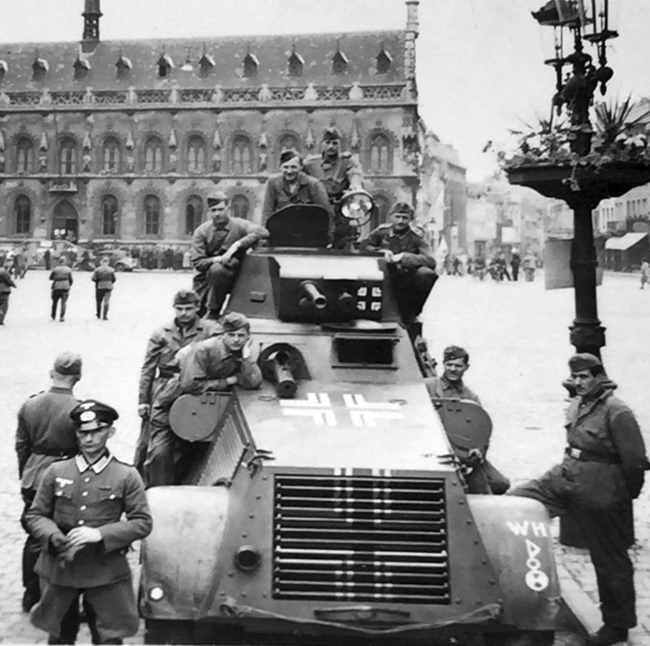
Pantserwagen M-38 in German service as Panzerspähwagen L202(h), note the non-standard headlight on the turret roof, source: Flickr.com with the permission of the publishing user, edited
Pantserwagen M-38
In 1937, the Dutch Army ordered 14 vehicles of the L-180 type from Landsverk — 12 in the standard combat configuration and 2 as command vehicles. As with the older L-181, the Dutch had the same armament installed: a Bofors 37 mm cannon and three Lewis M.20 machine guns in 7.92 mm. The vehicle could carry 60 rounds for the cannon. The Landsverk L-180 had a crew of five: front driver, front machine gunner, rear driver/machine gunner, turret gunner and commander. It weighed an even 7 tonnes (though some sources cite 7.4 or even 7.8 tonnes) and could reach a top speed of 65 km/h forward and 40 km/h in reverse.
The command vehicles were fitted with special turrets featuring a raised cupola equipped with observation periscopes around the circumference. The command vehicles carried no cannon, but bore at least a dummy barrel as a form of "camouflage." Some sources suggest that the command vehicle's turret also lacked a real machine gun, its barrel likewise being a dummy. Photographs, however, show that the machine-gun barrel on the command vehicle was movable, which raises the question of why that would be the case if it were truly a fake.
According to most sources, the Dutch managed to take delivery of only 13 of the 14 ordered vehicles before they were attacked — one of the two command vehicles was missing. The new armoured car entered service as the Pantserwagen M-38. All 13 vehicles were assigned to the 2nd Armoured Car Squadron (2de Eskadron Pantserwagens), which was officially established on 1 June 1938. The unit was based in Amersfoort and commanded by Captain J. R. Bruinier. During the May 1940 fighting, the squadron was actively engaged against the Germans. At least three Pantserwagen M-38 vehicles were seriously damaged in the fighting, and the unit suffered six killed and several wounded.
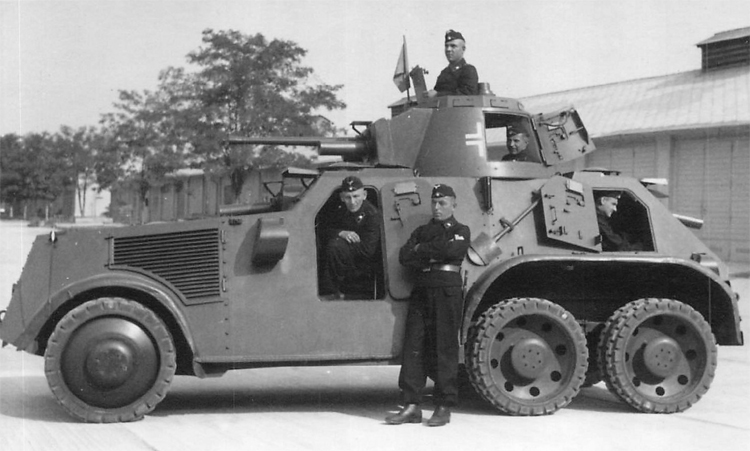
Pantserwagen M-38 or Panzerspähwagen L202(h) with its crew, source: Flickr.com with the permission of the publishing user, edited
After the Dutch capitulation, the Germans captured an exact number of these armoured cars that remains unknown and pressed them into service under the designation Panzerspähwagen L202(h). Notably, the Germans used the same designation for both the M-36 (L-181) and the M-38 (L-180) alike. Four armoured cars were demonstrably assigned to the reconnaissance battalion of the 227th Infantry Division. Within that unit they initially performed garrison duties in France before, by all accounts, accompanying the division to the Eastern Front. Photographs confirm that German crews made various minor modifications to at least some of the vehicles to suit their needs: at least one vehicle received new wheels fitted with standard pneumatic tyres, and the rear Lewis machine gun was replaced with a German MG 34.
Technical Specifications
|
|
L-181 / M-36 |
L-180 / M-38 |
|
manufacturer: |
AB Landsverk |
AB Landsverk |
|
chassis: |
Mercedes-Benz G 3a |
Büssing-NAG |
|
engine: |
Daimler-Benz M09 II |
Büssing-NAG L8V |
|
engine output: |
68 hp |
150 hp |
|
max. speed: |
65 km/h |
65 km/h |
|
hull armour: |
|
|
|
- front: |
9 mm |
9 mm |
|
- sides: |
7 mm |
9 mm |
|
- rear: |
7 mm |
9 mm |
|
crew: |
5 men |
5 men |
|
armament: |
Bofors m/34 cannon, 37 mm 3× Lewis M.20 machine gun, 7.92 mm |
Bofors m/34 cannon, 37 mm 3× Lewis M.20 machine gun, 7.92 mm |

ARTICLE
CONTENTS:
Reproducing text from the Panzernet website without the written consent of the operator is prohibited.