Sd.Kfz. 247
armoured command car
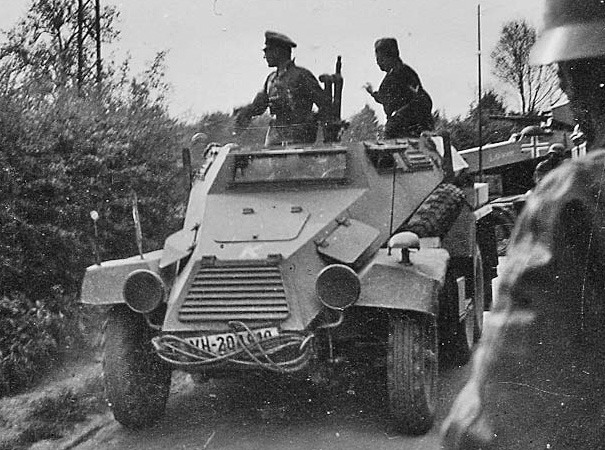
Sd.Kfz. 247 Ausf. A. Source: militarymodels.co.nz, used with permission of the site operator, edited
Origins of the Vehicle
In 1936, acting on requirements submitted by senior commanders, the German Army Weapons Office (Waffenamt) drew up the specification for a new armoured staff car. This was not intended as a fighting vehicle but as a command car — one that would allow senior officers to move safely in the vicinity of the front. The result was an armoured vehicle designated Sd.Kfz. 247. It was ultimately produced in two quite different variants, designated Ausf. A and Ausf. B.
Production of the first variant was begun in 1937 by Daimler Benz (Krupp is sometimes cited as the manufacturer instead). To save development time and cost, the chassis and powertrain were taken directly from the standard truck Krupp L2H 143, also known as the Protze. An armoured superstructure of flat steel plates welded together at various angles was then fitted to this chassis.
Design Description
The vehicle ran on three axles with six single wheels fitted with conventional tyres. The front wheels were steerable and suspended on leaf springs. The wheels of both rear axles were driven and each side was sprung by a single horizontally-mounted coil spring shared between the two rear axles. Power came from the air-cooled Krupp M304 four-cylinder petrol engine, displacing 3,308 cc and producing a maximum of 60 horsepower at 2,500 rpm. The ZahnradFabrik-Aphon Gb35bL gearbox offered four forward gears and one reverse. A fuel supply of 110 litres was sufficient for approximately 350 km on road and around 220 km cross-country.
The armoured hull was entirely in keeping with contemporary German armoured car design. The hull widened upward from the chassis before narrowing again toward the roof. This meant that even the side walls had no vertical surfaces on which enemy projectiles could strike at a right angle — they always hit at some oblique angle, improving the armour's effectiveness. Armour thickness was most likely 6 mm on the hull floor and 8 mm on all other surfaces.
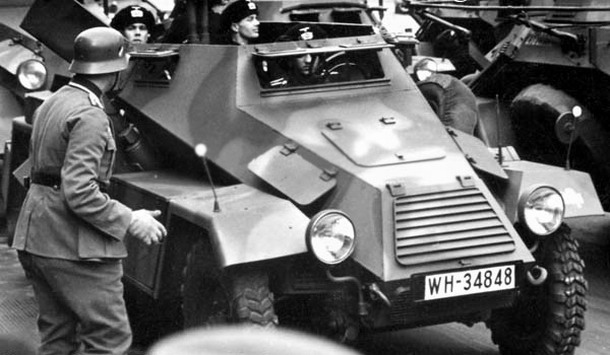
Sd.Kfz. 247 Ausf. A — note the open upper section of the entry door in the right wall. Source: kfzderwehrmacht.de, used with permission of the site operator, edited
The elongated front section of the hull housed the engine and gearbox. In the very nose, openings were cut in both the upper and lower plates for cooling air intake (the lower section of the nose is rarely visible in photographs, being obscured by the number plate). The air intakes were covered by horizontal fixed louvres. Headlights were mounted on either side of the nose, ahead of the front wheel mudguards. Some vehicles were also fitted with a Notek blackout driving light on the left front mudguard.
Photographs clearly show two hinges on the edge between the louvred front wall and the upper engine bonnet, indicating that the entire upper section of the front wall could be opened to provide access to the nose of the engine compartment. Further service hatches for access to the powerplant were provided in both side panels and in the upper plate of the engine bonnet. The space behind the front mudguards was used on the left side of the vehicle to stow the spare wheel, while on the right a wooden crate for equipment was secured, along with a fire extinguisher. Each pair of rear wheels shared a single mudguard on each side, which additionally served as a mounting point for a tool box and other items. A spade and pickaxe were hung on the left side of the hull toward the rear.
Behind the engine compartment began the crew compartment. In its front wall were two slit-type vision ports for the driver and commander, both set in a single hinged plate that could be lifted upward to give a much better view. In combat areas this plate remained closed, with the crew relying on the observation slits alone. Further vision ports were provided for the commander and driver in the side walls of their positions — one for the commander on the right, and two side by side for the driver on the left. These too were fitted with a closable cover incorporating a slit for use in dangerous areas.
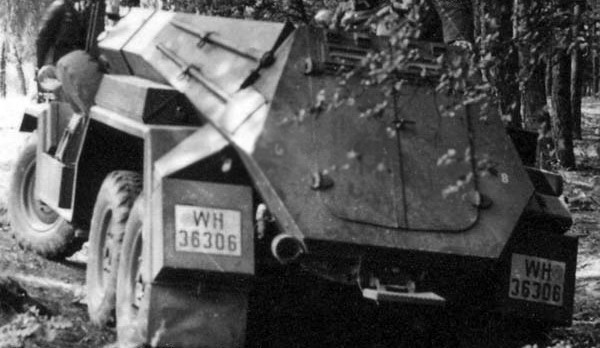
Rear view of the Sd.Kfz. 247 Ausf. A — note the large entry doors and the step beneath them. Source: kfzderwehrmacht.de, used with permission of the site operator, edited
As the above makes clear, the driver and commander sat side by side in the forward part of the compartment — driver on the left, commander on the right. These two men formed the vehicle's permanent crew. Behind their seat backs began the widest section of the compartment, which served as the main working space for the officers on board. Mounted in the centre of this area was a stand for securing a binocular artillery periscope, allowing officers to observe the battlefield. Entry and exit doors were provided in both side walls of this section.
Given the vehicle's intended role, it was assumed that not only young agile soldiers but also older senior officers would need to board and disembark. The doors therefore had to allow comfortable entry and exit, and consequently had to be quite large. The angled shape of the hull sides — the lower half narrowing downward and the upper half narrowing upward, like a coffin — made this no simple matter, and the doors had to be designed in two separate sections. The smaller upper section formed a complete rectangular cutout from the top portion of the side wall. The larger lower section extended deep into the lower part of the side wall and followed the line of the rear wheel mudguard. Each section had its own interior handle and could be opened independently — both opened toward the front of the vehicle, one swinging upward and the other downward. To make boarding even easier for senior officers, a grab handle was welded to the top of the hull beside each set of doors.
Behind this working area was a large padded bench seat for two men. One vision port was provided on each side above this bench, with a cover and slit. The bench marked the end of the widest section of the vehicle, beyond which the hull began to taper toward the tail. In this rearmost section of the compartment were positions for the last two men on board — either two individual seats or another two-person bench — facing rearward, with their backrests meeting those of the bench in the main working area.
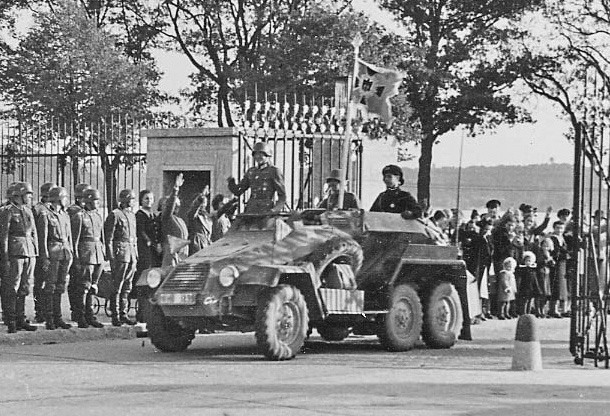
Sd.Kfz. 247 Ausf. A. Source: militarymodels.co.nz, used with permission of the site operator, edited
Entry and exit for these last two crew members was provided by large double doors in the rear wall of the hull. A pair of closable vision ports, one in each door leaf, gave them a view to the rear. The door leaves effectively formed the top edge of the rear wall; when opened, they created a genuinely unobstructed passage through the rear wall rather than merely a hatch requiring one to stoop. Officer comfort was, of course, the priority throughout — and for the same reason a folding step was fitted below the rear doors.
As the above text makes clear, the Sd.Kfz. 247 Ausf. A could accommodate up to six men. Given its purpose, the vehicle had no integral armament. The crew's only weapons were their personal sidearms and a single MP38 submachine gun stowed in the compartment with its ammunition. The compartment roof was open, allowing the crew to bail out over the sides in an emergency. In poor weather a waterproofed tarpaulin was draped over the open top.
The full official designation of this variant of the armoured staff car was "schwerer geländegängiger gepanzerter Personenkraftwagen (6 Rad)" — literally "heavy cross-country armoured personnel car (six-wheeled)". In some references, this already considerable title was further extended by "mit Fahrgestell des l. gl. Lkw" — meaning roughly "on the chassis of a light cross-country truck".
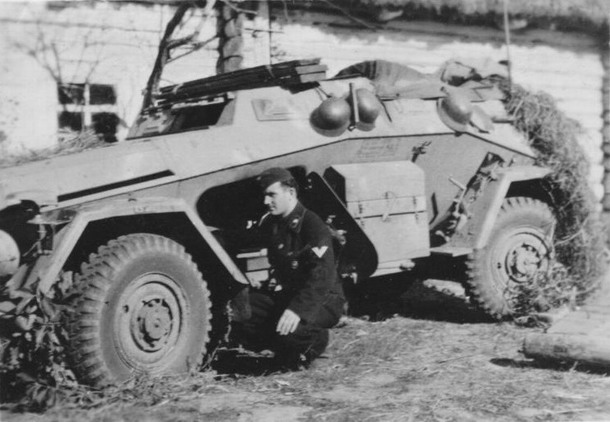
Sd.Kfz. 247 Ausf. B — note the open access hatch. Source: Flickr.com, used with permission of the publishing user, edited
The Sd.Kfz. 247 in its first variant weighed 5.2 tonnes and had a maximum road speed of around 70 km/h. Production ran only at the turn of 1937 and 1938, and a mere ten or so examples were completed. One curious point is that the literature makes virtually no mention of any radio equipment for this vehicle, nor are any aerials visible in photographs. If the Sd.Kfz. 247 was truly not fitted with a radio, that was a rather significant shortcoming given the role it was meant to fulfil.
Ausführung B
The Ausf. A was followed in production by the newer Ausf. B variant, which differed from it considerably. The Ausf. B was based on a four-wheeled Horch chassis with each wheel independently suspended and sprung by a coil spring, all four wheels being driven. The exact type of chassis used is a matter of some disagreement in the sources. Horch developed and produced two types of so-called universal chassis. The Einheitsfahrgestell I (also known as the Horch 801) had a rear-mounted engine and was designed from the outset for armoured vehicle construction — it served, for example, as the basis for the Sd.Kfz. 221. The Einheitsfahrgestell II, with a front-mounted engine, was by contrast intended primarily for cross-country passenger and cargo vehicles. Some sources state that the Sd.Kfz. 247 Ausf. B used the Einheitsfahrgestell I chassis but with the engine relocated to the front. Others hold that it was built on the Einheitsfahrgestell II and was the only armoured vehicle ever based on that chassis.
Similar disagreements surround the engine and the year production began. The powerplant is variously cited as the Horch V8 3.5 litre eight-cylinder producing 75 horsepower, the more powerful Horch 3.8 litre with 81 horsepower, or even its later version producing 90 horsepower. The start of production is given in some sources as 1938 and in others as 1941.
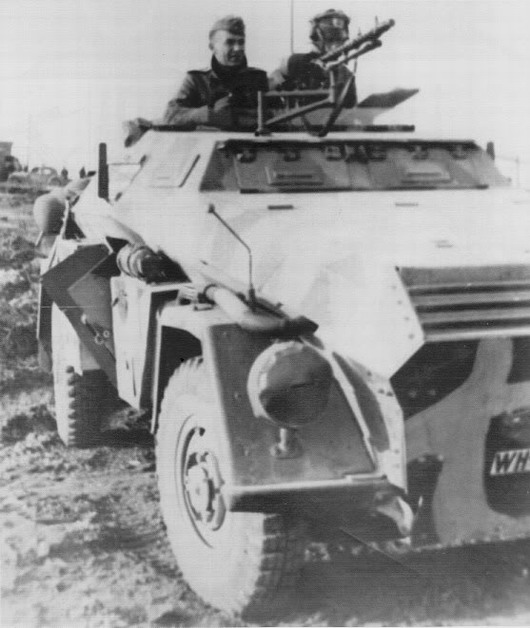
Sd.Kfz. 247 Ausf. B — note the MG 34 machine gun. Source: Flickr.com, used with permission of the publishing user, edited
The production start date and the engine type are probably best considered together. If the vehicle was indeed built from 1938, it could well have been fitted with the 3.5 litre engine to begin with, later replaced in production by the more powerful unit — as happened with other vehicles. If, however, Ausf. B production only began in 1941, the vehicle would most likely already have been equipped with the final Horch 3.8 litre engine producing 90 horsepower from the outset. A production start in 1938, immediately following the end of Ausf. A production, would make logical sense. On the other hand, the literature makes virtually no mention of the Ausf. B in combat before 1941 — for example in Poland or France.
Whichever chassis was used — Einheitsfahrgestell I or II — a new hull was required to go with it. Again consisting of upper and lower sections with walls angled in opposite directions, the hull had an unusually high lower front plate. Between it and the engine bonnet was only a relatively narrow strip of louvred engine air intake. The engine compartment sides featured cooling air outlets, though these were concealed behind protruding armour plates. A large opening in the bonnet, closed by what appears to have been a multi-piece cover, gave service access to the engine. A standard headlight was mounted on each front mudguard, with an additional Notek blackout light on the left, and rear-view mirrors for reversing were also fitted.
Behind the engine compartment was the crew compartment. Its front wall contained two separate closable vision ports for the driver and commander, each fitted with an observation slit for use in combat areas. Behind the front wall sat the commander on the right and the driver on the left. Side vision ports were provided in the walls beside each position, again with closable covers and slits. The front section of the compartment, above the driver's and commander's seats, was roofed over. The remainder was open at the top, with a waterproof canvas available for use in poor weather. This open section provided space for a further four men. Four vision ports were fitted in the side walls of the compartment in total — two on each side — though the seating arrangement in the rear section is not entirely clear.
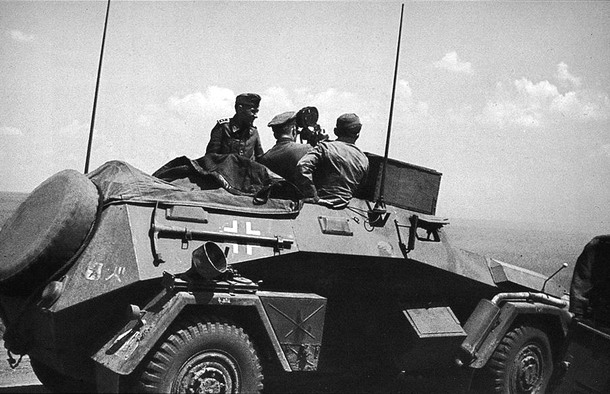
Sd.Kfz. 247 Ausf. B. Source: Flickr.com, used with permission of the publishing user, edited
Entry and exit was provided by two access hatches in the side walls — one on each side, in the lower portion of the hull. On the left, a trapezoidal hatch was positioned immediately behind the front mudguard, with a single-piece cover opening toward the rear of the vehicle. On the right, a square hatch positioned closer to the rear wheel had double-leaf doors. On this version of the staff car these were genuine hatches rather than the full doors of the Ausf. A — the officers had to duck to get in. The partially open compartment still, of course, allowed a rapid exit by simply vaulting over the upper edge of the armour.
The lower sections of the side walls beside the access hatches also provided mounting points for tool and equipment boxes — sometimes attached directly to the hatch doors themselves. On the upper portions of the sides, a spade or pickaxe could be secured, and aerial mounting brackets for the radio were also located here. A spare wheel was hung on the rear wall. Armour thickness was 5 mm on the hull floor, 6 mm on the partial roof over the front cab, and 8 mm on all other surfaces.
The engine exhaust ran along the right front mudguard and exited at the bottom of the hull. The Horch Einheits gearbox offered five forward gears and one reverse. With a more powerful engine than the Ausf. A — whatever its exact output — and a lower weight of 4.46 tonnes, it is unsurprising that the Ausf. B achieved a higher maximum road speed of up to 80 km/h. The 120-litre fuel tank was sufficient for approximately 400 km on road and 270 km cross-country.
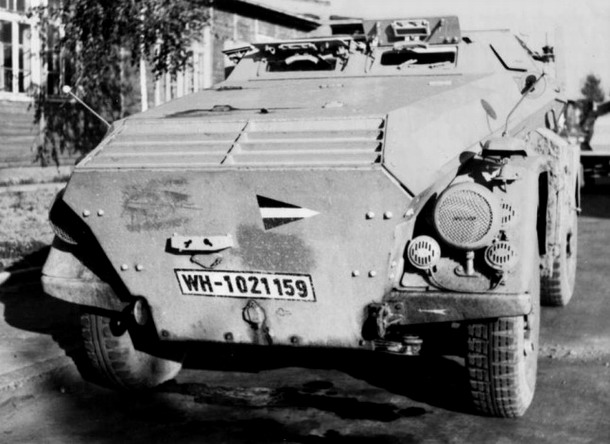
Sd.Kfz. 247 Ausf. B. Source: warwheels.net, used with permission of the site operator, edited
Like the Ausf. A, this version of the Sd.Kfz. 247 had no built-in armament. Photographs clearly show, however, that some vehicles were fitted with a mounting bracket for an MG 34 machine gun, positioned on the partial roof at the front of the open compartment.
The crew complement remained the same as on the first variant — up to six men. The Ausf. B was fitted with a radio. As for the production period, two different accounts have already been noted: one gives 1938 to 1942, the other only from July 1941 to January 1942. The negligible number of vehicles built argues in favour of the shorter period. Only 58 examples were completed in total.
From roughly the middle of the war these staff cars were gradually withdrawn from active service and replaced by more modern vehicles based on half-track armoured personnel carriers, which were far better suited to the demanding terrain of the Eastern Front in particular.

ARTICLE
CONTENTS:
Reproducing text from the Panzernet website without the written consent of the operator is prohibited.