TANK T-111
armour matters more than speed
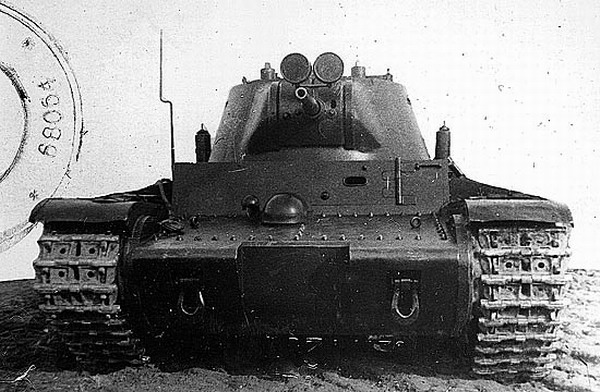
T-111 prototype, also known as the T-46-5, source: Aviarmor.net with permission, edited
Origins of the Project
In the first half of the 1930s, work was under way at Leningrad's factory No. 185 on a successor to the T-26. This resulted in the prototype convertible tank T-46, built in 1935, and its improved version T-46-1, completed a year later. The T-46, however, did not bring sufficiently significant improvements and was not accepted for production. A replacement for the ageing T-26 was still urgently needed, and so work at the Leningrad factory continued. The head of the factory's experimental design bureau, S. A. Ginzburg, believed that the new tank should focus not so much on speed, but above all on the strength of its armour. The later famous designer M. I. Koshin also participated in developing the new vehicle. Whether he was involved from the very beginning or joined at a later stage is not clear from the sources, but he too undoubtedly supported the idea of prioritising armour protection over high speed. According to some sources, the project description even carried the label "malyy tank tyazhologo bronirovaniya" — a small tank with heavy armour.
Tanks built during and after the First World War had no need for particularly thick armour — they were designed to provide protection against machine gun fire, rifle fire, and shell fragments. From the early 1930s onwards, however, anti-tank artillery developed rapidly, and the armour protection that had previously been adequate no longer met the demands of the modern battlefield. This applied equally to the T-26, which was based on the British Vickers Mark E design from the late 1920s and had armour only 13 mm thick — later increased to 15 mm. Soviet tankers experienced this first-hand when T-26s were committed to the Spanish Civil War. The designers therefore set out to build a tank whose armour would be proof against anti-tank gun fire.
The First Prototype
Work on the new tank at Leningrad's factory No. 185 began in 1936, and in April 1938 the first prototype was completed. The new vehicle carries two different designations in the sources — T-111 and T-46-5 (I will use T-111 throughout). The designation T-46-5 reflects the lineage from the earlier T-46 and T-46-1 prototypes, though in its actual design the new tank was very far removed from those older machines.
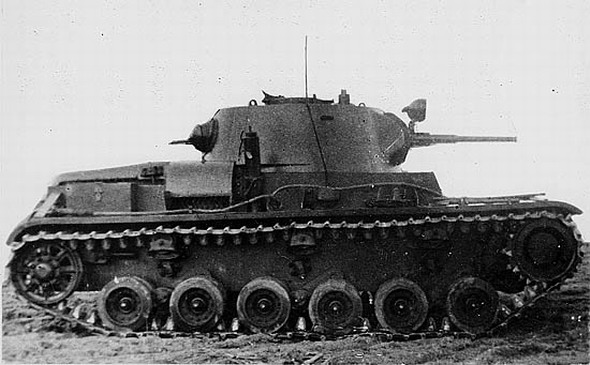
T-111 prototype, source: Aviarmor.net with permission, edited
Technical Description
The T-111 prototype rode on a running gear consisting of six paired small-diameter road wheels on each side, fitted with rubber tyres. At the front was the toothed drive sprocket, at the rear the idler wheel, and three return rollers carried the upper run of the track. The road wheels were paired, each pair sharing a common spring — the modern torsion bar suspension system was not used. What was progressive, however, was the concealment of the springs inside the hull, where they were less vulnerable to damage.
The hull was constructed from steel plates joined primarily by the modern technique of arc welding, though riveting was still used at some joints. The turret was cast. The frontal armour of the hull and cab was a full 60 mm thick — genuinely extraordinary protection for its time. The remaining hull walls were probably 20 mm, with the floor and roof possibly thinner still. Turret walls were probably 50 to 60 mm. Ballistic tests carried out in the summer of 1938 showed that the hull front could withstand fire from 37 mm and 45 mm anti-tank guns at any range. Some sources also mention resistance to 76.2 mm gun fire, though at that calibre the outcome presumably depended on the range. In any case, compared to the T-26 and T-46, this was not merely a step forward in armour protection — it was a leap.
Behind the hull nose rose the front wall of the crew compartment. In its left section was the driver's rectangular hatch, covered by a single-piece lid. The lid was mounted on a heavy hinge and opened sideways to the left. An oval vision port was cut into the lid to give the driver a view forward when it was closed. The turret had a circular footprint with an extension at the rear. From its front face projected the gun mount housing the cannon and its coaxial machine gun. The cannon was the 20K of 45 mm calibre. The 7.62 mm DT machine gun was positioned to the right of the cannon, and a second machine gun of the same type was installed in a ball mount in the rear turret wall. Ammunition stowage was 121 rounds for the cannon and 3,000 rounds for the machine guns. Vision slits were cut into both side walls of the turret. Two observation periscopes projected from the turret roof, with a ventilator outlet between them. Two hatches, each with a single-piece cover, were also located in the roof.
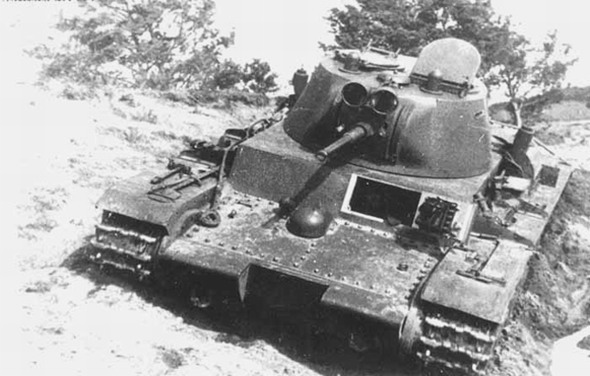
T-111 prototype during trials, source: Aviarmor.net with permission, edited
The crew consisted of three men. The driver sat alone in the hull. The loader and the gunner — who most likely also served as commander — were stationed in the turret. In the rear of the hull was the engine compartment, housing the MT-5 diesel engine producing a maximum of 300 horsepower (330 hp is also cited). The gearbox was located in the hull nose and connected to the engine by a driveshaft. Weight grew in proportion to the armour, and is variously given as between 28 and 32 tonnes. Although the project had started out as a light tank, the final weight placed it firmly in the medium tank category. The original design had aimed for a weight of only around 18 tonnes, and the much heavier prototype was consequently underpowered.
Overall Assessment
The underpowered engine was, however, only part of the problem created by the unexpectedly high weight. The other was the drivetrain, which had also been designed for a lighter vehicle and was therefore severely overloaded in the prototype, with a corresponding tendency to break down. The prototype's maximum speed was 30 km/h — representing zero progress over the older T-26. At first glance this might seem broadly acceptable, but it was the maximum speed; in practice, and especially cross-country, the tank moved considerably slower.
In the end, the designers were never even given the chance to fix the tank's shortcomings. The project was officially cancelled, probably in 1939, and work was brought to a close. Soviet military officials decided to direct their efforts toward other more promising projects, such as the T-126 SP — the prototype for the T-50. Despite its failure, the T-111 project provided Soviet designers with valuable experience, particularly in manufacturing and working with heavy armour plate. Mikhail Ilyich Koshin even received the Order of the Red Star for his work on the project.
Technical Specifications
Weight |
28 – 32 t |
Length |
5.26 m |
Width |
3.11 m |
Height |
2.416 m |
Engine |
MT-5 |
Maximum output |
300 – 330 hp |
Maximum speed |
30 km/h |
Armament |
1x 45 mm cannon 20K 2x 7.62 mm DT machine gun |
Crew |
3 men |

ARTICLE
CONTENTS:
Reproducing text from the Tankist website without the written consent of the operator is prohibited.