TANK T-46
the rejected convertible tank
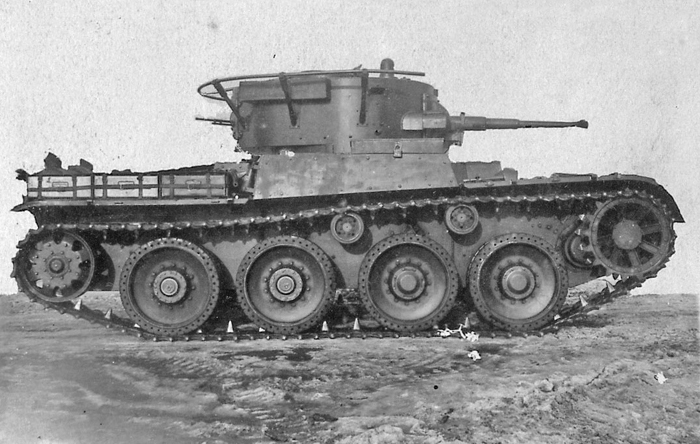
T-46-1 prototype, here on tracks, source: war-book.ru, edited
The light tank T-46 was the result of an attempt to create a more modern successor to the T-26. The new type was intended to bring improvements above all in the areas of armour protection and speed. Work on it began in 1933 or 1934 at the experimental design bureau (also known as OKMO) of the Leningrad S. M. Kirov factory No. 185, with S. A. Ginzburg as chief designer of the new vehicle.
Technical Description
To ease development, the designers borrowed certain elements from the T-26 — in particular, the overall shape of the hull and turret was very similar to the T-26 model 1933. What was entirely new, however, was the running gear. Gone were the small road wheels linked in bogies with leaf springs; instead, a Christie-type arrangement was adopted, similar to that of the BT series. The T-46 was thus to have four large paired road wheels with rubber tyres on each side, and like the BT tanks it was to be a convertible — capable of running either on tracks or on the road wheels alone. The running gear group was completed by a front toothed drive sprocket for track drive, a rear idler wheel, and two return rollers supporting the upper run of the track.
By adopting the convertible arrangement, the designers were clearly aiming to meet the part of the specification that called for increased speed. Tanks built this way could achieve very high speeds with their tracks removed — in the case of the T-46, a maximum of around 80 km/h was anticipated. Trackless running was of course only possible on roads or other hard surfaces, not cross-country. In this mode the T-46 was driven by its two rear pairs of road wheels, while the two front pairs served for steering, as they could be turned side to side.
The hull of the new tank was formed from flat plates joined primarily by riveting. The designers had intended to replace this outdated method with modern electric welding, but this proved still too complex in practice. Armour thickness ranged from 8 mm on the thinnest plates to 22 mm on the thickest — a clear improvement over the T-26 model 1933, whose maximum armour was only 13 mm (later 15 mm).
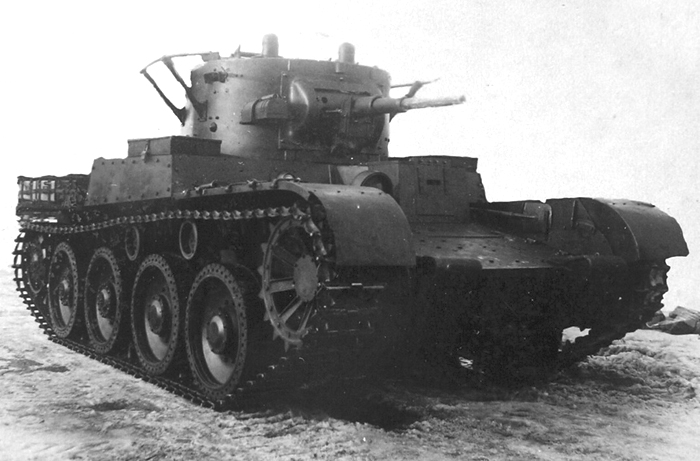
T-46-1 prototype, source: war-book.ru, edited
In terms of armament, the improvement over the T-26 was only partial. The main weapon remained the 20K cannon of 45 mm calibre — the same as on the T-26 model 1933 — along with the coaxial 7.62 mm DT machine gun positioned to the right of the cannon in the turret front face. A wholly new addition, however, was a second machine gun (again a DT) in the rear turret wall, and also an unusual flame-thrower installed in the turret to the right of the cannon and machine gun. Sources unfortunately do not make clear whether the flame-thrower was fitted on the first T-46 prototype or only on the revised T-46-1 version. Ammunition stowage was 101 rounds for the cannon, 2,709 rounds for the machine guns, and a 50-litre tank of incendiary mixture for the flame-thrower — sufficient for 10 to 12 bursts.
The number and layout of the T-46's crew remained virtually unchanged from the T-26. The driver sat alone in the forward cab behind the hull nose — though now on the left rather than the right as in the T-26. Behind him, in the main fighting compartment and turret, were the loader and the commander, who also served as gunner. The driver entered and exited through his own hatch in the wall in front of his seat. The turret crew used two hatches in the turret roof. The tank was equipped with a 71-TK-1 radio set — again, sources are unclear as to whether this was already fitted on the first T-46 prototype or only from the T-46-1 onwards. The radio was accompanied by a frame antenna mounted on several struts encircling the turret. The engine compartment was in the rear of the hull. The design originally called for a diesel engine of 180 to 210 horsepower, but no suitable diesel was available when the prototype was being built, and a petrol engine was used instead.
The first T-46 prototype was completed in 1935 and subsequently underwent both factory and army trials. The tank performed reasonably well overall, but certain shortcomings became apparent. Sources indicate that the prototype came in at around 14 tonnes — whereas the designers had originally anticipated a weight below 10 tonnes. Exceeding that figure by 40 percent inevitably showed in lower speed and mobility. The evaluation commission therefore decided that modifications were needed and that a further prototype version — or versions — should be built.
The T-46-1 Version
The first revised prototype, designated T-46-1, was completed in November 1936. The main change was the installation of a more powerful engine to compensate for the unexpectedly high weight. The designers were looking for a 300-horsepower diesel, which was again unavailable, and so they settled for a petrol engine producing 330 horsepower. The fuel capacity for it was 428 litres.
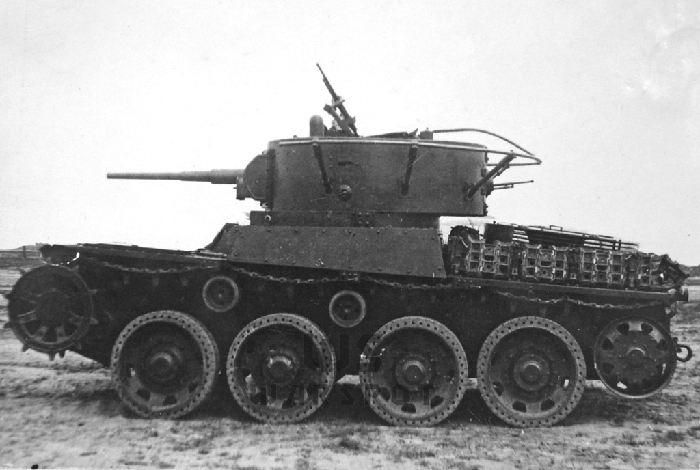
T-46-1 prototype with tracks removed, source: war-book.ru, edited
The T-46-1 prototype reached a speed of up to 72 km/h on its wheels on a road, bringing it closer to what the army had in mind. It was therefore transferred to the Leningrad K. E. Voroshilov factory No. 174 to begin preparations for series production. For that production run the flame-thrower was to be removed, as the army had reconsidered its use — perhaps on grounds of cost. Production was ultimately never launched, however, and the entire T-46 project was cancelled in 1937. The reasons for this decision are not entirely clear. The most likely explanation is that army officials concluded the new tank offered nothing substantially better than the fast BT tanks, while being considerably more expensive and complex to manufacture.
Combat Deployment
Despite this, a small number of tanks built to the production-ready configuration were apparently completed. They ended up in army storage depots with no prospect of battlefield glory — until October 1941, when a desperate Soviet command was searching for any armoured vehicle it could throw into the defence of Moscow against the advancing Germans. That was when the small stock of T-46-1s was called upon. They were not, however, deployed as conventional tanks: fearing that the vehicles might be unable to move after sitting idle for so long and would quickly break down on the battlefield, soldiers apparently removed their wheels and tracks and buried them in the ground with only their turrets projecting above the surface, to serve as static pillboxes. Whether even in this role they actually saw action against the Germans remains uncertain.
Technical Specifications
Weight |
approx. 14 t |
Maximum output |
330 hp |
Maximum speed |
72 km/h |
Fuel capacity |
428 l |
Armament |
1x 45 mm cannon 20K 2x 7.62 mm machine gun |
Crew |
3 men |

ARTICLE
CONTENTS:
Reproducing text from the Tankist website without the written consent of the operator is prohibited.