TANK BT-2
fast convertible tank
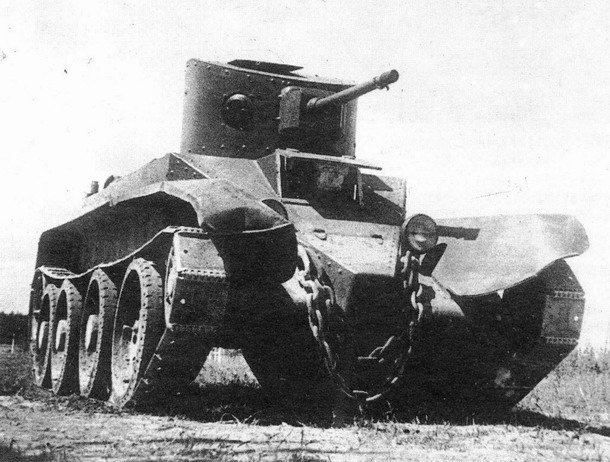
Light tank BT-2 in the version with cannon and supplementary machine gun, source: Aviarmor.net with permission, edited
Origins of the Tank
In 1929, the Soviet arms industry faced an extremely daunting — practically impossible — task: fulfilling the Red Army's tank and motorised vehicle rearmament programme. The programme outlined an ambitious vision for building weapons factories and mass-producing numerous types of armoured vehicles. Among other things, it called for the production of fast tanks capable of deep reconnaissance and wide flanking operations aimed at cutting enemy supply lines and encircling fighting units. Nothing then in service with the Red Army, in production, or at any reasonable stage of development could be described as a fast tank. The overall state of Soviet domestic industry and the capabilities of its design bureaux offered little hope of an early breakthrough. The Soviets therefore made the sensible decision not to wait for conditions at home to improve, but simply to buy the head start in development from more advanced countries.
For this purpose, a special procurement commission was formed under the leadership of the head of the Red Army's Mechanisation and Motorisation Directorate, I. A. Khalepsky. The commission's task was to find and acquire abroad such types of armoured vehicles as would meet the requirements set out in the programme. More important than purchasing the tanks themselves was obtaining the production documentation and licensing rights for manufacture in the USSR. The commission visited not only European countries but also the United States. The primary object of interest in America was reportedly the Cunningham light tank T1E1. That vehicle, however, ultimately failed to meet Soviet expectations, and Cunningham also demanded commercial terms that were impossible to accept.
The Soviet mission therefore pressed on, and in the spring of 1930 contact was made with designer John Walter Christie. The subject of negotiations was his latest creation — the prototype light tank M1931. Christie was a tireless advocate of what he called convertible tanks. Most of his designs were built on a suspension of his own invention, which used large road wheels, independently mounted and sprung by coil springs. The tracks could be removed and the tank could then travel on its road wheels like an automobile.
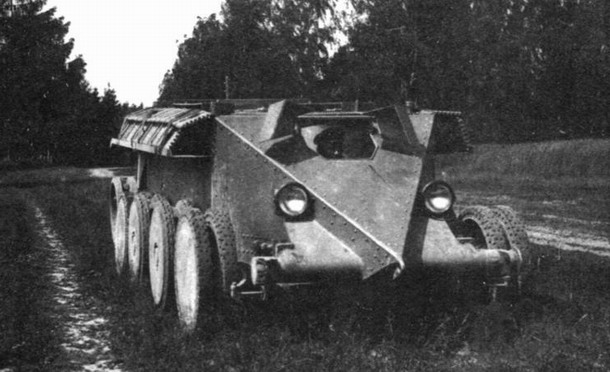
The purchased Christie M1931 chassis during driving trials in the USSR, source: Flickr.com, Public domain, edited
The US Army had shown little interest in Christie's creations, because it adhered to an entirely different tank warfare doctrine. While Christie built a fast machine with a long operational range, capable of striking deep into the enemy rear and destroying infrastructure, the American General Staff viewed the tank as a means of fire support for infantry and therefore demanded heavy armour and firepower rather than high speed. Christie's vehicles offered neither. Relations with the army were further complicated, reportedly, by Christie's stubbornness and the insults he allegedly directed at military officials.
Having failed at home, Christie decided to offer his tanks abroad and so very willingly entered into negotiations with the Soviets — it should be noted that he succeeded in other countries as well. The basic terms of the deal were agreed verbally between Christie and Khalepsky. In April 1930 they were confirmed in a written contract concluded officially between Christie's company, the U. S. Wheel Track Layer Corporation, and Amtorg Trading Corporation, the commercial organisation representing the Soviet Union in the United States. Some sources suggest the contract was signed not in April but as late as June 1930.
The contract called for the purchase of two Christie M1931 tanks, spare parts, complete production documentation, and a licence to manufacture in the Soviet Union for the next ten years. In addition, the designer undertook to make available to the Soviets all subsequent upgrades he carried out on the type. Christie reportedly also expressed willingness to travel to the USSR in person to assist with establishing series production — though whether this was included in the purchase contract is not entirely clear. The total value of the contract was $160,000 (which, incidentally, equates to roughly two million dollars at 2010 prices). The two tanks themselves cost $60,000, spare parts a further $4,000, and the largest portion of the price covered the production rights and documentation.
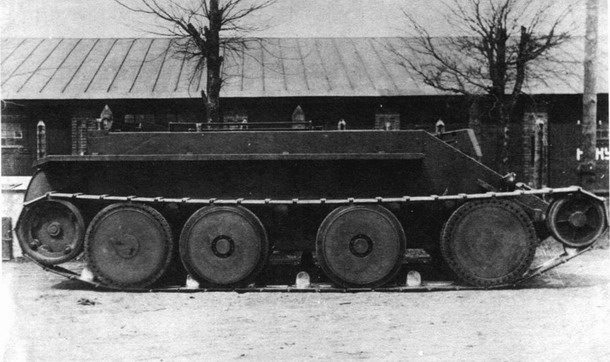
The purchased Christie M1931 chassis during driving trials in the USSR, source: Flickr.com, Public domain, edited
According to some sources, the entire transaction was conducted without the knowledge of American authorities, and both tanks were officially declared as agricultural tractors at customs. Other sources, however, maintain that everything was entirely legal and sanctioned by the appropriate bodies. It is possible that the confusion is introduced by a separate deal Christie concluded with the Soviets later — the purchase of one example of the M1932, which reportedly did take place without official approval.
The ordered tanks and other material were shipped from the United States on 24 December 1930 and apparently arrived in the Soviet Union in January 1931. The Christmas date is sometimes cited as the day the tanks arrived in the USSR rather than the day they left America. There is in fact no shortage of contradictions surrounding this transaction in the various sources. The most fundamental concerns what was actually purchased — complete tanks, or merely hulls without turrets and armament (which is precisely what was in fact delivered to the USSR).
The prevailing version holds that complete tanks were ordered, turrets and armament included. According to sources that follow this version, the absence of turrets was a breach of contract that was only discovered upon receiving the shipment in the USSR, and the Soviet side withheld $25,000 of the payment as a penalty.
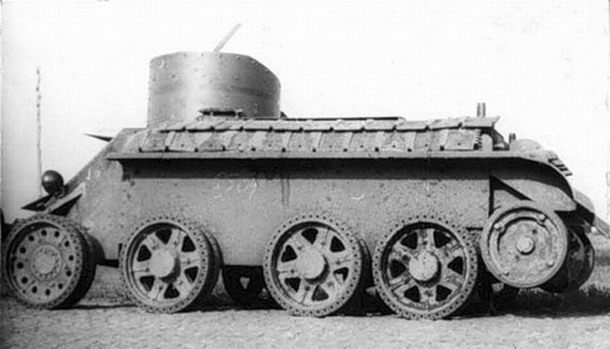
Already the Soviet BT-2 — note the cast road wheels with lightening holes, source: Aviarmor.net with permission, edited
The second version of the story, cited by a minority of sources, holds that the tanks were deliberately ordered without turrets and armament and that there was therefore no breach of contract. This version also has a certain logic to it. As for the armament of the original Christie M1931, I was unable to find any definitive information. Since it was a very recent creation still at the prototype stage, it is possible that at the time the deal with the USSR was concluded it did not yet have a finalised turret and armament configuration. When Christie later built evaluation prototypes of this vehicle for the US Army, they were armed with a 37 mm M1916 gun and a 7.62 mm machine gun, both of American origin — this was the infantry version designated by the US Army as the medium tank T3.
The Soviets most likely had no interest in those weapons — and why would they? If they wanted to mount them in their own tanks, they would have had to purchase an expensive production licence and go through the lengthy process of introducing the weapons into production. Why do that when they had their own suitable weapons? American weapons would have been useless to them, and paying for them as part of the tank purchase would simply have been a waste of money. In that case, they may not have needed the turrets either — since they would have had to rebuild them anyway to accommodate their own weapons — and could genuinely have ordered just the hulls.
The frequently cited $25,000 withheld by the Soviet side after delivery need not then have been a penalty for an incomplete shipment, but rather a contractual fine for missing the agreed delivery deadline. Delivery was supposed to take place within four months of signing the contract, which was not achieved — regardless of whether the contract was signed in April or June. Alternatively, it could have been a fine for incomplete documentation, which some sources also mention.
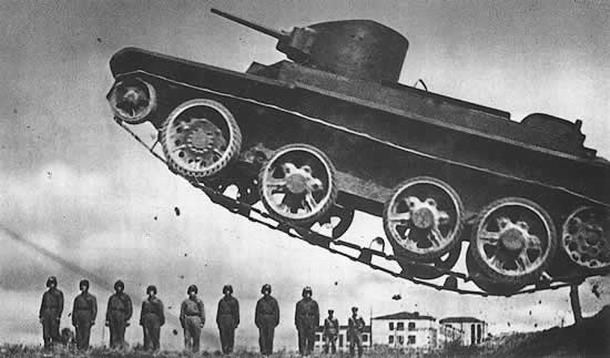
BT-2 performing a jump — a favourite stunt among drivers, source: Aviarmor.net with permission, edited
There is one more thing that supports the second version. Some sources mention that the export of the tanks from the United States was not blocked by the authorities because only the chassis and hulls were ordered — meaning they were not really combat vehicles at all, but rather something more like tractors... albeit armoured ones :-).
The Imported Christie Originals
Either way, both purchased tanks arrived in the USSR in January 1931 without turrets or armament. The Soviets reportedly referred to these two American-built examples as Original I and II, though the designation BT-1 is also sometimes encountered. One of the tanks was disassembled for a detailed study of its construction, while the other was sent in March 1931 to the test range at Kubinka. Driving trials began on 16 May — until then the tank had apparently been on display in the warehouse of the Auto-Tank Directorate, with one army dignitary after another coming to inspect it. Since the tank had no turret, its weight was simulated by an 800 kg ballast.
On the very second day of trials, 17 May, the right rear drive sprocket was damaged when the tank was turning on its tracks. The sprocket was repaired, but the weld cracked again after just 500 metres of track running. When the same problem recurred after a second repair, it was decided on 23 May to conduct all further trials without the tracks. The final report therefore noted that the tank had been tested almost exclusively on its wheels. The report summarised the shortcomings that would need to be resolved before series production, including oil system leaks, gears jumping out of engagement under high engine load, inadequate dimensions of the driver's hatch in the front plate — which made it very difficult to squeeze through — heavy and tiring steering on wheels at higher speeds, and similar issues. Overall, however, the report unequivocally recommended accepting the tank into service with the Soviet Army.
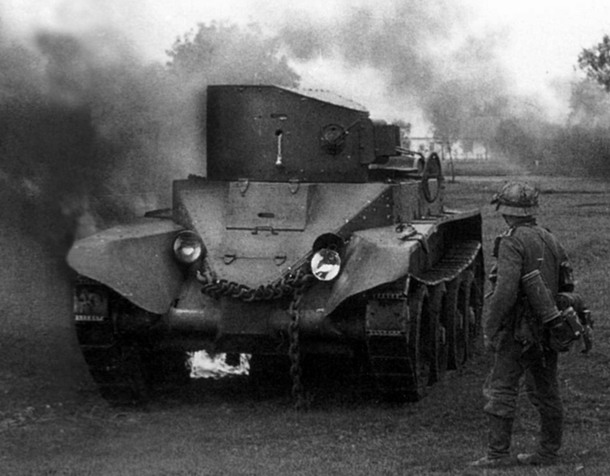
A burning BT-2 in the machine-gun-only configuration, source: Waralbum.ru with permission, edited
The preparation of documentation for series production, as well as the production itself, was entrusted to the Kharkov Locomotive Factory (KhPZ), plant No. 183. To this end, a new design bureau was established in May 1931 under the leadership of S. A. Ginzburg. The designers gathered there from several institutions and factories were tasked with preparing the technical documentation for the Soviet version of the tank by 15 July, and with completing the groundwork for introducing the tank into series production by 5 August. By 1 November 1931, the first six tanks were to be completed, and a further fifty by year's end. The new tank received the official designation BT-2 (BT = Bystrokhodny Tank = fast tank).
The designers had to solve a whole range of problems, including the already-mentioned absence of turrets, which therefore had to be developed from scratch. The manufacture of road wheels also turned out to be an unexpected complication. The Kharkov factory did not have the technology to produce stamped road wheels until the end of 1932. A large proportion of the tanks were therefore fitted with cast wheels. Although these were provided with lightening holes, they still added unwanted weight to the vehicle.
Start of Production in the USSR
Despite the difficulties, the documentation was completed on 26 June 1931. In preparation for production, a network of sub-suppliers was established. The Izhora plant in Kolpino was to supply armour steel, the Bolshevik plant in Leningrad was to supply suspension components, a Moscow radiator factory was to supply radiators, and so on.
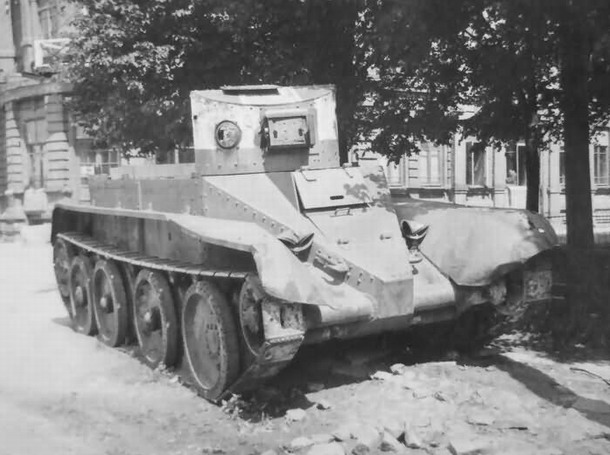
BT-2 in the machine-gun-only configuration, though here the machine guns have been removed, source: Worldwarphotos.info with permission, edited
Despite all efforts, neither the six tanks required by 1 November nor the fifty planned by the end of 1931 were completed. Instead, only three examples of the new tank were built, and even these were constructed from mild, unarmoured steel and suffered from poor workmanship. It is hardly surprising that the army refused to accept them. They did at least take part in a military parade in Kharkov.
Technical Description
The tank's running gear consisted of four road wheels on each side, 815 mm in diameter, fitted with rubber tyres. The wheels were paired so that the track guide teeth could engage between them. At the very rear was the elevated drive sprocket for the tracks, with a diameter of 640 mm. At the front was the smaller idler wheel. The road wheels were individually suspended and sprung by coil springs. The entire suspension concept was Christie's own invention and entered history under his name. The hull side walls were doubled, and in the space between them the road wheel springs were mounted vertically — except for the first wheel, whose spring was mounted horizontally inside the hull.
As already mentioned, the BT-2 was a so-called convertible tank, capable of running both on tracks and without them. The advantage of this concept was — at least in theory — the ability to achieve very high road speeds while sparing the tracks, whose service life was severely limited by the technology of the 1930s. Removing the tracks on the BT-2 was a 30-to-40-minute task. The removed tracks were stored on the mudguards and secured with leather straps. The tracks were 260 mm wide, each consisting of 46 links. Without tracks, the tank was driven by the rear pair of road wheels, with steering handled by the front steerable pair. When running on tracks, the driver used conventional brake levers; on wheels, a steering wheel was used — one that could be removed and refitted as required.
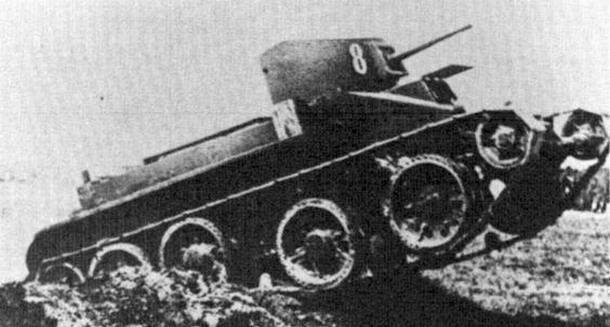
Light tank BT-2 armed with cannon only — one of the first 60 examples built, source: Flickr.com, Public domain, edited
The hull of the BT-2 was visually almost identical to the American original. It was built from rolled homogeneous steel plates joined by riveting. Plate thickness was 13 mm at the front, 10 mm on the sides, rear and roof, and just 6 mm on the floor of the hull. At the nose, the plates formed a kind of pointed bow. Unlike Christie's prototype, however, the BT-2's bow did not come to a true point — it was, so to speak, cut off flat. The purpose of the tapered hull sides at the front was not so much to increase protection as to create clearance for the turning of the front pair of road wheels.
From the sides of the hull nose, the idler wheel brackets projected outward, from which the mudguards extended back along the full length of the hull to the rear. From the sharply sloped upper nose plate rose the driver's compartment cover. Its front face opened upward and connected to a second hinged armour panel below. These two panels, opening away from each other, formed the hatch covering the driver's entry and exit opening. It is worth noting that this opening was considerably larger than on Christie's original, so that the driver could squeeze through it with some degree of comfort. The upper section of the cover was fitted with a vision slit through which the driver could observe his surroundings when operating in a combat zone.
Behind the driver's position was the main fighting compartment, and above it the fully rotating turret with the armament. This was where the second — and last — crew member was stationed, who therefore had to simultaneously serve as commander, gunner, and loader. As already mentioned, the turret was designed entirely from scratch by designer A. A. Moloshanov. It was cylindrical in shape and riveted together from 13 mm armour plate. The turret roof was horizontal at the rear and sloped at the front. In the rear part of the roof, slightly to the right, was the commander's entry and exit hatch, covered by a single-piece lid opening forward. An opening for flag signalling was later added to the sloped front section of the roof.
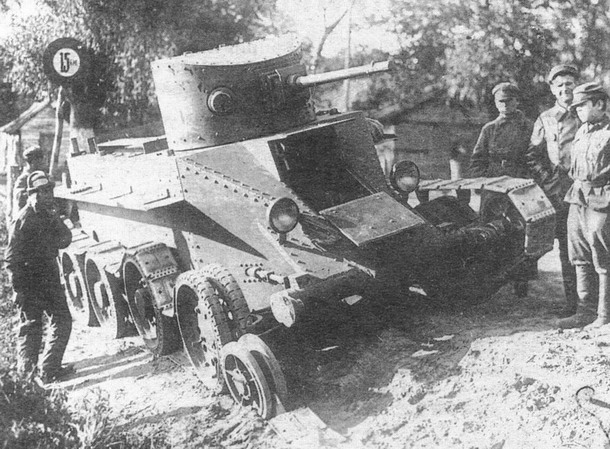
BT-2 in the standard configuration with cannon and supplementary machine gun, source: Flickr.com, Public domain, edited
Armament Variants
All armament was concentrated in the turret. The primary weapon chosen for the BT-2 was the B-3 cannon (factory designation 5-K) of 37 mm calibre, derived from a German Rheinmetall design. According to the original plan, a coaxial DT machine gun of 7.62 mm calibre was also to be fitted in the gun mantlet alongside the cannon — but this proved impossible to realise in practice.
Production of the B-3 cannon at factory No. 8 in Mytishchi near Moscow was running behind schedule, and so the first 350 BT-2 tanks were built without armament — the front plate of the turret simply left with an opening for the cannon to be fitted later. It soon became apparent that the weapons designers were struggling to fit a coaxial machine gun alongside the cannon. The supplementary machine gun therefore had to be mounted in a separate ball mount to the right of the cannon mantlet. This meant the machine gun did not point in the same direction as the cannon, but roughly 25° to the right. This naturally required a modification to the turret, consisting of cutting a circular aperture for the machine gun ball mount. The modification was applied from the 61st BT-2 produced.
When it became clear that problems with cannon B-3 deliveries would not be resolved any time soon, designers began looking for alternative solutions. Early in 1933, an attempt was made to install a 45 mm 20K cannon into the standard BT-2 turret. To this end, the turret had to be lightly modified. An 80 kg counterweight was added to its rear wall to balance the heavier gun and maintain the correct centre of gravity. Tests of the prototype were carried out in May 1933 and revealed a number of shortcomings. The small turret, designed for a single man and a light gun, now had to accommodate two men and a significantly more powerful weapon — and there simply was not enough room inside. Not only was working conditions for the crew extremely cramped, but the gun's recoil upon firing was literally dangerous for the commander. This was likely the main reason the proposal was rejected.
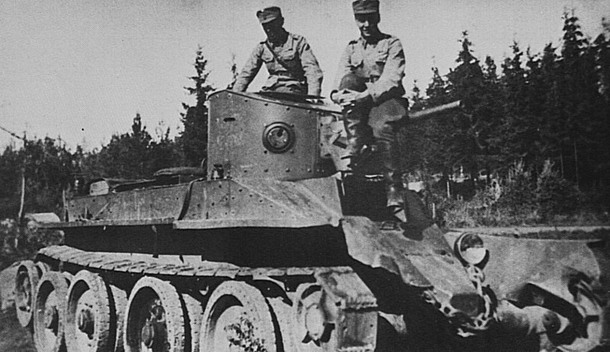
BT-2 captured by the Finns, source: Flickr.com with permission, edited
The designers therefore put forward another proposal for alternative armament. Instead of the cannon, two paired DA-2 aircraft machine guns of 7.62 mm calibre were installed in the front plate of the turret. Tests of this variant were carried out in June and July 1933 with positive results. The elevation of the twin machine guns ranged from -25° to +22°. They could also be traversed horizontally — independently of the turret — by 6° to the right and 8° to the left.
The production problems with the cannon and the difficulties of mounting the supplementary machine gun alongside it led to the emergence of three or four armament variants of the BT-2. The standard version was armed with the B-3 cannon and a DT machine gun in a separate ball mount to its right — though even this variant existed in two different cannon mantlet configurations. A large number were also built in the already-described variant with twin DA-2 machine guns instead of the cannon, plus the supplementary DT in a separate ball mount on the right. From the first sixty tanks, which had turrets without an aperture for the supplementary machine gun, a third variant emerged armed solely with the B-3 cannon. Some sources mention a fourth variant armed only with the twin paired DA-2 machine guns and no supplementary DT. This version would also have had to come from the first sixty vehicles without the machine gun aperture. Whether this last variant actually existed is not entirely certain — at any rate, I have never seen it in a photograph.
Behind the turret, in the rear of the hull, was the space for the engine, fuel tanks, and gearbox. Soviet designers specified the aircraft engine M-5 (sometimes also M5-400) for the new tank — a licence-built version of the American Liberty L-12. This was a water-cooled twelve-cylinder engine of 27 litres displacement, producing a maximum output of 400 horsepower at 1,650 rpm. There were not enough available for series production, however, and so 2,000 original Liberty L-12 engines were ordered from the United States. Since production of this engine had already ended in America, the Soviets had to settle for refurbished used units.
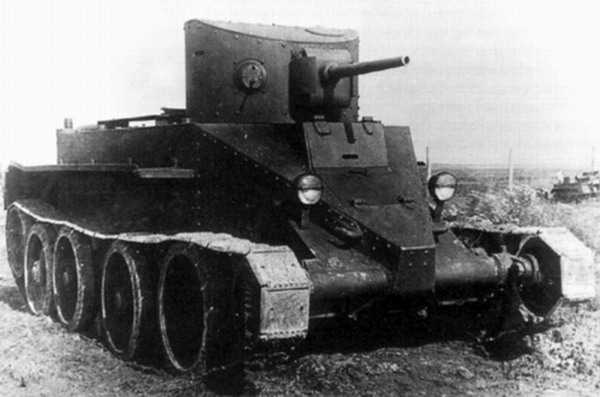
BT-2 in the standard cannon-and-machine-gun configuration, source: Wikimedia, Public domain, edited
The engine deck was quite complex in shape. Immediately behind the turret was a large access hatch opening toward the rear of the tank, allowing maintenance access to the engine below. On either side of the hatch ran covered air intake slots for the engine cooling system. The exhaust was further to the rear, protected by two large adjustable louvers. Mounted crosswise on the rear wall of the hull was a muffler with four exhaust outlets. Fuel capacity was 360 litres. The gearbox had four forward and one reverse gear.
The BT-2 weighed 11.3 tonnes. It measured 5.35 metres in length, 2.23 metres in width, and 2.16 metres in height. On a road it could reach a maximum speed of 52 km/h on tracks and 72 km/h on wheels, and approximately 35 km/h cross-country. Actual series production of the BT-2 began only in 1932. The plan for that year called for 600 vehicles, but only 434 were built — of which only 396 were accepted by the army. It should also again be noted that a large proportion of those tanks were completed without armament. Production continued in 1933, when a further 214 tanks were built. In total, 610 BT-2 tanks were handed over to the army (some sources give 620).
The first series vehicles suffered from a high rate of mechanical failures. The service life of the refurbished engines fell short of expectations, gearbox problems were frequent, and the tracks wore out very quickly. Many problems were also caused by the crews themselves, who lacked practical experience. Tank crews also complained about the intense heat inside the vehicle in summer and the bitter cold in winter. The technical shortcomings were certainly one reason why the BT-2 was regarded not as a true combat tank, but primarily as a training vehicle for bringing up a new generation of tankers — much as the light tank Panzer I served in the German Army.
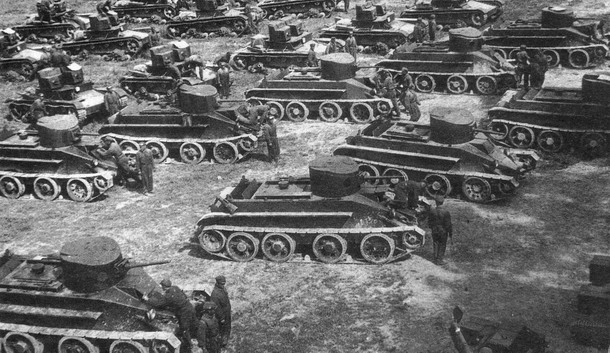
BT-2 tanks at a military unit, source: Flickr.com with permission, edited
BT-2 tanks began arriving at army units in 1932. The first unit to receive them was the 1st Mechanised Brigade of K. B. Kalinovsky of the Moscow Military District. In addition to brigades, BT-2s were also allocated to mechanised cavalry regiments, which from 1938 onwards were reorganised into tank regiments.
Despite the shortcomings described, BT tanks in general — and the BT-2 was no exception — began to win the affection of their crews, who gave them the nickname Betyusha. This was due above all to their high mobility and speed. Little wonder: the power-to-weight ratio of this tank was over 35 horsepower per tonne — compared to just over 11 hp per tonne for the T-26 model 1931. A particularly popular adrenaline pastime for drivers was jumping the tank at high speed. Clearing 15 to 20 metres was no challenge at all; record-breakers reportedly jumped as far as around 40 metres — which presumably sent the tank straight to the repair shop. Foreign military attachés who witnessed BT tanks in action at the Kiev manoeuvres of 1935 could scarcely believe their eyes.
Combat Deployment
Despite being designated as training tanks, the BT-2s did see combat. Exactly when and where they were first committed to action is unclear, as sources disagree. What is certain is that the BT-2 did not take part in the Spanish Civil War — only the more modern BT-5 was sent there. According to some sources, the BT-2 was first committed to combat in the summer of 1938 during the fighting against the Japanese at Lake Khasan. Other authors consider this an error, which would make Poland in September 1939 the type's first battlefield. No combat losses are reported for the type during the Polish campaign.
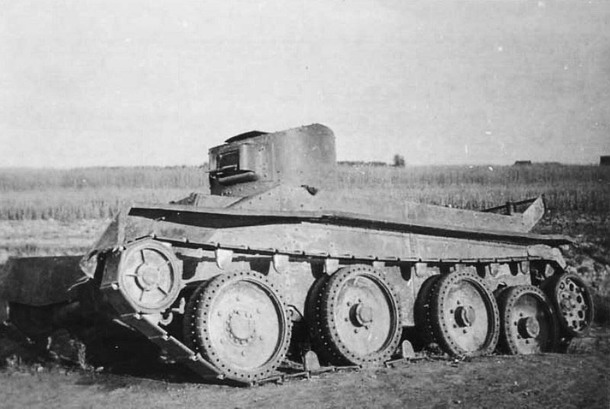
A destroyed BT-2 in the machine-gun-only configuration, here without the guns, source: Aviarmor.net with permission, edited
BT-2s were committed in considerable numbers to the Winter War against Finland at the turn of 1939 and 1940. Why the Soviets deployed these obsolete training tanks at all — given that they already had an overwhelming numerical superiority without them — is unclear. In Finland the BT-2s certainly did suffer losses, though the exact number destroyed was not something I was able to determine.
The type's most extensive combat use came of course during the Great Patriotic War against Nazi Germany, particularly in the first weeks and months. In June 1941 the Red Army had 587 BT-2 tanks on strength, but only 366 of those were in operational condition. The rest were either awaiting repair or had already been relegated to use as static instructional aids.
The results of their deployment were for the most part dismal. The 37 mm cannon — in those versions of the BT-2 that actually had one — was capable of penetrating the armour of light German tanks, but rarely got the opportunity to do so. The BT-2's armour was very thin and German guns could knock it out at long range. The tank's greatest asset — its high speed — could not be properly exploited in defensive fighting. In addition, the tanks were forced to make long road marches under their own power, which only increased mechanical breakdowns and therefore losses. The vast majority were lost very quickly. A few individual BT-2s still appeared as late as 1943 on the Leningrad Front.
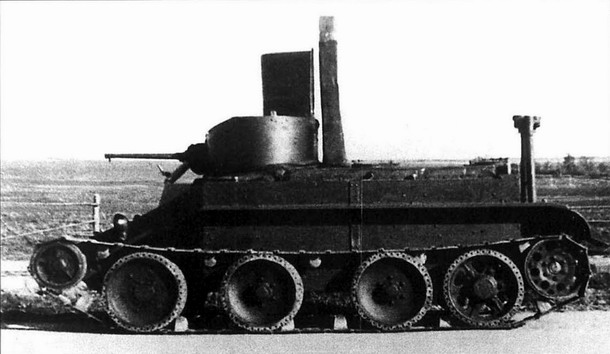
Submarine tank BT-2PCh, source: Aviarmor.net with permission, edited
Submarine Tank
A whole series of specially modified variants was developed on the BT-2 chassis. Among them was the submersible tank BT-2PCh (PCh = Podvodny Khod, underwater drive). The prototype was built by the parent factory KhPZ in 1934. Unlike the standard tank, it was fitted with additions to ensure the vehicle could be hermetically sealed. A sealing metal plate was bolted over the engine compartment — though some sources describe it as a textile cover, a claim that appears to be incorrect based on this photograph. The sealing plate was fitted with four closable circular openings.
Two of these openings connected to the engine cooling air intake, and two to the cooling air exhaust. During overland driving, these openings remained open so that cooling air could flow through and perform its function.
When preparing for underwater travel, the openings were closed with watertight covers. The plate itself remained permanently fitted to the tank, not just when preparing to enter the water — there was simply nowhere inside the tank to stow it once removed. It only needed to be removed when servicing the engine or gearbox.
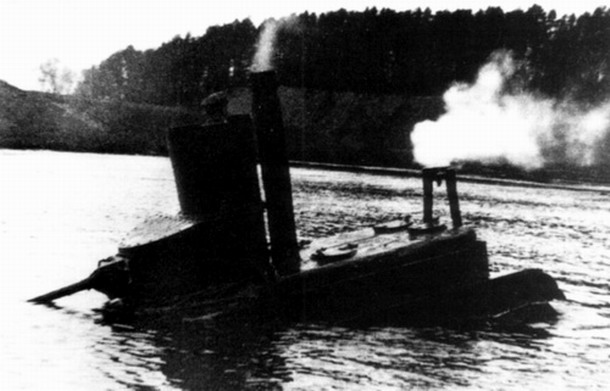
Submarine tank BT-2PCh, source: Aviarmor.net with permission, edited
The gun mantlet and turret ring were sealed with waterproof fabric (or possibly leather). The machine gun was removed from its ball mount, which was then also sealed with fabric or rubber. The driver's hatch had to be sealed in the same way. The exhaust muffler on the rear hull wall was unbolted and replaced with two pipes to carry the exhaust gases away. These pipes were relatively short and were not intended to reach above the waterline — the exhaust gases were to be discharged directly into the water, and the pipes were therefore fitted with non-return flap valves at their ends. Engine cooling was provided by the surrounding water.
For the supply of air to the engine as well as to the crew compartment, a long pipe was erected behind the turret. On the turret itself was a further pipe connecting to the roof hatch, which served as an emergency escape tunnel if things went wrong. Its diameter was 60 cm and its height 1 metre. Preparing the tank for underwater travel took the two-man crew approximately 90 minutes. Submerged travel speed was only around 3 km/h, and the tank could cover approximately 1 km this way. Maximum diving depth was 3 metres — though tests were conducted in a canal 4 metres deep. The entire solution had too many shortcomings, however, and was ultimately not accepted for production.
BT-2-IS Prototype
In spring — or according to some sources not until summer — 1934, a group of technicians from the 4th Tank Regiment of the Ukrainian Military District, led by N. F. Tsyganov, began work on an improved version of the BT-2. The order for this project came from the commander of the Ukrainian Military District, I. E. Yakir, who was seeking to impress his superiors. Tsyganov was a military engineer and an enthusiastic amateur designer who had already attracted the attention of senior army figures through his earlier work. His team of some twelve men worked on the technical documentation with remarkable dedication over many months, including weekends. The project was completed on paper in April 1935.
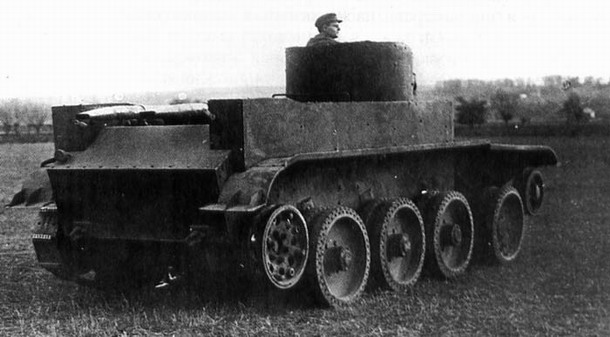
BT-2-IS prototype — note the newly designed hull rear, raised hull sides, and exhaust arrangement, source: Topwar.ru with permission, edited
On 23 April, I. E. Yakir presented the project in a report to the People's Commissar of Defence, K. E. Voroshilov — and possibly to Stalin himself. Yakir's report was naturally not short of superlatives, nor of unabashed flattery. Stalin himself was identified in the report as the true father of the brilliant concept, and in his honour the designers named the new tank BT-2-IS, with the letters IS representing an abbreviation of his name.
The essence of the improvement was increasing the number of driven wheels. Instead of just two — the single rear pair — the BT-2-IS had six driven road wheels: the three rear pairs (in other words, all pairs except the front steerable one). Power was transferred to the additional wheels via a system of cardan shafts. From the shafts mounted horizontally above the wheel suspension, drive was transmitted to vertical shafts and from there down to the wheels themselves.
With Voroshilov's blessing, the designers began building an evaluation prototype, which they completed with considerable effort in June 1935. The suspension modifications required certain changes to the hull and fuel tank arrangement. The most visually apparent of these was a raising of the hull sides to accommodate the horizontal shafts connecting the road wheels. The rear hull wall and the exhaust arrangement were also changed: instead of a crosswise-mounted exhaust box with four outlets, just two pipes directed straight rearward were used.
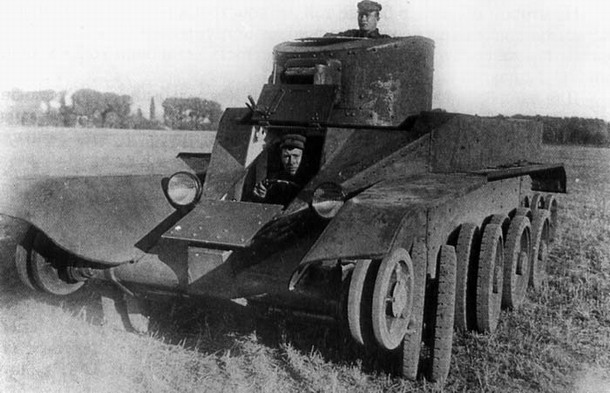
BT-2-IS prototype running on wheels — note the raised hull sides, source: Aviarmor.net with permission, edited
The prototype was fitted with a turret, though without armament, since weapons were irrelevant to the trials. Testing ran from summer to autumn 1935 and produced positive conclusions. Cross-country performance on wheels was of course improved. Furthermore, the vehicle was capable of moving even after losing two of the three driven wheels on either side of the suspension, or while running with only one track fitted. The qualities the prototype demonstrated convinced Voroshilov to order the production of a ten-vehicle evaluation series. This was already to be based on the more modern BT-5 variant, however, so the BT-2-IS remained a single prototype.
Diesel Version
Development of a powerful diesel engine suitable for tank installation had been underway at the Kharkov KhPZ factory since 1931. In April 1933 this work resulted in the construction of an engine designated BD-2 (BD = Bystrokhodny Diesel = fast diesel). The engine suffered from numerous teething problems, was unreliable, and required further development. Despite this, a trial installation in a BT-2 tank was carried out in November 1933. The designers hoped that a diesel engine would offer a greater operational range and reduced risk of fuel ignition. The outcome was predictably disappointing.
The engine smoked heavily, broke down frequently, and caused vibrations that shook the entire tank. The problems could not be resolved, and the project went no further than this single diesel-powered BT-2. In photographs, the diesel prototype can be identified by its different exhaust arrangement — instead of the standard crosswise exhaust box with four outlets, just two pipes directed straight rearward were used. The air intake cover in the centre of the engine deck also looked different from that of the production BT-2. A photograph exists of this vehicle showing signs of battle damage, suggesting the Soviets may have committed it to action in 1941 against the German invaders, out of sheer desperation.
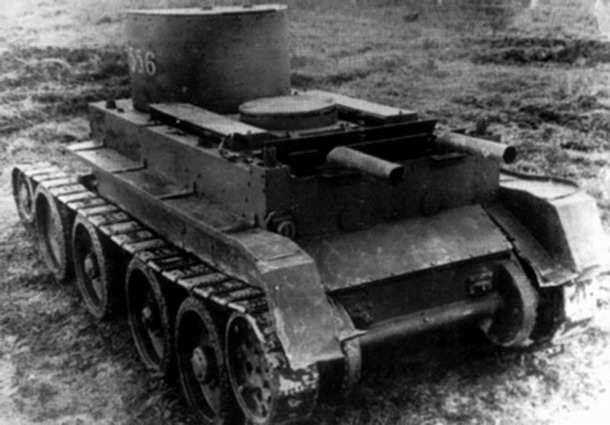
BT-2 prototype with the BD-2 diesel engine — note the air intake cover and exhaust arrangement, source: Aviarmor.net with permission, edited
Flame-thrower Tank
Towards the end of the 1930s, a flame-thrower tank project was also developed on the BT-2 chassis — referred to in Soviet terminology as a chemical tank. It received the designation KhBT-2. Instead of a cannon, a KS-23 flame-thrower was mounted in the turret, while the hull housed tanks for compressed air and the incendiary mixture. Several prototypes were reportedly built in early 1941, and some may have been experimentally deployed during the Winter War. Series production of the flame-thrower BT-2 was never undertaken.
Bridge-laying Tanks
Bridge-laying tanks form a separate chapter in the history of the BT-2, with several such vehicles built on its chassis. Their purpose was to accompany regular combat tanks and help them cross obstacles on the move, without having to wait for engineers — which would have delayed advances and undermined the very concept of fast tanks.
The first bridge-layer, designated DMBT, was developed between 1934 and 1935 at the Scientific Research Institute of Mechanical Engineering (NIIIT) of the Red Army under engineer Alexandrov. The bridge structure consisted of two wooden beams connected by a metal framework — hence the designation DMBT, where the letters DM abbreviated the words derevyany most, meaning wooden bridge. Each section was 40 cm wide and 7 metres long, with a gap of 166 cm between them. The bridge weighed 1,050 kg (750 kg is also given).
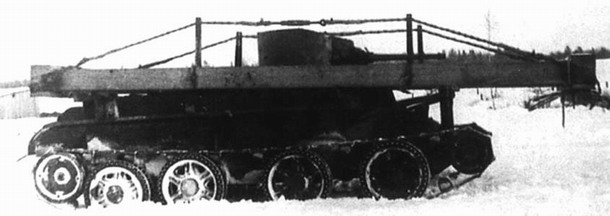
DMBT bridge-layer prototype with wooden bridge, source: Aviarmor.net with permission, edited
The bridge was designed to allow standard BT tanks to cross a gap up to 6 metres wide (5.5 metres according to some sources). Laying the bridge was intended to be possible without the crew dismounting, using a system of cables and a throwing beam. As the tank approached the obstacle, the driver released the throwing beam, which was caught by the tracks and pulled underneath. As the beam moved under the tank, it tensioned the lifting cables, which raised the bridge sections upright. The bridge then tipped forward and fell in front of the tank. The driver therefore had to judge exactly how far from the obstacle to begin the manoeuvre so that the bridge landed precisely where needed. The impact of the bridge hitting the ground was anything but gentle, and it is no surprise that the wooden structure withstood only about five such deployments before it became unusable. A special jack was used to reload the bridge onto the tank, an operation reportedly requiring eight men.
Tanks crossing the bridge had to travel at no more than around 7 km/h, and drivers had to take great care not to slip off the 40 cm wide beams. The bridge-layer retained its turret and armament. The field of fire was, however, severely restricted when the bridge was in place. Trials of the DMBT ran from March to April 1935. Due to shortcomings identified during testing, the vehicle was not accepted for production, and a sturdier bridge structure was recommended for further development.
Subsequent bridge-layer models therefore used metal bridge structures. How many types with a metal bridge were actually built is not entirely clear from the sources, but it was probably three different versions. The first was developed at NIIIT between 1934 and 1935. The vehicle received the designation SBT model 1935 (the S in the designation abbreviated the word Saperny, meaning engineer). The prototype was tested at the turn of 1935 and 1936. The bridge of this variant consisted of two joined metal "rails" with a wooden "deck". It measured 9 metres in length. The lifting and folding mechanism was manufactured by the VIM plant (All-Russian Institute of Agricultural Mechanisation). The SBT model 1935 had no turret — the opening was covered by a metal plate.
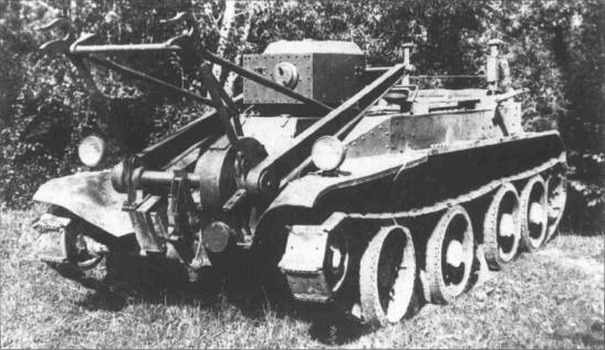
Bridge-layer SBT-2 model 1937, here without the bridge structure, source: Aviarmor.net with permission, edited
In September 1936 another bridge-layer variant was developed, this time designated SBT model 36. For this version a set of three bridge sections was developed that could be linked together to form a much longer crossing, or alternatively placed on pontoons to create a floating raft. Neither this variant nor its predecessor entered production.
The final bridge version for the SBT was developed in May 1937 at the G. K. Ordzhonikidze plant in Podolsk. The bridge again consisted of two joined metal rails 9 metres in length. The combined weight of the bridge and its mechanism was 2,670 kg. Both laying and reloading of the bridge were carried out by the crew without leaving the vehicle interior. Laying took just 30 to 45 seconds; reloading the bridge back onto the hull took between one and a half to two minutes and forty seconds. Vehicle trials ran from May to October 1937. During testing the bridge was laid and reloaded a total of 81 times. As a structural strength test, it was crossed 51 times by a standard BT tank and 7 times by a T-26.
On this bridge-layer, instead of the original turret, a smaller turret from the amphibious T-37 was fitted — it fitted neatly between the bridge rails, though it could not be traversed through a full circle. The turret was taken over complete with its 7.62 mm DT machine gun. In 1938 a pre-production series of five vehicles was to have been manufactured, but this ultimately did not happen, and further bridge-layer development moved on to the more modern BT-5.
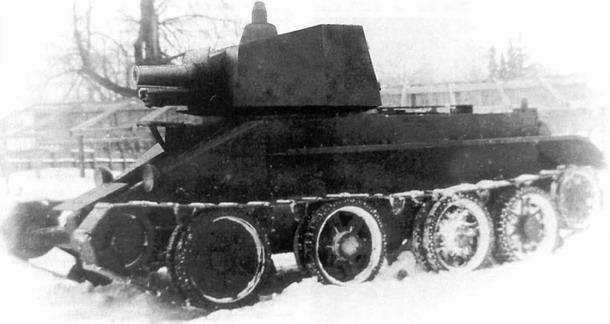
BT-2 prototype with A-43 turret, source: Aviarmor.net with permission, edited
Tank with A-43 Turret
In an effort to increase the combat value of the BT-2, several proposals were made to fit it with a more powerful weapon. As early as 1931, designer N. I. Dyrenko proposed equipping the tank with two guns: a smaller 37 mm gun would remain in the turret, while a second gun of 76.2 mm calibre would be installed in the hull. This proposal was rejected as impractical. Dyrenko's efforts continued, however, and the following year produced a design for a new turret that could accommodate the larger 76.2 mm gun.
The turret, designated A-43, was octagonal, welded, with a roof sloping downward from the midpoint toward the front wall. In the rear wall were fairly large double doors for loading ammunition. The same turret was also experimentally fitted to the T-26 tank. The front wall mounted a short-barrelled PS-3 gun of 76.2 mm calibre, with a 7.62 mm DT machine gun installed to its right. Ammunition stowage was 50 rounds for the gun and 2,700 for the machine gun.
The prototype BT-2 with this turret on a lightly modified hull was built in early 1932 under the direction of designer N. Gulenko, with verification trials following in March. The vehicle was not accepted for service. One of the reasons was likely the insufficient internal space in the turret, which made effective operation of the gun crew impossible. On the other hand, the experiment confirmed the practical feasibility of fitting the tank with a weapon of larger calibre than 37 mm — a conclusion that was put to use in subsequent years.
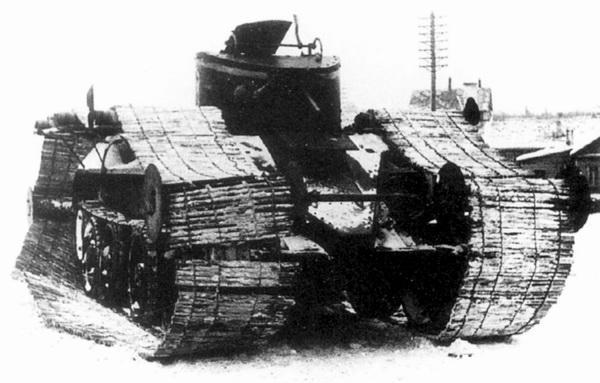
BT-2 with wooden tracks, source: Aviarmor.net with permission, edited
A 1933 proposal to fit a recoilless DRP gun (DRP = Dynamo-Reaktivnaya Pushka) designed by Leonid Vasilyevich Kurchevsky remained on paper only. Despite being of 76.2 mm calibre, the gun was relatively light, so a light tank could carry it without difficulty. It could fire both anti-personnel and anti-tank rounds at a muzzle velocity of up to 470 m/s. Thanks to the recoilless principle, the turret would not have to absorb the energy of firing such a powerful weapon. The project never reached even the prototype stage and was cancelled.
Wooden "Tracks"
A marginal but highly interesting project was the BT-2 fitted with wooden "tracks". The purpose of this modification was to improve the tank's ability to cross soft ground, swamps, or deep snow — terrain conditions that were fairly common in the Soviet Union. The wooden-track tank existed in at least two versions. In the first, developed in 1934, the wooden tracks were fitted onto a special framework. This framework ran the upper portion of each track high up over the standard track mudguards, above the level of the engine deck. At the front and rear were drums that guided the lower portion of the wooden track underneath the standard metal one, which then simply ran on top of it. The wooden tracks therefore did not replace the metal ones — they merely provided a kind of carpet for the metal tracks to ride on.
The wooden track was approximately three times wider than the metal one and consisted of slats held together in the shape of a track by four cables. The special framework for carrying them weighed approximately 500 kg. With the wooden tracks fitted, the tank could travel at only about 5 km/h and only in a straight line — turning was not possible. While both of these were significant drawbacks, they were not entirely fatal. The whole device was not intended for extended travel — the structure would not have survived that. It was designed only for crossing a problematic stretch of terrain, after which the wooden tracks were to be removed again. When not in use, the tracks were rolled into bundles and secured above the engine compartment.
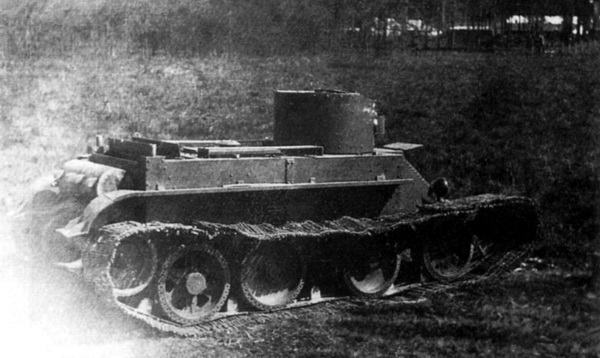
BT-2 with wooden tracks clipped directly onto the metal tracks, source: Aviarmor.net with permission, edited
In the second variant, the wooden tracks were clipped directly onto the standard metal tracks using clamps. Fitting them took the crew approximately one hour; removing them around 40 minutes. In this case too, the maximum speed with the wooden tracks fitted was around 5 km/h, and changing direction was not possible. When removed, the tracks were apparently rolled up and secured to the hull in the same way as in the first variant. Testing took place at the turn of 1934 and 1935. Neither version of the wooden-track BT-2 was accepted for service.
A version with wooden track-mats was also developed. In this case, these were not actual closed loop tracks running around the sprockets, but rather flat mats or runners. These were rolled up and stored along the sides of the hull nose. The driver could, from inside the vehicle using a cable mechanism, release a launching beam; this was caught by the tracks, pulled underneath the tank, and dragged the mat runners along behind it, progressively unrolling them as the tank drove over them. When the mats ran out, they were simply left on the ground behind the tank as it continued without them. Alternatively, the crew could dismount, roll the mats back up, and re-fit them to the tank — a process taking about 30 minutes.
The mats were reportedly about 45 metres long. It is therefore clear that this modification was intended only to cross very limited obstacles, such as small boggy patches. Travel on the mats was naturally only possible in a straight line and again at a limited speed of around 5 km/h. When rolled up on the tank's nose, they significantly restricted the gun's field of fire. This variant too was not accepted for service.
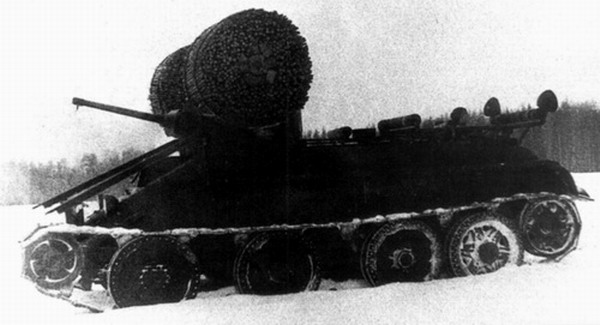
BT-2 with wooden fascines for crossing ditches, source: Aviarmor.net with permission, edited
In 1934 a variant was also developed with a device to help the BT-2 cross wide trenches. There was in fact nothing new under the sun here — the same principle was used on tanks in the First World War. Two large bundles of wooden staves (known as fascines) were fixed to the sides of the turret. As the tank approached a trench, the driver released the bundles from inside the vehicle. They then rolled down sloped metal rails fitted at the front of the hull and fell into the trench, making it easier for the tank to cross.
This "device" was therefore single-use, since the bundles remained in the trench. Fresh ones could of course be fitted to the turret later, but certainly not under combat conditions. While the fascines were mounted on the turret, they significantly limited its rotation and therefore the gun's field of fire — similar to the previous case. They also reduced the tank's stability and increased its visibility at a distance. This modification too was never taken into production.
What About BT-3 and BT-4?
Given that the next series-production generation of the BT tank carried the designation BT-5, the obvious question is what happened to the BT-3 and BT-4 designations. Different sources offer different answers. The BT-3 designation is apparently sometimes — incorrectly — applied to BT-2 tanks fitted with stamped road wheels, which the KhPZ factory switched to once it had mastered their production. In reality, however, BT-3 referred to a project to convert the BT-2 production documentation from the original American units of measurement to metric. This work was led in 1932 by A. O. Firsov. In addition to the conversion to metric units, several minor engineering changes were reportedly incorporated, aimed primarily at simplifying production.
For the BT-4 designation there are again two different stories, which are not entirely mutually exclusive. According to one, it was a modified BT-2 with a fully or partially welded hull (instead of riveting), which was developed in 1932. Beyond the change in joining technology, the project also introduced several other changes. The louvers covering the engine cooling air exhaust were to be remotely controlled by the driver. The arrangement of towing hooks and the system of attaching the external armour on the hull sides were also to be changed. Thanks to the latter modification, access to the road wheel spring system was to be improved. BT-4 never entered production.
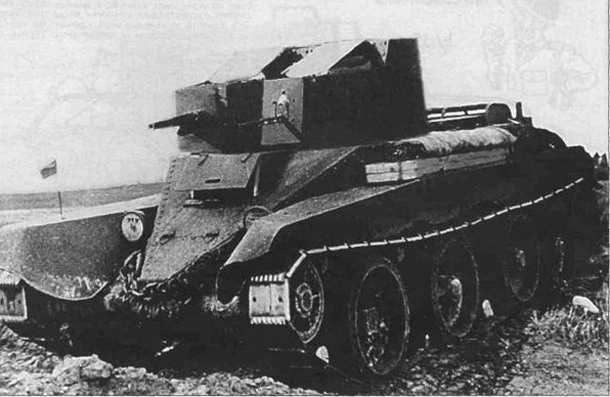
A photomontage presented as a photograph of the BT-4, source: Aviarmor.net with permission, edited
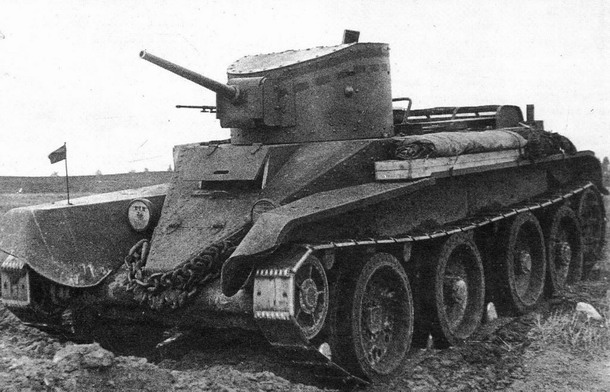
The original photograph of the BT-2, source: Aviarmor.net with permission, edited
The second theory essentially builds on the first and adds a further chapter to the story. According to this account, the BT-4 was similarly a modified BT-2 with a partially welded hull, revised louver controls at the rear, and a modified side armour arrangement — but additionally, the standard single turret was to be replaced by two smaller turrets from the light tank T-26 model 1931, specifically in a combination of machine-gun and cannon-armed versions. The twin-turret BT-4 was allegedly designed in 1932 at the design office of the parent factory KhPZ No. 183 under the project leadership of O. A. Firsov. According to this version, three BT-4 prototypes were to be built in the summer of that year and subsequently subjected to trials. They were reportedly not taken into series production because it was already clear that further development of the BT series would proceed in the direction of an entirely new turret capable of housing a more powerful weapon — that is, toward the BT-5.
Most authors agree, however, that this second chapter of the BT-4 story is apocryphal. While photographs do exist of twin-turret tanks combining a BT-2 hull and T-26 turrets, these are most likely photomontages — as in the example above, which is a manipulated image of an ordinary BT-2.
In conclusion, it must be noted that although the BT-2 was never regarded as a fully-fledged combat tank, suffered from numerous shortcomings, and was never produced in truly large numbers — at least not by Soviet standards :-) — it provided Soviet tankers, and especially designers, with invaluable experience. The BT-2 laid the foundation for a long line of Soviet convertible tank development that ultimately gave birth to the legendary T-34.

ARTICLE
CONTENTS:
Reproducing text from the Tankist website without the written consent of the operator is prohibited.