SU-152
self-propelled gun on the KV-1 tank chassis
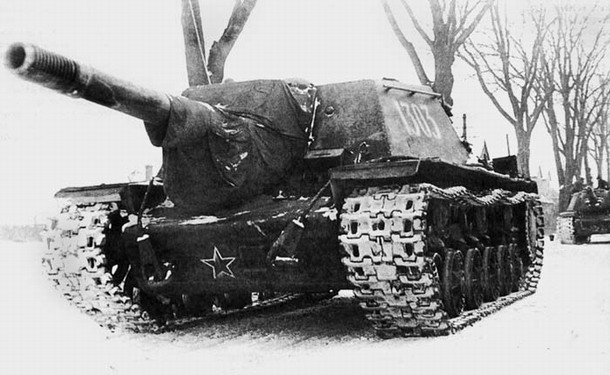
SU-152 self-propelled howitzer, source: Aviarmor.net with permission of the operator, edited
Origins
Plans to develop and produce a 152 mm self-propelled howitzer in the Soviet Union took shape at the turn of 1942–43. There were two principal driving forces behind the programme. The first was the Red Army's experience of fighting in and around Stalingrad, where a shortage of self-propelled guns capable of destroying stronger German fortifications had become apparent. The second was the appearance of the new German Tiger tank, which proved a genuine challenge for Soviet armour. The new self-propelled gun was therefore required both to neutralise fortified enemy positions in support of infantry and armoured formations, and to deal with the latest heavy tanks of the enemy.
Development work was led by designer Josef Yakovlevich Kotin. The vehicle he and his team produced was a purposeful combination of an already-proven chassis and an already-proven weapon. The chassis was taken from the KV-1 heavy tank, and the armament consisted of a modified version of the ML-20 field howitzer of 152.4 mm calibre. The original plans had called for lengthening the tank chassis, but this was abandoned as it would have significantly increased both production costs and development time.
First Prototype
Work on the project, designated KV-14, began on 31 December 1942 at the Chelyabinsk Kirov Plant. On 4 January 1943 the project was presented to the Defence Committee, which approved it and demanded a test prototype within 25 days. This brutally tight deadline was met. On 25 January the prototype was complete and underwent factory trials, followed by military trials. The vehicle passed, and on 14 February it was formally accepted into Red Army service under the designation SU-152 (SU standing for Samokhodnaya Ustanovka — self-propelled mount). Alongside approval of the vehicle, an order was also issued to begin series production immediately. The astonishing speed of the prototype's construction was partly a result of the vehicle's inherent simplicity — combining an existing chassis with an existing weapon — and partly due to the fact that the designers at the Chelyabinsk factory had already been independently exploring the theoretical possibility of building such a vehicle before any formal requirement was issued.
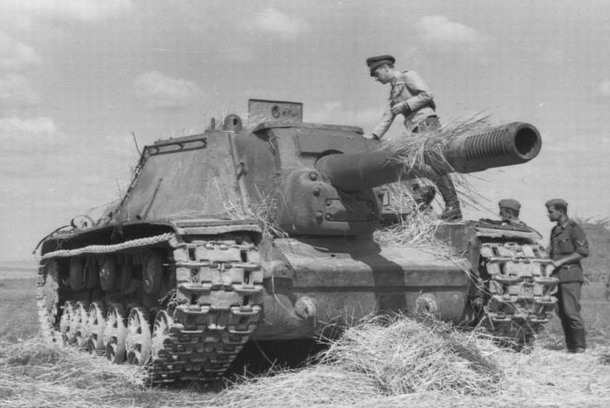
SU-152 self-propelled howitzer, source: Bundesarchiv Bild 101I-154-1964-28, Wikimedia, Creative Commons, edited
Design Description
The foundation of the SU-152 was, as noted, the chassis of the KV-1 tank. Each side of the running gear consisted of six road wheels, each independently suspended and sprung by a torsion bar. The wheels were all-steel with lightening holes and had a diameter of 60 cm. At the front was a larger idler wheel, also with lightening perforations; at the rear was a solid toothed drive sprocket. Three smaller return rollers supported the track from above.
Due to the large recoil travel of the main weapon, it could not be mounted in a conventional rotating turret but only in a fixed superstructure. This superstructure occupied the entire front half of the vehicle. It was fully enclosed and relatively low, giving the vehicle an overall height of just 2.45 m. The individual walls were joined by welding. The front wall of the superstructure was 75 mm thick, the side and rear walls 60 mm, and the roof 20 mm. In the front wall, to the right of centre, the vehicle's sole armament — the 152 mm howitzer — was mounted in a massive collar.
The original towed ML-20 howitzer was lightly modified for the self-propelled role and redesignated ML-20S. A major advantage of this weapon was its ability to engage targets both by direct and indirect fire, with direct fire possible out to approximately 700 metres. A significant drawback was its low rate of fire — just two rounds per minute — caused by the use of separate-loading (two-piece) ammunition and the considerable weight of the shells, which made loading very demanding. The howitzer fired high-explosive fragmentation rounds OF-540 weighing 43.6 kg at a muzzle velocity of 655 m/s, and armour-piercing rounds BR-540 weighing 48.8 kg at 600 m/s.
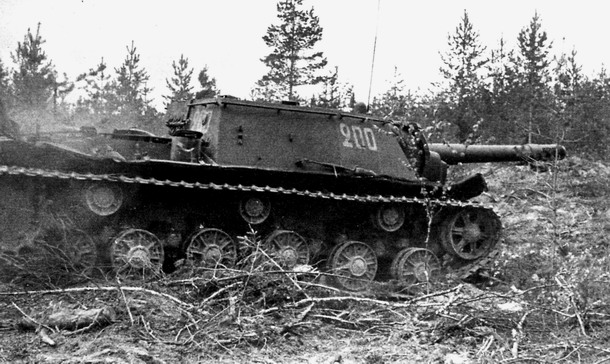
SU-152 self-propelled howitzer, source: Aviarmor.net with permission of the operator, edited
The armour-piercing round could penetrate 90 mm of vertical armour at 2,000 metres. Onboard ammunition stowage was limited to just twenty rounds. Even the high-explosive shell, however, thanks to its considerable mass and kinetic energy, could heavily damage or destroy German armoured vehicles — a direct hit was capable of blowing the turret completely off a tank.
At the rear of the vehicle was the engine compartment, housing a twelve-cylinder V-2K diesel engine with a maximum output of 600 hp. Fuel was carried in three separate tanks with a combined capacity of approximately 600 litres, providing a road range of around 330 km and roughly half that cross-country. An additional 360 litres could be carried in four external auxiliary tanks mounted at the rear over the mudguards.
The crew of five consisted of the driver, seated on the left in the front of the hull, who looked out through a small square vision port in the front armour — in an emergency this port could be closed by a cover, leaving only a narrow slit for observation. A searchlight was mounted on the front wall to the left of the driver's vision port. The remainder of the crew was stationed inside the fighting compartment: the gunner and first loader sat to the left of the howitzer, the second loader and vehicle commander to its right. The SU-152 had no integral anti-infantry armament, so crews carried PPSh submachine guns and hand grenades. Fire could be directed from the roof of the vehicle or through pistol ports — one such port for personal weapons was in the front armour to the left of the howitzer barrel.
Crew entry and exit was provided by three hatches in the superstructure roof. Two circular hatches in the forward part of the roof were each closed by a single-piece cover. The third hatch, in the rear left corner of the roof, straddled the junction of the roof and rear plate and was closed by a two-piece cover. The roof also accommodated the apertures for observation periscopes, ventilation outlets and so on. Internal communications were handled by a TPU-4-BisF intercom system, while external radio communications used a 10RK-26 set.
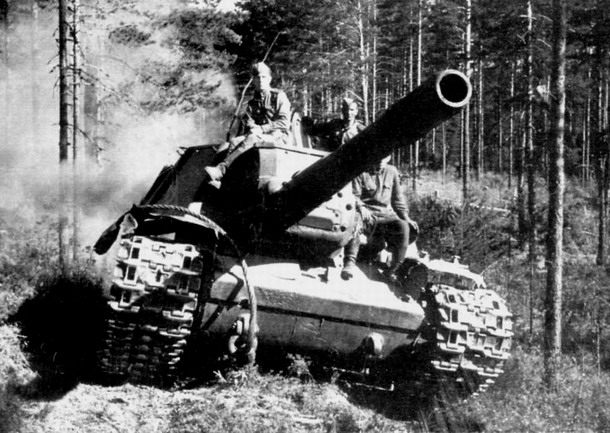
SU-152 self-propelled howitzer, source: Topwar.ru with permission of the operator, edited
The completed SU-152s were organised into new heavy self-propelled artillery regiments. Initially each regiment comprised 12 self-propelled howitzers divided into four batteries of three, supplemented by one heavy tank for the regimental commander. In November 1943 this organisation was revised and regimental strength grew to 21 vehicles. One of the SU-152's most notable combat deployments came during the fighting in the Kursk salient, where, according to Soviet sources, these vehicles destroyed twelve Tiger tanks and seven Ferdinand tank destroyers — though German sources do not corroborate these figures.
Production of the SU-152 ran from March to December 1943. It ended not because of any problem or deficiency in the vehicle, but simply because its successor — the ISU-152 — had arrived. A total of 671 SU-152s were built during the production run (figures of 670 and 704 are also encountered). Overall it was a capable self-propelled gun, whose combat value was reduced only by its low rate of fire, limited ammunition stowage and a cramped and not particularly ergonomic interior. The SU-152 proved effective in both defensive and offensive operations, against infantry, armoured vehicles and fortifications alike. Surviving vehicles continued to serve in the Soviet army after the war, with the last finally retired in 1954.
The SU-152 earned the nickname "Zveroboy" — animal killer — among Soviet soldiers, a reference to its ability to deal with German tanks and self-propelled guns whose names were drawn from the animal kingdom: the Tiger, the Panther and the Elefant.
Technical Specifications
Weight |
45.5 t |
Length |
8.95 m |
Width |
3.25 m |
Height |
2.45 m |
Engine |
V-2K |
Maximum power |
600 hp |
Maximum speed |
43 km/h |
Range – road |
330 km |
Range – cross-country |
165 km |
Superstructure armour |
60 – 75 mm |
Hull armour |
60 mm |
Armament |
1 × ML-20S howitzer, 152.4 mm |
Crew |
5 men |

ARTICLE
CONTENTS:
Reproducing text from the Tankist website without the written consent of the operator is prohibited.