VK 30.01
on the road to the Tiger
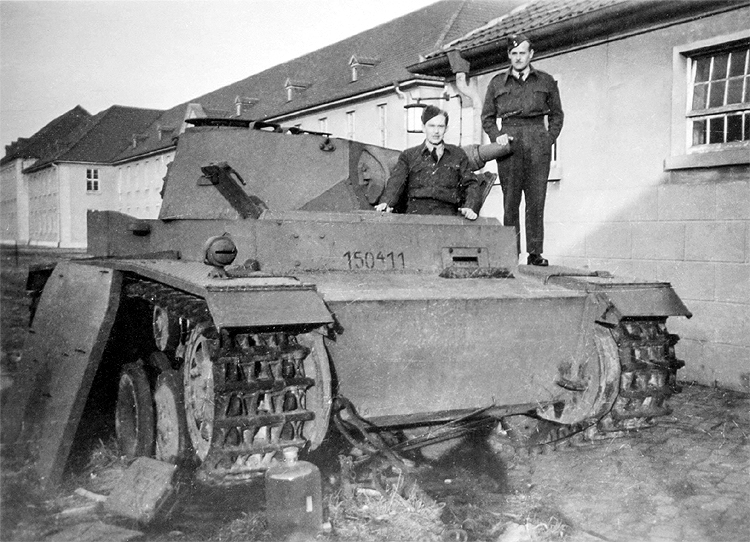
At the end of the war, the Allies captured this complete VK 30.01 neue Konstruktion prototype with hull serial number 150411. Source: flickr.com, Public domain, edited
The Thirty-Tonne Tank
A closer look at the designation VK 30.01 reveals that it contains an abbreviation for a fully tracked vehicle (VK = Vollkettenkraftfahrzeug) in the approximately 30-tonne weight class (the two digits before the dot indicate the weight in tonnes). The digits 01 after the dot indicate the project sequence number — in this case, ostensibly the first project in the 30-tonne category, though that was far from the truth. The VK 30.01 was by no means the first project in its weight class, nor would it be the last. It was, in fact, just one of many steps along a fairly long developmental road that ultimately led to the famous heavy tank Tiger. But where did that road begin?
The first mentions of a tank in the 30-tonne weight class appeared as early as October 1935, driven by the German army's desire for a vehicle capable of defeating the heavy frontal armour of French heavy tanks such as the Char 2C and Char B1. The army's primary requirement was therefore a powerful weapon — specifically a 75 mm gun with a muzzle velocity of at least 650 m/s. It was assumed that such a capable weapon could not be fitted into any existing or currently developing German tank, making it necessary to design an entirely new and considerably more robust vehicle. The representatives of the Weapons Office (Waffenamt), however, were concerned that a robust tank armed with such a powerful weapon would likely also be quite heavy. Existing German military bridges had a maximum load capacity of "only" 30 tonnes, and no combat vehicle should therefore exceed that weight — otherwise troops would be unable to get it across any sizeable waterway. For this reason the Waffenamt immediately set a weight limit of exactly 30 tonnes for the new tank. Further calculations by Weapons Office specialists concluded that if the new tank was to accommodate the required armament within the weight limit, it could afford armour of no more than 20 mm. It would therefore likely be a large, heavily armed machine with very thin protection.
The initial theoretical work on the new tank also produced a number of other findings. It became clear, for instance, that no engine of the power the Waffenamt required for the new tank was manufactured anywhere in Germany. An entirely new gun, a new engine, and then a complete new fighting vehicle would all have to be developed. The Waffenamt therefore had to approach several firms simultaneously to work in parallel on the necessary components. Negotiations began first with Maybach-Motorenbau regarding the development of a new tank engine producing 700 horsepower. The firm's chief designer, Ing. Karl Maybach, was sceptical from the outset, arguing that an engine of such power would require 16 cylinders, making it too large to fit inside a tank. The Weapons Office, however, insisted on no more than 12 cylinders in order to keep the dimensions manageable.
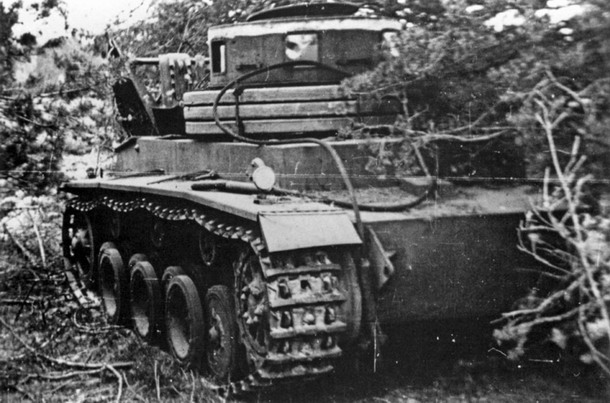
A VK 30.01 prototype during driving trials with a ballast weight in place of the turret. Source: Flickr.com, with permission of the publishing user, edited
An Unclear Role and an Unclear Name
Development of the hull and running gear for the new tank was contracted to Henschel, while Krupp was to design and supply the turret. At this point, however, we need to pause and consider the specification that Krupp received from the Weapons Office. It made no mention whatsoever of installing a high-velocity gun capable of defeating the armour of French tanks. On the contrary, the turret was to mount the 7.5 cm KwK L/24 — a short-barrelled weapon (24 calibres long) also used on early Panzer IV tanks, and certainly not designed for engaging heavily armoured targets. The 7.5 cm KwK L/24 was not intended to destroy tanks at all, but rather to engage so-called soft targets such as machine gun nests, bunkers, and artillery positions. What led to this departure from the original plans is not clear from the available literature, but it was by no means the only surprise.
Another surprise was the official designation assigned to the project: "Begleitwagen (verstärkt)". This can be fairly clearly interpreted as meaning the new tank was intended as a more powerful (verstärkt = reinforced) variant of the Panzer IV, since Begleitwagen was the army's designation for that tank. The word Begleitwagen literally means "escort vehicle" and neatly describes the tactical role of the Panzer IV — accompanying the more numerous Panzer III and supporting it in the destruction of the aforementioned soft targets. The choice of the name "B.W. (verstärkt)" combined with the selection of the 7.5 cm KwK L/24 therefore suggests fairly clearly that the new 30-tonne tank was intended to fulfil the same battlefield role as the Panzer IV. This, however, bears no resemblance to the army's original intention of acquiring a tank to defeat the heavily armoured French vehicles. It appears as though the Waffenamt had abandoned the original concept entirely and was now developing something more like a more powerful successor to the Panzer IV.
In any case, the designation B.W. (verstärkt) lasted only until March 1937, when the vehicle under development was renamed Infanteriewagen, abbreviated I.W. The name Infanteriewagen literally means "infantry vehicle" and evokes a tank for infantry support — which makes little sense within the German approach to armoured warfare doctrine. Was this yet another change to the intended combat role of the vehicle? The question is perhaps not worth dwelling on, since the I.W. designation lasted just one month. In April 1937 the project was renamed again, this time to Durchbruchswagen (literally "breakthrough vehicle"), abbreviated D.W. This designation was then retained until November 1939, when the familiar code VK 30.01 finally made its appearance.
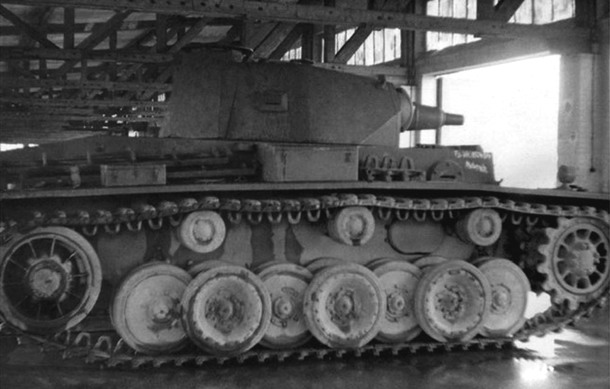
The complete VK 30.01 prototype, most likely at Henschel's test facility in Sennelager. Source: Flickr.com, with permission of the publishing user, edited
As already noted, Henschel was tasked with designing and building the hull and running gear for the new tank. The firm produced two design proposals, known as D.W. I and D.W. II, which differed primarily in their internal components. Probably around mid-1938, Henschel built prototypes of both designs — hull and running gear only, without turrets, and constructed from mild steel rather than armour plate, but perfectly adequate for driving trials. After evaluating both prototypes, the Weapons Office concluded that neither was sufficiently mature, and Henschel was tasked with continuing development and preparing a further version. Krupp was also to carry out an update of its turret design. November 1939 arrived, and the project designation was finally changed to the well-known VK 30.01. More precisely, the original Durchbruchswagen became known as the "VK 30.01 alte Konstruktion" (old construction), while the new variant in preparation was called the "VK 30.01 neue Konstruktion" (new construction).
VK 30.01 neue Konstruktion
For the VK 30.01 neue Konstruktion, Henschel designed an entirely new running gear with seven road wheel axles on each side, carrying two wheel discs per axle. The discs on odd-numbered axles were positioned close together, while those on even-numbered axles had a gap between them. This arrangement allowed the wheels on adjacent axles to partially overlap, fitting more wheels into the relatively short track run and distributing the tank's weight more evenly. The road wheels of the VK 30.01 neue Konstruktion had a diameter of 700 mm and were fitted with rubber tyres around their circumference. A drive sprocket was at the front, an idler at the rear, with 520 mm wide tracks running between them.
Since the originally requested 700 horsepower engine was still not available, the compact six-cylinder Maybach HL 116 TR producing 300 horsepower was chosen to power the VK 30.01. As noted earlier, the Weapons Office had originally calculated that keeping the new tank within the 30-tonne weight limit would restrict armour to a maximum of 20 mm. It turned out, however, that the weight limit could be met even with considerably thicker armour — no doubt aided in part by the lighter short-barrelled gun. The VK 30.01 hull therefore had armour 50 mm thick on the front, sides, and rear, 25 mm on the roof plate, and 20 mm on the hull floor. The Weapons Office reviewed Henschel's design and subsequently ordered three prototypes.
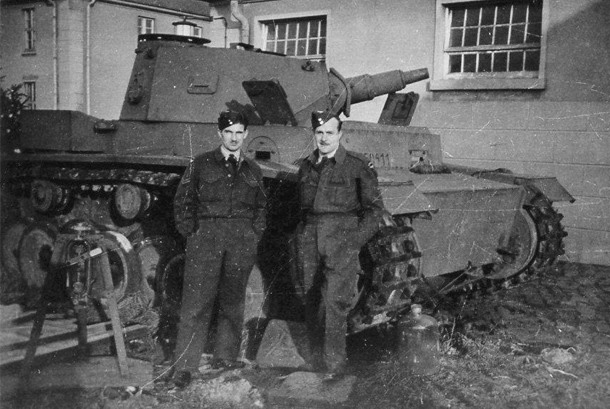
The complete VK 30.01 with hull serial number 150411, which fell into Allied hands in 1945. Source: internet, Public domain, edited
Before the VK 30.01 neue Konstruktion took shape as a prototype, a whole series of further changes and modifications were made — to the armour, the size of the road wheels and return rollers, the drive sprockets, hatches and their covers, the fuel tank, and various other details. Three different engines were considered for use (in addition to the Maybach HL 116, also the Maybach HL 150 and HL 190), and even three different gearboxes (Maybach SRG 32 8 128, Maybach SMG 90, and Zahnradfabrik SSG 77). According to the November 1939 plans, the three ordered VK 30.01 prototypes (without turrets) were to be delivered one per month in March, April, and May 1940. Although delivery ran somewhat late, as usual, all three hulls with superstructures were apparently delivered at some point during 1940.
Meanwhile, Krupp was working on a new turret design. The Weapons Office specification called for a low-profile turret with a commander's cupola fitted with a rotating ring carrying seven periscopes. The turret roof was also to have three fixed observation periscopes, two vision ports in the side walls, and of course an aperture for the gun sight. In May 1940, the Waffenamt added a further requirement: a machine gun port in the rear turret wall. The designers resolved this by creating a simple opening through which the machine gun barrel could be extended; when not in use, the port was closed with a metal plug.
In January 1940 the Weapons Office ordered the construction of eight complete VK 30.01 neue Konstruktion tanks. Krupp was to supply Henschel not only with turrets but also with armoured hulls. The hulls were to be delivered between July and October 1941, and the turrets between October 1941 and January 1942, with Henschel responsible for final assembly of all eight vehicles. Component deliveries began to get underway, but in January 1942 a significant change arrived: citing reduced available production capacity, the order was cut from eight to just four tanks. According to records from both Henschel and Krupp, four hulls with superstructures and four turrets were indeed built in 1942, though any mention of the completed vehicles being assembled is conspicuously absent. At least one tank was clearly completed and subjected to trials at Henschel's test ground in Sennelager.
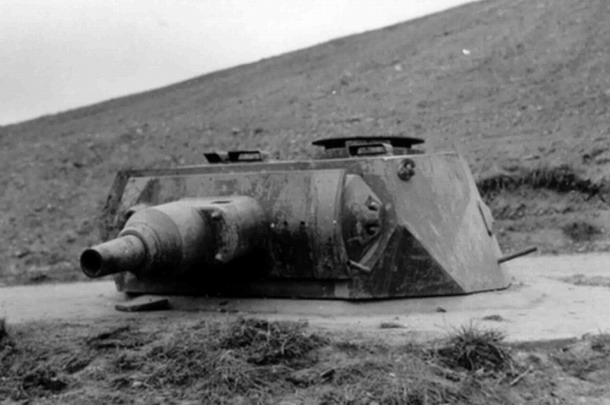
One of the six VK 30.01 turrets that were incorporated into the fortifications of the Atlantic Wall and the Siegfried Line. Source: internet, Public domain, edited
An Attempt at Re-arming
In the second half of 1941, someone at the Weapons Office apparently realised that a vehicle as robust as the VK 30.01 carrying the same weapon as the much lighter Panzer IV was significantly under-gunned. This represented something of a return to the original idea of equipping the 30-tonne tank with a gun capable of defeating heavily armoured opponents — now Soviet rather than French. Towards the end of 1941, the Waffenamt therefore approached Krupp with the question of whether a longer and more powerful gun could be fitted into the VK 30.01 neue Konstruktion turret in place of the originally intended 7.5 cm KwK L/24. First a 7.5 cm KwK L/34.5 was proposed, and later the even longer 7.5 cm KwK L/43. In both cases, Krupp's answer was negative. Changing the weapon would require fairly fundamental redesign of the entire turret, the likely reason being the commander's position located directly behind the gun — with a longer weapon producing greater recoil travel, there would simply not be enough room for the commander, necessitating a relocation of his position and with it the commander's cupola.
Into the Dustbin of History
1942 arrived, and a new variant of the Panzer IV armed with the long and powerful 7.5 cm KwK L/43 was heading into series production. With this weapon, the Panzer IV surpassed the VK 30.01 neue Konstruktion in firepower. Its frontal armour protection had also become comparable, while the Panzer IV remained more than a quarter lighter and, with production well underway, relatively inexpensive. The VK 30.01 neue Konstruktion had thereby become essentially pointless. A decision quickly followed that the four vehicles on order would not be sent to the front for combat trials but used solely for training new tank crews. With that, the project's fate was sealed.
In November 1942, someone quite reasonably noted that the VK 30.01 vehicles did not actually need their turrets for driver training purposes, meaning the turrets could be put to alternative use — specifically as part of the static fortifications of the Atlantic Wall and the Siegfried Line. According to reports from March 1945, a total of six turrets originally designed for the VK 30.01 were used in this way. At the end of the war, Allied soldiers captured at least two VK 30.01 prototypes. One incomplete vehicle was found at Henschel's test facility in Haustenbeck, fitted with a ballast weight instead of a turret and carrying a dozer blade at the rear. The second prototype, with hull serial number 150411, was captured in complete condition. For completeness, it is worth noting that a modified VK 30.01 chassis served as the basis for a 128 mm self-propelled gun that became known by the nickname Sturer Emil. This vehicle, however, also never reached series production and was built only as two evaluation prototypes.
ARTICLE
CONTENTS:
Reproducing text from the Panzernet website without the written consent of the operator is prohibited.