DURCHBRUCHSWAGEN
a tank for breaking through enemy lines
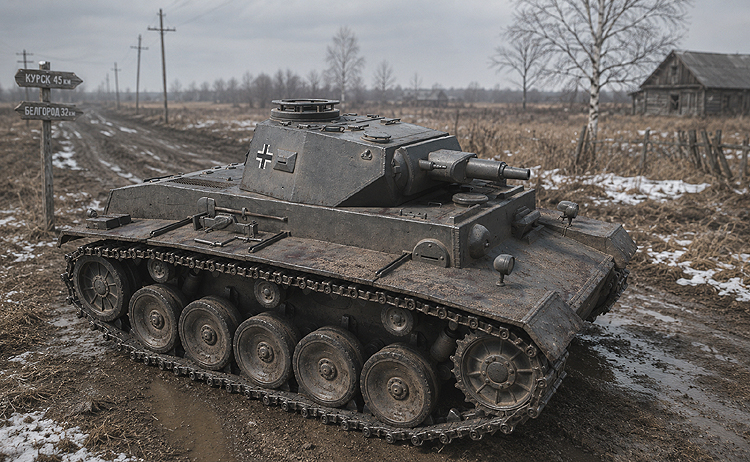
Theoretical appearance of the Durchbruchswagen tank, source: generated by AI
The project for a 30-tonne tank designated Durchbruchswagen (abbreviated D.W.) was itself a failure, but it helped lay the foundations for the subsequent development that ultimately produced the legendary heavy tank Tiger. The word Durchbruchswagen translates as "breakthrough vehicle" – not in the sense of a groundbreaking invention or technology, but of breaking through enemy defensive positions. Durchbruchswagen was not, however, the first or last designation this project would carry – but more on that later.
Origins of the Project
The first thoughts about building a tank in the 30-tonne class appeared as early as October 1935, driven by the German Army's desire to obtain a tank capable of defeating the heavy frontal armour of the French Char 2C and Char B1 (the Char B1 had entered production that very year). The Army's primary requirement was therefore a powerful 75 mm gun capable of firing rounds at a muzzle velocity of at least 650 m/s. It was assumed that such a capable weapon would need an entirely new carrier – an entirely new tank. German Ordnance Office calculations showed that a tank mounting this weapon would, with armour of just 20 mm, already reach a weight of approximately 30 tonnes. And 30 tonnes was the limit beyond which the Ordnance Office did not wish to go, owing to the load capacity of German military bridges.
Three companies were involved in the project as the main contractors. Maybach-Motorenbau was to develop a new engine producing 600 to 700 hp for the tank; Henschel was to design the chassis and hull; and Krupp was assigned the development of the fighting turret. The specification Krupp received in 1936 was, however, somewhat surprising. It called for the installation of the 7.5 cm KwK L/24 in the turret – a short-barrelled weapon (24 calibres), the same gun that armed the early Panzer IV. This weapon was entirely unsuitable for penetrating the armour of French heavy tanks, as it had not been designed to destroy armoured vehicles but to engage so-called soft targets such as machine-gun nests, bunkers, and artillery positions.
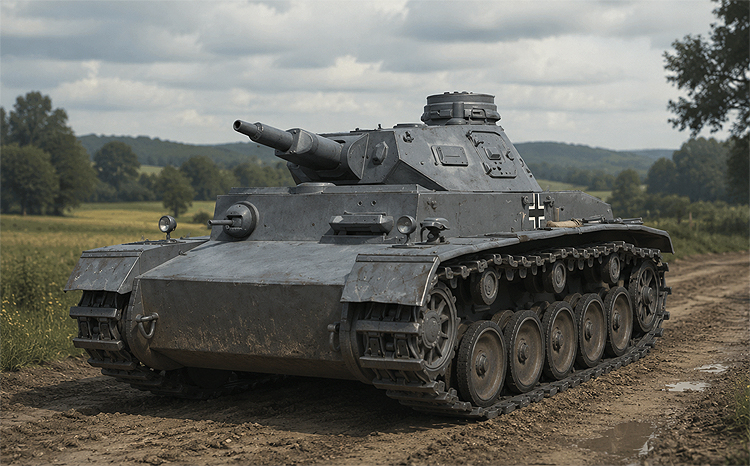
Theoretical appearance of the Durchbruchswagen tank, source: generated by AI
B.W., I.W., or D.W.?
The first official designation of the project was also surprising: Begleitwagen (verstärkt), abbreviated B.W. (verstärkt). This made it fairly clear that the intention was to produce a more powerful (verstärkt = reinforced/strengthened) variant of the Panzer IV, since Begleitwagen was the designation the Army used for the Panzer IV itself. The word Begleitwagen means literally "escort vehicle" and very accurately describes the tactical role of the Panzer IV – accompanying the more numerous Panzer III tanks and supporting them in destroying the soft targets mentioned above. The choice of the name B.W. (verstärkt) combined with the choice of the 7.5 cm KwK L/24 suggests that the new 30-tonne tank was to fulfil the same battlefield role as the Panzer IV. This, however, bears no resemblance to the soldiers' original intention of obtaining a tank capable of destroying the heavily armoured French vehicles. It appears as though the Ordnance Office had entirely abandoned the original idea and was instead preparing something like a more powerful successor to the Panzer IV – though why this shift occurred is nowhere explained in the literature.
In any case, the designation B.W. (verstärkt) remained in use only until March 1937, when the tank under development was renamed Infanteriewagen, abbreviated I.W. The word Infanteriewagen means literally "infantry vehicle" and evokes a tank intended to support infantry – which makes little sense within the framework of the German approach to building an armoured force. Was this yet another change to the intended combat role of the vehicle? It is probably not worth dwelling on, since the designation I.W. lasted exactly one month. In April 1937 the project was renamed again – this time to Durchbruchswagen (abbreviated D.W.). This designation then remained in use until November 1939, when the code VK 30.01 (alte Konstruktion) entered the picture – but more on that later.
Design Description
As already noted, the chassis and hull for the new tank were to be designed and manufactured by Henschel. The company produced two design proposals for the new vehicle, designated D.W. I and D.W. II, which differed from each other mainly in their internal components. The Durchbruchswagen was given a chassis with six twin road wheels and three return rollers on each side. The road wheels were fitted with rubber tyres for a smoother ride and were individually suspended on torsion bars. The first and last road wheels were additionally fitted with external shock absorbers mounted on the hull sides. The idler wheel was at the rear and the drive sprocket at the front, the latter strongly inspired by the type used on half-tracked artillery tractors. The tracks were 300 mm wide and also derived from those used on German half-tracked vehicles.
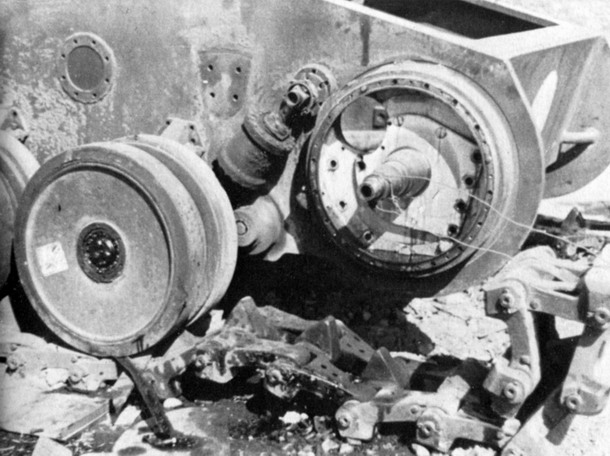
One of the two known photographs of the Durchbruchswagen prototype, showing detail of the front drive sprocket axle and the first road wheel with its shock absorber, source: internet, public domain, edited
Because Maybach was unable to deliver the required more powerful engine in time, the Durchbruchswagen was powered by the petrol twelve-cylinder Maybach HL 120 TR producing 300 hp. The gearbox was a Maybach Variorex. The Ordnance Office's original calculations had assumed that to stay within the 30-tonne weight limit, the armour could be no more than 20 mm thick. It turned out, however, that the limit could be met even with much heavier armour – aided no doubt by the use of the lighter short-barrelled gun. The Durchbruchswagen's hull thus received 50 mm of armour on the front, sides, and rear, with 20 mm on the floor and roof.
The first design variant, D.W. I, was given a Cletrac-type steering unit with a three-speed track control mechanism. The second variant, D.W. II, had a different drive arrangement including steering brakes and final drives, as well as modified drive sprockets, tracks, and road wheel suspension. In all other respects the two variants were practically identical. In both, the hull was made up of two separate sections – a forward crew compartment section and a rear engine section – bolted together. Henschel built prototypes of both designs, the D.W. I and D.W. II, sometime around mid-1938. They were constructed from mild steel only, primarily for driving trials.
Krupp submitted its fighting turret design to the Ordnance Office as early as February 1937. All turret walls were 50 mm thick, with only the roof at 15 mm and the weapon mantlet at 20 mm. Very unusually for German tank design practice, the radio set was to be installed not in the hull but in the rear of the fighting turret. After both Henschel and Krupp had submitted their designs, an unexpectedly long period of silence followed for some reason. Only in June 1938 did the Ordnance Office sign a contract with Krupp for the construction of one trial turret (Versuchsturm). Its manufacture then continued until the end of May 1939.
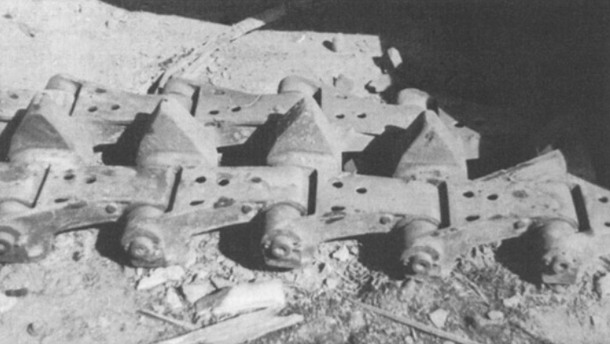
The second surviving photograph shows only a section of the Durchbruchswagen's track, source: internet, public domain, edited
Trials and Cancellation
After evaluating the driving trials of the D.W. I and D.W. II prototypes, the Ordnance Office concluded that neither was sufficiently mature, and Henschel was tasked with continuing development and preparing a further chassis and hull design – or designs – while Krupp was to carry out an upgrade of the fighting turret. In November 1939 the original Durchbruchswagen was redesignated "VK 30.01 alte Konstruktion" (old design), while the next generation of the 30-tonne tank then under development received the designation "VK 30.01 neue Konstruktion" (new design). A further prototype was subsequently ordered, this time with full-weight armour. Whether this third prototype was ever actually built is not clear from the available sources. In any case, development of the Durchbruchswagen – or VK 30.01 alte Konstruktion – proceeded no further.

ARTICLE
CONTENTS:
Reproducing text from the Panzernet website without the written consent of the operator is prohibited.