MEHRZWECKFAHRZEUG
Guderian's "universal soldier"
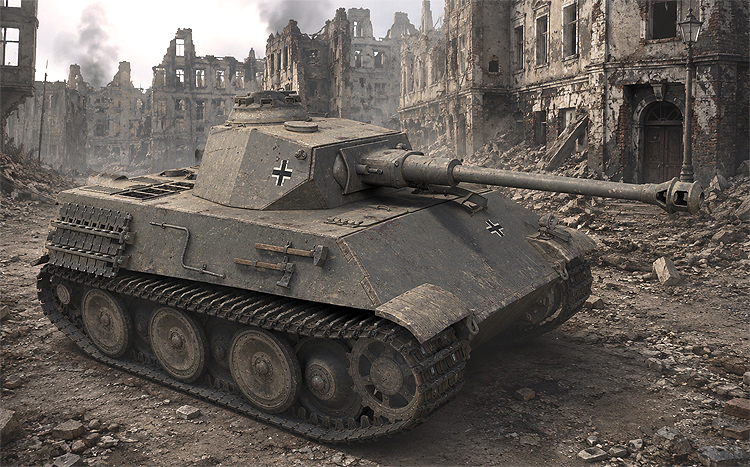
Theoretical appearance of the Mehrzweckfahrzeug tank with overlapping road wheels, the Panzer IV turret and a new commander's cupola, source: generated by AI
Panzer III and IV No Longer Sufficient
Practically from the very outset of building their armoured forces, the Germans had planned around two backbone tank types: the lighter Panzer III, optimised for destroying armoured targets, and the heavier Panzer IV, functioning essentially as mobile artillery support. The light tanks Panzer I and Panzer II were conceived as purely interim types, intended to allow practical experience to be gained in tank production and mass deployment, and to train an entire generation of new tank crews. The two-backbone concept worked reasonably well during the first years of the war – until 1941 brought an encounter with a new opponent: Soviet medium and heavy tanks. The German Panzer III and Panzer IV were rendered obsolete so rapidly that new types had to be found urgently to swing the balance of armoured power back in Germany's favour.
The existing Panzer III and Panzer IV were substantially modernised, but the future, in the eyes of many senior commanders, lay with the upcoming heavy tank Tiger and above all with the entirely new medium tank Panther. When the Panther's series production finally got underway in January 1943, those same commanders began asking what was to become of the increasingly obsolete Panzer III and Panzer IV. Production of the former was indeed halted that summer; the latter was kept on the production lines essentially only because Panther output was nowhere near meeting demand – in terms of quantity, or yet of quality.
General Guderian Steps In
It was into this atmosphere that the newly appointed Inspector General of Panzer Troops, Heinz Guderian, arrived in March 1943. Guderian quickly assembled the key facts: 1) the Panzer IV was genuinely obsolete with no bright future ahead of it; 2) the Panther was too expensive to be produced in the necessary numbers; 3) there would therefore be too few Panthers for their chassis to serve as the basis for the other types of fighting vehicle the German Army also needed – self-propelled guns, tank destroyers, Flakpanzers, and reconnaissance tanks. Guderian concluded that the Wehrmacht could not do without some mass-produced vehicle capable of fulfilling this wide range of roles. And if neither the Panther (too expensive) nor the Panzer IV (too outdated) could serve that purpose, an entirely new fighting vehicle would have to be developed.
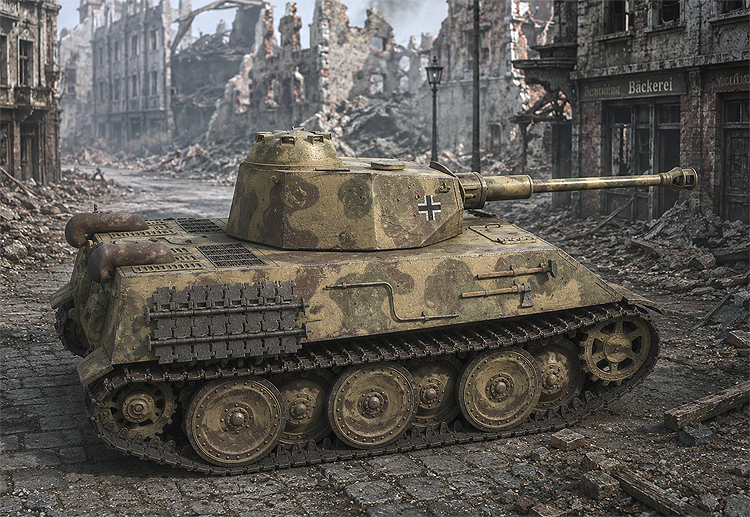
Theoretical appearance of the Mehrzweckfahrzeug tank with overlapping road wheels, the Panzer IV turret and a new commander's cupola, source: generated by AI
In June 1943 these ideas crystallised into a formal requirement for a new multi-purpose armoured vehicle – literally a Mehrzweckfahrzeug. It was essentially to be a successor to the Panzer IV (which the required weight class of 28 tonnes also reflected), but in a far more versatile form. The vehicle was to be developed from the outset not merely as a tank but as a platform for the straightforward mounting of various superstructures, enabling cheap mass production of self-propelled guns, reconnaissance vehicles, artillery observation vehicles, tank destroyers, Flakpanzers, and other specialised derivatives.
This approach was intended to achieve significant consolidation of production across many different fighting vehicle types. The Ordnance Office turned the requirement into a concrete specification and passed it to Krupp. Why did the Army officials not put it out to multiple competing firms? Most likely because Krupp was the manufacturer of the Panzer IV, and the assumption was simply that its capacity could transition smoothly from producing the old type to the new one. The Waffenamt tracked the new tank project under the standard development designation VK 28.01 (VK = Vollketten = fully tracked, 28 = expected weight in tonnes, 01 = sequential project number).
Krupp's Design
Already on 20 July 1943 Krupp presented Army representatives with a conceptual design for the new tank, designated Mehrzweckfahrzeug mit BW-Turm – multi-purpose vehicle with the Panzer IV turret (the production designation of the Panzer IV was Begleitwagen, or B.W.). The chassis concept envisaged six road wheels 700 mm in diameter on each side, though the suspension and springing arrangement is not specified in the available literature. The tracks were to be 600 mm wide with a contact length of 367.5 cm; given the expected track gauge of 253 cm, this gave a ratio of approximately 1.45. Three small return rollers supported the upper run of the track.
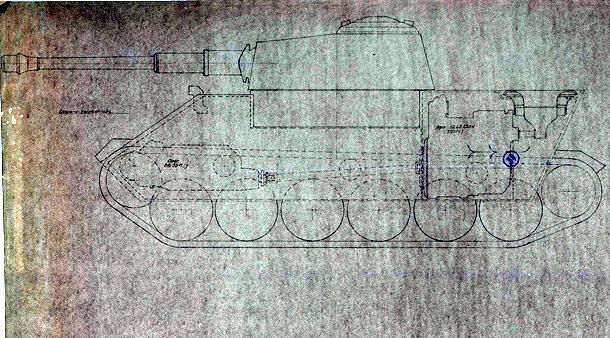
Drawing of an early version of the Mehrzweckfahrzeug (non-overlapping road wheels) fitted with the Panzer IV turret and a new commander's cupola, source: dzen.ru, edited
All hull walls were to feature sloped armour. The most exposed upper section of the front hull plate was to have 50 mm of armour at an angle of 55 degrees; the hull sides were to be 30 mm at 30 degrees, and the rear 30 mm at 25 degrees. The hull roof was to be 20 mm thick, with the hull floor 20 mm at the front and 16 mm further back. As the powerplant, a diesel engine was chosen – somewhat surprisingly – in the form of the Argus type 12LD330H, rated at a maximum output of 550 hp. The gearbox was to be a Maybach Olvar 55 11 17. Their positioning followed the traditional German tank school layout: engine at the rear with the gearbox and therefore the drive sprockets at the front.
The fighting turret, taken from the Panzer IV Ausf. G, had a 50 mm front wall and 30 mm sides and rear. Unlike the standard production turret, however, the one designed for the Mehrzweckfahrzeug received a new commander's cupola similar to that of the Panther. The documentation specified use of the KwK 40 L/43 gun of 75 mm calibre (even though the more powerful version with a longer barrel, designated L/48, was already available). The tank was to be 5.685 metres long (excluding gun overhang), 3.22 metres wide, and 2.595 metres tall. Total weight was calculated at 26 tonnes and maximum speed at 30 km/h. However, the requirement was not simply for a tank but for a universal platform for building a range of different vehicle types. Krupp therefore also presented the Army with drawings for a tank destroyer and a Flakpanzer on the same chassis – these can be read about in separate articles in the relevant sections. Somewhat surprisingly, a drawing was also produced for a railway variant of the vehicle, fitted with a retractable rail bogie for running on tracks (similar to the SK1 prototype based on the Panzer III).
Second Variant
Surviving documents show that the Krupp designers also prepared a second variant of the chassis and hull for the Mehrzweckfahrzeug. Again there were six road wheels on each side, but of a larger diameter and with partial mutual overlap – as on other late-war German tanks. Support rollers were not needed, since the upper run of the track rested directly on the road wheels. The rear hull wall was inclined at the opposite angle to the first design, shortening the hull overall. Even so, the expected vehicle weight increased slightly, to 26.5 tonnes. This variant was reportedly intended to use a Maybach HL 100 engine producing 400 hp, paired with a Zahnradfabrik SSG 76 gearbox. Despite the use of a less powerful engine, the maximum speed increased to a remarkably ambitious 60 km/h – which is certainly interesting.
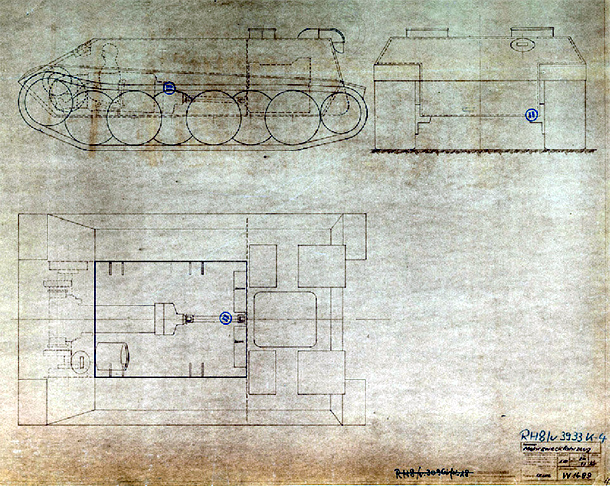
The second version of the chassis featured larger-diameter road wheels with partial mutual overlap; the hull was also shorter overall thanks to the reversed slope of the rear wall, source: dzen.ru, edited
According to the schedule Krupp drew up in July 1943, preparing the detailed design would take approximately 3 months, manufacturing a development prototype a further 6 months, prototype testing 3 months, and incorporating modifications and improvements another 8 months – only after which could series production begin. This meant the first production tanks could realistically not be available until April 1945. None of this came to pass, however, as the Mehrzweckfahrzeug project was officially cancelled at the end of October 1943, shortly after the second variant had been submitted.
ARTICLE
CONTENTS:
Reproducing text from the Panzernet website without the written consent of the operator is prohibited.