5 cm Pak 38 auf VK 9.01
a tank destroyer on the wrong chassis
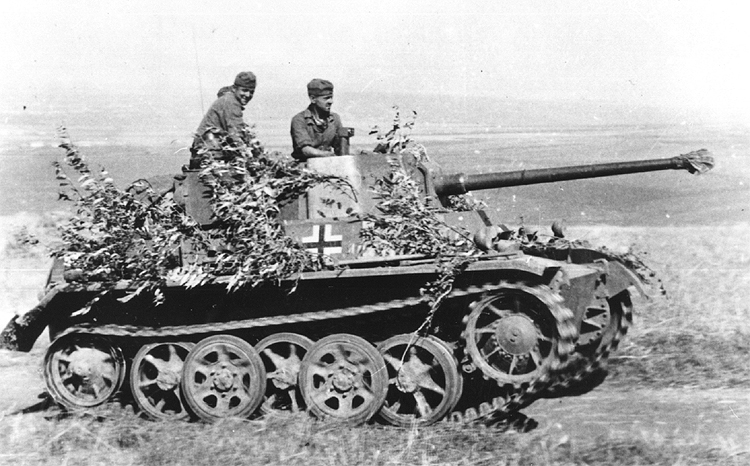
although built in only two evaluation examples, the 5 cm Pak 38 auf PzKpfw II Sonderfahrgestell 901 did see combat deployment on the Eastern Front, source: Flickr.com with permission of the publishing user, edited
The VK 9.01 Project
This light tank destroyer, built in only two examples, was one of the few tangible outcomes of an ambitious project known as VK 9.01. The VK 9.01 project was launched in June 1938 with the aim of creating an entirely new generation of the Panzer II light tank — one that would be produced in enormous numbers and replace all previous Panzer II variants in service. One of the principal driving forces behind the vehicle was Heinrich Ernst Kniepkamp, an engineer at the ordnance office and a former MAN employee with extensive experience in the design of half-track prime movers.
Two key requirements headed the list of specifications for the new tank. The vehicle was to be very fast and its handling so straightforward that "anyone" could drive it — similar to the half-tracks. The chassis for the VK 9.01, together with all internal components, was to be developed by MAN, while the hull with fighting superstructure and rotating turret was entrusted to Daimler-Benz. The first chassis prototype (Versuchs-Fahrgestell), without the upper hull and therefore without the turret, was completed at some point before the end of 1939. The first complete tank prototype appears to have been built in April 1941.
Description of the Design
The tank's running gear consisted of five double road wheels of 650 mm diameter on each side. Each side had five axles, with two wheel discs on each axle. The discs on the even-numbered and odd-numbered axles were positioned at different distances from the hull centreline, causing the wheels to interleave and overlap. This type of running gear, known as Schachtellaufwerk, was widely used by the Germans on half-track vehicles and later on medium and heavy tanks.
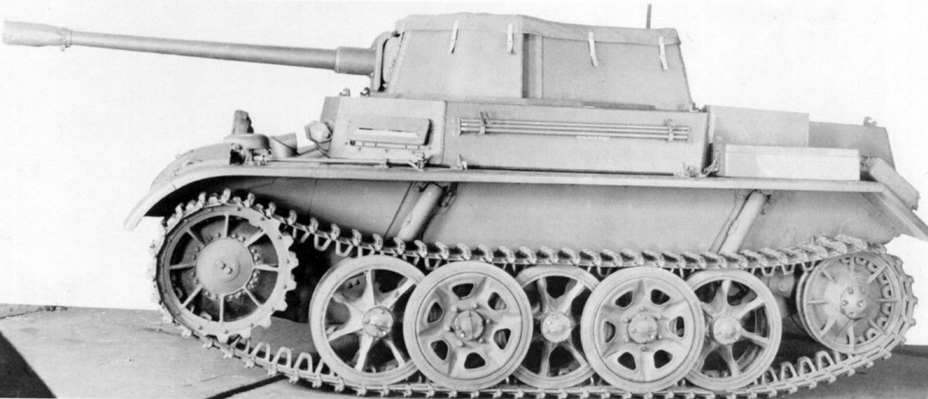
this factory photograph clearly shows the additional armour plates welded to the hull sides beneath the track mudguards, as well as the widened crew superstructure, source: Flickr.com with permission of the publishing user, edited
All wheels were fitted with solid rubber tyres for a smoother ride, and were sprung by torsion bars. The first and last road wheels, which were subjected to the greatest stress during travel, were also fitted with additional shock absorbers. Ahead of the road wheels was the toothed drive sprocket, and at the rear the idler wheel. The tracks were 300 mm wide, each consisting of 77 links joined by dry pins.
The tank was powered by a Maybach HL 45 six-cylinder petrol engine with a displacement of 4.678 litres, developing 150 horsepower at 3,800 rpm. This drove an eight-speed semi-automatic Maybach VG 15319 gearbox connected to a newly developed track steering unit designated LGR 15319 (originally named LG 45 R). Steering was by a steering wheel rather than the usual brake levers. Depending on the angle of the steering wheel and the gear engaged, the steering unit varied the braking force applied to the inner track and thereby determined the turning radius. Gear changing was also simplified: the driver had the gear selector on the steering wheel itself, operated simply by moving a small lever up or down with the right hand, while the semi-automatic gearbox took care of the rest.
At first glance, MAN appeared to have met the specification: the tank could reach 67 km/h and its handling was automated to an unprecedented degree. In practice, however, results fell well short of expectations. The new VG 15319 gearbox and LGR 15319 steering unit suffered from fundamental deficiencies. The situation was serious enough that the ordnance office ordered in April 1941 that further prototypes be built fitted with alternative components. The next ten chassis produced therefore received new LGL 15319 steering units, with half fitted with Maybach OG 20417 gearboxes and the other half with Zahnradfabrik SMG 50 gearboxes.
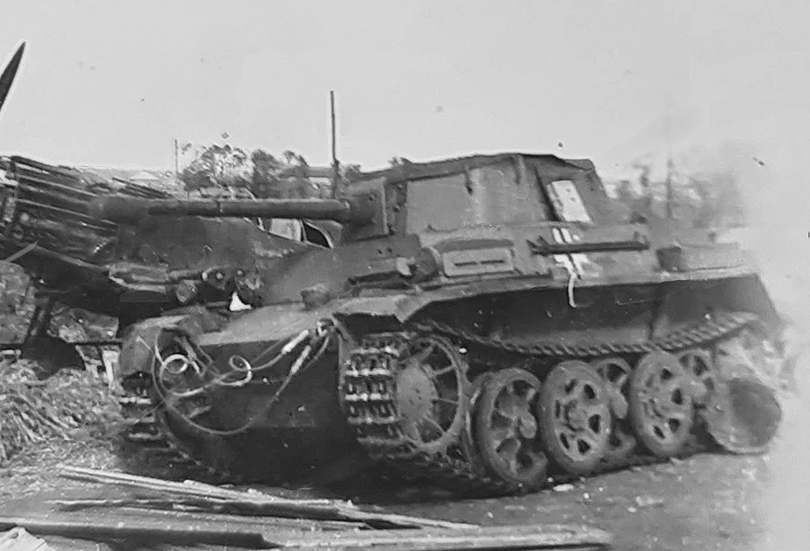
5 cm Pak 38 auf PzKpfw II Sonderfahrgestell 901 on the Eastern Front, source: Flickr.com with permission of the publishing user, edited
This was an improvement of sorts, but by no means the solution. Despite the ongoing problems, production of the so-called pre-series run of the VK 9.01 continued, and by the end of 1942 a total of 45 chassis and 60 hulls and turrets had been built. Some chassis received Maybach OG 20417 gearboxes and others the Zahnradfabrik SMG 50, though the number of fully assembled complete tanks was most likely considerably lower.
A New Tank Destroyer
At this point we need to step back in time to July 1940. The Germans were then evaluating their experience with the deployment of the new Panzerjäger I tank destroyer during the campaign in France. They concluded that the vehicle had performed well in combat, and that it would therefore make sense to continue development of further types along the same lines — preferably with more capable armament. A complete VK 9.01 tank prototype had not yet appeared at this point, but plans for its future mass production remained in force. It is therefore no surprise that the ordnance office hit upon the idea of building a new tank destroyer on the VK 9.01 chassis, and promptly tasked Rheinmetall-Borsig with designing an installation of the 50 mm Pak 38 anti-tank gun on the MAN chassis.
In reality it was slightly more complicated than that. Since June 1940, MAN had also been working on a further tank variant designated VK 9.03, developed from the VK 9.01 but intended to have heavier armour and a more powerful engine. It was in this development variant that the German ordnance office had placed its main hopes, and accordingly the new tank destroyer was also intended to use the VK 9.03 chassis. In the end, however, things turned out quite differently.
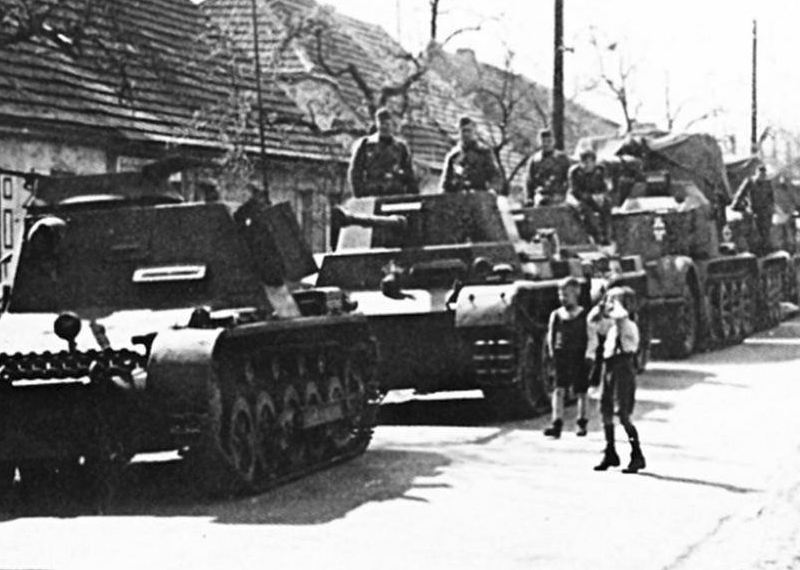
the 5 cm Pak 38 auf PzKpfw II Sonderfahrgestell 901 and other vehicles belonging to Panzerjäger-Kompanie 601, source: Flickr.com with permission of the publishing user, edited
The plan was as follows: a VK 9.03 chassis with a Maybach HL 66 P engine developing 180 horsepower, 30 mm frontal armour and 20 mm on the sides. Mounted on the chassis was to be a new armoured superstructure housing a modified version of the 50 mm Pak 38 gun. Total projected production was over two thousand vehicles for service with armoured units and motorised infantry formations.
And what was the reality? The development of the VK 9.03 evaluation chassis was running dramatically behind schedule. The ordnance office, apparently no longer willing to wait, made do with the VK 9.01 chassis instead, despite its thinner side armour and the less powerful Maybach HL 45 engine. The weaker side armour was addressed by simply welding additional 5 mm plates to the sides of the VK 9.01 hull, bringing the protection to essentially the same level as had been planned for the VK 9.03.
The chassis modified for the new tank destroyer was designated Panzerselbstfahrlafette Ic, abbreviated Pz.Sfl. Ic. The tank destroyer itself carried the designation 5 cm Pak 38 auf PzKpfw II Sonderfahrgestell 901. Various other designations also appear in German documents, such as Pz.Jg.Sfl 5 cm Fgst. Ic. An order was placed for two evaluation vehicles. A report from July 1941 states that both would be ready in September of that year. It is not clear from the available literature whether the tank destroyers were built on chassis with Maybach OG 20417 or Zahnradfabrik SMG 50 gearboxes — or whether each had a different one.
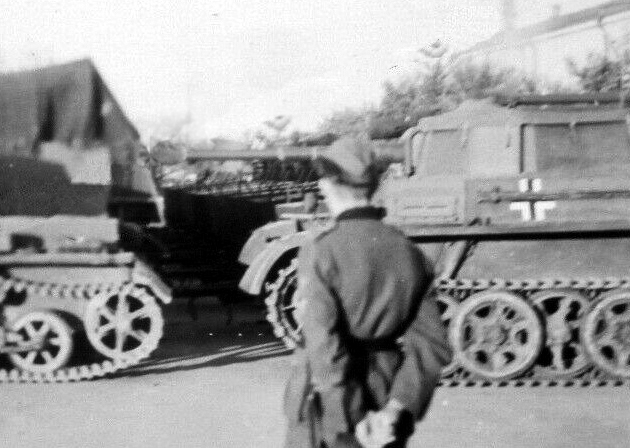
5 cm Pak 38 auf PzKpfw II Sonderfahrgestell 901 tank destroyer, source: Flickr.com with permission of the publishing user, edited
The original crew superstructure from the VK 9.01 tank proved too narrow for the new application. The tank destroyer therefore received a new superstructure that widened slightly outward from the front plate. Unlike the VK 9.01 superstructure, the tank destroyer's front plate had only a single vision port for the driver. A second vision port was in the left side wall (apparently taken from the Panzer I light tank). On the roof of the widened superstructure sat a fixed open-topped gun housing.
Armament
Installed in the open-topped housing was a 50 mm gun designated the 5 cm Kanone L/60 — a modified version of the Pak 38 anti-tank gun. It received a new mount and a breech taken from the tank gun KwK 39 L/60 (thanks to this breech, the gun was most likely fired electrically). The ammunition used included the armour-piercing round PzGr. 39, weighing 2.06 kg with a muzzle velocity of 823 m/s (sometimes quoted as 835 m/s), and the sub-calibre core round PzGr. 40, weighing 0.85 kg at 1,198 m/s (sometimes quoted as 0.925 kg at 1,180 m/s). The first round could penetrate at 500 metres a homogeneous armour plate 57 mm thick angled at 30 degrees. The second could defeat at the same range an angled plate up to 78 mm thick.
Combat Deployment
In March 1942, both completed tank destroyers on the Pz.Sfl. Ic chassis were assigned to the 601st Tank Destroyer Company (Panzerjäger-Kompanie 601), which was subsequently incorporated into Tank Destroyer Battalion 559 (Panzerjäger-Abteilung (Sfl.) 559). Both vehicles saw action with this unit on the Eastern Front. According to a report dated 20 August 1942, both vehicles were still in service — one in operational condition and one under repair.
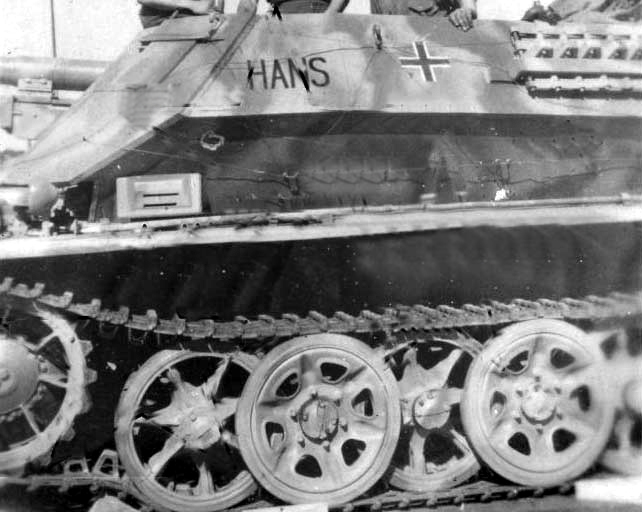
an unidentified conversion of the VK 9.01 chassis into a carrier for the 75 mm Pak 40 gun, source: Flickr.com with permission of the publishing user, edited
A Pak 40 Variant?
One rather poor-quality photograph exists showing a VK 9.01 chassis fitted with a fixed superstructure and the 75 mm Pak 40 anti-tank gun. The superstructure design is clearly different at first glance from the Pz.Sfl. Ic with the 50 mm gun. The Pak 40 can be identified with reasonable confidence by the design of its recoil mechanism housing beneath the barrel. No further information about this vehicle has been found anywhere.

ARTICLE
CONTENTS:
Reproducing text from the Panzernet website without the written consent of the operator is prohibited.