ZIMMERIT
anti-magnetic paste against magnetic mines
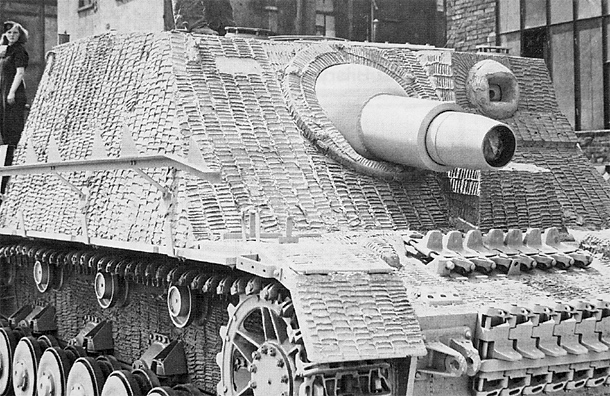
A particularly thorough coat of Zimmerit paste on a Brummbär self-propelled gun, source: Flickr.com with permission of the publishing user, edited
A New Anti-Tank Weapon
The German Army responded to the overwhelming numerical superiority of Soviet tanks in many different ways. This included not only the development and production of more powerful anti-tank guns and new tank types, but also a whole range of new infantry weapons. Among these was a magnetic hollow-charge mine known as the Hafthohlladung, which entered service in November 1942. It was a very simple device combining a hollow-charge warhead – similar to that fired from a Panzerfaust – with a tripod made of powerful magnets. The weapon was produced in several versions, but the most common, the Hafthohlladung 3, weighed 3 kg and contained 1.5 kg of explosive. The three magnets not only allowed easy attachment to any metal surface, but also maintained the correct standoff distance between the charge and the armour to maximise the effect of the explosion. The charge could penetrate homogeneous armour 110 mm thick – with the later, heavier version achieving even more.
Incidentally, each of the three magnets had a holding force equivalent to approximately 6.8 kg, meaning the entire Hafthohlladung 3 clung to armour with a force of more than 20 kg. This deliberate over-engineering ensured the charge would not fall off even if it could not be placed perfectly and all three magnets failed to make full contact. The principle of the weapon was very simple and production costs were relatively low, making truly mass production possible – the Germans ultimately manufactured more than half a million of them in total. It was precisely this simplicity and low cost that prompted German military authorities to worry that enemies would soon either develop something similar themselves or copy the German weapon directly and deploy it on a mass scale. And so the Germans began looking for a defence against their own weapon.
Possible Countermeasures
As early as January 1943 the Ordnance Office organised a series of experiments to find possible ways of protecting German armoured vehicles from magnetic mines. Following the experiment, a report titled "Gegenmittel gegen Haft-Sprengladungen" was issued, describing five possible solutions: protecting the armour with a 3 to 5 mm layer of concrete mixed with fine stone chippings; coating the armour with a layer of asphalt also mixed with fine stone chippings; applying a slippery coating such as a mixture of oil and asphalt; applying multiple coats of paint until the total coating thickness reached at least 2 to 3 mm; and finally, for the winter conditions of the Eastern Front, simply repeatedly dousing the tank's walls with water to build up a sufficiently thick ice crust.
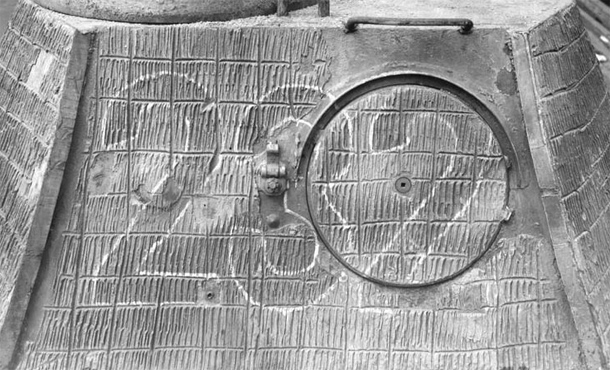
Partially flaking Zimmerit paste on the rear wall of a Panther tank's fighting turret, source: Flickr.com, public domain, edited
In February 1943 all the options described were evaluated by armoured forces representatives, and all except the first were immediately rejected. Coating the tank's walls with ice was only feasible during hard frosts; on the engine section, ice would most likely soon melt from the heat generated, and any ice that did not fall off by itself during travel would certainly be knocked off by even small-arms fire. The use of asphalt was unsuitable in hot weather, as it would tend to run. The slippery asphalt-and-oil mixture raised concerns among the soldiers about the risk of ignition if the vehicle were hit. The option of layering paint was dismissed as insufficiently effective. The only solution left on the table for further investigation was the application of a concrete layer with small stone chippings.
Enter Zimmer
This winning option, based on the use of concrete, most likely directed the authorities towards the construction chemistry manufacturer Chemische Werke Zimmer & Co of Berlin. The firm was tasked with producing the described material. The experts at Zimmer apparently concluded, however, that ordinary concrete would not be the right solution for the purpose and came up with their own proposal instead. They developed a chemical compound based on a material known as lithopone – an inexpensive product with no odour, stable in air, non-toxic, and above all non-flammable and non-explosive. It has been known in the chemical industry since the mid-19th century and is used as an additive in the manufacture of paints, plastics, and fillers.
Lithopone itself is a mixture of barium sulphate and zinc sulphide. The chemists at Chemische Werke Zimmer & Co most likely adjusted the proportions of these two substances to their own specification and then added a pigment (ochre), an inexpensive filler in the form of wood sawdust, and above all polyvinyl acetate to serve as a binder and adhesive. The resulting compound was named after its manufacturer: Zimmerit. The proportions of the individual constituents in the final product were as follows: 40% barium sulphate, 25% polyvinyl acetate, 15% ochre pigment, 10% zinc sulphide, and 10% sawdust. None of the ingredients was magnetic or flammable – except for the sawdust.
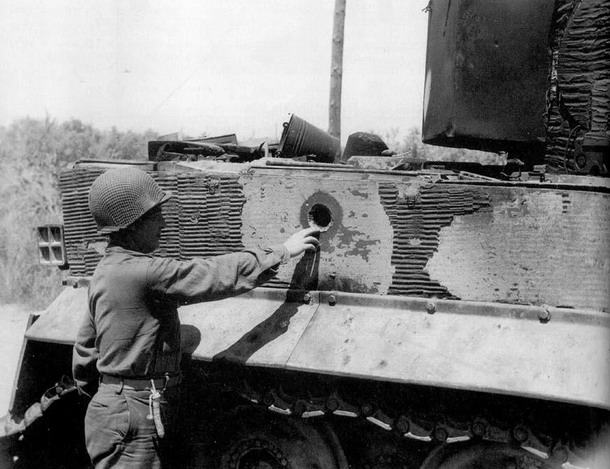
The last remnants of Zimmerit on the shot-through side of a heavy Tiger tank, source: Flickr.com, public domain, edited
Series Application Begins
Trials of the new material took place at the beginning of June 1943 at the Kummersdorf testing centre near Berlin. The details of how they were conducted are not clear from the sources, but everything apparently went well, and on 30 June it was decided to carry out further evaluation directly with combat units – specifically the 4th and 7th Panzer Divisions. Here too all clearly went as intended, because by the end of summer 1943 the decision was made to begin "series" application of Zimmerit to German tanks. On Tiger tanks the paste began appearing as early as August 1943; on Panzer IV and Panther tanks approximately a month later. Zimmerit was not used on tanks alone, however, but also on other types of armoured fighting vehicles. It can be seen fairly commonly in photographs on assault guns StuG III, StuG IV, StuH 42, Brummbär, and Sturmtiger, as well as on tank destroyers Nashorn, Hetzer, Jagdpanther, Jagdpanzer IV, Elefant, and Jagdtiger. While on tanks the Zimmerit was applied to the fighting turrets as well (since it was easier to climb onto a tank), on turretless vehicles such as the Elefant and Jagdtiger the coating ended at the height an enemy infantryman could reasonably reach from the ground (as can be clearly seen in the photograph HERE).
Zimmerit was applied directly in the factories, where it was delivered in barrels with the consistency of a fine filler. Workers spread it directly onto the vehicle armour – which had been primed with an anti-corrosion coating – using metal spatulas. The surface required virtually no preparation before application, though the paste naturally adhered better to a clean, grease-free surface. According to some sources Zimmerit was applied in two layers; other sources mention only one – though it is possible both accounts are accurate, since sometimes only a single coat may have been applied for the sake of time. In any case the total coating thickness was reportedly around 5 to 6 mm. The final surface treatment was the creation of a ridged pattern, applied either with a spatula or using a template. The coating was then hardened using a hot-air gas pistol. Without it, Zimmerit needed about 6 to 8 days to dry and harden fully; with the hot-air pistol, just one hour sufficed.
The ridged pattern both increased the effective thickness of the coating while using less paste in absolute terms, and made it harder for a mine to find purchase on the uneven surface. Zimmerit had no active anti-magnetic properties; it simply formed a non-magnetic layer on the surface of the armour, thereby eliminating or at least reducing the grip of a magnet. A magnetic mine would either fail to attach to the tank at all, or detach more easily under vibration. Zimmerit also offered no reinforcement of the armour against conventional projectiles, as it was far too thin and brittle for that.
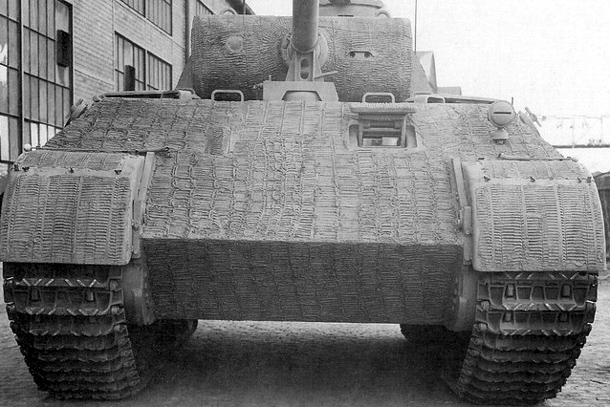
A Panther command tank thoroughly covered in Zimmerit paste, source: Flickr.com with permission of the publishing user, edited
The paste was applied to all surfaces except the roof plates of the turret and hull. Spaced armour was rarely coated with Zimmerit. To coat a StuG III assault gun required 70 kg of Zimmerit. A Panzer IV needed 100 kg, a Panther 160 kg, and a Tiger a full 200 kg. Through the use of shared tank chassis, Zimmerit also found its way onto vehicles of entirely different types, such as the anti-aircraft tanks Ostwind and Wirbelwind, and the recovery and repair vehicles Bergepanther and Bergetiger. Probably the least typical vehicle to carry this coating, however, was a single example of the half-tracked armoured personnel carrier Sd.Kfz. 251.
An Inglorious End
Almost exactly one year after series application of Zimmerit had begun, an unexpected order came on 9 September 1944 to halt its use on new fighting vehicles immediately. The reason was reports that the coating was allegedly catching fire when struck by enemy projectiles. An experiment was therefore organised to either confirm or refute this suspicion. Zimmerit was applied in the standard manner to a captured T-34 tank, and on 11 November 1944 it was subjected to test firing with various types of ammunition. Armour-piercing, hollow-charge, and high-explosive fragmentation rounds were all fired at armour coated with the anti-magnetic paste – as were phosphorus incendiary rounds. Not a single type of ammunition succeeded in igniting the Zimmerit.
It is remarkable that a similar test had not been carried out during the initial trials of the new material in June 1943 – or perhaps it was, but had lost its credibility with the passage of time. In any case, the November 1944 experiment confirmed that the Zimmerit coating posed no danger to the vehicle. The Germans nevertheless did not resume applying the paste. In the intervening period a fundamental reassessment of its practical value had taken place. None of the enemy armies had begun deploying magnetic anti-tank mines on a mass scale during the final year of the war. Why, then, waste money and above all time coating tanks with something that was not actually needed on the battlefield?
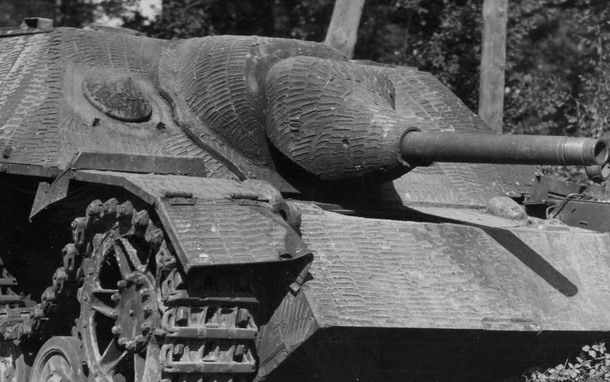
The factory workers who applied Zimmerit to this Jagdpanzer IV were clearly thorough – the paste was extended to the track guards, the gun mantlet, and the machine-gun embrasure cover as well, source: Flickr.com, public domain, edited
After Germany's defeat, Allied soldiers came into possession of approximately 100 tonnes of Zimmerit, some of which they took away for testing. The British, French, and possibly the Canadians all carried out experiments applying the coating to their own armoured vehicles (photograph for example HERE), but that was where their interest in Zimmerit ended. It was clear that magnetic anti-tank mines were already leaving the stage of history, making way for rocket-propelled infantry anti-tank weapons – bazookas and RPGs.
ARTICLE
CONTENTS:
Reproducing text from the Panzernet website without the written consent of the operator is prohibited.