TANK CREWS
composition and roles of individual crew members
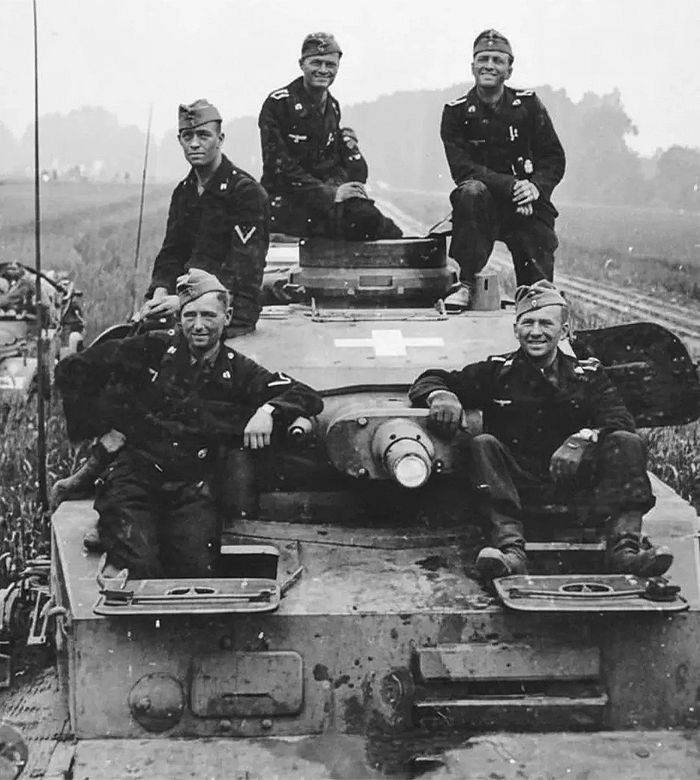
complete crew of an early-version Panzer IV: driver, radio operator, loader, commander and gunner, source: Worldwarphotos.info with the permission of the operator, edited
Introduction
Just like the tanks themselves, tank crews went through their own evolution. The first German tank, the A7V of 1917, carried an extraordinary 18 men on board. Large crews were also common in multi-turreted tanks, which came into fashion at the turn of the 1920s and 1930s – crew size broadly tracked the number of turrets, so the more turrets, the more men. By international standards the Germans showed relative restraint in this regard, as their multi-turreted tanks, the Grosstraktor and the Neubaufahrzeug, had "only" six-man crews. More importantly, the Germans grasped very early on that multi-turreted tanks were a developmental dead end: more turrets did not lead to greater firepower but to worse coordination. By around 1933, those responsible for German tank development had concluded that the ideal arrangement was a single artillery weapon mounted in one rotating turret, operated by a crew of five, three of whom would be stationed in the turret itself.
This may sound trivial from today's perspective, but this insight – and the Germans' very effective application of it – played a substantial part in the combat successes of German armour. From the Panzer III onwards, all German tanks were thus crewed by a driver, a radio operator, a loader, a gunner, and a commander. We are speaking here of standard combat tanks, not vehicles modified for special purposes such as command tanks, observation tanks, recovery vehicles, and so on. It is this standard five-man German tank crew that we will describe in the following article.
Driver - Fahrer
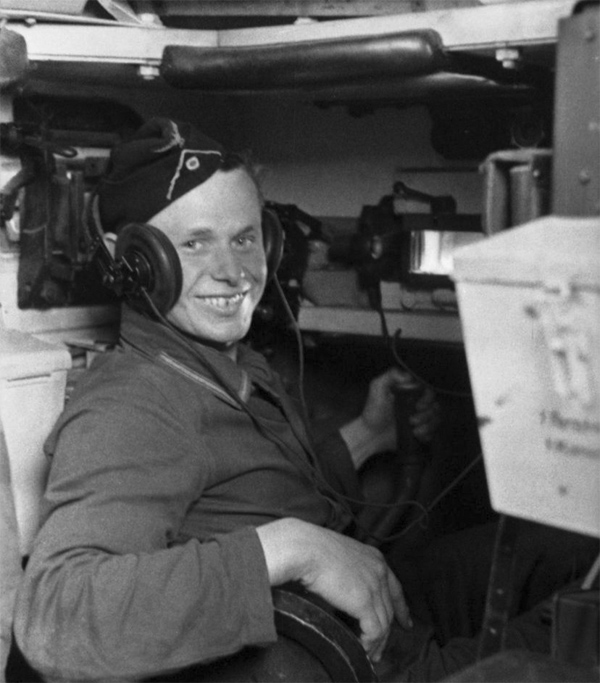
a young Panzer IV driver in his seat, source: flickr.com with the permission of the publishing user, edited
Every vehicle needs a driver – that goes without saying. But beyond simply operating the vehicle, a tank driver also acted as mechanic and was responsible for the basic maintenance of his machine. The standard position for the driver in a German tank was on the left side of the front hull. The only exceptions were the Panzer 35(t) and the Panzer 38(t), which were of original Czechoslovak design and had the driver's position on the right, since pre-war Czechoslovakia drove on the left in the British fashion. A tank had the same basic set of three pedals familiar from ordinary cars – brake, clutch, and accelerator. Steering in a tank is achieved by braking one track or the other, and the most common primary controls were therefore braking levers, colloquially known as "tiller bars". The exception within German tanks was the heavy Tiger and Königstiger, which used a steering wheel as their primary control – though turning it still simply applied braking to one track or the other. The ex-Czechoslovak Panzer 38(t) (and vehicles derived from it) also stood apart in having its braking levers arranged horizontally rather than vertically.
The driver naturally needed to see out of the tank. In early German tanks, drivers had direct-vision ports: openings cut into the front armour through which the soldier looked straight out. For safety these were filled with a thick block of bulletproof glass (in the Panther Ausf. D, for instance, the glass block was a full 9 cm thick!), and a spare glass block was also carried as part of the tank's kit. Even so, use of the main vision port was recommended only during road marches. In combat areas, where enemy fire was a risk, the driver was supposed to close the main port completely using an outer armoured shutter (Fahrersehklappe) and instead use the safer periscope known as the Kampfwagenfahrerfernrohr (KFF), whose lenses required only two tiny 15 mm holes drilled into the hull above the main port.
In later German tanks, the driver's indirect vision was provided by a periscope passing through the hull roof, doing away with even those two small holes in the front plate. In later models still, the direct-vision port in the front hull was eliminated entirely, leaving the driver with only the safe periscope. To his right the driver had a small instrument panel with the essential gauges: typically a large rev counter, a speedometer with odometer, an oil pressure gauge, and a coolant temperature gauge. In practice, however, the driver probably had little opportunity to watch the instruments while on the move, as his eyes were effectively glued to the vision port just trying to see where he was going. Another interesting instrument available to the drivers of certain German tank types was a directional gyroscope, which helped them navigate in open terrain without landmarks – such as the African desert or the endless Russian steppe.
Radio Operator - Funker
the radio operator was also responsible for operating the hull machine gun, here in a Panzer IV, source: flickr.com with the permission of the publishing user, edited
"Without communications there is no command" – that was as true during the Second World War as it is today. The Germans understood very clearly what a decisive role the ability to communicate continuously played on the battlefield, both between tanks and with higher command and support elements. As a result, a radio set became standard equipment in every German tank. According to some sources, the rank-and-file Panzer II, Panzer III, and early Panzer IV carried only a receiver, the Fu 2 (sometimes listed as FuG 2, where FuG stands for Funkgerät, meaning radio set). On this account, ordinary tanks could only receive orders, with the transmitter being the preserve of command tanks. Other sources maintain, however, that standard fighting tanks were fitted with a combined receiver-transmitter set from the outset – a configuration known as the Fu 5. In later versions of German tanks, both receivers and transmitters were unquestionably installed. If the tank was intended for a platoon or company commander, it also carried an additional receiver (giving a combination of the Fu 5 and Fu 2 sets).
The radio sets were accompanied by a whole range of additional components that the radio operator had to understand and maintain. These included voltage converters, an antenna distribution unit, a central distribution box in the hull to which the driver and radio operator connected their headsets and microphones, and two further distribution boxes in the turret – one for the commander's headset and microphone, and one for the gunner's. The radio equipment also provided an intercom function, allowing crew members to communicate with one another inside the tank. In early tanks, however, this was far from standard. In the first versions of the Panzer II, for instance, communication between the commander in the turret and the driver in the hull was managed by a simple speaking tube – not unlike a vacuum cleaner hose. In command tanks at least, it was also possible to connect an ordinary ground cable to the radio system and communicate over it when the commander did not wish to broadcast over the air for whatever reason.
The radio operator's station was in the right front section of the hull. The radio sets were typically positioned above the gearbox, between the driver and radio operator, in racks suspended from the hull roof, though sometimes also in front of the radio operator, below the machine gun mounting. Inside their metal housings the radio sets rested on rubber pads that absorbed the vibrations caused by driving and firing – vibrations that were particularly damaging to the glass vacuum tubes inside the sets. The radio operator was the only crew member who continuously monitored external radio traffic, and whenever he picked up a message relevant to his tank, he relayed it to the commander via intercom or connected the commander directly into the transmission. The commander was therefore free from having to listen to the airwaves the whole time and could concentrate fully on directing the battle.
In addition to operating the radio, the radio operator had a second duty: manning the hull machine gun. German tanks typically used the MG 34, and continued to do so even after the newer MG 42 was introduced. The MG 42, despite being more modern, was not suited to installation inside an armoured vehicle, due to the way its barrel was changed. Machine gun barrels heat up considerably during sustained fire and must either be given long enough cooling breaks or replaced before they are ruined. On the MG 42, the barrel was removed from the side, which was clearly impossible when the gun was mounted in a fixed hull aperture. The older MG 34, by contrast, had its barrel withdrawn along the axis of the gun – perfectly feasible in this application. Machine guns were installed in tanks without their stocks, which were unnecessary and would have taken up precious space in the already cramped interior. Tank-mounted machine guns also received a specially adapted barrel jacket without the characteristic circular ventilation holes found on the standard infantry version; this variant was known as the MG 34 Panzerlauf – literally "tank barrel".
Loader - Ladeschütze
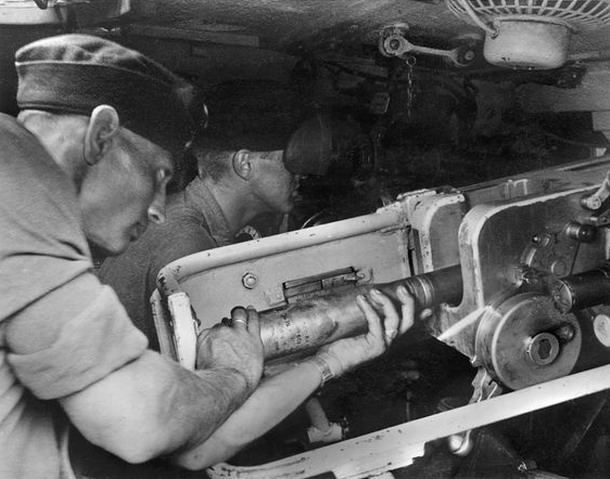
a Panzer III tank, the loader (and behind him the gunner) at work, source: flickr.com with the permission of the publishing user, edited
The loader's role hardly requires lengthy explanation – his job was simply to load the tank's gun. That might sound straightforward, but in practice there was nothing enviable about the loader's lot. His work was physically demanding, requiring strength, dexterity, and speed. On the commander's instructions, the loader had to select the correct type of round, ram it into the breech as quickly as possible, close the chamber, signal to the gunner that the gun was ready, and then get clear of the breech as fast as he could. A tank typically carried two to four types of ammunition for its main gun. High-explosive fragmentation rounds were used against soft targets, while armour-piercing, shaped-charge (Hohlgeschoss), and – against especially well-protected targets – sub-calibre rounds were available for use against armoured opponents. In the darkness, noise, and confusion of combat, the loader could not afford to make a mistake.
The loader's station was to the right of the gun. His seat was usually foldable, since the loader worked standing – or rather crouching and hunched, as the cramped turret interior permitted nothing better. As the war progressed and the power of tank guns grew, so too did the size and weight of their ammunition. The 88 mm round for the Königstiger's gun, for example, weighed more than 20 kg and measured around 113 cm in length. Manoeuvring such a large and heavy object – one packed with explosive – inside the confined space of a tank turret must have been a genuine ordeal.
The need to clear the breech as quickly as possible after loading was not mentioned above without reason. After firing, the gun recoiled sharply rearwards. The recoil space was enclosed by a metal guard that also held a bag for catching the spent cartridge cases (most German tank guns ejected the case automatically after firing). Every crew member knew better than to put a hand – or any other part of the body – inside the guard during combat, yet the loader was the one man who absolutely had to do so. If the gunner fired too quickly and the loader did not manage to get clear in time, the recoiling breech could kill him outright, or at the very least break his arm – and this did occasionally happen.
When required, the loader also operated the turret machine gun, firing it and keeping it fed with ammunition. The loader suffered one further disadvantage: he was the only crew member without headphones and a microphone, meaning he was not connected to the intercom. The commander therefore had to shout instructions directly at him. In a good number of tanks the loader also had no forward-facing vision port, and even if he did, there was certainly no opportunity to look through it in the middle of a fight. The loader thus neither saw nor heard what the rest of the crew could, and had the least situational awareness of anyone on board – which was, perhaps, sometimes a blessing.
Commander - Panzerführer
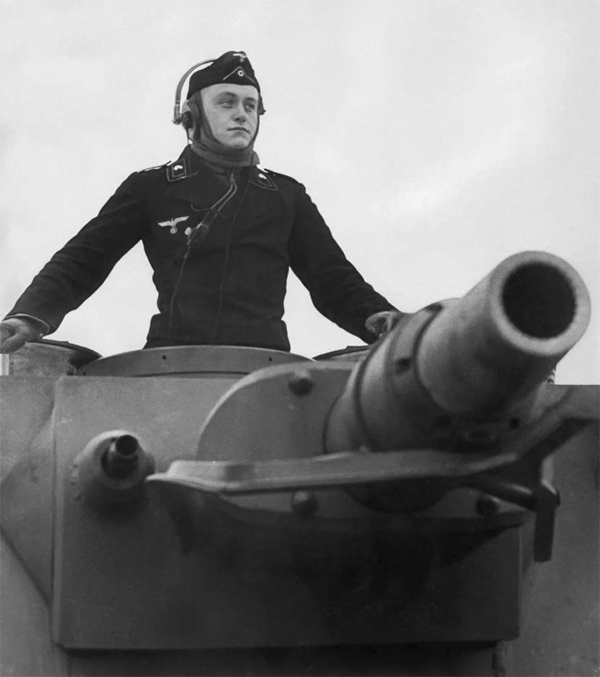
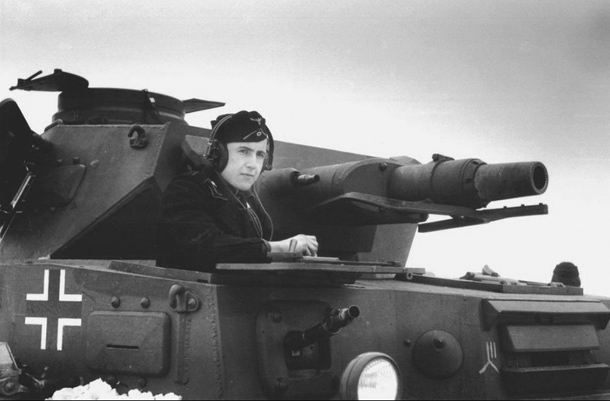
the commander of an early-version Panzer IV, source: Worldwarphotos.info with the permission of the operator, edited
There is no room for democracy in an army; you cannot sit down in the heat of battle and debate what should or should not be done. A tank therefore has a commander who makes decisions and bears responsibility for them. For the commander to issue orders to the rest of the crew, he needs the best possible awareness of what is happening on the battlefield, and for this purpose he has the commander's cupola. The cupola is the highest point of the tank – a kind of observation tower offering a view in every direction. While the driver, radio operator, gunner, and loader each have a field of view in essentially one direction (forward, or perhaps to one side), the cupola is fitted with vision devices around its entire circumference, allowing the commander to survey the whole battlefield.
In early German tanks, commanders' cupolas typically had direct-vision periscopes with bulletproof glass blocks that could be sealed by an external armoured shutter. With this type, the commander had to position his eyes precisely at the level of the aperture, meaning his head was almost entirely inside the cupola's tube – which consequently had to be quite tall. This made it an easier target for enemy fire, and if struck directly by an anti-tank round, the cupola would typically be torn off – along with the commander's head. Later, more modern cupolas were therefore introduced, fitted with indirect periscopes arranged around their circumference. Such a cupola could be made significantly lower, presenting a smaller target, while the commander's head remained essentially below the turret roof, affording much greater protection. The individual periscopes were easily replaceable from inside, and the surrounding area was padded to prevent the commander from injuring himself against them while on the move.
The design of the cupola hatch also evolved in the direction of greater safety. The two-piece hatch typical of early Panzer III and Panzer IV tanks was later replaced by a single-piece hatch – which still opened by swinging upward. This meant that to close it, the commander had to raise his arm well outside the tank, a highly precarious situation if enemy infantry got too close. Leaving the hatch open risked a hand grenade being dropped into the tank's interior; reaching up to close it risked being shot. Later hatches were therefore redesigned to swing slightly upward and then slide to one side, a motion that required virtually no exposure of the hands at all. Commanders may not ultimately have been entirely enthusiastic about this solution, however, since opening the new hatch was done by "unscrewing" it with a crank handle – a process that took several seconds. Very long seconds, if you were trying to escape from a burning tank.
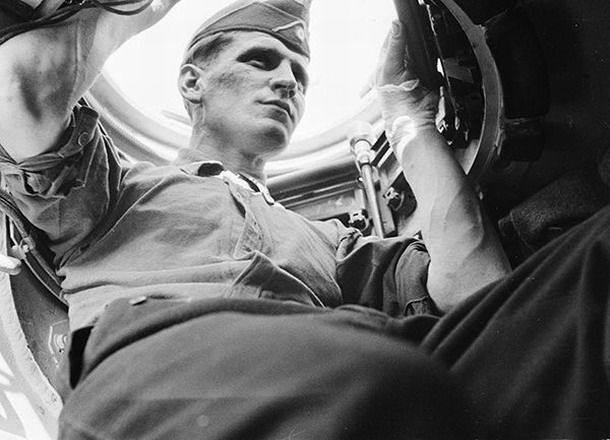
the commander inside his cupola, source: flickr.com with the permission of the publishing user, edited
The independent role of the commander was one of the key factors behind the effectiveness of German tank crews. When the commander does not have to concern himself with anything else, he can focus entirely on observing the battlefield and directing the crew. He identifies targets and calls them out to the gunner, instructs the loader which type of ammunition to use, tells the driver which direction to travel and at what speed, warns him of obstacles, and – with the help of the radio operator – communicates with other tanks and with higher command (his platoon or company commander). In the earliest German tanks, the Panzer I and Panzer II, the commander was also required to serve as gunner and loader, placing a considerable burden on him: if you are firing at one target, it is very difficult to simultaneously scan the surroundings for the next one. From the Panzer III onwards, all subsequent German tanks had a five-man crew in which the commander was commander and nothing else. The only secondary task that remained with the commander even in these tanks was operating the anti-aircraft machine gun that could be mounted on the ring around the cupola – though this was typically done during road marches rather than in combat.
Even with their cupolas offering vision in all directions, German tank commanders frequently drove with their heads partially out of the hatch even in combat. The reason was simple, and was described very well by Oberleutnant Otto Carius in his memoirs. For a tank commander, sight matters far more than hearing. Inside a fighting vehicle the noise is such that the commander often has no chance of hearing the shot from an enemy anti-tank gun, let alone determining which direction it came from. In this regard, vision is irreplaceable. If the commander is watching the battlefield only through his periscopes, he would need to be looking in exactly the right direction at the precise moment of firing to catch the muzzle flash. But if he has his head out, he gains a field of view of effectively 180 degrees and has a far greater chance of locating the source of enemy fire. Carius summed it up neatly by saying that a tank commander who closes his hatch at the start of an attack and does not open it again until it is all over is a commander who is worth nothing.
It is hardly surprising, then, that brave commanders who fought this way frequently became targets for snipers. In theory a commander could reduce the risk by wearing a standard steel helmet on such occasions – but then he could not wear his headphones, and without those he could not communicate quickly with his crew. Commanders therefore either ignored the problem or improvised, like the soldier in the photograph HERE, who fashioned a makeshift "helmet" that still allowed him to wear his headset. The commander's seat was suspended from the turret wall so that it rotated with it. In early German tanks – the Panzer III and Panzer IV – the commander sat in the centre rear of the turret, directly behind the gun. In later types – the Panther, Tiger, and Königstiger – he moved to the left rear corner of the turret. These tanks carried high-powered guns with long barrels that had a substantial recoil stroke, leaving insufficient room for the commander directly behind them. In the Königstiger, moreover, ammunition was stowed in the extended rear bustle of the turret, where the commander would have been in the loader's way.
Gunner - Richtschütze
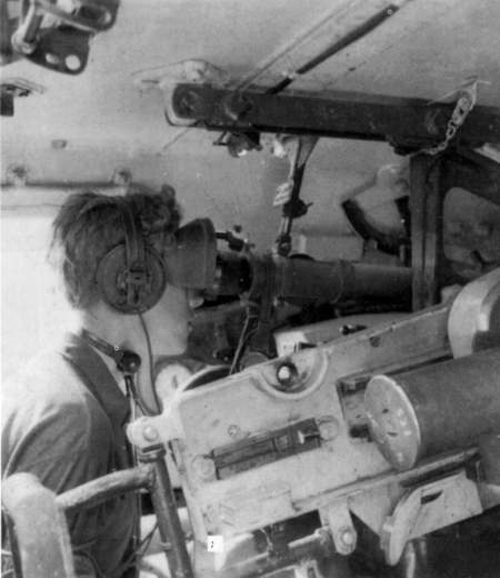
the gunner in a Panzer IV with his eyes "glued" to the sight eyepiece, source: Flickr.com, edited
The last, and very important, man on board was the gunner. His task was straightforward: aim accurately, fire, and destroy whatever target the commander had designated. His primary working tool was the gun sight, in German the Turmzielfernrohr (abbreviated TZF). These were telescopic sights fitted with an articulated joint that allowed the outer lens (or lenses) to elevate and depress together with the gun barrel while the eyepiece at the gunner's end remained in a fixed position – meaning the gunner did not need to change his posture at all.
Inside the sight was a sliding glass reticle plate engraved with the aiming graticule, and a rotating glass plate with a scale for setting the range to the target. Determining range was one of the gunner's most critical tasks, particularly once effective long-barrelled guns with a high muzzle velocity came into service. Getting the range right was half the battle. The standard method was the so-called mil system. German tank sights used a graticule in the form of seven triangles arranged side by side, with the distance between the upper vertices of two adjacent triangles corresponding to 4 mils. This meant that if the gunner was looking at a target 1,000 metres away that was 4 metres wide, it would fill exactly the space between the vertices of two neighbouring triangles.
Every tank gunner had to know from memory the dimensions of the principal enemy tank types, so that when he spotted one in his sight he could compare it against the graticule and calculate or at least estimate the range. German rounds were fitted with tracer elements, allowing the gunner to track the shell's trajectory after firing and correct his aim if necessary. In practice this was not always straightforward, since after firing a tank would typically raise a large dust cloud in front of it, obscuring the gunner's view. The gunner also controlled the co-axially mounted turret machine gun: since it was mounted in the same mantlet as the main gun, he had full control of its traverse and elevation, and fired it using a Bowden cable trigger (on the Tiger, for example, the gunner fired the machine gun using a foot pedal).
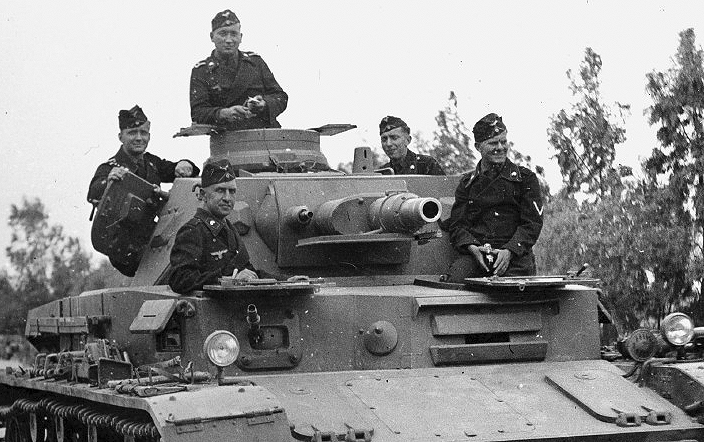
and again the full crew together, source: Worldwarphotos.info with the permission of the operator, edited
An interesting piece of equipment serving both the gunner and the commander (and indirectly the driver as well) was the turret traverse indicator, more often called the azimuth indicator. The entire fighting turret of a tank rotates, taking all the men inside with it. In the heat of battle, with a very limited view outside, it is remarkably easy to lose track of which direction the turret is pointing at any given moment – in other words, how far it has rotated relative to the hull. It was therefore essential that everyone on board shared a common directional reference. This might sound obvious, but if the turret is rotated 90 degrees to the left and the radio operator suddenly shouts "enemy on the right!", that means "enemy behind us" for the men in the turret. In the middle of a battle there is simply no time to clarify from which direction the threat is actually coming. The well-known clock system was therefore used for orientation: 12 o'clock was straight ahead, 3 o'clock was to the right, 6 o'clock was to the rear, and 9 o'clock was to the left.
In this system, the reference point was always the hull – meaning 12 o'clock was the direction in which the tank was driving straight ahead, regardless of where the turret was pointing. The commander and gunner, sitting in the turret, had an indicator linked to the hull that showed the current turret traverse angle. For the gunner it took the form of a dial with numerals and a pointer; for the commander it was a graduated ring running around the inside of the cupola. Consider the following situation: the driver in the hull always has 12 o'clock straight ahead of him; the turret is rotated slightly to the right, so the gunner is looking directly at the driver's 2 o'clock; but the commander is not looking through the periscope directly in front of him – he is looking through the one to his right, which means he is looking at the driver's 4 o'clock. If he spots an enemy through it, he simply glances up for a moment from the periscope to the azimuth indicator around the cupola rim, and sees the numeral 4 directly above that aperture. He shouts "target at 4 o'clock", and both the driver and the gunner know immediately where to look. The commander can thus give precise instructions to the gunner about where to traverse the turret, or to the driver about which direction to steer.

ARTICLE
CONTENTS:
Reproducing text from the Panzernet website without the written consent of the operator is prohibited.