PZ.SFL. II
Rheinmetall-Borsig half-track tank destroyer
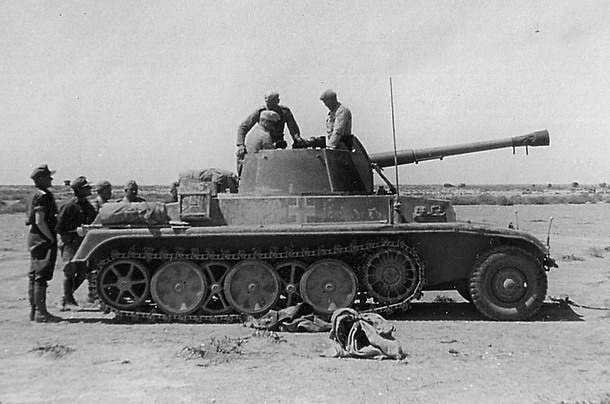
one of the two Panzer Selbstfahrlafette II prototypes deployed with Panzerjäger-Abteilung 605 in North Africa; source: Flickr.com, used with permission of the publishing user, edited
Half-track Tank Destroyers
Around the mid-1930s the German Army Ordnance Office launched three projects for new tank destroyers based on half-track chassis. These were preceded by a thorough theoretical analysis of what qualities a vehicle designed for the active pursuit and destruction of enemy tanks should actually possess. The conclusions were that tank hunters should above all be fast, powerfully armed, capable of cross-country movement, and reasonably priced — armour protection was a secondary consideration. Weighing these requirements against the available technical possibilities, a half-track chassis appeared to be the most suitable solution. The vehicle described below was the last of these three projects (the preceding projects — the 3.7 cm Selbstfahrlafette L/70 and the 7.5 cm Selbstfahrlafette L/40.8 — are described in separate articles). Its development was ordered in March 1936.
The chassis — and apparently the armoured hull as well — was to be prepared by Büssing-NAG. As their starting point, the Büssing-NAG designers borrowed the chassis of the 5-tonne half-track artillery tractor the company was developing at the time. That tractor later entered history under the designation Sd.Kfz. 6, but in 1936 it still existed only in its development variants BN L 5, with the next variant BN L 7 just coming through. For the new vehicle, however, the chassis was substantially modified and given its own type designation HKP 902 (sometimes also written HKp 902).
Vehicle Description
The track unit of the modified chassis had a front drive sprocket, a rear idler wheel, and between them five axles carrying road wheels arranged in the standard interleaved pattern, partially overlapping one another. The road wheels were apparently purpose-made for the HKP 902, as their design did not match the wheels of either the BN L 5 or BN L 7 half-tracks. Ahead of the track unit was the steering wheel axle, which handled gentle curves; sharper turns additionally engaged track braking. A long mudguard ran the full length of each side of the vehicle, covering both the wheeled axle and the track unit. Behind the flat nose of the hull rose the walls of the main crew cab. In the front wall was a pair of vision ports — the left one for the driver, the right for the commander, who also served as radio operator. Each man additionally had his own vision port in the side wall of his station. Entry and exit for driver and commander were through two roof hatches positioned directly above their seats.
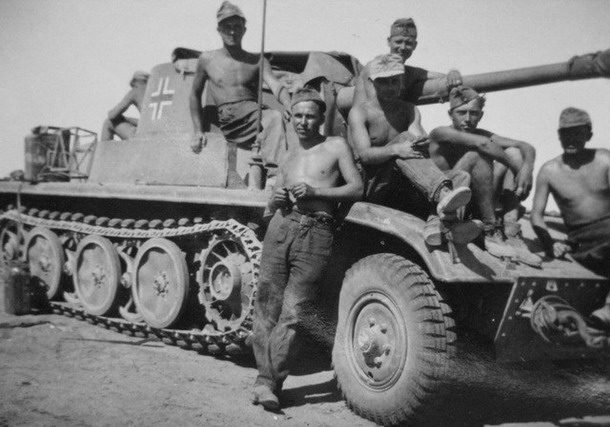
Panzer Selbstfahrlafette II in Africa; the open turret roof has been partly covered by the crew with a canvas sheet for protection against sun and dust; source: worldwarphotos.info, used with permission of the operator, edited
Behind the driver and commander's compartment came the main and widest section of the hull. On its roof sat a fully rotating fighting turret housing the vehicle's main weapon — the 7.5 cm L/40.8 cannon. Both the turret and the cannon were developed and supplied by Rheinmetall-Borsig. The mounting allowed the gun to be elevated vertically from -8 to +20 degrees. Available ammunition included an armour-piercing round weighing 6.8 kg with a muzzle velocity of 685 m/s, and a high-explosive fragmentation round weighing 5.85 kg leaving the barrel at 485 m/s. At a range of 1,000 metres the armour-piercing round could penetrate 62 mm of sloped homogeneous armour plate, and at 1,500 metres it could still manage a very respectable 59 mm. The on-board ammunition supply amounted to 35 rounds. The cannon was paired with a periscopic gun sight that extended through the open turret roof. Yes, the fighting turret roof was left completely open; in bad weather the crew could cover it with a waterproof canvas. The open roof also served as the entry and exit hatch for the gunner and loader, who were stationed in the turret.
The engine compartment was at the rear of the hull. Almost the entire bonnet consisted of two large service hatch panels fitted with louvred ventilation grilles allowing airflow to reach the engine and radiator. Beneath the bonnet sat a Maybach HL 45 petrol six-cylinder engine with a displacement of 4.678 litres, developing a maximum of 150 hp at 3,800 rpm. With this engine the eleven-tonne vehicle could reach a top speed of 50 km/h. The front armour of the hull and cab was 20 mm thick; the sides ranged between 10 and 14.5 mm; the rear was 10 mm; the roof plates 10.5 mm; and the floor of the hull tub a mere 5.5 mm.
Production and Organisation
Rheinmetall-Borsig completed the two full prototypes during 1941. As for the designation of the new combat vehicle, the historical record offers quite an array of different names. For clarity we will stick to one of the simpler, less unwieldy ones: Panzer-Selbstfahrlafette II. In August 1941 the Army decided that the two existing vehicles would form a special heavy anti-tank platoon — schwere Panzer-Jäger Zug (Sfl.) — to be assigned to Panzerjäger-Abteilung 605 and deployed with it in North Africa as part of the German Afrika Korps. This heavy anti-tank platoon was given its own (admittedly modest) organisational structure. In addition to the two half-track tank destroyers, the platoon included one truck and two cross-country cars. Its personnel numbered just 18 soldiers: two four-man crews for the tank destroyers, two reserve drivers for the tank destroyers, the platoon commander, two mechanics, one despatch rider, and four vehicle drivers.
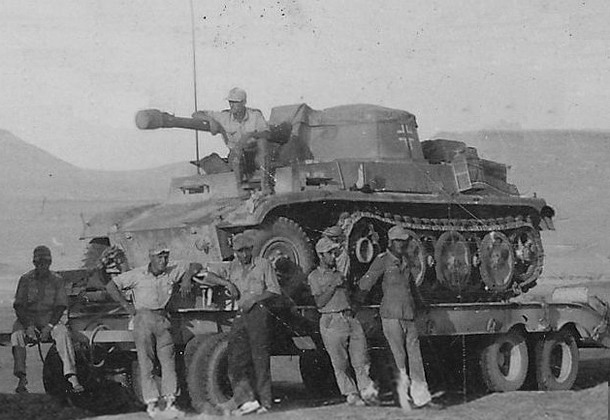
Panzer Selbstfahrlafette II being prepared for transport on a tank transporter; source: Flickr.com, used with permission of the publishing user, edited
Combat Deployment
In early December 1941 the first of the two Panzer-Selbstfahrlafette II was dispatched from Germany to Italy to be loaded onto a ship bound for Africa. On 5 January 1942 the vehicle was unloaded at the port of Tripoli and on 17 January it arrived at Panzerjäger-Abteilung 605. On 21 January 1942 the vehicle was therefore able to take part in Rommel's offensive against the British east of Marsa el-Brega. On 8 March 1942 the entire schwere Panzer-Jäger Zug (Sfl.) was transferred to the headquarters combat group of Panzerarmee Afrika. It is difficult to say how to interpret this organisational change, but in our modest opinion it does not speak particularly well of the half-track tank destroyers — it looks rather as though the main combat units were keen to be rid of them.
The Panzerarmee Afrika report dated 31 March 1942 still listed both Panzer-Selbstfahrlafette II vehicles. By 25 May of the same year only one was reported. What happened to the second is not apparent from the report. The loss of the last half-track tank destroyer is then recorded in the report of 5 June 1942, which also notes that during its service in Africa the lost vehicle had destroyed three enemy tanks.
ARTICLE
CONTENTS:
Reproducing text from the Panzernet website without the written consent of the operator is prohibited.