7,5 cm SELBSTFAHRLAFETTE
a half-track tank destroyer project
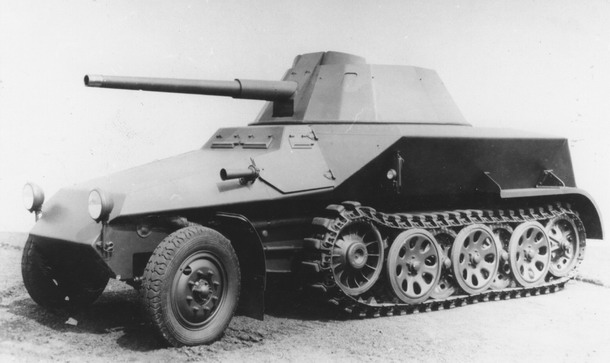
prototype of the earlier version of the 7.5 cm Selbstfahrlafette L/40.8, based on the BN L 6 (H) chassis; source: Flickr.com, used with permission of the publishing user, edited
Half-track Tank Destroyers
Before the first German series-production tanks appeared, the Reichswehr (and later the Wehrmacht) had to navigate a difficult period of searching for the right path forward. Due to the restrictions imposed by the Treaty of Versailles, the Germans were for a long time confined in this search to theoretical deliberation, studying the available knowledge of other nations, and conducting their own first experiments with more or less embarrassing tank mock-ups. The clandestinely developed and tested Grosstraktor and Leichtraktor projects can in this context be regarded as little more than dead ends in that broader process.
Self-propelled anti-tank guns went through a similarly uncertain period of theorising and searching before firmly establishing themselves in the German arsenal under the designation Panzerjäger — literally "tank hunter," or in the standard military translation, tank destroyer. The Germans understood very clearly that anti-tank warfare would be a critically important discipline in any future conflict. If tanks were to dominate the modern battlefield, an effective defence against them was essential. For Germany in the early 1930s this was doubly true, as the country found itself in the position of the weaker party, still working on developing its own tanks while potential adversaries already had hundreds in their arsenals. And since tanks — at least in the German conception — were above all to be fast, anti-tank weapons had to be fast as well, or rather faster still than their intended prey. They also had to be capable of cross-country movement and, ideally, relatively inexpensive.
In formulating these requirements, the German Waffenamt drew on analogies from its own air force and navy, reasoning roughly as follows: if you want to attack an enemy bomber, you do not send your own bomber against it, but a faster, more agile and cheaper fighter. If you want to sink an enemy ship, you can, among other options, dispatch a small, fast and inexpensive torpedo boat. Why not apply the same logic to a specialised machine for destroying tanks? Within the technical means available to the Germans in 1934, the decision was made that the ideal candidate for a tank destroyer would be a lightly armoured vehicle on a half-track chassis. Three projects were launched in response to this decision, among them a tank destroyer based on the chassis of the artillery tractor then being developed by Büssing-NAG.
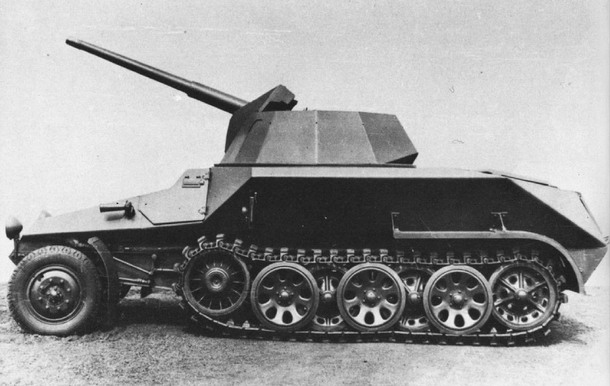
7.5 cm Selbstfahrlafette L/40.8 on the BN L 6 (H) chassis; it is not entirely obvious from the photographs, but the fighting turret had an open roof; source: Flickr.com, used with permission of the publishing user, edited
The Büssing-NAG Design
The tractor in question was a 5-tonne unit that Büssing-NAG was developing at the time, initially under the designation BN L 4 and subsequently as the BN L 5 — though the vehicle later entered history under its ordnance designation Sd.Kfz. 6. For the purposes of the planned tank destroyer, however, a substantially modified chassis variant had to be created, which received the separate designation BN L 6 (H). The main change was the relocation of the engine from the front to the rear of the chassis. The sources do not explicitly state why the designers chose to move the powerplant from the front to the rear, but their reasoning can be deduced. The artillery tractor for which the chassis was originally being developed was not intended to carry any armour or weapons. The new tank destroyer, by contrast, was to be both armoured and armed — and therefore inevitably heavier. The weakest point of any half-track chassis is its front wheeled section, and the engine relocation was most likely intended to relieve the front axle of weight that would otherwise risk overloading it — particularly when going downhill or climbing over uneven terrain.
The chassis also underwent several other modifications. Compared to the BN L 5, the BN L 6 (H) had one additional road wheel axle on each side, which reduced the gap between the track unit and the front wheel axle. The track road wheels were sprung by torsion bars and fitted with rubber tyres to improve ride characteristics. Each wheel was a double unit made up of two steel discs, and the wheels on adjacent axles overlapped one another — the standard configuration for German half-tracks and, later, tanks as well. At the front was the drive sprocket, at the very rear the idler wheel. The tracks were fitted with rubber pads to reduce vibration when travelling at speed on hard surfaces.
In addition to Büssing-NAG, the firm Rheinmetall Borsig was also involved in the project, responsible for designing and supplying the armoured hull, the rotating turret, and the 75 mm cannon. At the front of the armoured hull were seats for the driver and his co-driver. Each had his own vision port ahead of him and a small entry door in the side panel beside him, also fitted with a vision port. It is not clear from the literature what role the co-driver actually performed. Theoretically, the possibilities include machine gunner, radio operator, commander, or some combination of these — though the machine gunner option can be ruled out, as no machine gun was fitted in the cab. No source mentions a radio set, and no aerial is visible in photographs either, so the radio operator role also seems unlikely. This leaves the commander's role, though it was admittedly unusual to position a vehicle commander in the hull rather than in the turret, where he would have had the best possible view of the battlefield. In this case, however, there apparently simply was not room for a commander in the turret.
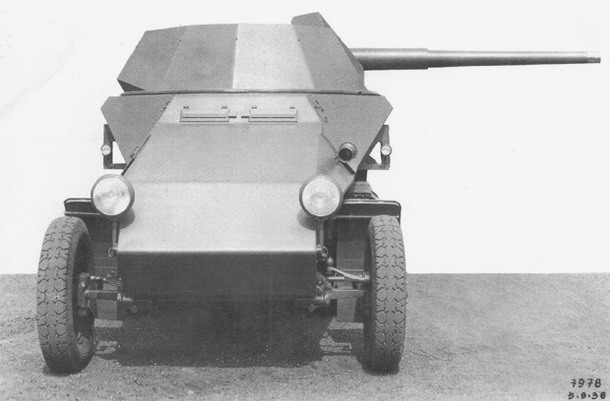
7.5 cm Selbstfahrlafette L/40.8, earlier version based on the BN L 6 (H) chassis; source: Flickr.com, used with permission of the publishing user, edited
In any case, behind the driver and co-driver's compartment came the main hull section, whose walls flared outward significantly as they rose from the chassis. This flare provided a sufficiently wide surface on the roof to accommodate the fighting turret. The rear section of the armoured hull enclosed the engine compartment, which was accordingly fitted with several access hatches and three raised ventilation covers. The vehicle was probably powered by a Maybach NL 38 TU six-cylinder engine with a displacement of 3.79 litres developing 100 hp at 3,000 rpm. Connected to the engine was a Zahnradfabrik ZG45 gearbox with four forward speeds and one reverse, supplemented by a two-speed reduction gearbox, giving the driver a total of eight forward gears and two in reverse.
Armament
On the roof of the hull sat a rotating fighting turret, through whose front wall the barrel of the 7.5 cm Kanone L/40.8 (sometimes also referred to as the 7.5 cm Kanone L/41) protruded. The mounting allowed the weapon to be elevated from -9 to +20 degrees vertically. Horizontal movement was achieved by rotating the turret, which had a full 360-degree traverse. Available ammunition included an armour-piercing round weighing 6.8 kg with a muzzle velocity of 685 m/s, and a high-explosive round weighing 5.85 kg leaving the barrel at 485 m/s. At a range of 1,000 metres, the armour-piercing round could penetrate 62 mm of sloped homogeneous armour plate — and at 1,500 metres it could still manage a very respectable 59 mm. To the left of the cannon in the front wall of the turret was a closeable opening for the gun sight. The roof of the fighting turret was left open; in poor weather the crew could cover it with a waterproof canvas. The open roof also served as the entry and exit hatch. From photographs and the available literature it is not entirely clear, but there may have been an additional entry hatch in the left side wall of the hull above the tracks. The fighting compartment and turret were occupied by two further crew members — the loader and the gunner, who apparently also served as vehicle commander.
The new half-track tank destroyer on the BN L 6 (H) chassis was designated 7,5 cm Selbstfahrlafette L/40,8 (Modell 1). Assembly of the prototype was carried out by Rheinmetall, probably in August 1938 — at least, that is the date on the factory photographs. Armour thickness on the front and sides of the hull was 20 mm. Further details such as total weight, speed, and ammunition capacity are not given in the available literature. The completed prototype remained a one-off and never entered series production.
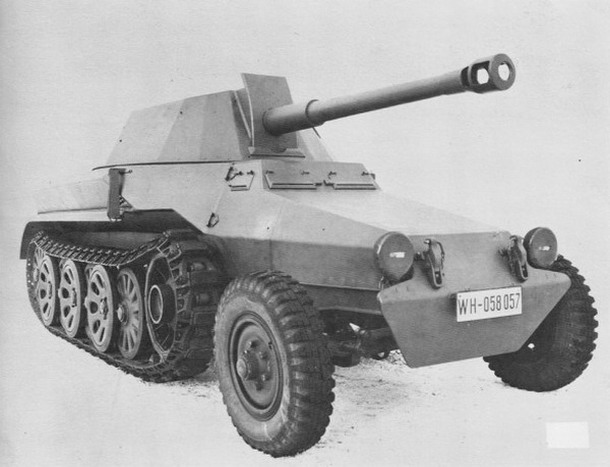
later version — 7.5 cm Selbstfahrlafette L/40.8 Versuchsstück 3 on the BN 10 (H) chassis; source: Flickr.com, used with permission of the publishing user, edited
The Later Version
As time passed, the artillery tractor project itself continued to mature. In late 1936 a new chassis variant appeared under the designation BN L 7, followed a year later by the BN L 8, with work underway on a further variant designated BN 9. Büssing-NAG therefore decided to use a more modern chassis version for the continued development of the half-track tank destroyer. Again, certain modifications were required, most importantly moving the engine to the rear of the hull once more. The new modified chassis received the designation BN 10 (H), and its track unit had six road wheel axles on each side.
The armoured hull was very similar in design to that of the earlier version, though somewhat lower overall. The fighting turret also looked much the same as on the previous tank destroyer variant, including the open roof. The cannon remained the 7.5 cm Kanone L/40.8, but was now fitted with a muzzle brake. An oval-shaped automatic case ejector mechanism protruded from the rear wall of the turret. The engine was probably a Maybach NL 38 TUK or TUKRM with a displacement of 3.79 litres and an output of 100 hp at 2,800 rpm. Further details such as overall weight and even armour thickness are not given in the available sources. This generation of the half-track tank destroyer on the BN 10 (H) chassis was recorded as the 7,5 cm Selbstfahrlafette L/40,8 (Modell 1) Versuchsstück 3 — literally "evaluation piece 3." The factory photographs of this prototype are dated 27 January 1940.
End of the Project
The designation Versuchsstück 3 implies that beyond the first prototype on the BN L 6 (H) chassis — which we might reasonably consider the first example — there must have been a second evaluation vehicle of some kind, a Versuchsstück 2. The literature, unfortunately, is silent on the matter. The photographic record does clearly establish that in August 1938 a full-scale wooden mock-up of the half-track tank destroyer was built, which while closely resembling Versuchsstück 3, shows certain differences — for example in the number of road wheels in the track unit. Is it possible that the missing Versuchsstück 2 was the designation for this development stage, which never progressed to a physical prototype but materialised only as a wooden mock-up? Whatever the case, it is certain that the tank destroyer on the BN 10 (H) chassis — Versuchsstück 3 — also never entered series production. It too apparently failed to meet its creators' expectations.
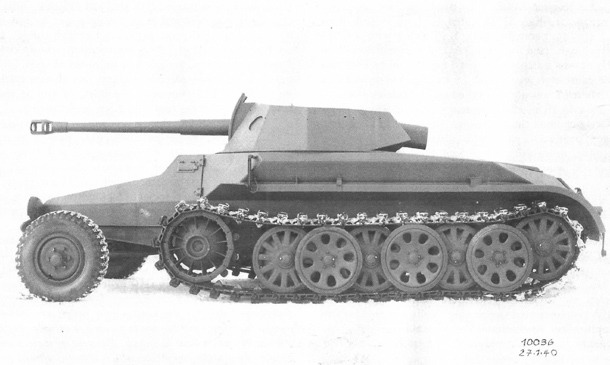
later version — 7.5 cm Selbstfahrlafette L/40.8 Versuchsstück 3 on the BN 10 (H) chassis; note how low the vehicle's hull was; source: Flickr.com, used with permission of the publishing user, edited
The same verdict applied to the entire concept of the half-track tank destroyer. Practical experience had simply shown that a half-track vehicle in this role did not possess the desired qualities and that it made no sense to adopt it as a standard type. The tank destroyer as a concept still had a future ahead of it — but that future would belong to vehicles on fully tracked chassis taken from tanks themselves.
ARTICLE
CONTENTS:
Reproducing text from the Panzernet website without the written consent of the operator is prohibited.