MEHRZWECKFAHRZEUG
a Flakpanzer project on a universal chassis
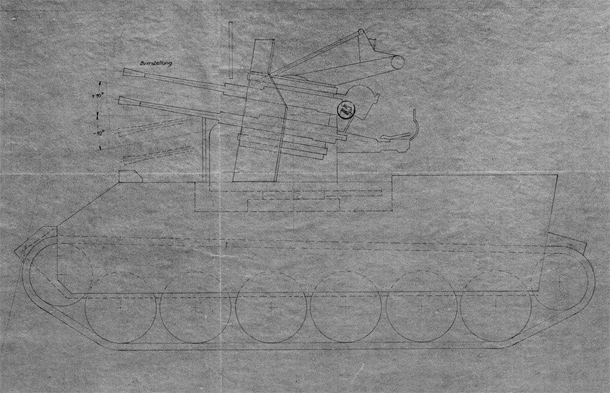
Krupp's design for a Flakpanzer on the Mehrzweckfahrzeug chassis, July 1943, source: Flickr.com with permission of the publishing user, edited
In June 1943, General Inspector of Armoured Troops Heinz Guderian set out a requirement for the development of a new multi-purpose armoured vehicle — in German, a Mehrzweckfahrzeug. The concept was essentially that of a successor to the Panzer IV, but in a far more versatile form. The vehicle was to be developed from the outset not merely as a tank but as a platform designed for the straightforward fitting of various superstructures, allowing the cheap and large-scale production of self-propelled guns, reconnaissance vehicles, artillery observation vehicles, tank destroyers, Flakpanzers, and other purpose-built conversions. The aim was a significant consolidation of production across the different types of combat vehicle.
The Ordnance Office translated Guderian's requirements into a concrete specification, which it then passed to Krupp, simultaneously assigning the project the standard code designation VK28.01 (VK = Vollketten = fully tracked, 28 = expected weight in tonnes, 01 = project serial number). As early as July 1943, Krupp presented army representatives with a conceptual design for the new universal vehicle in several variants, including one intended for the destruction of enemy aircraft — the Flakpanzer.
The design for the universal Mehrzweckfahrzeug chassis called for six road wheels of 700 mm diameter on each side, though the type of suspension and springing is not specified in any available source. The upper run of the 600 mm wide tracks was supported on each side by three small return rollers. All hull walls were to have sloped armour: 50 mm on the front face and 30 mm on the sides and rear. The roof was to be 20 mm thick, and the hull floor 20 mm at the front, tapering to 16 mm further to the rear. The vehicle's length was calculated at 5.68 metres, its width at 3.22 metres, and its height including the weapon at 3.21 metres. Two or even three different engines were under consideration: the diesel Argus 12LD330H producing 550 horsepower, the petrol Maybach HL 100 producing 400 horsepower, and possibly also a Saurer eight-cylinder diesel of unspecified output. The gearbox was to be of the Maybach Olvar 55 11 17 type. The layout of the drivetrain followed the traditional German armoured vehicle approach: engine at the rear, gearbox — and with it the drive sprockets — at the front.
The Flakpanzer's armament consisted of a four-barrel 20 mm assembly. The weapon was fitted only with a frontal shield 20 mm thick; the crew had no protection from the sides or rear. The Flakpanzer was to have a crew of five: the driver, the commander, the gunner, and two loaders. The four-barrel cannon — known in German as a Flakvierling — had an impressive theoretical rate of fire of 1,800 rounds per minute (4 × 450). The practical rate of fire was "only" around 720 to 800 rounds per minute, but even so the two loaders would have had their work cut out keeping this hungry beast fed. It was never to be, however — at the end of October 1943 the entire Mehrzweckfahrzeug project was officially cancelled and nothing beyond drawings was ever produced.

Reproducing text from the Panzernet website without the written consent of the operator is prohibited.