TANK ACES – INTRODUCTION
who earned the title of "ace" and why
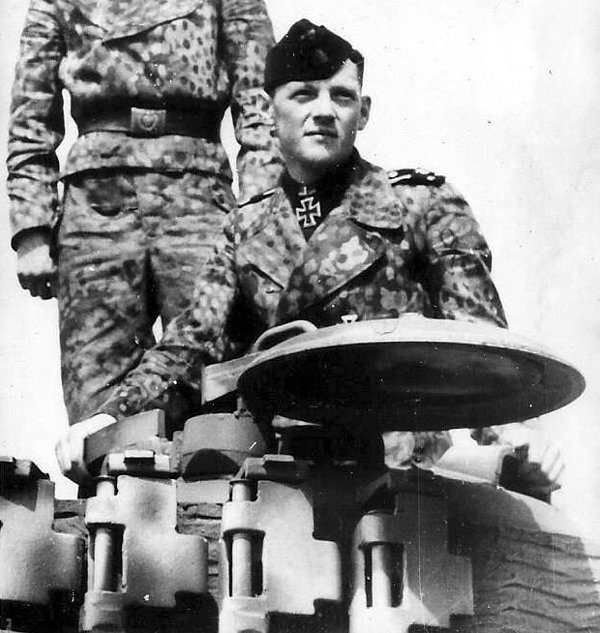
Balthasar Woll earned his laurels first as gunner in the crew of the legendary Michael Wittmann and later as commander of his own Tiger tank, source: Flickr.com with the permission of the publishing user, edited
The Term "Ace" in Military Usage
The term "ace" was first used in a military context by the French during the First World War, and the man who earned it was pilot Adolphe Pégoud. It was, of course, the title of flying ace – French: as de l'aviation – and since it evidently caught on, the French began using it to honour pilots who had achieved five or more aerial victories. It was not a rank or a decoration of any kind, merely a symbolic honorary title with primarily propaganda value. The title of "hero" had apparently become stale and lacked impact, and so something new was needed to stir the enthusiasm of a war-weary public.
Applying the concept of the ace specifically to successful fighter pilots made perfect sense on every level. The deployment of aircraft in combat was one of the novelties of the First World War; aeroplanes were a symbol of modern technology and their pilots were in a sense automatically heroes – knights of the sky. Unlike the anonymous foot soldiers crawling through endless mud, a fighter pilot was a kind of soloist: a specific individual, often of high rank and noble birth. While ground battles involved the mass clash of thousands of infantrymen in which, amid the din of rifles, machine guns and artillery, it was impossible to say who had killed how many of the enemy, aerial combats were one-on-one duels whose participants sometimes even knew their opponent's name. For a fighter pilot it was straightforward to count how many opponents he had sent down, how successful he was, and whether he deserved the title of flying ace and the admiration that came with it. It is unsurprising, then, that the use of this title in the air forces quickly spread to other countries, including the United States. In Germany, however, the designation apparently never really caught on.
Tank Ace?
Beyond the world of aviation, the term ace did not spread widely in other armies either – or only marginally so. And this applied to the Second World War as well. The ace designation was again used primarily for airmen, and primarily outside Germany. This is interesting, because the Germans were, as is well known, great believers in propaganda generally, and in the later stages of the war genuinely needed to keep their heroes visible in the eyes of a war-weary public. They simply used different terminology. The concept of the German tank ace is therefore most likely a post-war construction.
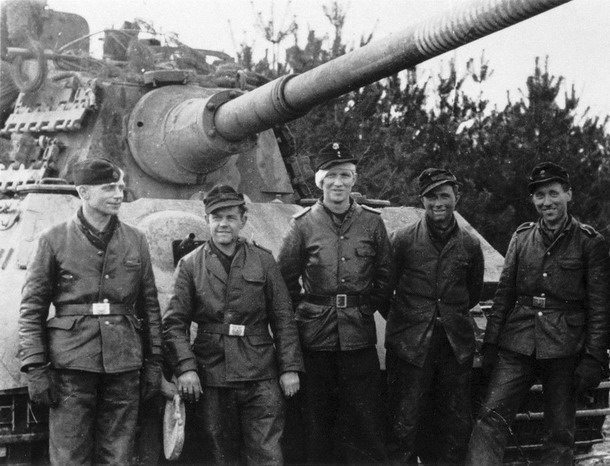
with his 66 destroyed enemy tanks, SS Untersturmführer Karl Brommann certainly counted among the "aces"; he is seen here standing in the centre with his comrades in front of a Tiger II, source: Flickr.com with the permission of the publishing user, edited
Conferring the title of ace on someone is no trivial matter. It has to apply to an individual whose combat achievements can be measured with reasonable reliability. It is hard to count how many enemies were killed by a bomber pilot or an artilleryman, who eliminates targets they cannot even see. Heroes – and potential aces – were thus identified among, for example, German U-boat captains or snipers, where a combat score could be counted with some degree of accuracy. And then of course there were the tank crews. It might seem that their kills could be tallied easily too, but that was not entirely true. In a minor skirmish, or especially an ambush at close range, it may indeed have been possible to keep track of who had hit what. In a major battle involving artillery and aircraft, however, it was far less straightforward.
A one-on-one tank duel was more of a romantic notion than a reality. In May 1950 the British Army produced an analysis examining the causes of combat damage or destruction to 3,710 British tanks during the Second World War, drawing on contemporary reports from nearly a hundred different tank units that had fought in North Africa, Italy and Western Europe. The analysis showed that only 25.3% of these tanks had been damaged or destroyed by fire from enemy tanks. A further 13.5% of losses were attributable to fire from enemy self-propelled guns – including tank destroyers and assault guns. At the top of the list, however, was fire from conventional towed anti-tank guns at 29.8%, with anti-tank mines also accounting for a substantial share at 22.3%. Another 6.1% were attributed to hand-held infantry anti-tank weapons (Panzerfausts and Panzerschrecks), and the remaining 3% of British tanks were destroyed by other unspecified means.
Overall Statistics
But let us move from the British back to the Germans. When it came to the overall statistics of how many enemy armoured vehicles had been destroyed in combat, the Germans worked from reports submitted by their own fighting units. Such reports naturally came not only from tank crews but from all branches of the armed forces; what will interest us in the text that follows, however, are the victories claimed by German tankmen. The accuracy of data obtained directly from soldiers was compromised by several factors. There was the risk of deliberate exaggeration of personal successes by tank crews; there was the danger of unintentional duplication, as when two German tanks independently fired at the same target and both crews believed their own shot had been the killing one; and finally there was the fact that crews also reported enemy tanks that had not been destroyed by fire but merely temporarily put out of action. The German Army command therefore introduced a correction to the reported figures, aimed at compensating for these biases and exaggerations.
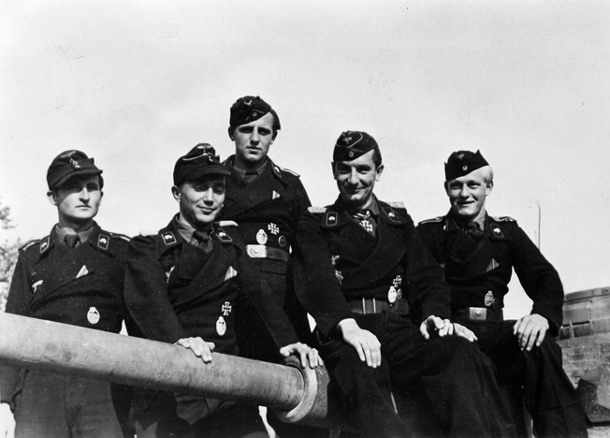
the decorations on the uniforms of these tankmen suggest this was a very successful crew (the commander wears the Tank Battle Badge, the Wound Badge, the German Cross, the Iron Cross First Class and the Knight's Cross), source: Flickr.com with the permission of the publishing user, edited
From the start of Operation Barbarossa until June 1943, reported counts of destroyed enemy tanks were therefore automatically reduced by 20%. From 1 July 1943 onwards, however, this correction was substantially tightened and combat unit reports began to be reduced by a drastic 50%. The reasons were straightforward. By mid-1943 the Germans were no longer advancing but rather losing ground. It was now the Soviets who were pushing forward, and therefore the Soviets who were able to recover their damaged fighting vehicles on a far larger scale (when you are retreating, you simply have to leave your knocked-out tanks behind). Examination of the wrecks of destroyed Russian tanks was also increasingly revealing evidence of repairs to earlier battle damage. Halving the reported figures was intended to remove from the statistics those tanks that the Russians would most likely succeed in repairing and returning to service. Later comparison of these adjusted figures with Soviet records showed that after the 20% reduction the German numbers had been overestimated, while after the 50% reduction they were substantially underestimated. The ideal correction factor for 1943 turned out to be around 37%.
One cannot help but think that instead of collecting inherently subjective figures from fighting units and then adding them up and applying corrections, it would have been simpler to just count the wrecks after the battle. After all, combat units were often followed by recovery teams that checked wrecks and towed lightly damaged or simply broken-down vehicles away for repair. The primary source remained the reports from fighting units nonetheless – as it also did when gathering statistics on one's own losses, the number of serviceable vehicles, and those awaiting repair. Then again, counting the wrecks of enemy equipment after a battle is only possible if you have won the battle and are advancing.
Individual Scores
The reductions described above were applied only at the level of overall statistics, where destroyed enemy equipment was counted in thousands and tens of thousands of vehicles. The victory tallies of individual crews were not adjusted in this way. This means in practice that the kill counts of specific commanders could sometimes be inflated. German tankmen were not primarily decorated or promoted on the basis of their victory count, however, but on the number of assaults participated in, time served at the front, generally exemplary service, or some particularly courageous act that had to be objectively documented or confirmed by witnesses. Inflating their success figures could therefore boost their personal image more than it could automatically improve their career prospects. Even the army itself had no particular interest in questioning or actively deflating the scores of individual tankmen – especially once the numbers became noteworthy and the individual in question had already begun to be perceived as a hero. At that point it was no longer about obtaining the most accurate statistical data possible, but about propaganda.
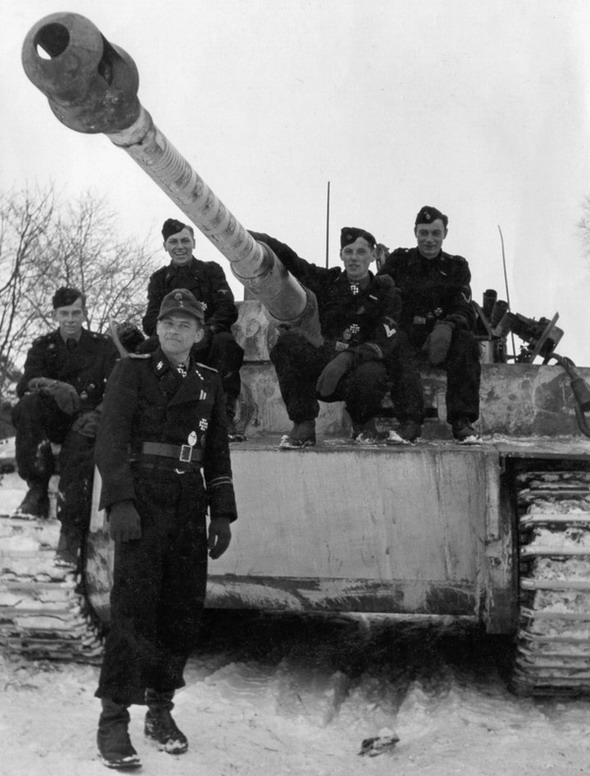
Michael Wittmann with his crew and Tiger tank, photographed in January 1944 to mark his 88th victory over an enemy tank, source: Flickr.com with the permission of the publishing user, edited
And how should individual victories actually be counted when the individual in question is part of a crew? Among German tankmen, victories were somewhat unfairly attributed only to the commander and the gunner. The driver, loader and radio operator were thus treated as interchangeable, while the interplay between the commander and the gunner was considered the decisive element. If a soldier had served first as a gunner and later as a commander during his career (for example Kurt Knispel), his victories in both roles were simply added together.
The German Phenomenon
Even though the Germans themselves did not use the term tank ace during the war, today it is practically synonymous with German tankmen. This is partly, without doubt, a matter of embellishment and legend-building that sells well in various types of popular history literature (tales of the invincibility of Tiger tanks and enormous tank battles on the Eastern Front are simply compelling). But in part it also reflects entirely justified achievement. German tankmen were given an opportunity to build their reputation that none of their opponents enjoyed. The German army applied tactics that allowed tanks to exploit their potential to the maximum and to distinguish themselves on the battlefield accordingly. German tankmen had excellent training and vehicles designed and built to perform clearly defined tasks effectively. The Germans were also among the first to grasp the advantages of a five-man tank crew in which the commander had no responsibility other than command – a principle that proved highly effective.
High victory tallies can only be achieved if there are enough opportunities to rack them up – and the enormous numbers of light Russian tanks presented a uniquely favourable opportunity of a kind that tankmen of no other army ever had (from 22 June to the end of 1941 alone, the Germans destroyed more than 20,000 Russian tanks!). Accumulating a large number of victories also requires a certain amount of time, and here too the Germans had the advantage of fighting longer than their opponents: when they first came up against the Soviets in summer 1941, many German tankmen already had nearly two years of war experience behind them and genuinely knew what they were doing.
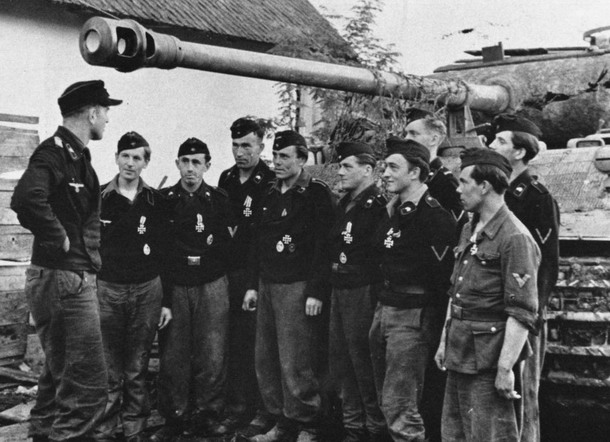
a group of tankmen who have just received their Iron Crosses, source: Flickr.com with the permission of the publishing user, edited
And then of course there was the already-mentioned chapter called the Tiger. It was not an invulnerable or indestructible machine, but at the time it first appeared on the battlefield it was genuinely its master. Evidence enough is the simple fact that the great majority of the most successful German tankmen – the tank aces – spent a substantial part of their careers fighting in the heavy Tiger tank (Wittmann, Carius, Knispel). Not only did the Tiger's accurate and powerful gun in some sense "facilitate" the accumulation of victory tallies, but the heavily armoured vehicle also substantially increased the crew's chances of surviving combat – and thereby gave them the opportunity to keep fighting, accumulating experience and, above all, winning over a longer period.
The Tank "Ace of Aces"
The most successful tank commander not only in the German army, not only in the Second World War, but in the entire history of warfare to date, is generally held to be Feldwebel Kurt Knispel, with 168 destroyed enemy tanks. If, however, we wanted to find the man with truly the highest number of destroyed enemy tanks, we would have to look not on the ground but in the sky. The ace of aces in this regard was the pilot of the Junkers Ju 87 Stuka ground-attack aircraft, the sole recipient of the Knight's Cross with Golden Oak Leaves, Swords and Diamonds, Colonel Hans-Ulrich Rudel, who flew 2,530 combat sorties during the war and destroyed a total of 519 enemy tanks! So we have, in the end, come full circle back to the flying aces :-)

ARTICLE
CONTENTS:
Reproducing text from the Panzernet website without the written consent of the operator is prohibited.