OPERATION HOLZFÄLLER
they fought so hard the splinters flew
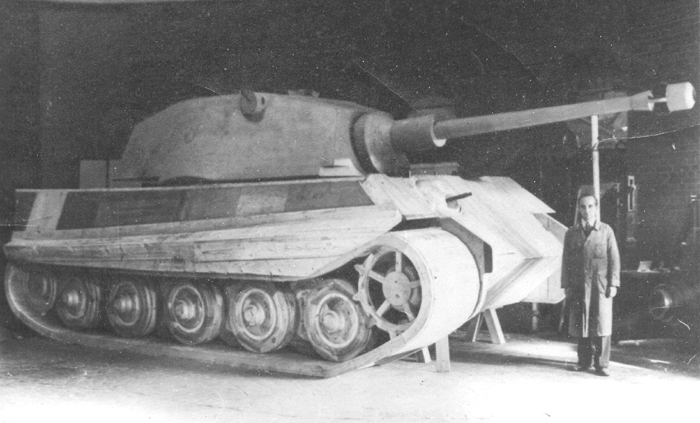
wooden model of a heavy Königstiger tank; source: Flickr.com with permission of the publishing user, edited
These April days seem like the perfect occasion for Panzernet to bring back to memory one nearly forgotten but all the more fascinating operation that took place in the final weeks of the war. The military situation of the Third Reich at the end of March 1945 was, to put it mildly, desperate. Italy had fallen long ago, Budapest was in Soviet hands, and Russian tanks were rolling across Hungarian territory towards Austria. A little further north the Red Army stood on the Oder, some 60 km east of Berlin, with the Germans frantically preparing to defend their capital. Industry and infrastructure had been devastated by bombing, and on the Western Front the Allies had already set foot on German soil.
These were times when the Germans urgently needed not only every available pair of hands but every available fighting vehicle. "Any" vehicle that could move under its own power and carry some form of weapon was being converted for combat. Desperate improvised conversions of ammunition carriers and cargo tractors appeared, armed with little more than Panzerschreck rocket launchers. Slow and lightly armoured, these machines had to close to within a hundred metres of the enemy to be effective – which amounted to more or less certain death. But even this was not enough for the German High Command. Something more was needed. "Absolute devotion to our cause and unshakeable faith in our Führer is the most powerful weapon of all! Armed with such powerful ideals, any German can stand firm against ten Bolshevik tanks armed with nothing but a wooden stick!" thundered Propaganda Minister Joseph Goebbels – and promptly ordered the immediate launch of a top-secret operation codenamed Holzfäller (Lumberjack).
The idea was, in its way, brilliantly simple. The development of new German tank types and other armoured vehicles typically passed through several stages. First came the specification, defining the army's requirements for the new vehicle. Then came the design phase, conducted at drawing boards, resulting in full technical documentation including estimated weight and speed. And before the first functional prototype was ever built, it was common practice to construct a full-scale wooden model of the future armoured vehicle. Such models were intended to help army representatives form a clearer picture of what the actual vehicle would eventually look like.
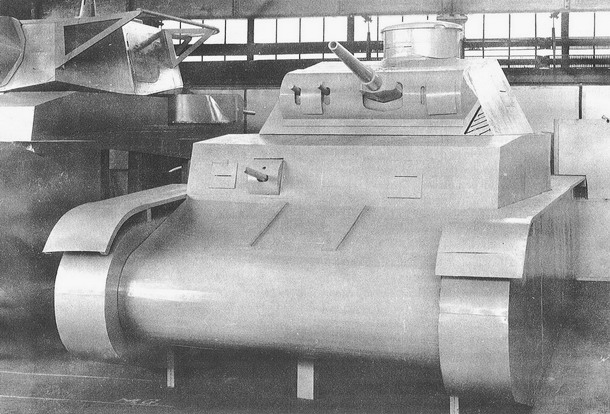
a Holzpanzer III next to a wooden Neubaufahrzeug; source: Flickr.com with permission of the publishing user, edited
Over more than a decade of armoured vehicle development, this meant that an enormous quantity of wooden tank models had accumulated in the warehouses of Germany's arms manufacturers – models of tanks, self-propelled guns, tank destroyers, and more. Some were rough approximations, others finished down to the finest details. They stood quietly in forgotten corners of warehouses, many already blanketed in years of dust. But their moment of glory had now arrived!
Krupp, Rheinmetall, Henschel, MAN, and many other firms received an urgent and strictly classified dispatch. All Holzpanzers (as the memo affectionately nicknamed them) were to be ready for combat deployment by 21 March 1945 at the latest. Nothing was left to chance. Storekeepers at every firm were tasked with carrying out thorough inspections of the wooden vehicles. Wherever the armour showed signs of bark beetle, dry rot, or mould, the affected sections were cut out and replaced with new timber. Rusty screws and nails were pulled out and replaced with stainless ones. The vehicles also received a moisture-resistant impregnating coat. And in the spirit of the general petrol-saving programme, most of the wooden armoured vehicles were converted to run on wood gas.
Everything was proceeding smoothly, with just one truly major problem arising at the Henschel warehouse during the inspection of the Tiger H2 model. It emerged that the local storekeeper had, over the previous three winters, gradually chopped up an entire half of the wooden tank and taken it home for firewood. There was nothing to be done – the Tiger H2 (or rather what remained of it) would have to stay in the warehouse. What happened to the unfortunate cold-blooded storekeeper, the historical record does not say.
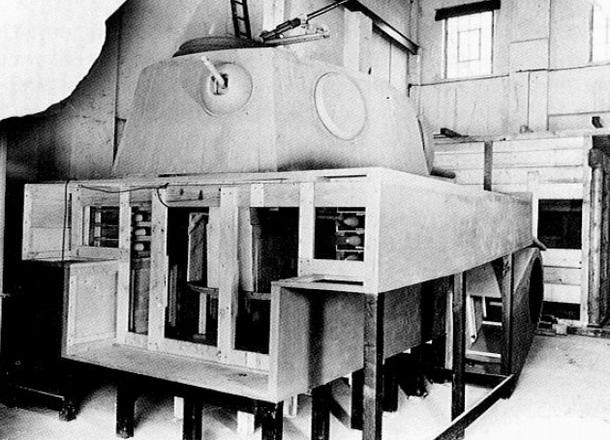
the Holzpanzer Tiger H2 could not take part in Operation Lumberjack – the Henschel storekeeper had burned the entire rear half over three winters... only this torso remained; source: Flickr.com with permission of the publishing user, edited
More than three thousand carpenters across Germany were contacted and told to immediately stop work on tables and wardrobes and get started on producing wooden ammunition, which they then personally delivered to the factories by bicycle. Reports of completed assignments gradually came back from the individual firms. In total, nearly thirty combat vehicles of various categories were found in warehouses and readied for deployment! There was the elderly and already-greying model of the Neubaufahrzeug from the mid-1930s, and alongside it the still-fresh-smelling model of the Rutscher tank destroyer. There were wooden Panzer IIIs, Panzer IVs, and even a Königstiger. But presiding over the entire knotty arsenal was a truly colossal model of the Maus!
From the assembled vehicles, a new special unit was rapidly formed. Its core consisted of experienced tank crews who had been left "orphaned" after their original units were destroyed. These were supplemented with Luftwaffe ground personnel, Volkssturm members, and even Hitler Youth. Command of the unit was given to Oberleutnant Hermann Zweig, after whom it was also named – quite simply, Kampfgruppe Zweig (Zweig meaning "twig").
With typically German thoroughness, the deployment area for this group was also carefully planned – specifically the eastern approaches to Berlin. The area around the town of Müllrose, at the very southern tip of the Seelow Heights defensive line, was chosen – and surely not by coincidence. The forests south of the town would provide an ample supply of material for any replacement parts the Holzpanzers might require. At the end of March 1945, all the assembled fighting vehicles were transported to Beeskow railway station and from there proceeded under their own power to Müllrose.
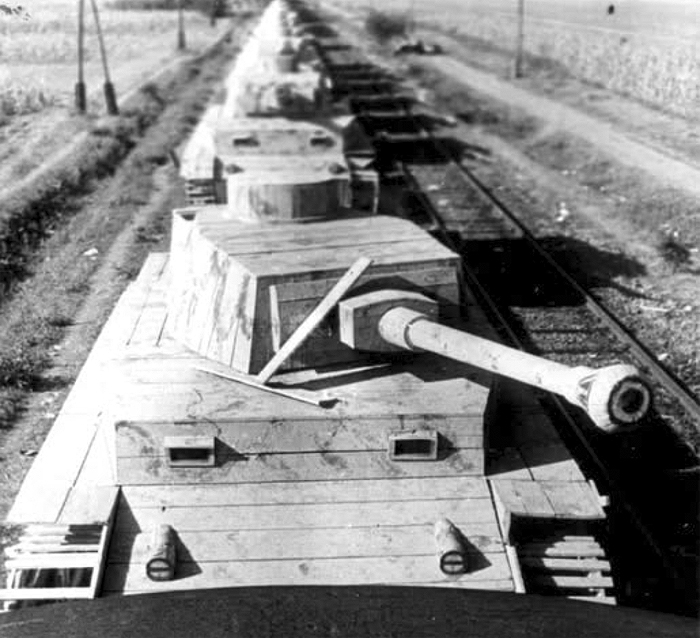
Holzpanzers of Kampfgruppe Zweig moving up to the front (travelling by wooden train, naturally); source: Flickr.com with permission of the publishing user, edited
The crews did not have much time to familiarise themselves with their new vehicles, but enthusiasm was high nonetheless. The inside of the tanks smelled wonderfully of wood (a refreshing change from steel tanks, which reeked of oil). If a wooden seat was digging into someone uncomfortably, a quick pass with a plane sorted it out. But the loaders were the happiest of all. An 88 mm armour-piercing round for the wooden Königstiger weighed a mere 2.5 kg!!! This meant that even the youngest Hitler Youth recruits could serve as loaders in Kampfgruppe Zweig without the slightest difficulty. True, the occasional round needed a light file-down with a rasp to fit properly in the barrel, but that was no great trouble.
Crossing water obstacles with Holzpanzers had also become child's play. All that was needed was a sufficiently long pole, with which the crew – floating atop their tank – could push off from the riverbed. The only thing to watch out for was the current. One crew learned this the hard way while crossing the Spree river on the journey from Beeskow to Müllrose. The Panzer III, along with its unfortunate crew, was caught by the strong current and, to the horror of their watching comrades, simply carried away downstream. Three weeks later, this tank was sunk by a Russian submarine in the North Sea, twenty miles offshore. The submarine captain, Vasily Krupkov, was subsequently demoted for alcoholism upon filing his report of torpedoing a fascist tank.
Holzpanzers naturally came with certain operational peculiarities. Each crew was required to include one carpenter, and the standard tool kit was modified to replace spanners with hand saws, chisels, and woodworking planes. On 1 APRIL 1945, Kampfgruppe Zweig stood in full combat readiness at its positions on the edge of the forest below Müllrose, watching for the Soviet attack. Operation Holzfäller had entered its final phase! On the southern end of the Seelow defensive line, however, the Russian advance was slower than in the north, meaning it took nearly three more weeks for the Red Army to approach Kampfgruppe Zweig's sector. The Germans waited. Spring had arrived, the sun was gaining strength, and the wooden tanks soon began to put out their first buds. Before long, fresh leaves were sprouting from the armour plating as well, which actually contributed quite nicely to the unit's camouflage as it stood at the edge of the forest.
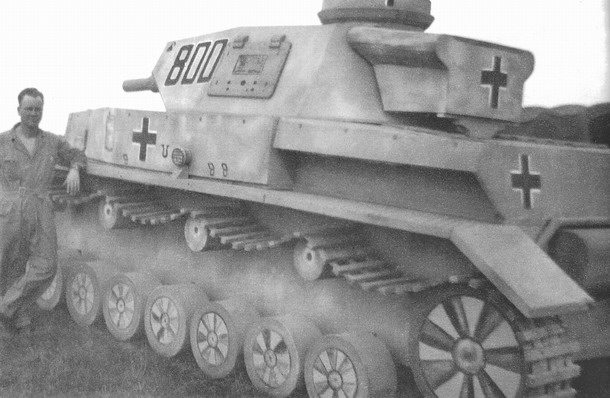
a very rare photograph from the deployment area – gunner Karl Moltke beside his Holzpanzer IV; source: Flickr.com with permission of the publishing user, edited
After three weeks of waiting, the German soldiers finally spotted Russian tanks. They slammed shut their wooden hatches and prepared to launch a counterattack. At that moment, however, they discovered their vehicles could not move. A rapid assessment of the situation revealed a cause that none of the German planners had anticipated. The moment the wooden tracks of the Holzpanzers had felt the touch of the rich, moist forest soil after years in dark warehouses, they had – during three weeks of waiting – taken root. With the Red Army now in sight, there was no time to cut the tanks free from the ground one by one. Some soldiers fled in panic; others decided to fight on without the ability to move, at least from a fixed position.
One of those who stayed and fought was twenty-year-old gunner Karl Moltke. He later recalled the events of that day as follows: "Some ran, but our entire crew stayed. In the distance below us, about ten Russian tanks were advancing. I watched them through a knothole in the front armour. I had an armour-piercing round of hard oak wood loaded and aimed at the nearest Russian. The shot threw up such a cloud of dust and sawdust that I couldn't see where it went at all. But the Russians spotted us straight afterwards and started firing too. The second or third Russian shell hit our tank full on. It was terrible – when I got out I was covered from head to toe in splinters... thank goodness none of them went in my eyes!"
When the Soviets wanted to take the super-heavy Maus tank home after the war to put it on display at the museum in Kubinka, they found it was unexpectedly heavy and loading and transporting it was frankly far too much work. One of the soldiers assigned this honour recalled something he had seen during the attack at Müllrose, and an idea was born. Yes, that's right. The Maus tank the Russians took home and put on display at Kubinka is the wooden model from Kampfgruppe Zweig. This is why the museum has a strict rule: do not knock on this exhibit.
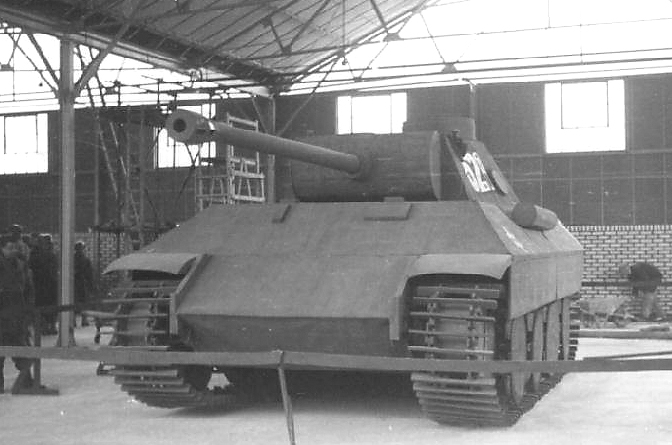
a Holzpanzer Panther in barracks, just before departing for the Seelow Heights; source: Flickr.com with permission of the publishing user, edited
The Holzpanzers only found their way to the battlefield in the very final days of the war, and so had little opportunity to demonstrate what they were capable of in combat. When the fighting ended, wrecked and abandoned armoured vehicles were scattered all across Germany. While the wrecks of conventional tanks were mostly a nuisance to the local civilian population (what do you actually do with a 50-tonne monster that has decided to stop permanently in the middle of your village square?), the wrecks of the Holzpanzers were a completely different matter – the local population took cheerful and enthusiastic care of them all by themselves. For a long time after the fighting ended it was entirely normal to spot remains of these combat vehicles in the sheds and courtyards of the local population... being gradually chopped up for firewood.
1 April 2021 – APRIL FOOLS!

Reproducing text from the Panzernet website without the written consent of the operator is prohibited.