SPRINGER
a remote-controlled bomb on tracks
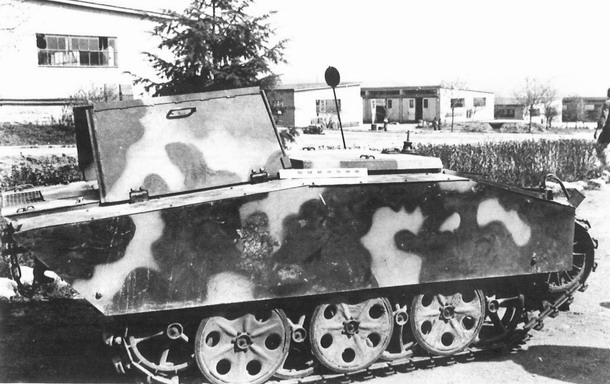
remote-controlled demolition vehicle Mittlerer Ladungsträger Springer, with the driver's compartment covers raised, source: Flickr.com, Public Domain, edited
The concept of an engineer vehicle
As early as the end of 1939, the Germans began working on remote-controlled vehicles designed for the safe clearance of minefields. Starting from the original concept of an unarmed machine that detonated mines using towed explosive rollers (Minenräumwagen B I), engineers and soldiers eventually moved towards a vehicle that carried a large explosive charge on board and cleared mines in its vicinity by detonating that charge (Minenräumwagen B II). This approach was also far more versatile, as such a machine could be used not only for minefield clearance but also to destroy bunkers, barricades, and even enemy fighting vehicles.
Since the explosive charge was an inseparable part of the vehicle, it was essentially a single-use machine. This meant that during both its development and production, great emphasis was placed on minimising costs. However, when it came to the resulting value for money, neither of the Minenräumwagen vehicles produced by Borgward met the customer's expectations. Sometime around mid-1941, the idea emerged of building a different but similar vehicle that would offer a higher quality of construction at a still reasonable price. This was to be achieved by using the proven, mass-produced semi-tracked motorcycle kleines Kettenkraftrad HK 101 (Sd.Kfz. 2), commonly known simply as the Kettenkrad. The motorcycle was fitted with remote-control equipment and an explosive charge, and in June 1942 it was experimentally deployed in Crimea, near the port city of Sevastopol.
Once again, however, the desired success failed to materialise. The Kettenkrad (f.g.), as the vehicle was designated, proved to be quite prone to tipping over. The trials did nevertheless demonstrate that the Kettenkrad's running gear was broadly suitable for the intended purpose, provided the centre of gravity could be significantly lowered to improve the vehicle's stability. This marked the beginning of a development programme that ultimately resulted in the demolition vehicle known as the mittlerer Ladungsträger — better known, however, as the Springer (meaning "jumper").
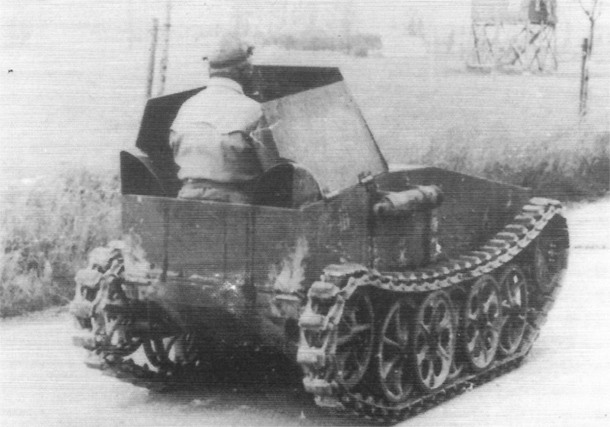
one of the first prototypes from July 1943; these prototypes had only five road wheel axles, source: Flickr.com with the permission of the publishing user, edited
Development of the vehicle
At the beginning of 1943, NSU of Neckarsulm was commissioned to develop a new demolition vehicle that would make use of components from the running gear of the Kettenkrad semi-tracked motorcycle. NSU had been founded in 1873 as a manufacturer of knitting machines, as reflected in its full name Neckarsulm Strickmaschinen Union (Strickmaschine meaning knitting machine). In the years before the Second World War, however, the company had gradually moved into the production of bicycles, motorcycles, and even automobiles. Most importantly, NSU had developed and manufactured the Kettenkrad itself, which made the company the natural choice for developing the Springer as well.
First prototype
According to the army's requirements, the Springer was to carry an explosive charge weighing 300 kg, which was again a fixed part of the vehicle — making it once more a single-use machine. The first three pre-production prototypes were completed in early July 1943 and still differed considerably from the later series vehicle. The running gear was extended by one road wheel compared to the Kettenkrad, giving it five road wheel axles instead of four. Both the front drive sprocket and the rear idler wheel were positioned significantly higher than on the Kettenkrad, to improve cross-country performance. The driver's position was located at the rear of the vehicle, protected by a three-part folding shield. The driver was to bring the vehicle to the assembly area for the attack, while the final approach to the actual target would be controlled by a wireless remote.
Prototype trials were conducted at Kummersdorf in July 1943. Although the vehicle performed reasonably well, it suffered from a number of serious shortcomings. The most significant of these was apparently its relatively high weight, which caused excessive strain on the running gear, gearbox and steering. The army therefore asked the manufacturer to address the identified problems and subsequently produce a pre-series pilot batch. At the same time, the military indicated that once the vehicle had been refined for full series production, they intended to order 500 units.
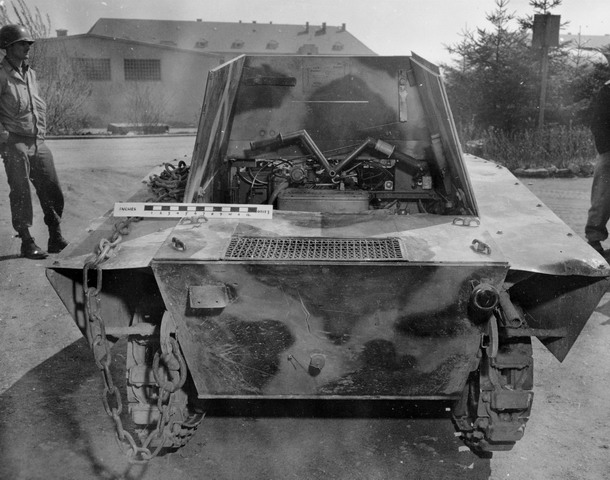
view into the driver's cab of a Springer captured by the Allies, source: Flickr.com, Public domain, edited
Series production
NSU accordingly revised the vehicle's design to achieve a better distribution of its weight across the running gear. In practice, this meant adding an additional — sixth — road wheel axle. The hull structure was also modified, as were apparently some of the internal components. The vehicles additionally received sponsons on both sides of the hull — possibly retrofitted in some cases — which covered the upper portion of the tracks and provided additional side armour. On the pre-series Springers, the front edge of these sponsons was cut at an angle, whereas on the later production vehicles it was squared off.
According to the authors of the Panzer Tracts series, as many as 16 pre-series vehicles were already under construction or completed by 15 September 1943, with some apparently already undergoing army trials at that time. M. Jaugitz, on the other hand, suggests that deliveries of the pre-series vehicles were considerably delayed, and that the army did not take delivery of the first pre-series machine until April 1944. Both sources do agree, however, that the first 9 series-production vehicles — meaning the first proper production batch, not the pre-series — were delivered in October 1944. A further 16 followed in November, 10 in December, 9 in January 1945, and the final 6 in February. Total production therefore amounted to 50 series vehicles and possibly 16 pre-series vehicles.
Before the end of the war, plans were apparently drawn up to relocate Springer production from Neckarsulm to the Protectorate — specifically to the factory of Noe Stross in Bělá pod Bezdězem. This originally textile factory had been converted for mechanical production during the war and reportedly also manufactured tank tracks, among other things. According to various sources, only 6 Springer vehicles were completed in Bělá pod Bezdězem in total, which would correspond to the generally cited production figure for February 1945. Photographs taken in the factory compound confirm the presence of at least three examples (see photos HERE and HERE, source: family album of P. Koštejna, with his kind permission).
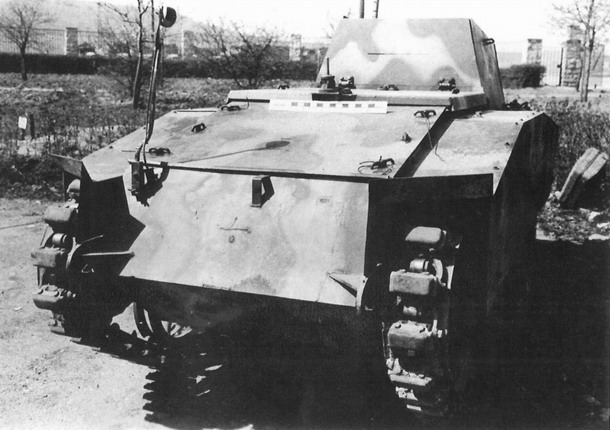
Springer captured by the Americans, source: Flickr.com, Public domain, edited
Design description
As already mentioned, the official designation of the Springer demolition vehicle was mittlerer Ladungsträger (literally "medium charge carrier"), and its ordnance designation was Sd.Kfz. 304. The series production version had six road wheel axles on each side of the hull. Each axle carried two discs with a diameter of 450 mm and a rubber tyre around the circumference. The odd-numbered wheels had spoked discs mounted close together on the axle, while the even-numbered wheels had solid discs with circular cutouts, mounted further apart. The odd and even wheels therefore overlapped one another — a solution typical of virtually all German half-tracks and some tanks as well. Suspension was provided by torsion bars. The tracks were 170 mm wide and fitted with rubber pads.
The powerplant was also taken from the Kettenkrad: a four-cylinder petrol engine made by Opel with a displacement of 1.5 litres, producing 36 horsepower at 3,400 rpm. The exhaust was routed out through the right side of the hull. A silencer was housed in the space beneath the right-track "mudguard", from which the exhaust pipe continued rearward to the back of the vehicle. The engine's radiator was located in the extended rear section of the hull, behind the driver's seat. Above the radiator was a louvred opening for cooling air; on late production vehicles this opening was fitted with a sheet-metal cover that could be closed. The standard Kettenkrad had a three-speed forward and one reverse gearbox, combined with a two-speed reduction gearbox that doubled the number of available gear ratios. The Springer had only two forward speeds, suggesting that only the reduction gearbox was carried over from the original arrangement.
The driver's position was located at the rear of the hull. The driver had a seat, simple handlebars, a gear lever and other controls at his disposal. When the driver was not on board, his position was enclosed by a three-part cover. When the cover sections were raised, they served as a shield protecting the driver's head on three sides. The series production Springer measured 3.15 metres in length, 1.43 metres in width and 1.45 metres in height. In the front section of the hull, an explosive charge weighing 330 kg was installed. The charge was again an integral part of the vehicle, meaning the Springer was destroyed along with it when detonated. The vehicle's total weight was 2.4 tonnes and its maximum speed was around 42 km/h. With 65 litres of petrol in the tank, it could travel up to 200 km on road and 80 km cross-country. The range of the wireless remote control was approximately 2 km.
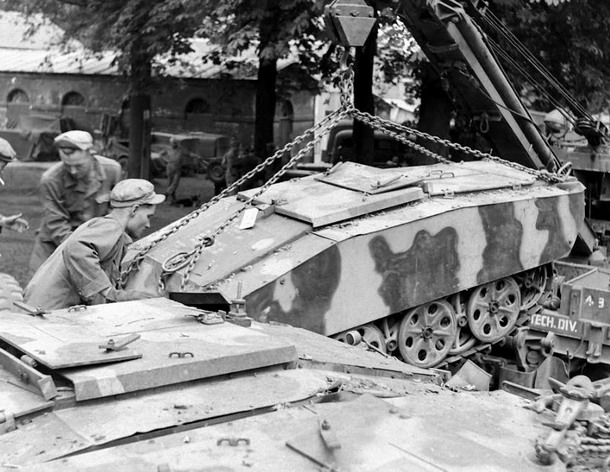
American army technicians loading captured Springers, source: Flickr.com, Public domain, edited
As already noted, only 50 Springer demolition vehicles were ever built, and production only began in the final stages of the war. No records of the type's actual combat deployment exist, and not a single Springer appears in any of the unit reports of remote-controlled demolition vehicle formations.
Technical data
|
weight: |
2.4 t |
|
length: |
3.15 m |
|
width: |
1.43 m |
|
height: |
1.45 m |
|
engine: |
Opel 1.5 litre |
|
engine output: |
36 hp |
|
max. speed: |
42.0 km/h |
|
fuel capacity: |
65 l |
|
range - road: |
200 km |
|
range - cross-country: |
80 km |
|
crew: |
1/0 men |
|
armament: |
330 kg of explosives |
ARTICLE
CONTENTS:
Reproducing text from the Panzernet website without the written consent of the operator is prohibited.