SICHERUNGSFAHRZEUG UE
improvised vehicles for airfield security
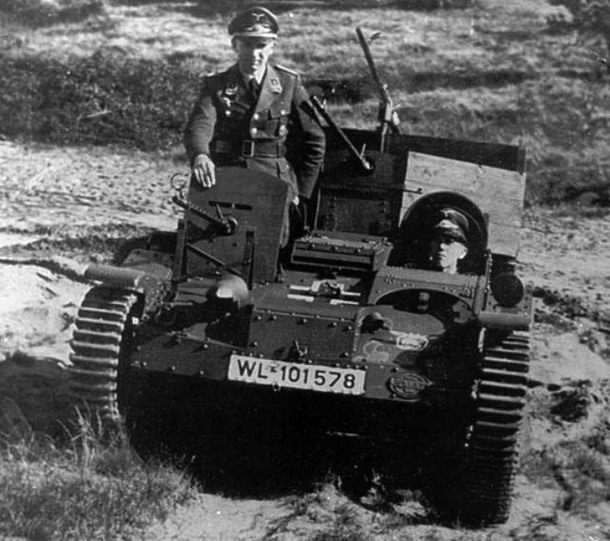
Sicherungsfahrzeug UE (f), source: Flickr.com, courtesy of the publishing user, edited
Following the fall of France, the Germans captured several hundred of the small tracked cargo carriers known as the Renault UE. These vehicles had served the French Army primarily as ammunition carriers. Despite their compact dimensions, the machine could carry 400 kg of cargo in its own rear load bay, plus a further 500 kg in a towed trailer.
The running gear on each side consisted of six small road wheels, suspended and sprung in pairs. The wheels were separated by a flat beam that extended rearward to connect with the last spoked idler wheel. At the very front sat the drive sprocket, which was also of spoked construction. The track was supported from above by two return rollers.
The engine was mounted at the very front of the hull. Behind it was space for a two-man crew. Above their positions, hemispherical hatch covers protruded through the roof — the roof itself was simply too low for the crew to sit with their heads below it otherwise. These dome-shaped covers featured a vision slit at the front. The driver sat on the left, with the vehicle commander on the right. Armour protection reached 7 mm on the front and sides, and only 4 mm on the rear wall. Power came from a four-cylinder engine with a displacement of 2.1 litres, producing a maximum of 38 horsepower.
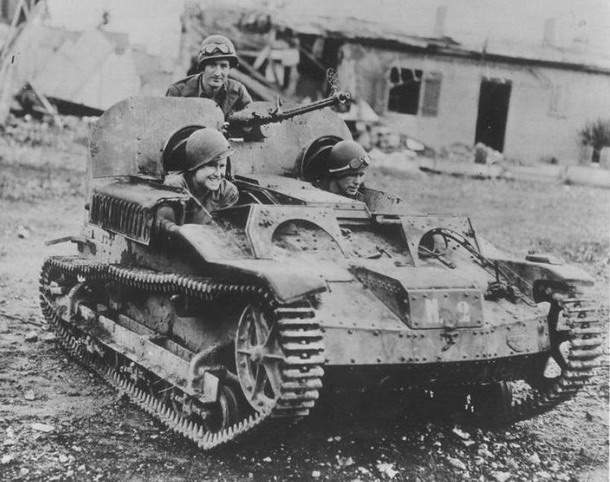
Sicherungsfahrzeug UE (f) captured by the Americans, source: internet, Public domain, edited
The Germans made extensive use of these vehicles for their own purposes. In addition to fulfilling their original role as cargo haulers, the chassis were also adapted for entirely different applications. The Renault UE chassis served as the basis for, among other things, a light tank destroyer armed with a 37 mm gun, and a self-propelled rocket launcher — the former is described in the Other Tank Destroyers section, the latter in the Other Self-Propelled Guns section.
A separate chapter in the vehicle's wartime story was its conversion into machine gun carriers for the Luftwaffe. The Sicherungsfahrzeug — literally "security vehicle" — was used to protect German field airfields. The vehicle existed in several distinct variants. In the first of these, a boxy superstructure with vision slits was added above and to the right of the commander's position. An MG 34 machine gun in 7.92 mm calibre was mounted in its front wall. The gunner entered the superstructure through a two-part hatch in its roof.
Another variant of the vehicle was armed with two machine guns. The first was again mounted in the front wall of a box-shaped superstructure above the commander's seat, though this superstructure was noticeably smaller than on the previous version. At the rear of the vehicle, where the original cargo bay had been, a cabin for a second gunner was installed. This compartment was accessed through a door in its rear wall.
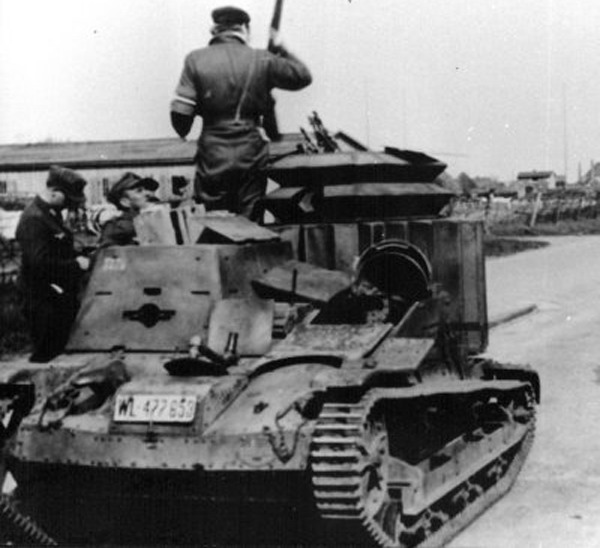
Sicherungsfahrzeug UE (f) with an almost bizarrely armoured cabin, source: internet, Public domain, edited
At least one further version of the Sicherungsfahrzeug UE (f) was produced, apparently as a test prototype. It also had two firing positions, but carried a total of three machine guns. This variant had almost no armour to speak of. The front gunner's station was protected only from the front by a small armoured plate fitted with a vision slit, in which the first machine gun was also mounted. The rear gunner likewise had armour protection only from the front. This man operated two machine guns — one fixed in the front plate and a second mounted on a beam above it. The gun on the beam was likely intended for use against enemy aircraft.
The Sicherungsfahrzeug was an inexpensive vehicle, but also a limited one in combat terms. With its light armament, it could only engage infantry effectively.
Reproducing text from the Panzernet website without the written consent of the operator is prohibited.