GOLIATH
remote-controlled bomb on tracks
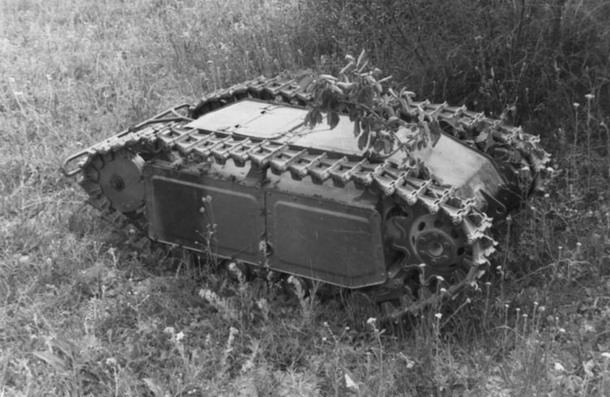
the electric motor-powered Goliath, i.e. the Sd.Kfz. 302; source: Bundesarchiv_Bild_101I-230-0686-01, Wikimedia, Creative Commons, edited
A Brief History
The first experiments with remotely controlled military equipment took place not on land but in the air and on water — which makes sense, as these environments are free of the complications posed by terrain obstacles. A water surface is flat, with no holes, ruts or tree stumps to contend with, and the open sky allows practically unlimited freedom of movement. The earliest remote-controlled military devices were therefore hot-air balloons, small airships, boats, and torpedoes. As an early example of this type of weapon being used in anger, the "bombing" of Venice by the Austrian Army in the summer of 1849 is sometimes cited. The Austrians released hundreds of small unmanned hot-air balloons over the city, each carrying an explosive charge. In this case, however, one cannot really speak of remote-controlled technology, since the balloons were carried toward the target by the wind — and many of them ended up somewhere else entirely.
During the nineteenth century, remotely controlled motorboats and wirelessly guided torpedoes were also tested with reasonable success. The celebrated inventor Nikola Tesla patented a device for the remote control of ships and vehicles in 1898, which he called the teleautomaton. When he demonstrated it to potential investors at an electrical exhibition in Madison Square Garden — controlling a small vessel with it — the audience reportedly refused to believe that Tesla was steering the boat wirelessly, with some even suggesting that a trained monkey was sitting inside the vessel.
Development of remotely controlled ground-based "bombs" essentially stalled for a time, only to resume shortly before the outbreak of the First World War — or more precisely, once the war had settled into its phase of positional fighting. Soldiers and engineers began thinking about machines that could either create gaps in wire obstacles or eliminate enemy soldiers sheltering in trenches directly. It was clear that such machines would have to be unmanned, and therefore remotely controlled. The French appear to have gone furthest in this direction, referring to such vehicles collectively as Torpille Terrestre — land torpedo. In 1915 the French firm Schneider developed a small vehicle called the Crocodile, steered by cable and carrying 40 kg of explosives. Around the same time, the Aubriot-Gabet Torpille Electrique and the American Wickersham land torpedo also appeared. All these designs were soon overshadowed, however, by the arrival of a far more advanced and promising machine — one that could cut through barbed wire entanglements, cross trenches, withstand enemy machine gun fire, and deal death with its own guns. That machine was, of course, the tank.
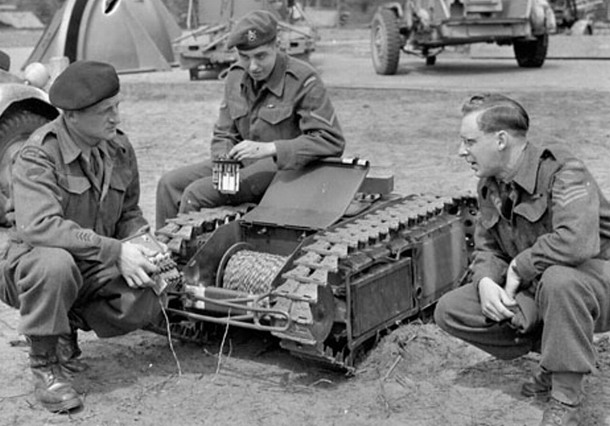
British soldiers inspect a captured electric Goliath; note the drum of wound control cable and the controller in the hands of the soldier on the left; source: Flickr.com, public domain, edited
French Inspiration
Development of remotely controlled ground "bombs" therefore stalled again for a time, only to pick up once more shortly before the outbreak of the Second World War — again primarily in France. At the start of 1939 the French Army was testing a vehicle named after its designer, the véhicule Pommellet. In April 1940, the military even placed an order for 2,000 of these demolition vehicles, though only 11 had been built before the German invasion. In the spring of 1940 the French were also testing a small and lightweight vehicle designed by Adolphe Kégresse. This promising machine naturally did not have time to enter series production given the course of events, and the built prototypes were to be destroyed to prevent them falling into enemy hands. One of them was apparently thrown in haste into the River Seine, from where the Germans later retrieved it and studied it carefully. A single glance at the overall design of this French vehicle (e.g. HERE) makes it abundantly clear that it provided the Germans with a great deal of inspiration when building their own light demolition vehicles, the Goliath.
The Waffenamt apparently issued the requirement for a German vehicle of this type to the firm Borgward at the end of 1940. Borgward — full name Carl F. W. Borgward Automobil und Motorenwerke GmbH — was selected presumably because it had previously worked on a similar device called the Minenräumwagen. The army's specification called for a small electrically powered tracked vehicle capable of carrying a charge of at least 50 kg. The machine was to be controlled by a cable-connected remote controller. The entire device was intended for single use, since the charge was a fixed part of the vehicle — detonating it destroyed the whole machine. The purchase price therefore had to be kept as low as possible. The vehicle was intended for remote destruction of bunkers, minefields, and armoured vehicles.
First Prototype
The project was evidently not a high priority, as the first prototype did not appear until late 1941. It differed considerably from the later series-production vehicles. It had four relatively large road wheels on each side, and all other components were accommodated in the open space between the tracks. At the front was a metal box containing the explosive charge, behind it were presumably the electric motors, then the batteries, and at the rear a spool of wound control cable (a photograph of the prototype can be viewed HERE).
The Electric Sd.Kfz. 302
Although the prototype trials were reportedly satisfactory, the vehicle's design was substantially revised. First, the running gear was redesigned, now featuring four small road wheels. The upper run of the track was supported by three small return rollers, with a toothed drive sprocket at the front and an idler at the rear. A further small roller ahead of the first road wheel helped the vehicle mount obstacles.
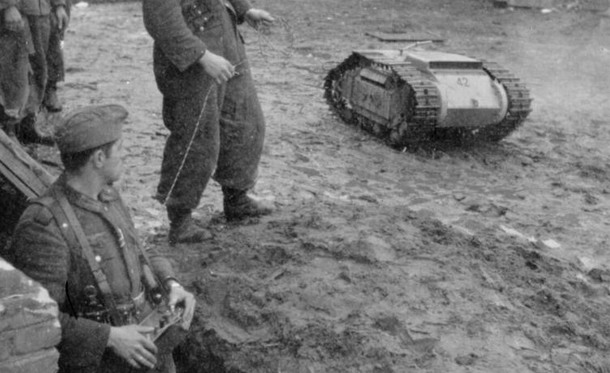
the second-generation vehicle received a petrol engine; here it is seen in action in Russia — note the soldier operating the controller while his colleague holds the guide cable; source: Bundesarchiv_Bild_101III-Ahrens-026-12, Wikimedia, Creative Commons, edited
The use of small road wheels freed up additional space in the sides of the hull, in which two closeable compartments were formed. The forward compartment on each side housed a Bosch electric motor producing 2.5 kW. The rear compartments each housed one battery. All other internal components were enclosed in the new steel hull between the tracks. At the front of the vehicle was a compartment containing the explosive charge; behind it was space for the control unit, which switched the motors on and off in response to commands from the remote controller; and at the rear was a drum of wound control cable.
The vehicle could carry a charge of up to 60 kg. None of the available sources specifies what type of explosive was used in this version. One reasonably plausible possibility is the explosive ecrasite, also used in the later demolition vehicle Sprengladungsträger B IV. Ecrasite is well suited to such purposes on account of its inertness — it is unaffected by moisture, shock, friction, or even fire. As shown in THIS photograph, the explosive was loaded into the front compartment in several moulded pieces, shaped to fill the compartment completely.
The demolition vehicle's official designation was leichte Ladungsträger — literally "light charge carrier". Its ordnance code was Sd.Kfz. 302, but the vehicle became by far most widely known under the name Goliath. The inspiration for this name was indeed a "giant" — not the biblical one, however, but the giant of the insect world, the Goliath beetle (Goliathus regius). The steel Goliath measured 1.5 metres in length, 85 cm in width, and 56 cm in height. It weighed 370 kg and had a top speed of 10 km/h. Fully charged batteries were sufficient for approximately 1,500 metres of road travel or 800 metres cross-country.
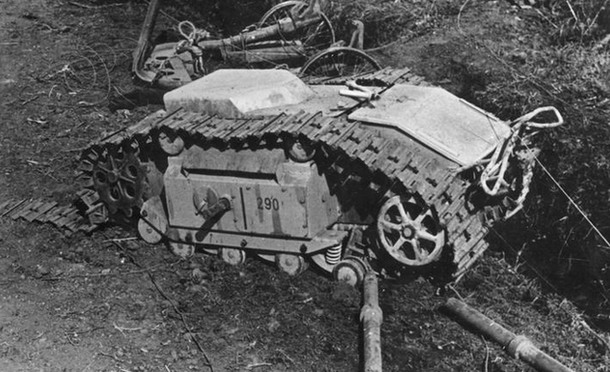
the wreck of a second-generation Goliath, the Sd.Kfz. 303a; source: Flickr.com with permission of the publishing user, edited
As already mentioned, the Goliath was controlled by a cable-connected remote controller. Some sources give the cable length as 500 metres, others as 650 metres or even 800 metres. An American report on captured Goliaths gives the cable length as "approximately half a mile" — roughly those 800 metres — which would also be consistent with the cited battery range cross-country. In any case, vehicles were usually transported to the area of operation by truck; for the final short stretch they could be towed on a special two-wheeled trolley pulled by the soldiers themselves. The Goliath would then proceed to the target under its own power. The remote controller allowed forward and reverse travel, stopping, turning, and of course detonation of the charge.
The controller cable automatically paid out from the spool as the vehicle moved, passing through a frame on the rear wall of the vehicle that prevented the cable from being caught by the tracks during a sharp turn. When the charge detonated and destroyed the vehicle, the operator simply disconnected the remaining control cable from the remote controller — the controller itself could then be used again for the next vehicle. The vehicle's hull was made from ordinary mild steel; only the front received 5 mm of armour plate. In April 1942 a pre-series batch of 15 evaluation vehicles was built, followed by the start of series production a month later. By the end of 1942, 835 vehicles had been completed; 1,731 more were produced in the following year, with a final 69 in January 1944. Total production of this version of the Goliath thus reached 2,635 vehicles.
The Petrol-Engined Sd.Kfz. 303a
While production of the electric Sd.Kfz. 302 was still underway, a new version of the demolition vehicle was developed. This time, instead of electric motors, a small Zündapp SZ7 two-stroke petrol engine was used, with a displacement of 0.7 litres and an output of 12.5 horsepower. This version was designated Sd.Kfz. 303a. The petrol-engined Goliath was somewhat larger than its predecessor — 162 cm long, 84 cm wide, and 60 cm tall. The frontal armour was increased to 10 mm, and the explosive charge grew to 75 kg. Total weight, however, decreased slightly to 365 kg. The fuel tank held 6 litres of petrol, sufficient for approximately 12 km of travel — a radical improvement in range. Normal cruising speed of the petrol Goliath was around 5 km/h, with a top speed of approximately 11 km/h.
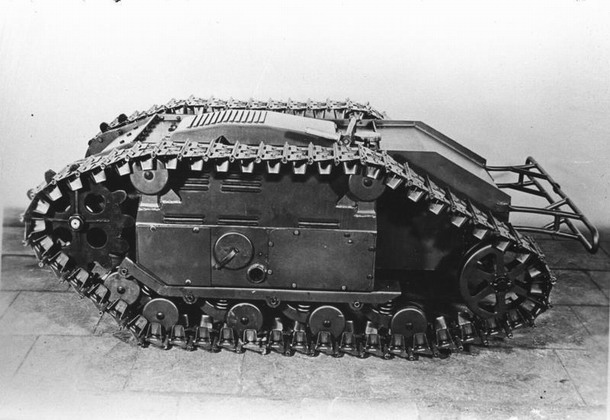
the third-generation Goliath was again petrol-powered, but differed from its predecessor in many details; source: Bundesarchiv_Bild_146-1980-053-53, Wikimedia, Creative Commons, edited
The running gear was also redesigned. The petrol-engined vehicle had five road wheels on each side, the foremost of which was raised above ground level to assist in mounting obstacles. The upper run of the track was now supported by only two return rollers. The drive and idler sprockets were also of a new design. The engine was located in the centre of the hull, alongside the fan that cooled it. Immediately behind the engine was the fuel tank, and at the very rear the drum of wound remote-controller cable. At the front was again the compartment containing the explosive. On the hull roof was a raised air intake for engine cooling. The engine was started by a crank located on the roof plate. The Sd.Kfz. 303a entered series production in April 1943. In the autumn of the same year, a further revised version was developed, designated the Sd.Kfz. 303b.
The Petrol-Engined Sd.Kfz. 303b
The third generation of the Goliath was again slightly larger than its predecessors: 169 cm long, 91 cm wide, and 62 cm tall. Weight increased accordingly to 430 kg. The engine remained the petrol-powered Zündapp producing 12.5 horsepower, and the fuel tank volume and frontal armour thickness were likewise unchanged. The explosive charge, however, grew to a full 100 kg. The Sd.Kfz. 303a and 303b are easily distinguished in photographs by the different design of the air intake cover on the hull roof. In the remainder of 1943, 2,112 petrol Goliaths were completed; 2,694 were produced in the following year, with a final 123 in January 1945. Total production of the Sd.Kfz. 303a and 303b combined thus amounted to 4,929 vehicles. For clearer mutual identification, the names of the electric and petrol versions were expanded to leichte Ladungsträger (Sd.Kfz. 302) (E Motor) and leichte Ladungsträger (Sd.Kfz. 303) (V Motor).
Combat Deployment
The first unit to receive demolition Goliaths was the Panzer-Abteilung 300 (FL) (FL = Funklenk = radio-controlled). The first battlefield on which Goliaths were deployed was the area around the port of Sevastopol in Crimea, in June 1942. Between October and December 1942, further independent companies were formed: specifically Panzer-Pionier-Kompanie 811, 812, 813, and 814. Each such company was to have 162 Goliath vehicles.
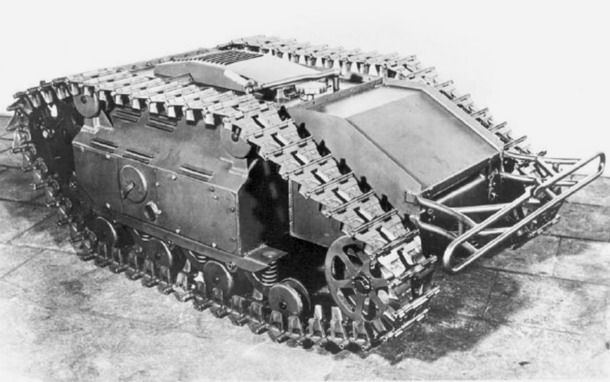
a third-generation Goliath, the Sd.Kfz. 303b; source: Flickr.com with permission of the publishing user, edited
Despite the high number of vehicles produced, the Goliath was not considered a particularly effective weapon. Its cross-country mobility was quite limited — even a relatively small obstacle such as a tree stump, a boulder, or a shell crater could stop it. And when guiding the vehicle toward a target from a distance of more than half a kilometre — usually from cover — it was easy to miss such an obstacle. The Goliath itself was also fairly easily put out of action, for example by machine gun fire or hand grenades. The same applied to its control cable, which could be easily severed by a grenade.
There are references to Borgward also working on a wirelessly controlled variant of the Goliath. Details are not available, but it is true that the museum at Kubinka displays a very interesting Goliath example with some kind of additional equipment and something resembling a small radio antenna. Unfortunately I have been unable to find any further information about this exhibit anywhere. Could it really be a prototype of a radio-controlled Goliath captured by the Red Army in 1945? (photo HERE (source: www.tankmuseum.ru) and HERE (wikipedia.org, Alan Wilson, Creative Commons))
Technical Data
|
|
Sd.Kfz. 302 |
Sd.Kfz. 303a |
Sd.Kfz. 303b |
|
weight: |
370 kg |
365 kg |
430 kg |
|
length: |
1.50 m |
1.62 m |
1.69 m |
|
width: |
0.85 m |
0.84 m |
0.91 m |
|
height: |
0.56 m |
0.60 m |
0.62 m |
|
engine: |
2x Bosch 2500/24 RL2 |
Zündapp SZ7 |
Zündapp SZ7 |
|
engine output: |
2 x 2.5 kW |
12.5 hp |
12.5 hp |
|
max. speed: |
10 km/h |
11 km/h |
11 km/h |
|
fuel supply: |
2 batteries |
6 l |
6 l |
|
range – road: |
1.5 km |
12 km |
12 km |
|
"armament": |
60 kg explosive |
75 kg explosive |
100 kg explosive |
ARTICLE
CONTENTS:
Reproducing text from the Panzernet website without the written consent of the operator is prohibited.