FEUERLEITFAHRZEUG
mobile fire control vehicle for V-2 rocket launches
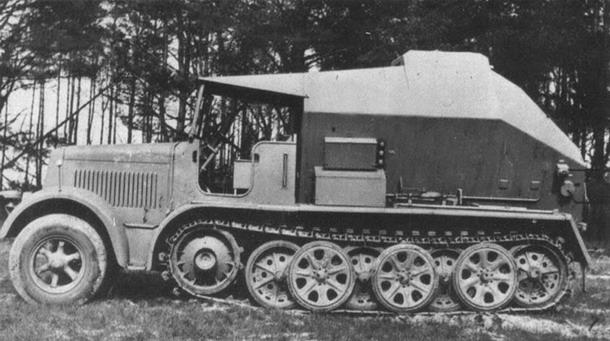
Feuerleitpanzerfahrzeug für V-2 Raketen on the Sd.Kfz. 7 half-track chassis. Source: Flickr.com, with permission of the publishing user, edited
Among the vehicles built on the half-track Sd.Kfz. 7 chassis, alongside several self-propelled anti-aircraft guns, was one particularly interesting vehicle bearing the official designation Feuerleitpanzerfahrzeug für V-2 Raketen. As its name implies, this vehicle was connected with Germany's famous V-2 rockets.
The V-2 was a complex and highly advanced device of considerable size and destructive power. Maintaining, preparing, and launching it required a substantial number of personnel and supporting equipment -- cargo tractors to transport the rockets, fuel tankers, cranes to erect the rocket on its launch pad, and finally a fire control vehicle for the launch itself.
As the war progressed into its second half, the intensity of Allied bombing over German territory grew steadily. Relying solely on fixed launch sites for these rockets would therefore have been extremely unwise. Once the Allies located such a site -- which would have been relatively straightforward -- destroying it by bombing and preventing further launches would have presented no great difficulty.
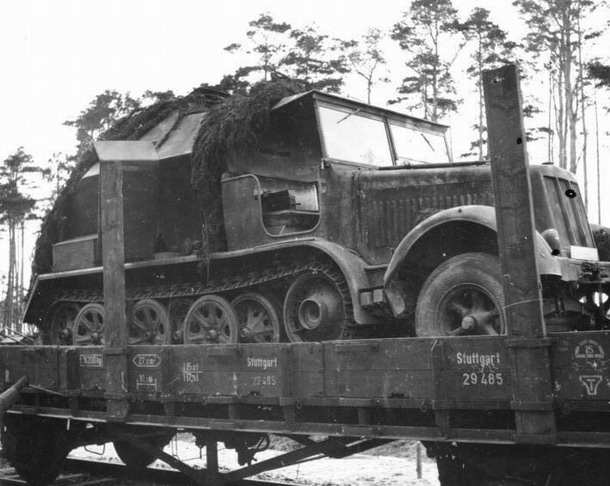
Feuerleitpanzerfahrzeug für V-2 Raketen on the Sd.Kfz. 7 chassis during rail transport. Source: Bundesarchiv_RH8II_Bild-B1945-44, Wikimedia, Creative Commons, edited
The Germans therefore worked on developing mobile equipment that would allow a rocket to be launched from virtually any location. A mobile fire control vehicle was required, and the chassis of the Sd.Kfz. 7 half-track tractor was selected as its basis.
On the rear half of the chassis, a large armoured superstructure was built up from flat welded steel plates. At the very rear of the superstructure was the firing control console, at which two launch technicians were seated. A pair of rectangular closeable vision ports in the rear wall of the superstructure gave them a view of the outside. The driver therefore had to position the vehicle with its rear facing the launch site.
A hatch in the roof of the superstructure allowed the crew to observe the rocket's flight after launch. The front half of the vehicle was unchanged from the original half-track. Only the previously open driver's cab was given a sheet metal roof, which joined flush with the top of the superstructure.
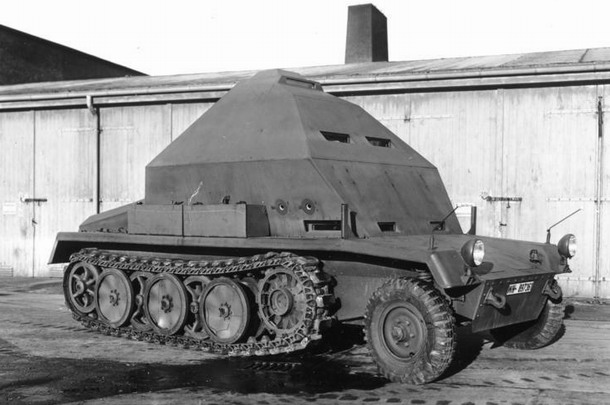
Feuerleitpanzerfahrzeug für V-2 Raketen on the HKp 902 prototype chassis. Source: Bundesarchiv_RH8II_Bild-B0767-42_BSM, Wikimedia, Creative Commons, edited
During transport, a mobile launch stand on a simple two-wheeled trailer was towed behind the Feuerleitpanzerfahrzeug. This stand is visible two images above. Although it looks rather fragile at first glance, it was capable of providing the rocket with the support needed for its launch.
During the war a second vehicle of the same purpose was also built, this time on the chassis of one of the four prototypes of the half-track self-propelled gun HKp 902. This version of the Feuerleitpanzerfahrzeug was therefore built in a single example only, and little is known about it. In what may be its only surviving photograph, the superstructure built onto the chassis can be seen to be structurally very similar to that of the earlier Feuerleitpanzerfahrzeug.

Reproducing text from the Panzernet website without the written consent of the operator is prohibited.