STUH 42
looks like a Sturmgeschütz, but it's a Sturmhaubitze
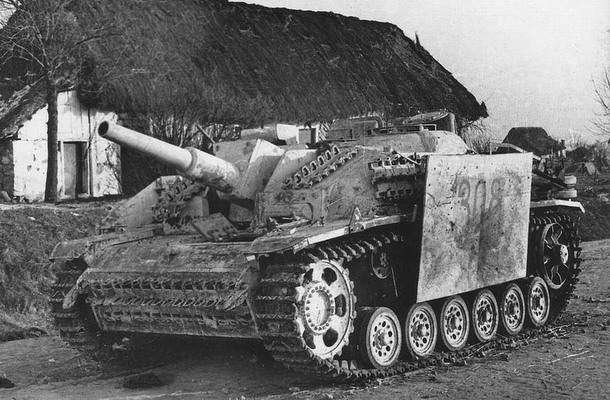
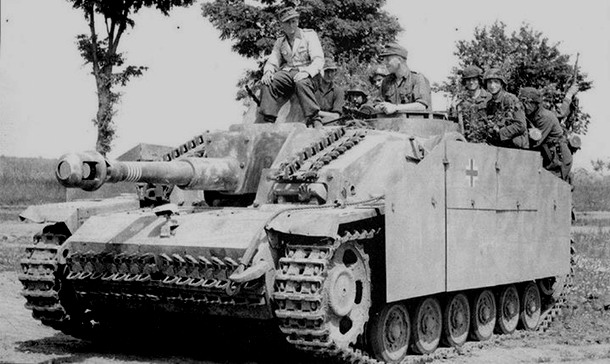
a Sturmhaubitze 42 without a muzzle brake; the vehicle has all-steel return rollers, a shield for the roof-mounted machine gun, and additional armour on the commander's cupola — remnants of the side skirt armour hang from the hull side; source: Flickr.com, published with the permission of the original contributor, edited
Origins of the vehicle
The StuH 42 self-propelled gun was essentially nothing more than a more heavily armed version of the famous assault gun StuG III. The StuG III was intended for direct fire support of infantry — it was to advance alongside the infantry and rapidly destroy enemy machine gun nests, artillery positions, fortified points, and other so-called soft targets. Following the invasion of the Soviet Union, however, these vehicles were increasingly being drawn into combat against overwhelming numbers of enemy tanks. In response to this, a decision was made in September 1941 that set a clear direction for the further development of the StuG III: maximising its ability to destroy armoured vehicles.
The StuG III was therefore re-armed with a long-barrelled gun and increasingly came to be regarded as a tank destroyer. This raised the question of who would take over its original role — that of primarily destroying the soft targets blocking the advance of German infantry. The answer came quickly, in the form of a proposal to build a new version of the assault gun armed with a more powerful weapon suited to that task. The first mention of such a vehicle dates to 2 December 1941, when an army requirement was issued for the production of 12 verification vehicles based on the StuG III but armed with 105 mm howitzers. The new weapon was to be installable in the StuG III in place of its original 75 mm gun, with the minimum possible additional structural modifications to the vehicle — which would naturally reduce the cost and complexity of production.
The new weapon was developed by modifying the le.F.H. 18 light field howitzer of 105 mm calibre, manufactured by Rheinmetall-Borsig. The weapon was adapted for installation in the StuG's fighting compartment and given the new designation 10.5 cm Sturmhaubitze 42 L/28 (Sturmhaubitze = assault howitzer), abbreviated 10.5 cm StuH 42.
The StuH 42 howitzer
The first 12 verification howitzers — just the guns themselves, not complete vehicles — were scheduled for delivery between December 1941 and February 1942. Their production was apparently delayed, however, as various sources consistently report that only 5 had been delivered by May 1942. At least one example of the new weapon was certainly complete by March 1942 at the latest, since it was in that month that Alkett completed the first full prototype of the new fighting vehicle. This vehicle was produced by fitting the new StuH 42 howitzer into a standard StuG III Ausf. E. The prototype is documented in factory photographs dated 9 March 1942.
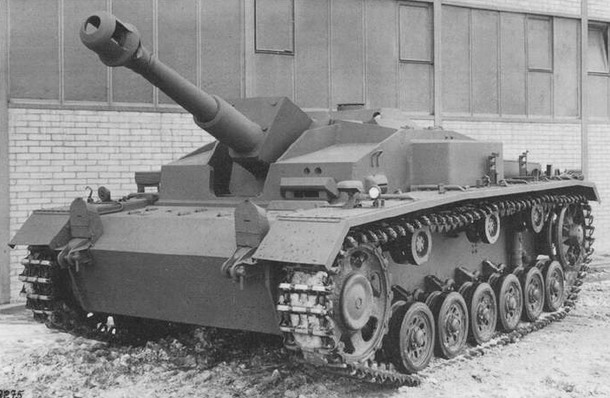
the Sturmhaubitze 42 prototype built in March 1942 on the basis of a StuG III Ausf. E; source: Flickr.com, published with the permission of the original contributor, edited
Compared with the standard StuG III, only three structural changes were made. The first was of course the new howitzer. The second was a revised arrangement of the ammunition stowage inside the vehicle to accommodate 105 mm rounds. The third change was a raised centre section of the fighting compartment roof (in the area where the roof ventilator was located), intended to allow a greater negative elevation angle for the howitzer — i.e. to allow the barrel to depress further downward. This last roof modification was ultimately not carried over into production, however, meaning that the production vehicles' roof configuration was the same as on standard StuG IIIs. The new vehicle became known essentially by the abbreviated name of its main weapon: StuH 42. Its official designation, however, was Sturmhaubitze mit 10.5 cm StuH 42, and its ordnance code was Sd.Kfz. 142/2.
Production of the remaining 11 verification prototypes dragged on at a snail's pace. On 2 October 1942, one of the completed vehicles was demonstrated to Adolf Hitler. He made no secret of his enthusiasm at seeing such a powerful weapon successfully fitted into a vehicle with such a low silhouette, and immediately enquired when series production could begin. His subordinates had to inform him that only 12 verification vehicles had been ordered so far, and that only 6 of those had actually been built. Three more were due to be completed by the end of October, and the remaining three in November 1942. Hitler ordered series production to be started without delay.
By the end of October 1942, nine of the twelve prototypes ordered in December 1941 had been completed. The final three were eventually delivered only in January 1943. All of these vehicles were produced by converting existing StuG IIIs rather than as new-build production. In November 1942, the nine available assault howitzer prototypes were assigned to the 3rd Battery of Sturmgeschütz-Abteilung 185, within which they were experimentally committed to combat in the area south of Leningrad.
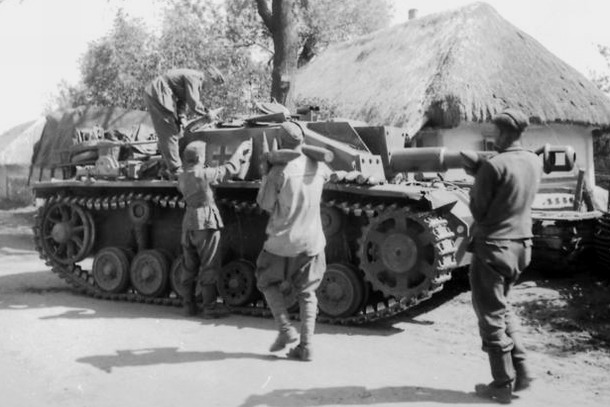
a StuH 42 being re-supplied with ammunition — each such round weighed almost 15 kg; source: Bundesarchiv_Bild_101I-220-0636-16, Wikimedia, Creative Commons, edited
Series production
Series production of the StuH 42 got underway in March 1943, running at the Alkett plant in parallel with production of the standard StuG III. Production assault howitzers were built on the basis of the StuG III Ausf. G, meaning the foundation of the vehicle was the chassis from late-production versions of the Panzer III tank. Atop the chassis sat the low fighting superstructure. The front wall of the superstructure was divided by the aperture through which the main weapon protruded. To the left of the howitzer in the front wall was the driver's vision port, closed by a heavy armoured flap. At the upper left of the rear section of the superstructure roof was the circular commander's cupola, fitted with vision ports. The cupola also served as the entry hatch and was therefore fitted with an openable cover. The vehicle's armour was thickest on the front faces, totalling 80 mm (a 50 mm base plate plus a 30 mm plate either bolted or welded on).
The StuH 42 howitzer
The vehicle's main armament was the aforementioned StuH 42 howitzer of 105 mm calibre. Horizontal traverse was 10 degrees to each side, and vertical elevation ranged from -6 to +20 degrees. The howitzer used separate-loading ammunition and, with the maximum propellant charge, had a range of approximately 10.6 km. The standard high-explosive fragmentation shell, the Sprenggranate 38, weighed 14.81 kg and carried 1.38 kg of explosive. Anti-tank shaped-charge ammunition was also available for the weapon, supplied as fixed rounds rather than separate-loading. The on-board ammunition supply totalled only 36 rounds. The StuH 42 had a barrel length of 28 calibres — 2.94 metres. The howitzer was originally delivered with a muzzle brake at the end of the barrel. Photographs reveal three different muzzle brake variants: the conventional type similar to that of the StuG III (HERE (source: flickr.com)), a version with lateral extensions (HERE (source: flickr.com)), and finally a narrow version of the type also used on self-propelled howitzers such as the Wespe (HERE (Public domain)). From September 1944, the fitting of muzzle brakes was discontinued entirely.
The crew consisted of four men. The driver sat at the front in the left side of the hull. The remaining crew members were stationed in the fighting superstructure: the gunner sat to the left of the main weapon, the commander sat behind and slightly above him, and the loader had his seat to the right of the howitzer. The StuH 42 assault howitzer weighed 23.9 tonnes. Power was provided by a rear-mounted Maybach HL 120 TRM petrol engine of 11.9 litres displacement, producing a maximum output of 300 horsepower at 3,000 rpm. The gearbox was a Zahnradfabrik SSG 77 with six forward and one reverse ratio. Maximum road speed was around 40 km/h. The 310-litre fuel supply was sufficient for approximately 155 km on roads and around 95 km cross-country.
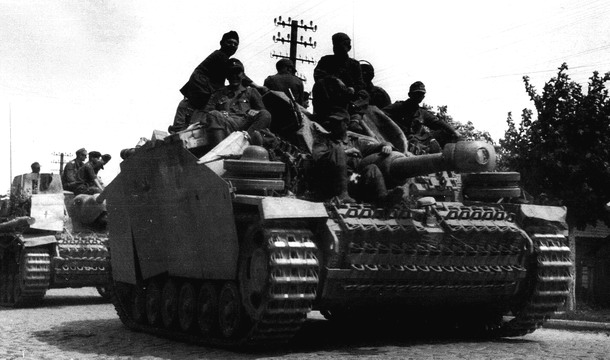
a StuH 42 with the wider pattern muzzle brake; source: Flickr.com, published with the permission of the original contributor, edited
Ongoing modifications
From around June 1943, StuH 42s began to be fitted with side skirt armour, known as Schürzen. This armour was intended primarily as protection against Soviet anti-tank rifles. From around May 1943, vehicles began leaving the factory with a homogeneous front armour plate 80 mm thick — no longer the basic 50 mm plate with an additional 30 mm plate bolted on, but a solid homogeneous plate a full 80 mm thick.
The upper part of the StuH 42's commander's cupola was originally rotatable. From September 1943, however, cupolas had to be installed in a fixed, non-rotating position. The reason was straightforward: in August 1943 the Allies had bombed the ball bearing factories at Schweinfurt, making ball bearings scarce for several months. The commander's cupolas on the StuH therefore had to temporarily do without bearings — and without the ability to rotate. In August 1944, once the worst of the bearing shortage had been overcome, production returned to rotating cupolas. From September 1943, newly produced vehicles began to receive a coating of Zimmerit anti-magnetic paste, intended to prevent magnetic anti-tank charges from adhering to the armour.
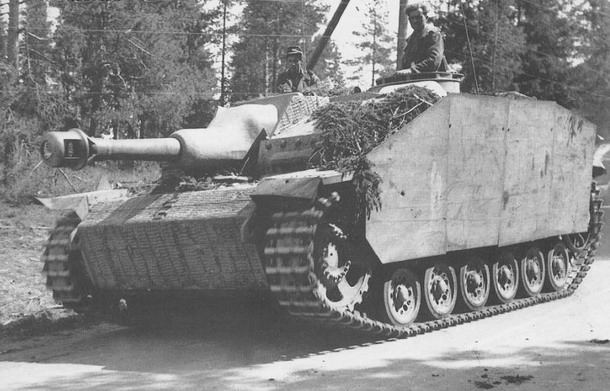
a StuH 42 with Zimmerit paste coating and the cast gun shield known as the Saukopfblende; source: Flickr.com, published with the permission of the original contributor, edited
In November 1943 a new cast gun shield was introduced. It was significantly more resistant to penetration than the older type, both in shape and armour thickness. Due to its distinctive appearance, it was nicknamed by the troops Saukopf (or Saukopfblende), meaning literally "pig's head". Production of the new shield could not keep pace with overall StuH 42 production, however, and so new vehicles continued to be fitted with both shield types simultaneously right through to the end of the war.
From February 1943, smoke discharger launchers began to be fitted. Triple-barrelled launchers appeared at the front on both sides of the superstructure, remotely triggered from inside the vehicle. Already in May 1943, however, their fitting was discontinued. Crews had complained that when the launcher was struck by a shell fragment — or even by small arms fire — the smoke canister could detonate right inside the launcher barrel, with the resulting smoke then entering the fighting compartment and making it impossible for the crew to function.
One of the assault howitzer's persistent weaknesses was its ability to defend itself against close infantry attack. The StuH simply had no built-in machine gun. There was the roof-mounted machine gun with its folding shield mentioned above, but operating it in combat was quite dangerous — the loader, who was responsible for it, had to expose his upper body through the hatch to do so. In April 1944 a new method of mounting the supplementary weapon was therefore tested. An MG 34 was fitted in a low, fully rotatable mount that could be operated from the safety of the interior, again by the loader, who aimed using a periscope. The machine gun had a low arrow-shaped shield. Only after the drum magazine was expended did the loader have to open his hatch to reload — and even then only his hands needed to be exposed, not half his body.
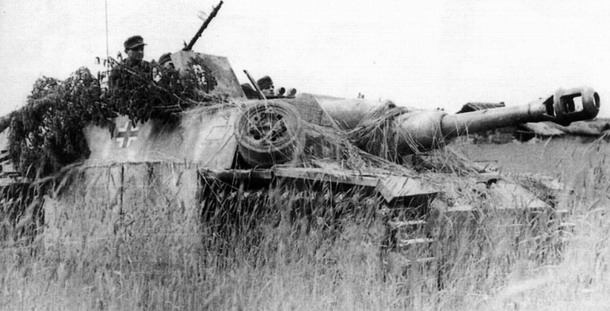
a StuH 42 — this photograph illustrates beautifully the advantage afforded by the vehicle's low silhouette: tall grass alone is enough to conceal nearly half the vehicle's height; source: Flickr.com, published with the permission of the original contributor, edited
In June 1944 the designers came up with yet another solution — they managed to fit a machine gun directly alongside the howitzer, firing through an aperture cut into the upper left section of the gun mantlet. This was a far safer arrangement, similar to the way machine guns were installed in tank turrets. However, the gun could only fire straight ahead and had a very restricted field of aim. This installation existed in versions for both the older rectangular mantlet and the newer Saukopfblende.
In October 1943, additional armour protection was introduced for the front section of the commander's cupola. In an effort to conserve scarce rubber, all-steel return rollers began to be used on the StuH 42 sometime towards the end of 1944, replacing the original rubber-tyred rollers. This increased noise levels and rolling resistance, but both remained within acceptable limits.
From May 1944, a new launcher for smoke grenades was fitted to the assault howitzers. The original smoke dischargers mounted on the sides of the superstructure had proven too vulnerable. The new launcher was therefore positioned not outside but inside the vehicle, where it was protected by the armour. It was mounted under the superstructure ceiling, with its barrel exiting through the left side of the forward roof section. This device carried the official designation Nahverteidigungswaffe — literally "close-defence weapon". In addition to smoke grenades, it could also fire anti-personnel shrapnel rounds, and even signal pistol flares could be fired through its barrel. Due to limited production capacity, however, only a small proportion of vehicles were fitted with this weapon.
a StuH 42 with the side skirt armour known as Schürzen; source: Flickr.com, published with the permission of the original contributor, edited
The last modification worth mentioning was the introduction of attachment points for a folding mini-crane. These took the form of small metal cylinders welded to the superstructure roof — five in total, one in each corner of the roof and one in the centre. The crane's tubular components were inserted into the cavities of these cylinders. The crane had a maximum lifting capacity of 2 tonnes and was used primarily during field engine repairs, as it allowed the armoured engine compartment cover to be easily lifted clear.
Organisation
StuH 42s were deployed alongside StuG IIIs in assault gun batteries (Sturmgeschütz-Batterie). At the time StuH 42 production began, the organisational structure called for a battery of 10 assault guns — three platoons of three vehicles each, plus the battery commander's vehicle. Following the start of StuH 42 series production, army command issued an order in March 1943 allowing one platoon within a battery to be equipped with the new Sturmhaubitze 42 instead of StuGs. A single battery could therefore have three StuH 42 vehicles and seven StuGs. Assault gun batteries were further organised into battalions (Sturmgeschütz-Abteilung). A battalion from early 1943 consisted of three batteries, making for 3 times 10 fighting vehicles plus one additional vehicle for the battalion commander. An entire battalion could therefore theoretically field up to 9 StuH 42 vehicles — three in each of the three batteries.
By the end of the war, a total of 1,299 StuH 42 assault howitzers had been produced (plus the 12 prototypes). The record month was September 1944, when 119 new vehicles rolled out of the Alkett factories. StuH 42s were deployed on both the Eastern and Western Fronts, right up to the very end of the war. In its ability to destroy infantry, bunkers, and enemy artillery positions, the StuH 42 surpassed the older StuG thanks to its substantially more powerful armament. According to a report dated 15 March 1945, a total of 220 StuH 42 vehicles were present with front-line units on both fronts at that date, either operational or under repair.
Technical data
|
weight: |
23.9 t |
|
length: |
6.14 m |
|
width: |
2.95 m |
|
height: |
2.16 m |
|
engine: |
Maybach HL 120 TRM |
|
engine output: |
300 hp |
|
max. speed: |
40 km/h |
|
fuel capacity: |
310 l |
|
range - road: |
155 km |
|
range - cross-country: |
95 km |
|
armour: |
|
|
- front: |
50+30 / 80 mm |
|
- sides: |
30 mm |
|
- rear: |
50 mm |
|
- superstructure roof: |
10 mm |
|
crew: |
4 men |
|
armament: |
10.5 cm StuH 42 L/28 howitzer, 105 mm calibre optionally 1 x MG 34 machine gun, 7.92 mm calibre |
|
in production: |
03/1943 - 04/1945 |
|
total production: |
1,299 units |

ARTICLE
CONTENTS:
Reproducing text from the Panzernet website without the written consent of the operator is prohibited.