GRANATWERFER AMR 35(f)
self-propelled mortar on a French tank chassis
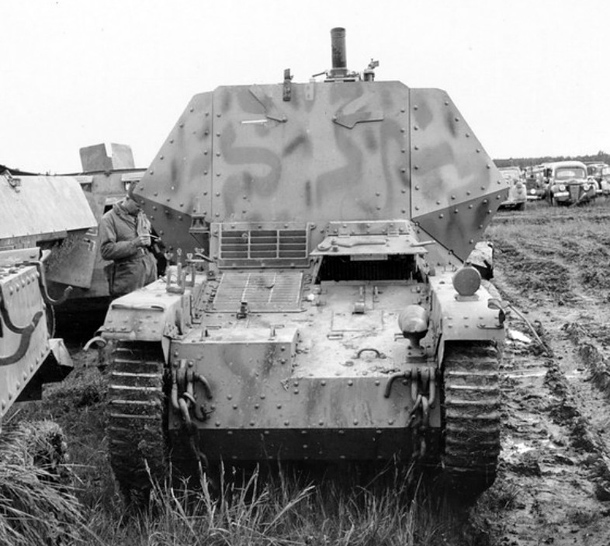
8cm schwerer Granatwerfer 34 auf Panzerspähwagen AMR 35(f) at a German vehicle collection point near the end of the war — the two vision slits and their covers on the front armour plate are clearly visible, source: internet, Public domain, edited
Introduction
The self-propelled mortar described in the following paragraphs was born out of an effort to make sensible use of the captured French Renault AMR 35 tank. The Germans seized around a hundred of these light tanks in 1940 and introduced them into their own service under the designation Panzerspähwagen Renault ZT 702(f). They were not at all impressed with their performance — a sentiment, as it happens, shared by the original users of the vehicle, namely the French. But why was that?
The AMR 35 Tank
The Renault AMR 35 tank was originally developed as the successor to the older AMR 33 fast reconnaissance tank, intended for use with the light mechanised divisions (Division Légère Mécanique). The letters AMR stood for the French designation Automitrailleuse de Reconnaissance — literally a reconnaissance machine-gun car (a somewhat misleading term for a tank, but one in perfectly common use in France in the 1930s). Development of the vehicle began in 1933, though its path to production was rather winding. The first prototype was ready as early as February 1934 and achieved an astonishing top speed of 72 km/h during trials, but the army was not satisfied. A second prototype followed, fitted with a somewhat less powerful but more reliable Renault 432 engine (which incidentally derived from a bus engine). This too failed to satisfy the customer, and so a third prototype was prepared in October 1934 with a new running gear. Thorough trials were conducted in 1935 and the tank was approved for series production, though a number of further modifications — large and small — were still to be made beforehand (including the adoption of the newer Renault 447 engine).
An order for the first hundred production tanks was actually placed while development was still ongoing, specifically in May 1934. The French army was clearly in a considerable hurry to receive the new vehicle and demanded unrealistic delivery schedules. The first production vehicles were probably completed in June 1935, with trials running through July and August. By the end of August, 12 production tanks were ready for handover to the army — but the army refused to accept them after one of the first vehicles failed a steep-slope test during trials. Renault therefore had to adjust the gear ratios, which pushed the official acceptance of the first production tanks back to January 1936. Production then continued until the turn of 1938–39, yielding 167 vehicles in total.
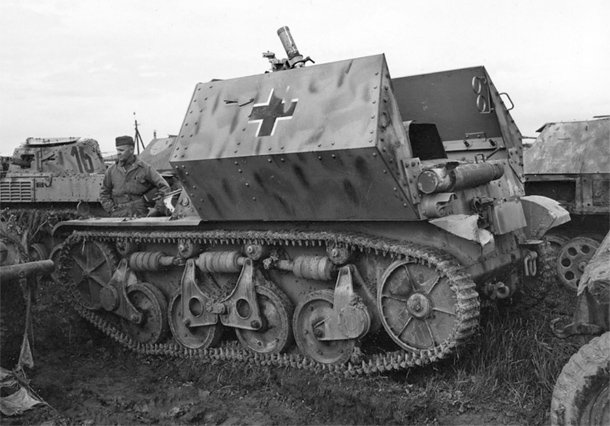
For the mortar carrier conversion the Germans used chassis of the Renault AMR 35 ZT-4 variant, originally ordered by the French Ministry of Colonies, source: internet, Public domain, edited
Almost immediately after the tank entered service, crews began running into various technical problems. One example was the weak design of the final drives on the drive sprockets, which were prone to overloading and failure under hard driving. During 1937 Renault had to invest considerable effort in repairs and large-scale preventive replacements. The AMR 35 never quite shed its reputation as an unreliable machine.
The tank's running gear consisted of four road wheels on each side. The first and last wheels were independently suspended, while the two middle wheels were paired in a bogie. Suspension was provided by horizontally-mounted rubber springs. The drive sprocket was at the front and the idler wheel at the rear. The upper run of the 200 mm wide track was supported by no fewer than four small return rollers. Power came from the already-mentioned Renault 447 four-cylinder petrol engine with a displacement of 5.88 litres, producing a maximum output of 82 horsepower. The engine was mounted at the rear of the tank and connected to the gearbox in the right front section of the hull. The gearbox had four forward speeds and one reverse. The fuel tank, located at the right rear, held 130 litres of petrol. So equipped, the 6.5-tonne vehicle could reach a road speed of up to 55 km/h.
The armour on the most exposed areas was only 13 mm thick, and even thinner elsewhere. Both the hull and the fighting turret relied on riveting armour plates to a structural frame. The French tank's crew consisted of just two men — a driver and a commander who handled everything else: firing, loading, and operating the radio, if one was fitted (which was not always the case). The AMR 35 was produced in several variants including command vehicles. The two main combat versions were: the variant with the Avis 1 turret and 7.5 mm Reibel MAC 31 E machine gun, and the variant with the Avis 2 turret and the more powerful 13.2 mm Hotchkiss 1930 machine gun. Purely as a curiosity, mention should also be made of the version with the APX 5 turret and 25 mm SA modele 1935 gun, of which only a negligible number were produced.
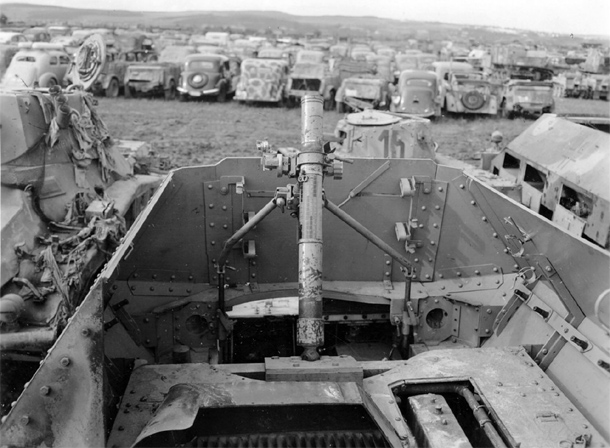
An excellent view into the vehicle's fighting compartment — the four K 98k rifle racks visible on the front wall give a good indication of how many men probably made up the crew, source: internet, Public domain, edited
For the purposes of our story, however, an entirely different variant of the tank is what matters — one that Renault gave the internal designation ZT-4. This variant was not ordered by the French army but by the Ministry of Colonies. The vehicle was therefore naturally intended for service in the colonies, specifically in French Indochina, which covered the territory of present-day Vietnam, Laos and Cambodia. Compared with the standard AMR 35, the "colonial" variant was to receive an enhanced cooling system to cope with tropical conditions. The ZT-4 differed from the main AMR 35 versions in having a differently arranged engine cooling air duct on the roof of the engine compartment, additional vents on both sides of the hull, and only a single exhaust silencer.
Renault received an order for 21 ZT-4 vehicles at the beginning of 1936. Most of the vehicles were reportedly to be delivered without fighting turrets, as the Ministry of Colonies intended to fit them with turrets taken from older Renault FT tanks. A further 34 examples were then ordered during 1937 and 1938. When France was attacked by Nazi Germany in May 1940, a significant number of the AMR 35 ZT-4 tanks were already completed — but true to specification, without fighting turrets. In a desperate attempt to use whatever was available, the French sent at least some of the ZT-4s into action fitted only with a machine gun in an open ring mount where the turret would have been.
In German Hands
Having introduced the original French Renault AMR 35, we can now return to how its new owners — the Germans — put it to use from 1940 onwards. Certainly not as a reconnaissance vehicle with front-line combat units — quite the opposite. In German service, the Panzerspähwagen Renault ZT 702(f) tanks served in the rear, specifically performing security and garrison duties in occupied France and, in smaller numbers, also in the Protectorate of Bohemia and Moravia.
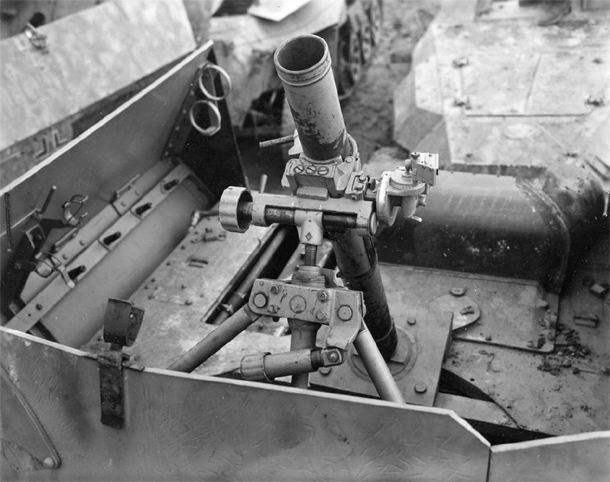
The Granatwerfer 34 mortar had a calibre of 81.4 mm and could send a 3.5 kg bomb to a range of up to 2.4 km, source: internet, Public domain, edited
In the summer of 1942, the so-called Baukommando Becker began operating in France, tasked with gathering obsolete but usable French army surplus equipment and arranging its conversion into self-propelled guns and tank destroyers. A certain number of serviceable Renault AMR 35 ZT-4 tanks — or rather their hulls without turrets — most likely also fell into the Baukommando's hands. The chassis of this tank was too weak to carry any reasonably powerful artillery weapon, but someone had the idea that it might at least serve as a carrier for the much lighter mortar. Sometime around the turn of 1943–44, an unknown number of tank chassis were therefore converted into self-propelled mortars — it is even possible that only a single example was built, intended as a prototype that was not approved for further production.
Design Description
A fixed superstructure was built on the original tank hull, riveted from steel plates 10 or 13 mm thick (depending on which source you choose to believe). All walls were angled for improved protection. The superstructure was left open at the top and rear. The front wall had two vision slits fitted with a simple rotating cover; one additional slit was provided in each side wall. The floor of the rear section of the fighting compartment was in effect the engine hatch cover, so openings for engine cooling airflow and service access to the powerplant had to be retained there.
In the front section of the superstructure, an 8cm Granatwerfer 34 mortar of 81.4 mm calibre was installed. This was an infantry weapon capable of sending a bomb (mortar shell) weighing 3.5 kg to a range of up to 2.4 km (though the effective range limit was around 1.2 km). Instead of the original baseplate, the mortar tube was mounted on a pedestal bolted to the floor. The elevation and traverse adjustment mechanism was retained, but the mortar's support legs had to be substantially modified — shortened, and in the case of the left leg given a new curved shape. Each leg was connected at its lower end by a pivot to a toothed rack inserted into a short tubular bracket fitted with a pinion and crank handle. Turning the crank handles thus allowed the mortar tube to be moved up and down, and even tilted slightly from side to side. The vehicle had no built-in secondary armament, but the crew most likely carried an MG 34 machine gun, which they fired over the top of the armour. A mounting bracket for securing this machine gun more firmly was even fitted to the front wall (photo HERE).
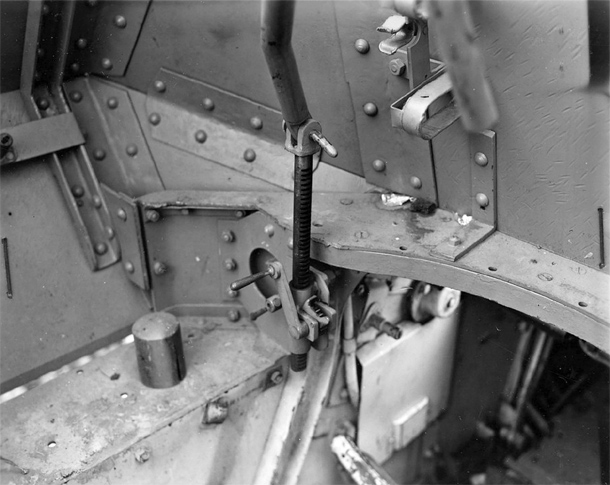
Detail of the left mortar support leg showing the pinion and crank handle used to adjust the barrel elevation, source: internet, Public domain, edited
If the self-propelled mortar was given any official designation at all, it was probably something along the lines of 8 cm schwerer Granatwerfer 34 auf Panzerspähwagen Renault ZT 702(f) or 8 cm schwerer Granatwerfer 34 auf Panzerspähwagen AMR 35(f). Very fine photographs of this vehicle have survived to the present day, taken by American soldiers at a German vehicle collection point near the end of the war. These detailed images make clear that while the conversion of the original tank chassis into a mortar carrier was not particularly sophisticated, it was by no means an amateur improvisation. The armoured superstructure is very well finished and the joints between the armour plates appear quite precise — which only supports the theory that this vehicle was the work of Baukommando Becker rather than some ordinary repair workshop.
Unfortunately no further details about the vehicle are known. According to most sources, its crew consisted of four soldiers — driver, commander, gunner and loader — which would be consistent with the four rifle racks visible on the inside of the front wall of the superstructure (photo HERE). On the right side wall, a pair of brackets can be seen, most likely used to stow two spare mortar tubes (photo HERE). The interior, on the other hand, shows no integrated ammunition stowage bins, from which one can conclude that the mortar bombs were carried aboard in their standard wooden (or possibly metal) transit boxes of three rounds each.
ARTICLE
CONTENTS:
Reproducing text from the Panzernet website without the written consent of the operator is prohibited.