BA-21
a rejected prototype
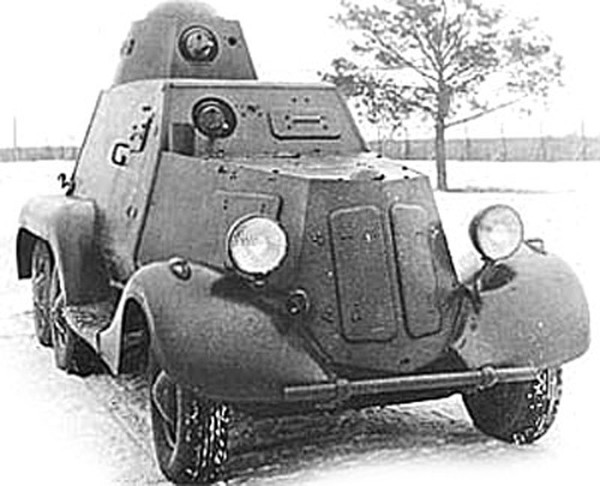
BA-21 prototype, source: Aviarmor.net with permission of the operator, edited
Origins and Description of the Vehicle
The BA-21 armoured car was developed from 1937 as a future replacement for the older BA-20. The prototype was completed during the following year (though 1939 is sometimes cited instead). The vehicle was based on the three-axle chassis of the GAZ-21 civilian truck, which was lightly modified for its new purpose. The front axle hubs were strengthened and additional leaves were added to the rear axle leaf springs. All axles carried single, non-doubled wheels, giving the vehicle a total of six — two front steerable and four rear driven. The designers hoped that the multi-axle chassis would improve cross-country mobility and reduce ground pressure.
On this chassis sat a hull whose basic architecture resembled that of the older BA-20. It again featured conventional automotive mudguards running from the front wheels along the sides of the hull to the rear wheels, with both rear wheels covered by a single shared mudguard. The mudguards gave the vehicle something of a civilian look — the front ones even retained their indicator lights. The engine bonnet was also virtually identical to that of the BA-20, with two vertical closable air intake openings in its front plate and larger openings on either side.
The engine compartment widened towards the rear as it opened into the crew cabin. Rising from the bonnet was the angled front wall of the cabin, which carried the driver's vision port on the left and the first of the two machine guns on the right. The vision port was rectangular and could be closed with an armoured cover in dangerous situations, leaving only a slit for the driver to see through. The driver therefore sat on the left, with the radio operator — who also served as the machine gunner — to his right. Doors in the cabin side walls served both men for entry and exit. These doors were fitted with vision ports of the same design as the one in the front wall. The cabin side walls were slightly angled, which improved their resistance to hits.
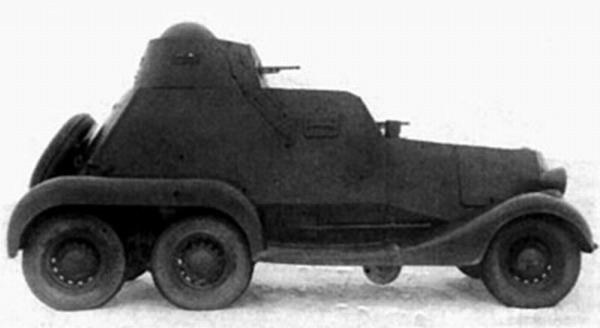
BA-21 prototype, source: Aviarmor.net with permission of the operator, edited
A spare wheel was mounted on the steeply angled rear wall of the cabin. At the rear of the cabin roof sat a rotating turret taken from the older BA-20 armoured car. The turret had a horseshoe-shaped footprint, and the second machine gun was mounted in its front wall. Both machine guns were DT-type weapons of 7.62 mm calibre, with a combined ammunition load of 1,890 rounds carried on board (1,860 is sometimes quoted). The turret machine gun was operated by the commander, who was also stationed there. A circular hatch in the turret roof served for entry and exit, closed by a single-piece heavily domed cover. The commander rotated the turret by hand.
Hull armour thickness ranged from 6 to 11 mm. The vehicle's combat weight was 3,240 kg. The GAZ-M1 four-cylinder engine with a maximum output of 50 hp gave a top speed of 52 km/h. Fuel was stored in two separate tanks — a 40-litre front tank and a 60-litre rear tank — giving a combined road range of around 400 km. External communications were handled by a type 71-TK-1 radio set.
The prototype was tested in February and March 1939. While it showed certain improvements over the older BA-20, these were not significant enough to justify the complexity of switching production from one vehicle to another. The BA-21 was therefore not accepted for series production, and the first example built remained the last. That prototype has incidentally survived to this day and can be seen at the tank museum in Kubinka.
Technical Specifications
Weight |
3.24 t |
Length |
4.22 m |
Width |
1.78 m |
Height |
2.26 m |
Engine |
GAZ-M1 |
Maximum power |
50 hp |
Maximum speed |
52 km/h |
Fuel capacity |
100 l |
Range – road |
400 km |
Armour |
6–11 mm |
Armament |
2 × DT machine gun, 7.62 mm |
Crew |
3 men |

ARTICLE
CONTENTS:
Reproducing text from the Tankist website without the written consent of the operator is prohibited.