BA-20
light armoured car

BA-20M during a military parade, source: Topwar.ru with permission of the operator, edited
Origins of the Vehicle
The BA-20 was a continuation of the Soviet line of armoured cars built on the chassis of mass-produced civilian vehicles. In this case the basis was the GAZ-M1 car chassis, manufactured from 1936 at the factory in Gorky (formerly Nizhny Novgorod). Work on the military version proceeded virtually in parallel with the development of the civilian car, and was handled by the factory in Vyksa, near the aforementioned Gorky. Thanks to this parallel development, the military version of the vehicle — designated BA-20 — was ready for production in the same year as the civilian model, namely 1936.
In its design the BA-20 closely resembled the older FAI armoured cars built on the chassis of the licence-built American Ford. This similarity was a natural consequence of the fact that the civilian GAZ-M1 had itself been developed as a modernised version of those same licence-built Ford vehicles. The BA-20 rode on a two-axle chassis with only the rear axle driven. The wheels were single (i.e. not doubled).
Description of the Design
The chassis was carried over together with the front bumper, mudguards and headlights, giving the vehicle a partly civilian appearance. On this chassis an armoured body was built, welded and riveted from flat plates 6 mm thick on the front, rear and sides, and a mere 4 mm on the roof and floor.

original BA-20 — note the shape of the turret, source: Topwar.ru with permission of the operator, edited
The front of the hull housed the engine compartment, containing the GAZ-M1 four-cylinder engine developing a maximum of 50 hp — also carried over from the original civilian car. The gearbox offered three forward speeds and one reverse. So equipped, the 2.3-tonne BA-20 could reach a top road speed of 90 km/h. The 70-litre fuel tank gave a range of around 350 km. The engine compartment was fully armoured. Air was admitted to the engine through a pair of vertically oriented rectangular openings in the front plate, which could be closed with covers. Service openings fitted with closable covers were also provided on both sides of the engine compartment.
On either side of the engine compartment were the prominent front mudguards already mentioned, which merged smoothly into running boards along the sides of the vehicle, with the rear wheel mudguards continuing behind them. The engine compartment widened towards the rear as it opened into the crew cabin. The cabin's front plate carried two vision ports providing the driver with a view ahead. These ports were fitted with covers that could be closed in dangerous situations, leaving only slits to see through.
The side walls of the cabin featured fairly large rectangular crew entry doors, each also fitted with a vision port with a slitted cover. The doors opened towards the front of the vehicle. The rounded rear wall of the cabin contained a pistol port for firing personal weapons, and below it the spare wheel was mounted, covering a large portion of the wall. On the cabin roof, at its rear, sat a fully rotating turret. The turret had a circular footprint from which only the flat front wall protruded. In the right half of this front wall was the mounting for a DT machine gun of 7.62 mm calibre. A total of 1,386 rounds of ammunition were carried for the machine gun.
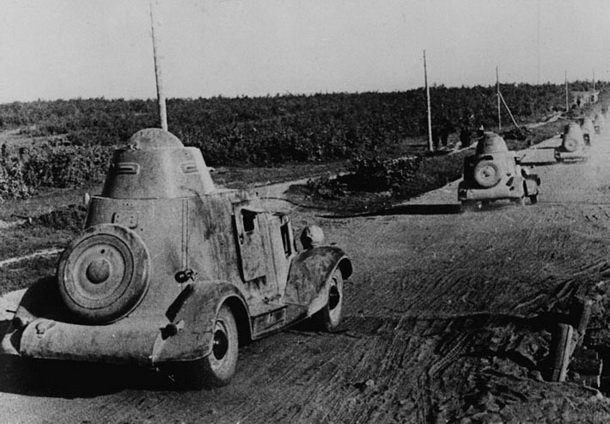
rear of the BA-20M, source: Topwar.ru with permission of the operator, edited
Three slit vision ports were arranged around the circumference of the turret. In its roof was a circular hatch closed by a single-piece domed cover. The dome was intended to provide extra interior headroom and easier operation of the machine gun. The weapon mounting allowed limited traverse of the gun without rotating the entire turret, which was very practical in combat.
The BA-20 was equipped with a standard 71-TK-1 radio set with a range of 15 km for voice communications and up to 30 km when using Morse code. The radio was connected to a large frame antenna which, supported on six brackets, encircled the entire cabin. The crew consisted of two men — the driver and the commander, who also served as the machine gunner and radio operator.
Railway Version
At the end of 1936 a railway version of the armoured car was developed, designated BA-20ZhD. On this variant the standard road wheels could be replaced with steel railway wheels, after which the vehicle could travel on rails for reconnaissance or as an armed escort for military trains. After removal, the road wheels were hung on the sides and rear of the cabin — one on each side and two at the rear. Swapping all four wheels reportedly took the crew no more than 30 minutes. The BA-20ZhD could reach 80 km/h on rails, and thanks to an increased fuel capacity of 100 litres its range grew to 540 km. Weight increased to 2.78 tonnes.
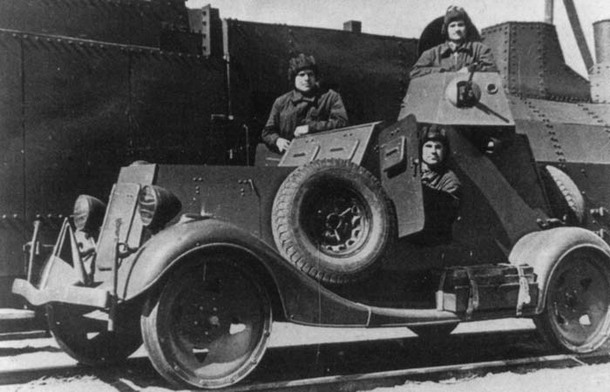
BA-20ZhD railway armoured car, source: Worldwarphotos.info with permission of the operator, edited
Modernised Version
Series production of the BA-20 began in 1936 at Vyksa, with chassis supplied by the Gorky factory. In 1938 a modernised version entered production, designated BA-20M. The most noticeable change was a new turret with conically sloped walls offering better resistance to hits. The BA-20M received a new 71-TK-3 radio set, and a third crew member was added with the specific role of radio operator. The new radios initially continued to use the frame antenna, but later vehicles were fitted with a simpler and more modern whip antenna. The frontal armour of both the hull and turret was also increased from the original 6 mm to 9 mm.
The armament, ammunition load and engine remained unchanged. The fuel capacity was increased to 90 litres, which extended the operational range to approximately 450 km on road and 335 km off-road. The changes added over 200 kg to the vehicle's weight, bringing the total to 2.52 tonnes, and top speed dropped slightly to 85 km/h. The railway BA-20ZhD was also produced in a version based on the BA-20M.
Combat Deployment
The BA-20 saw its combat debut during the Spanish Civil War, where the Soviets sent a number to aid the Spanish Republicans. The type went on to fight against Japanese forces at the Khalkhin-Gol river on the Manchurian- Mongolian border, and also took part in the Winter War against Finland. During that last conflict, 22 of these vehicles fell into Finnish hands and were subsequently taken into Finnish service, where they remained until the armistice with the Soviet Union.
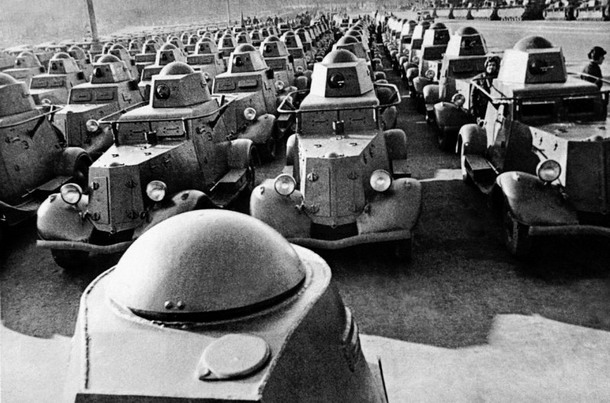
BA-20M during a parade, source: Topwar.ru with permission of the operator, edited
The BA-20 entered the Second World War proper with the Soviet invasion of Poland. Well-known photographs show the crew of a Soviet BA-20M chatting amicably with German tank crew members in a captured Polish town. Less than two years later, however, those same vehicles were fighting against the Wehrmacht advancing across Soviet soil. The Germans captured around a hundred BA-20s of both variants during the fighting in the east and made active use of them in anti-partisan and police units. The original BA-20 received the German captured-equipment designation Panzerspähwagen BA 20 (R), while the modernised BA-20M was designated Panzerspähwagen BA 202 (R).
Every engagement in which the BA-20 took part confirmed its principal weakness — inadequate armour protection. Even some heavy machine guns were capable of penetrating the 6 mm plating, to say nothing of artillery. A further shortcoming was the wheeled chassis, which confined the vehicle to roads and other firm surfaces; its cross-country capability on broken terrain was negligible. The vehicle's designers had envisaged its use primarily to the west of the Soviet border, in territories with good road networks. However, the Germans and their Operation Barbarossa in June 1941 firmly determined that Soviet military equipment would be fighting on Soviet soil — where both the quality and density of roads fell far short of western standards.
Production of the BA-20 and BA-20M continued until 1941, with a combined total of 2,013 vehicles of both variants built.
Technical Specifications
|
BA-20 |
BA-20M |
Weight |
2.3 t |
2.52 t |
Length |
4.3 m |
4.3 m |
Width |
1.8 m |
1.8 m |
Height |
2.3 m |
2.3 m |
Engine |
GAZ-M1 |
GAZ-M1 |
Maximum power |
50 hp |
50 hp |
Maximum speed |
90 km/h |
85 km/h |
Fuel capacity |
70 l |
90 l |
Range – road |
350 km |
450 km |
Range – off-road |
270 km |
335 km |
Armour |
4–6 mm |
4–9 mm |
Armament |
1 × DT machine gun, 7.62 mm |
1 × DT machine gun, 7.62 mm |
Crew |
2 men |
3 men |

ARTICLE
CONTENTS:
Reproducing text from the Tankist website without the written consent of the operator is prohibited.