FAI
"Ford A Izhorskiy"
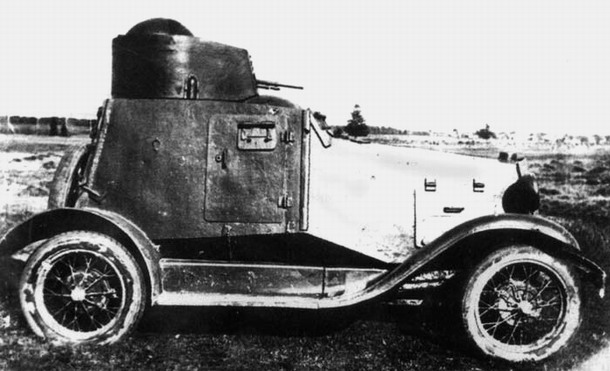
Armoured car FAI, source: Aviarmor.net with permission of the operator, edited
Origins of the Vehicle
The FAI armoured car was one of the indirect results of Soviet cooperation with the American Ford Motor Company. On 31 May 1929, under an agreement between Ford and the Soviet government, the import of components for licensed series production of the Ford A passenger car began. Assembly from imported parts gradually gave way to full domestic manufacture, and before long the Red Army took an interest in the chassis for use in an armoured car. Acting on a military requirement, the Izhora plant developed the D-8 and D-12 between 1930 and 1931. These ultimately failed to meet expectations, however, and development was to continue. The main improvement over the older vehicles was to be the installation of the armament in a rotating turret.
Design and Construction
The new armoured car that emerged from this development received the straightforward designation Ford A Izhorskiy, abbreviated to FAI. The chassis was taken over unchanged from the civilian Ford. The vehicle thus rode on four wire-spoked wheels sprung by leaf springs, with only the rear pair driven. The wheels were protected by pressed steel mudguards carried over with the chassis. Much like the earlier D-8 and D-12, the FAI featured a very simply constructed hull welded from flat steel plates. These were 6 mm thick on all sides except the roof and floor, where 4 mm plate was used. The FAI's hull was overall larger than that of either of its predecessors. The armour values make it clear that protection was effective only against small arms fire and light shell fragments — not an ideal situation, but the load-bearing capacity of the automotive chassis simply did not permit greater weight and therefore heavier armour.
At the front was the engine compartment, housing a GAZ-A petrol engine with a displacement of 3,280 cc and a maximum output of 42 horsepower. The gearbox offered only two forward speeds and one reverse (though some sources cite four forward gears). Given this, the vehicle's top speed of 80 km/h was surprisingly high. The fuel tank held 40 litres, giving a road range of up to 200 km and approximately 160 km across light terrain. Operation in heavier off-road conditions was practically out of the question given the vehicle's construction. The engine compartment was fully armoured. Air intake was provided by a pair of rectangular openings in the front mask, which could be closed with covers. Service access panels on both sides of the engine compartment were likewise protected by closeable covers.
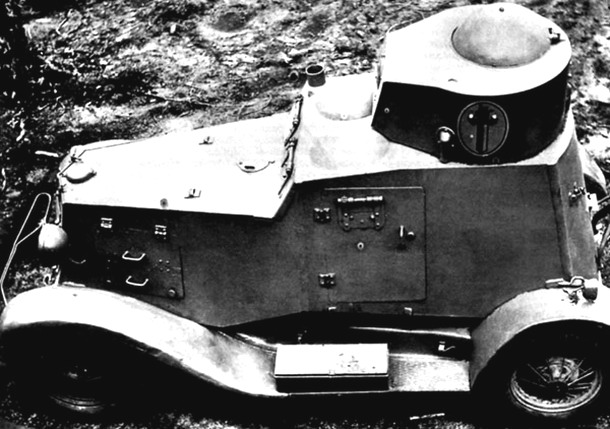
Armoured car FAI, source: Aviarmor.net with permission of the operator, edited
The engine compartment widened and rose towards the rear, transitioning into the crew compartment. Behind the angled front wall of the cabin the roofline continued to rise gently, and at this point two spherical bulges protruded from it — their purpose being to increase headroom for the crew seated below. The crew consisted of two men, a driver and a commander. Under normal conditions both sat side by side beneath these bulges, looking out through rectangular vision ports in the front wall. In the event of danger, each port could be closed with a single-piece cover, after which the only means of observation was the narrow slit in the cover. The commander also served as the machine gunner and loader.
Further to the rear the cabin roof was flat and carried the rotating turret, which housed the vehicle's sole integral armament. The side and rear walls of the turret were rounded, giving it a horseshoe-shaped floor plan. The front face of the turret was flat and slightly angled, with the machine gun embrasure positioned in its right-hand section. The machine gun was of the DT type, calibre 7.62 mm, and 1,323 rounds were carried on board. The gun mount allowed 10° of lateral traverse in each direction without rotating the turret — a very practical feature. In the turret roof was a circular hatch covered by a prominently domed single-piece cover that opened rearward, the dome being designed to give the commander sufficient working space beneath it when operating the machine gun.
In addition to the turret roof hatch, the crew could also enter and exit through large rectangular doors on each side of the cabin. These opened towards the front of the vehicle and were fitted with rectangular side-facing vision ports, likewise closeable, their covers equipped with observation slits. Slits were also present on both sides and on the rear wall of the turret. A final vision port was located in the right-hand section of the cabin's rear wall; this too was closeable, though unlike the others its cover had no observation slit.
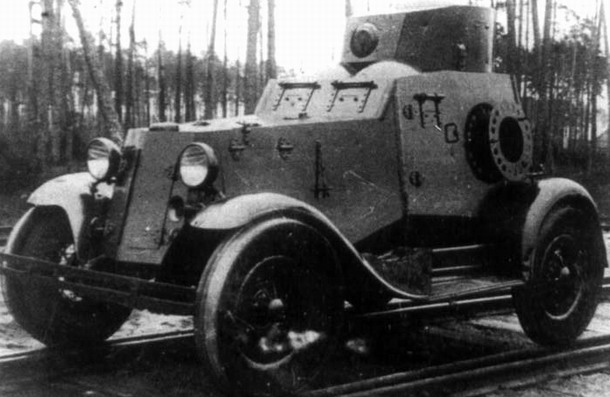
Rail-going armoured car FAI-ZhD, source: Aviarmor.net with permission of the operator, edited
The rear wall of the hull was nearly vertical and rounded. Most of its surface was typically covered by the mounted spare wheel. Headlights were placed on the front mudguards. Between the front and rear mudguards ran a running board connecting the two — much as on civilian passenger cars of the period — and on each side of this board a tool and equipment box was mounted.
Rail-Going Variant
Series production of the FAI began in 1933 and ran until 1936, during which time a total of 676 of these armoured cars were produced. In 1935 a variant adapted for operation on railway tracks appeared, designated the FAI-ZhD. Although some sources state that the standard road wheels were removed and replaced with solid metal wheels for rail running, photographs of the vehicle suggest a different system. The photos indicate that metal flanged rims were simply fitted over the existing pneumatic tyres to guide the vehicle along the rails. Exactly how these rims were secured to prevent them slipping off is not apparent from the images. When travelling on roads, the metal rims were stowed on the sides of the cabin.
On rails, the vehicle could reach a speed of up to 86 km/h, though in reverse only around 24 km/h. The FAI-ZhD's role was to conduct reconnaissance ahead of armoured trains. A significant handicap in this role, however, was the absence of a radio for communication with the train — which may well explain why only a handful of these vehicles were ever built.
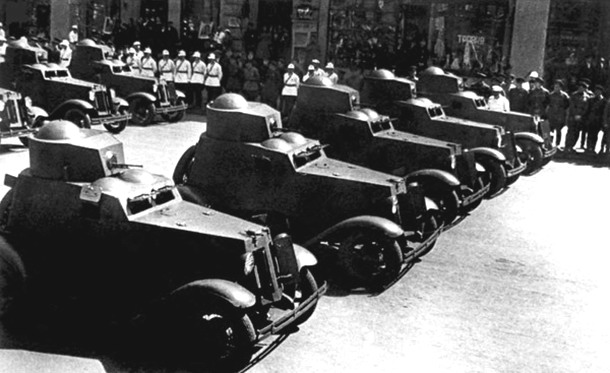
FAI armoured cars at a parade, source: Aviarmor.net with permission of the operator, edited
The Upgraded FAI-M
In 1938 production began of an upgraded variant designated the FAI-M. The vehicle had a lengthened chassis and newly designed solid-construction wheels. The hull design was also revised: the transitional angled section with the two domed bulges disappeared from the cabin roof, which was now flat along its entire length. The cabin side walls were straight, unlike the original FAI which had an angled profile. The cabin itself was roughly the same length as in the earlier version, but a low extension was added at the rear. This extension provided space for a larger fuel tank, and the spare wheel was relocated to the extended rear as well.
As already mentioned, the FAI-M's fuel capacity grew — to 60 litres. A new powerplant was also fitted, the GAZ-M1 producing 50 horsepower, paired with a gearbox offering three forward speeds and one reverse. Armour thickness and overall weight remained unchanged, but both the range and top speed increased, the latter now reaching up to 90 km/h. Approximately 350 FAI-M vehicles were produced.
Combat Deployment
The FAI and FAI-M saw their combat debut in Spain during the Civil War. They subsequently fought in the Far East against the Japanese, alongside the Wehrmacht in Poland, and against the Finns during the Winter War. As historical photographs confirm, the Finns captured several of these vehicles and went on to use them themselves. The FAI and FAI-M also took part in the fighting against the Germans in the early stages of Operation Barbarossa, where their obsolescence and inadequacy became fully apparent and the vehicles began to be withdrawn from front-line combat duties.

Armoured car FAI-M in Finnish Army service, source: Aviarmor.net with permission of the operator, edited
The FAI suffered from several fundamental shortcomings. The chassis design restricted the vehicle to roads and light firm terrain. The armour offered protection only against small arms fire and light fragments, and the armament likewise limited it to engagements with infantry. Given that the vehicle's primary role was reconnaissance, the absence of a radio set was a further significant disadvantage.
Technical Specifications
|
FAI |
FAI-M |
Weight |
2.0 t |
2.28 t |
Length |
3.75 m |
4.31 m |
Width |
1.68 m |
1.75 m |
Height |
2.24 m |
2.24 m |
Engine |
GAZ-A |
GAZ-M1 |
Max. power |
42 hp |
50 hp |
Top speed |
80 km/h |
90 km/h |
Fuel capacity |
40 l |
60 l |
Road range |
200 km |
315 km |
Off-road range |
160 km |
250 km |
Turret armour |
6 mm |
6 mm |
Hull armour |
6 mm |
6 mm |
Armament |
1 x DT machine gun 7.62 mm |
1 x DT machine gun 7.62 mm |
Crew |
2 men |
2 men |

ARTICLE
CONTENTS:
Reproducing text from the Tankist website without the written consent of the operator is prohibited.