CAPTURED TANKS
don't look a gift horse in the mouth — unless it's a tank
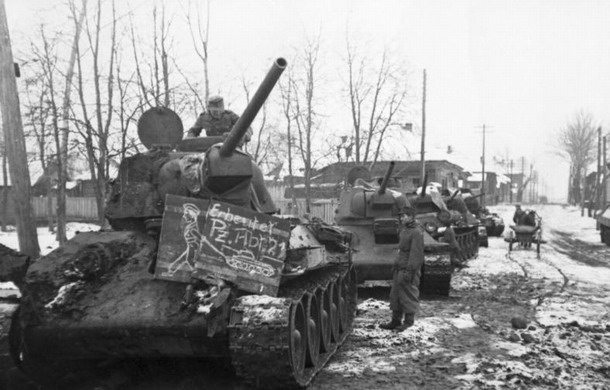
captured Soviet T-34 tanks; note the sign on which the soldiers proudly display their achievement: Erbeutet Pz.Abt.21, source: Bundesarchiv_Bild_101I-277-0836-04,_Russland, Wikimedia, Creative Commons, edited
The German army made use of captured enemy equipment on both fronts and at every stage of the war — and not only tanks. The largest and most significant haul, acquired moreover without a fight or any losses, was the confiscated Czechoslovak tanks LT vz. 35 and LT vz. 38. After occupying Czechoslovakia, the Germans took over more than 370 of these tanks into their own inventory under the new designations PzKpfw 35(t) and PzKpfw 38(t) respectively.
After the outbreak of war, the Germans continued to capture serviceable enemy equipment in relatively large numbers during their lightning campaigns — in Western Europe thanks to the capitulations of entire national armies, and in Russia thanks to the vast encirclements in which whole Soviet armies surrendered.
These so-called Beute Panzerkampfwagen (Beute meaning "booty" or "spoils") were gathered together for inspection by German technical personnel, who then decided their fate. Vehicles selected for direct use were, wherever possible, transported back to their original manufacturers' factories. There, the necessary modifications were carried out — and repairs where needed — the camouflage scheme and national markings were changed, and the vehicles were put into service. Among the most frequently performed modifications were the fitting of German radio sets and the installation of German-style commander's cupolas.
Within the German army there were units equipped exclusively with captured equipment — for example, the 7th SS Volunteer Mountain Division Prinz Eugen, which operated in the Balkans. The Deutsche Afrikakorps also became well known as prolific users of captured vehicles; records show that at times the proportion of enemy equipment in their inventory actually exceeded their German-built holdings.
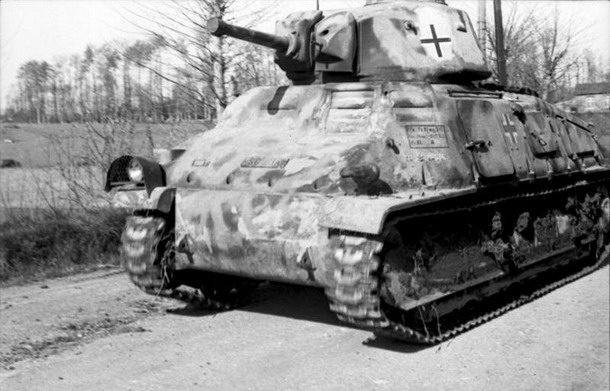
in France the Wehrmacht captured hundreds of tanks, among them the Somua S-35, which was subsequently taken into service under the designation Panzerkampfwagen 35S 739(f), source: Bundesarchiv_Bild_101I-300-1858-35A, Wikimedia, Creative Commons, edited
The most common practice, however, was the conversion of captured tanks into carriers for various weapons systems and into support vehicles of all kinds. Given the large numbers of captured equipment available in the early phases of the war, such systematic conversion was both feasible and worthwhile. Captured vehicles were combined with German-built and other captured equipment. While such conversions naturally carried costs that could not be argued away, they were still far cheaper than manufacturing new vehicles from scratch.
Vehicles that did not meet German requirements were used at least for "policing" duties in occupied territories, or as training vehicles for new crews, as cargo tractors, or even as target practice during live-fire exercises. Some were also handed over to Germany's allies — the Romanians, Slovaks, and others.
A specific designation system was introduced for captured equipment in German service. Vehicles were classified by type into seven groups (tanks, armoured cars, self-propelled guns, half-tracks, etc.), and each group was assigned a serial number range. After the vehicle's name, a number from this system was given, followed by a letter indicating the previous operator of the vehicle — not the manufacturer (r = Russland/Russia, a = Amerika, p = Polen/Poland, and so on). The T-34 in German service, for example, received the designation Panzerkampfwagen T-34 747(r) under this system.
After the easy windfall of Czechoslovak tanks, Polish booty followed in 1939. From the vehicles of the Polish army, the Germans adopted in particular the light tank 7 TP, which entered service under the designation PzKpfw 7TP 731(p).

more French booty: Hotchkiss 38H tanks pressed into service under the designation Panzerkampfwagen 39H 735(f), source: Bundesarchiv_Bild_101I-300-1858-33A, Wikimedia, Creative Commons, edited
The fall of France in 1940 brought the Wehrmacht a genuine windfall. The tanks and other vehicles captured there were counted in the hundreds — light and medium tanks such as the Renault R-35, R-39 and R-40, the Somua S-35, the Hotchkiss H-35, H-38/H-39, and heavy tanks including the Char B. The letter assigned to French captured equipment was naturally (f). The full designation of a French captured tank then looked, for example, like this: PzKpfw 35R 734(f) or PzKpfw FCM 737(f).
The captured equipment from France was also used in unprecedented quantities for the conversions already mentioned — into self-propelled guns, tank destroyers, and other specialised vehicles. A large proportion of these subsequently became the equipment of the newly formed and enormous formation known as Schnelle Brigade West.
In France, however, the Germans also got their hands on substantial quantities of British equipment left behind by the hastily evacuated expeditionary forces. The Wehrmacht's collection of British vehicles was then supplemented during the fighting in North Africa. Apart from various light tanks, the most notable captures included the Crusader, Valentine, and Matilda.
In North Africa the Germans also captured smaller quantities of American combat vehicles, chiefly the light tank M3 Stuart and the medium tank M3 General Lee. After the Allied landings in Normandy in 1944, further American vehicles fell into German hands, most notably the medium tank M4 Sherman. The new German designation for the latter was PzKpfw M4 748(a).
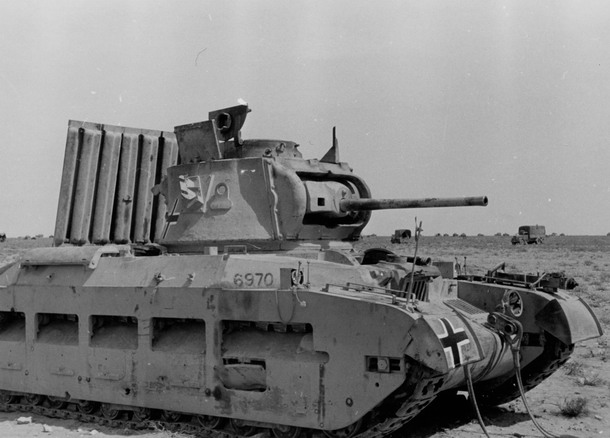
this captured British Matilda II was put into German service and subsequently knocked out by its original owners, source: Flickr.com, Public domain, edited
After the forced occupation of Italy — formerly an ally — seized Italian vehicles were also added to the tally of captured equipment. These included primarily the tanks Carro Armato M.11, M.13, and M.14 and the Fiat Ansaldo L.3. The letter assigned to these vehicles was of course (i). The Italian vehicles, being of rather modest quality, saw only limited use, mainly with reserve and security units.
The Eastern Front became an entirely distinctive environment for the use of captured equipment. In the opening months of Operation Barbarossa, enormous quantities of every conceivable type of Soviet equipment fell into German hands — most notably the light tanks T-26, T-40, and BT-2, along with considerable numbers of medium T-34s and heavy KV-1s. The situation in the Soviet Union was, however, different from the Western Front. Fighting on the Eastern Front was continuous, and deploying the enemy's own tanks carried a constant risk of misidentification and friendly fire.
Captured Soviet tanks were therefore very frequently used for purposes other than those for which tanks are intended. They served as the basis for various conversions, as cargo tractors, and as recovery vehicles.
The most celebrated tank of its day — and the greatest rival to Germany's own armour — and therefore logically the most prized capture of all, was undoubtedly the Soviet T-34. It was the most advanced tank of its time; in 1941 it had no equal in any other army, and it came as a very unpleasant surprise to the Germans.
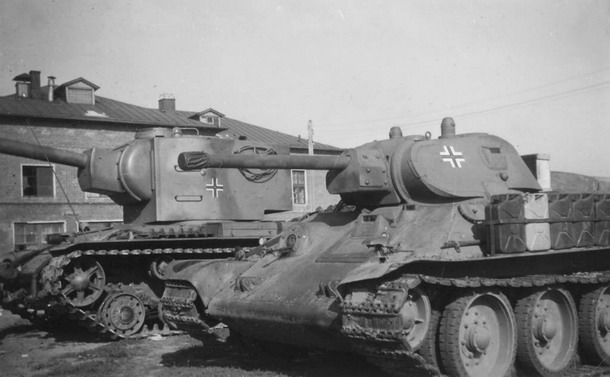
captured KV-2 and T-34 tanks; note that the KV-2 has even been fitted with a German commander's cupola, source: Flickr.com with permission of the publishing user, edited
During the Western campaigns the German army had certainly encountered qualitatively comparable enemy tanks, but never in numbers large enough to threaten the advance of the German armoured formations. The Eastern Front and the T-34, KV-1, and KV-2 changed all that. Not only was the numerical superiority of Soviet armour absolutely overwhelming, but this was also a qualitatively new kind of opponent.
That the German tank armies continued to advance on the Eastern Front in spite of this reality was due to German air superiority and, above all, to the greater experience of German crews and their mastery of armoured tactics. Even so, it was clear from the first large-scale engagements with the T-34 that Germany was for the first time in the war beginning to lose the upper hand on the armoured battlefield.
The T-34 was by no means a technically perfect machine. Veterans recall, for instance, that the driver sometimes had to use a hammer to change gears. Its qualitative superiority over German tanks lay less in its mechanical sophistication than in its passive protection — and specifically in the brilliantly simple concept of sloped armour. The T-34 had sloped plates not only on the front, but on all surfaces including the turret walls. The only flat surface on which a German shell could strike at anything close to a right angle were the sides of the hull. These, however — unlike those of German tanks — were largely shielded by the large road wheels, which acted as additional protection and prevented shells from penetrating the vehicle.
At the time of the first encounters with the T-34, German tanks were without exception armed with short-barrelled guns of relatively low muzzle velocity, which were incapable of penetrating the opponent's sloped armour except at suicidally close range.
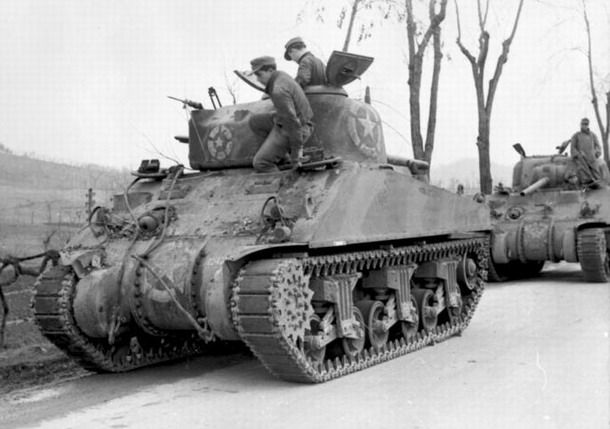
these captured American Shermans are still awaiting repainting with German markings, source: Bundesarchiv_Bild_101I-311-0944-07, Wikimedia, Creative Commons, edited
The first captured T-34s appeared in German service as early as the summer of 1941. Crews of captured tanks marked their vehicles with prominent beam crosses or swastika crosses to make their allegiance to the German army clearly visible. Even so, occasional identification problems persisted, since most gunners were accustomed to orienting themselves on the battlefield by vehicle silhouette rather than by markings.
On the turret hatches, crews painted very prominent swastika crosses for the benefit of the Luftwaffe. The high value the Germans placed on their captured T-34s is further demonstrated by the fact that they repaired and maintained them for long-term use — after all, finding spare parts for a T-34 on the Russian battlefield was no problem whatsoever. Turrets from tanks that were beyond repair were subsequently used in static fortifications or mounted on armoured trains.
The majority of T-34s captured by the Germans were of the T-34/76 variant, armed with the 76.2 mm gun, while captured T-34/85s were relatively rare. The reason is obvious: the more modern T-34/85, with its 85 mm gun, did not appear on the battlefields until late 1943, by which time the German armies were in retreat — more likely to be abandoning equipment than capturing new enemy vehicles.
Reproducing text from the Panzernet website without the written consent of the operator is prohibited.