4,7 cm Pak 188 auf BREN
a tank destroyer built from whatever was at hand
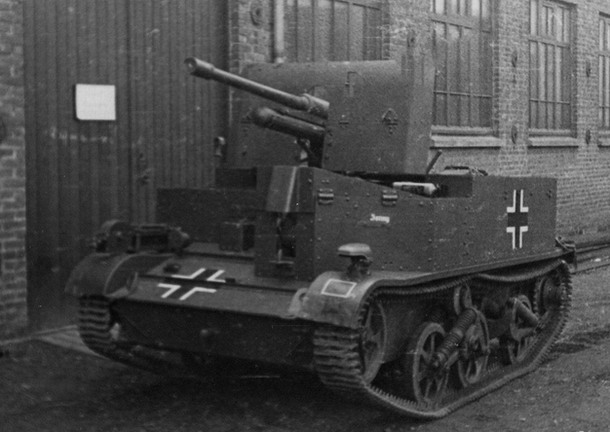
Improvised tank destroyer: 4.7 cm Pak 188 (h) auf Selbstfahrlafette Bren (e). Source: Flickr.com, with the permission of the publishing user, edited.
The Universal Carrier
The British Universal Carrier proved that it truly deserved its "universal" name time and again – not only in the service of its country of origin, but also on the other side of the wire, in the hands of the German Wehrmacht. Most of the Universal Carriers that fell into German hands were left behind in France by the evacuated British Expeditionary Force. The German Army put them to use not only in their original role of transporting infantry and supplies, but also as the basis for several different variants of improvised self-propelled guns. The following pages introduce the variant armed with the 47 mm Böhler anti-tank gun.
The standard troop-carrier version of the vehicle received the German designation Gepanzerter MG-Träger Bren 731 (e). For reasons of their own, the Germans did not use the official British designation Universal Carrier but based their name on the unofficial "Bren Carrier" – a term sometimes applied to the British vehicle because its primary weapon was usually the Bren light machine gun. The modified version intended to carry an artillery piece was then designated Selbstfahrlafette Bren (e), or Selbstfahrlafette Bren-Carrier (e).
Conversion to a Tank Destroyer
Unfortunately, little detail is available about the conversion of the carrier into a mount for the 47 mm anti-tank gun. The precise period in which these conversions were made is unknown, as is the number of vehicles built. Some authors attribute the conversions to the well-known Baukommando Becker, though this is most likely incorrect. To be frank, the conversion of the carrier into a tank destroyer was so elementary that any small workshop could have managed it – no complex factory-level machinery was needed. It was essentially an assembly of existing components. The two principal elements were of course the Universal Carrier and the Böhler Model 1935 47 mm gun. A third conspicuous element was the gun shield, which can be seen in photographs in at least three different configurations – but more on that shortly.
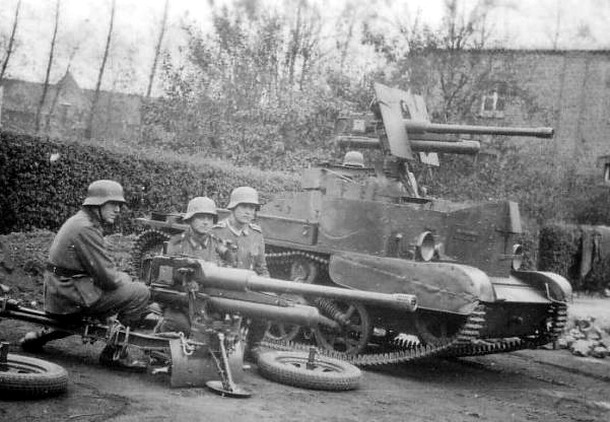
Most likely a trial installation of the 47 mm Böhler Model 1935 gun on a Universal Carrier with part of its armour removed. Source: Flickr.com, with the permission of the publishing user, edited.
With the Universal Carrier, the improvised tank destroyer (or self-propelled anti-tank gun, if you prefer) gained a chassis with three road wheels on each side, sprung by coil springs. At the front was a spoked idler wheel and at the rear a solid toothed drive sprocket. Roughly in the middle sat a single return roller supporting the upper run of the track. Power came from a Ford V-8 air-cooled eight-cylinder petrol engine of 3.6 litres displacement, producing 85 horsepower at 3,500 rpm. The vehicle's weight was most likely around 4.5 tonnes and its top speed probably similar to that of a standard Universal Carrier – approximately 48 km/h. The fuel tank held 91 litres, sufficient for a road range of around 250 km.
The Pak 188 (h) Gun
Let us look a little more closely at the vehicle's main armament: the Böhler Model 1935 gun. Although of Austrian manufacture, the Germans acquired it as booty from the defeated Dutch Army. The Netherlands had purchased somewhere between 370 and 380 examples of this anti-tank gun between 1937 and 1940. How many fell into Wehrmacht hands after the Dutch capitulation is unknown, but the number was certainly not negligible. The Böhler Model 1935 was a solidly effective weapon for its time. Its 1.44 kg anti-tank round left the barrel at approximately 630 m/s (660 m/s is also quoted) and at 500 metres could penetrate armour up to 43 mm thick (though some authors give only 35 mm) – more than enough for all German tank types of the period, with the exception of the latest variant of the Panzer IV, the Ausf. D, whose hull had 60 mm of frontal armour. A trained crew could fire up to 15 aimed rounds per minute. In German service the weapon received the designation Pak 188 (h).
The original Austrian weapon apparently came with a shield angled at 45 degrees, which the Dutch soldiers found unsatisfactory and therefore did not use. Indeed, in all available photographs the gun is seen without any shield (e.g. HERE). For the self-propelled version, however, the Germans did want some form of shield and apparently tried several – at least, photographs show shields in at least three distinct configurations. One series of images shows a single vehicle fitted with only a small flat gun shield, and with the side and rear armour of the fighting compartment removed. It is quite possible that this was only an initial test prototype, a suggestion supported by the fact that the vehicle still retains its original British headlights rather than the German Notek blackout light (photos HERE and HERE).
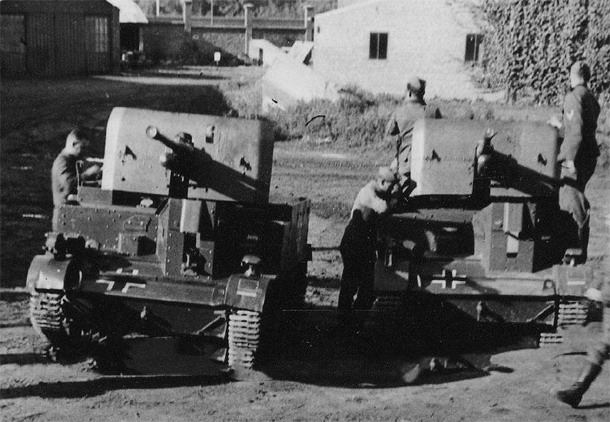
4.7 cm Pak 188 (h) auf Selbstfahrlafette Bren (e). Source: Flickr.com, with the permission of the publishing user, edited.
The standard configuration used a considerably larger shield taken from the captured British QF 2-pounder gun. This shield first had to be trimmed slightly at the bottom to fit the new weapon, and the barrel cutout extended further upward. The third of the three documented shield variants had large cutouts at the bottom on both sides, leaving very little of the original shield material in place (photo HERE). In this last case, it may simply have been an improvisation made by a particular crew.
The tank destroyer described here was most likely designated 4.7 cm Pak 188 (h) auf Selbstfahrlafette Bren (e). The sources unfortunately do not make clear which unit operated these vehicles or in which area they served, though France seems a reasonable assumption. Details of their actual combat use are equally scarce, but according to some sources they did see action – in 1944, against Allied forces on the Western Front.

ARTICLE
CONTENTS:
Reproducing text from the Panzernet website without the written consent of the operator is prohibited.