3,7 cm Pak 36 auf BREN
improvised tank destroyer
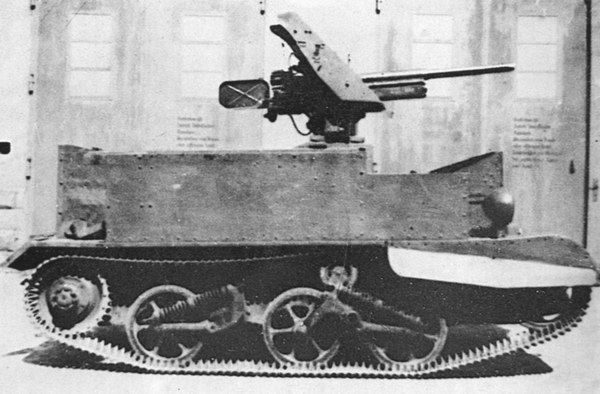
Improvised mounting of the 3.7 cm PaK 36 on a British Universal Carrier chassis. Source: Flickr.com, with the permission of the publishing user, edited.
The vehicle described on the following lines was produced in only very small numbers – most likely just a handful of examples – as an improvised field conversion. Its basis was the British Universal Carrier light tracked vehicle, of which the Germans captured a considerable number in France in 1940, with further examples taken later in North Africa. This small tracked vehicle soon proved capable of carrying not only troops and supplies but also lighter artillery pieces, and the Germans produced several different weapon-carrier conversions of the Universal Carrier under their own management. Among these was a variant armed with the 37 mm Pak 36 anti-tank gun. Regrettably, little is known about the circumstances of its creation, though we can say with reasonable confidence what the basic characteristics of its two main components – the chassis and the gun – were.
The standard British Universal Carrier had three road wheels on each side, sprung by coil springs. At the front was a spoked idler wheel and at the rear a solid toothed drive sprocket. Roughly in the middle sat a single return roller supporting the upper run of the track. Power came from a Ford V-8 air-cooled eight-cylinder petrol engine of 3.6 litres displacement, producing 85 horsepower at 3,500 rpm. The vehicle had light armour of 7 to 10 mm, weighed 3.2 tonnes and had a top speed of approximately 48 km/h. As a vehicle of British origin, the driver sat on the right, with a gunner to his left who could fire a machine gun through a port in the front armour. All of the above applied equally to the Universal Carrier in German service, except that the original Bren machine gun was replaced by a German MG 42, and the vehicle's designation was changed to Gepanzerter MG-Träger Bren 731 (e).
As part of the conversion in question, a Pak 36 anti-tank gun – developed by Rheinmetall in the mid-1930s – was installed in the vehicle's cargo area. By 1940 this weapon was already past its prime, yet the German Army still had to rely on it heavily because more powerful anti-tank guns were not available in sufficient numbers. With standard armour-piercing ammunition, the Pak 36 could penetrate 36 mm of sloped armour at 500 metres, and with tungsten-core rounds it could defeat armour up to 40 mm thick. The gun was also very light, making it an ideal choice for improvised self-propelled mountings of this kind.
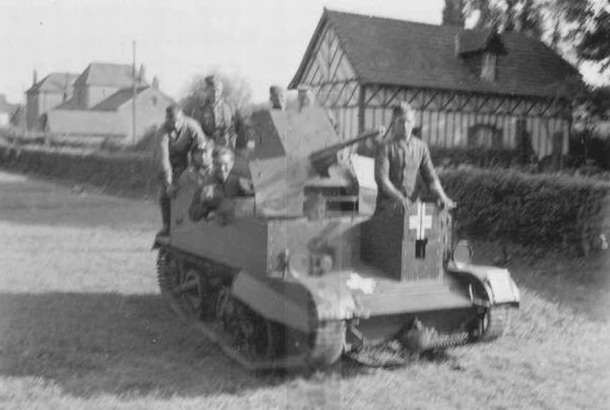
3.7 cm PaK 36 auf Selbstfahrlafette Bren(e). Source: worldwarphotos.info, with the permission of the site operator, edited.
From the few known photographs, the vehicle appears to have existed in at least three variants. One image (heavily retouched) shows a version in which the armour of the cargo area was replaced by a simple wooden frame, presumably to save weight. A second variant retains the original armour and has the gun fitted with its standard shield. A third documented configuration also has two additional pieces of armour placed forward of the gun shield itself – though these may simply have been added later to the same vehicle that was previously photographed without them. The conversion was most likely carried out in a field workshop of some kind. Exactly when and by which unit remains unknown. One reasonably plausible suggestion is that it was a unit stationed in France, since an improvised fighting vehicle of this sort would have been better suited to rear-area guard duties than to the front line, and the half-timbered building visible in the background of one surviving photograph is consistent with a French setting – though this is speculation.

Reproducing text from the Panzernet website without the written consent of the operator is prohibited.