PANZERFÄHRE
an amphibious vehicle for the invasion of Britain
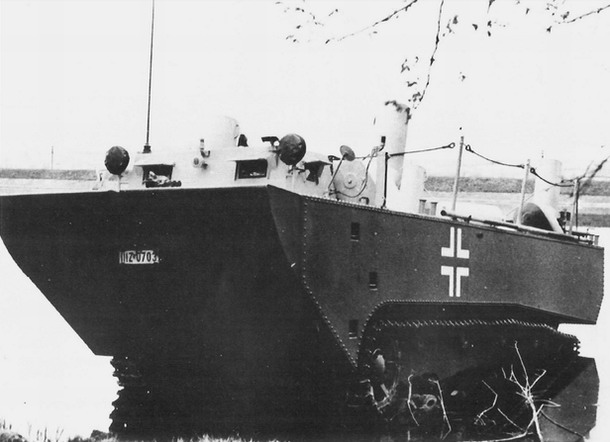
the amphibious tractor gepanzerte Landwasserschlepper, also known as LWS-II, shown here after the first round of modifications — it therefore has the folding air intake and exhaust stacks, source: Flickr.com with the permission of the publishing user, edited
An armoured amphibious vehicle
As early as May 1935, the German Army Weapons Office issued a specification for the development of a specialised amphibious transporter intended for a landing operation on the British Isles. Development work ran from spring 1936 until 1940, when the first four prototypes were completed. The vehicle received the designation Landwasserschlepper — literally "land and water tractor". Already during its development it became clear that the vehicle would be too complex and expensive for series production. The soldiers themselves also criticised the fact that it had no armour whatsoever, offering its crew and the troops it carried no protection even against the lightest enemy fire. The Weapons Office therefore decided to initiate the development of a second, more modern version of the amphibious vehicle, one that would make greater use of existing components — making it cheaper to produce — and would also be at least lightly armoured.
On 19 April 1941, the Weapons Office commissioned the development of the described vehicle from Klöckner-Humboldt-Deutz AG, which had incorporated the Magirus company since 1936. A number of other firms also became involved in the development of the vehicle, which received the designation Landwasserschlepper II (abbreviated LWS-II), including Maybach, Zahnradfabrik, Kässbohrer, Krupp, and even the shipyard Bodan Werft Metallbau. In addition to LWS-II, the new amphibious vehicle was apparently also referred to as gepanzerte Landwasserschlepper. The first design drawings of the vehicle were completed on 1 July 1941.
The overall concept of the new vehicle differed considerably from its unarmoured predecessor. While the original LWS had an internal space for carrying troops, the new LWS-II had nothing of the sort. It was substantially smaller overall than its predecessor, primarily in order to reduce its total weight. Adding armour to the hull walls meant a significant amount of additional weight, which was of course highly undesirable for an amphibious vehicle. Although the LWS-II was 0.75 metres shorter, 0.2 metres narrower and 0.65 metres lower than the original LWS, it was nonetheless 2 tonnes heavier — possibly even 4 tonnes heavier, if one accepts the lower weight figure for the older LWS cited by some authors. The older unarmoured LWS was designed to tow a cargo trailer behind it. The new LWS-II was instead conceived to operate with a cargo pontoon positioned in the middle, between two tractors. This combined assembly was referred to as the Panzerfähre — literally "armoured ferry".
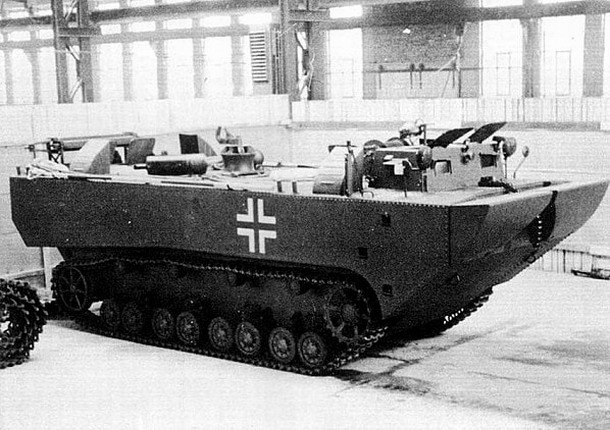
early-production LWS-II; the air vents are protected only by raised "dormers", source: Flickr.com with the permission of the publishing user, edited
Vehicle description
To simplify and reduce the cost of development, the running gear of the Panzer IV tank — specifically its latest Ausf. F variant — was used as the basis for the new amphibious vehicle. The track system of the LWS-II therefore consisted of eight road wheels on each side, 470 mm in diameter, with rubber-tyred rims for a smoother ride. The wheels were doubled, and the guide teeth of the 400 mm wide track passed through the gap between the two wheel discs. The road wheels were suspended in pairs, each pair sprung by a shared quarter-elliptical leaf spring. The upper run of the track was supported by four return rollers. At the very front was a toothed drive sprocket and at the rear a spoked idler wheel.
Resting on the running gear was a hull of considerably simpler shape than that of the first-generation LWS. The hull consisted of an inner load-bearing frame welded from steel L- and T-sections, to which the individual armour plates — 14.5 mm thick — were attached by riveting. Armour of this thickness provided protection against armour-piercing rifle and machine-gun rounds of 7.92 mm calibre at a range of 30 metres or more. At the front of the hull, on the vehicle's centreline, the gearbox was installed, with the engine directly behind it — both taken from the Panzer IV tank. The engine was therefore the Maybach HL120TRM developing 300 horsepower, and the gearbox was the Zahnradfabrik SSG 76 with six forward speeds and one reverse. At the rear of the engine, a second smaller transfer gearbox connected it to the propeller (photo HERE). Two large fans were connected to the engine's radiator and expelled the heated air through vents in the hull roof.
The hull's side walls were vertical. The bow was formed by two removable floats. The purpose of this arrangement was most likely to reduce the risk of the bow being pierced and the entire hull flooding — which would have caused the vehicle to sink. During a contested landing it could reasonably be expected that the invasion beach would quickly become strewn with debris and obstacles into which the Landwasserschlepper would collide while approaching through the water. If the armour were pierced in such a collision, water would flood only the replaceable float, without entering the hull itself. The floats could thus be thought of as a kind of frontal "crumple zone". Rising from the flat hull roof at the front was a slightly raised crew cabin, with two vision ports in the front wall, two in the side walls, and two entry hatches in the roof.
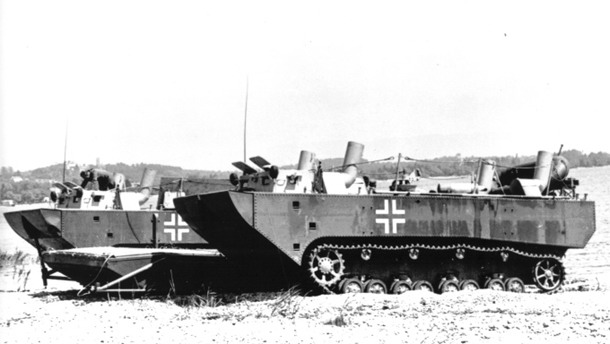
a pair of LWS-II tractors with the pontoon between them formed the so-called Panzerfähre; shown here are again vehicles after the first round of modifications, fitted with the four folding stacks, source: Flickr.com with the permission of the publishing user, edited
Immediately behind the raised cabin, two "dormer"-like structures on the hull roof served as air intake vents for the engine compartment. Two further similar dormers for expelling the engine's warm air were located at the rear of the roof. Also on the hull roof were two exhaust pipes with large silencers, four entry and exit hatches, a circular access hatch for servicing the engine and gearbox, and a rope winch positioned directly in the centre. At the very stern of the hull roof, the components of a simple hand-operated crane were stowed. Using this crane, the crew of one LWS-II could provide maintenance support to the other LWS-II, as is nicely demonstrated in the photograph HERE. The winch already mentioned was used for hoisting loads with the crane.
Propulsion during waterborne travel was provided by a propeller located at the stern of the hull. Interestingly, the LWS-II had no rudder, and steering in the water was achieved by running or stopping one of the tracks. Sources give no further details on this steering method, but even a layman might reasonably suspect it was not particularly effective — for at least two reasons. First, the vehicle used standard tracks taken from the Panzer IV tank, naturally designed primarily for travel on land. Their links therefore had no additional protrusions to improve their "grip" in water. Second, during waterborne travel the entire track assembly was submerged, including the upper run of the track, which moved in the opposite direction to the lower run. So while the lower track was driving forwards, the upper track was effectively working against it and driving backwards. It is true that the upper track was more sheltered under the hull, so its steering effect was smaller than that of the lower run, but it certainly influenced steering to some degree. In any case, the propulsion system used for waterborne travel makes it clear that the vehicle's final drives had to allow the propeller and the tracks to operate simultaneously.
The cargo pontoon positioned between the two tractors had a payload capacity of 24 tonnes — enough to carry a Panzer IV tank. The pontoon was attached to both tractors by four chains, two at the front and two at the rear. The tank or other vehicle being transported had to drive onto the pontoon while it was already in the water, so a suitable boarding point on the bank had to be identified in advance. Before the pontoon was attached, two vertically mounted protective rails were installed on the adjacent side of each tractor to prevent the pontoon from damaging the hull (photo HERE).
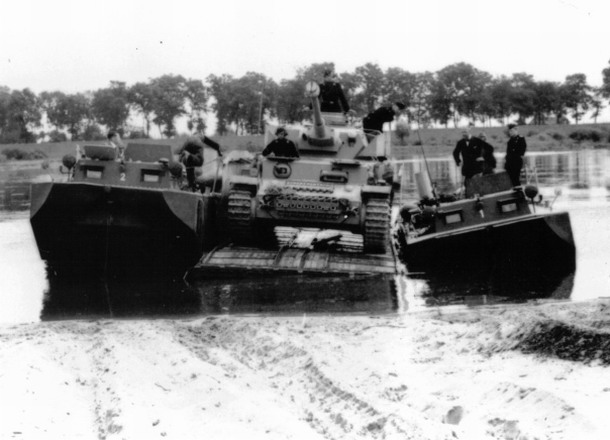
the complete Panzerfähre ferry with a Panzer IV tank loaded on board; the tractors are shown in their final modified configuration with the narrowed bow floats and the raised observation platform on the cabin roof, source: Flickr.com with the permission of the publishing user, edited
Prototypes
The LWS-II design presented to the army on 1 July 1941 was approved, and the production of two pre-production prototypes began as early as 22 July of the same year. The first was completed on 15 May 1942, and the second followed on 1 July 1942. At the same time, a prototype of the cargo pontoon — known as the Fährendecke — was also completed. Assembly of the vehicles took place at the Magirus factory in Ulm. Different dates can also be found in the literature regarding the delivery of the prototypes. Prototype testing then followed, conducted both on land and on water as a matter of course. The results led to several design modifications, all of which were relatively minor in nature. Changes to the air intake and exhaust vents for the cooling system can be identified fairly clearly in photographs.
Modifications and improvements
On the first version of the LWS-II, all four vents in the hull roof took the form of "dormers". It soon became apparent, however, that this design offered insufficient protection against water ingress. The LWS-II had a rather deep draught. The draught of 1.6 metres cited in some sources does not sound particularly alarming given the vehicle's overall height of 2.5 metres, but it must be borne in mind that the overall height included the raised crew cabin — meaning the hull roof itself sat at a height of only around 2 to 2.1 metres above the waterline. It was therefore not at all inconceivable that a wave might occasionally wash over the roof. An improvement was therefore carried out in which all vents were fitted with folding stacks. When travelling on land, these lay flat on the roof; when afloat, they were raised upright.
In a further round of modifications to the prototypes, the number of intake vents at the front of the roof was reduced from two to one, now positioned centrally in the roof immediately behind the crew cabin and protected not by a folding but by a permanently fixed stack. Other changes were also made. The raised crew cabin was extended rearward, allowing two vision ports on each side instead of one. At the same time, a raised observation platform appeared on the cabin roof. The modifications also included the installation of rope railings along the sides of the roof and a change to the shape of the removable floats at the bow, which were now bevelled on the sides (see photo HERE).
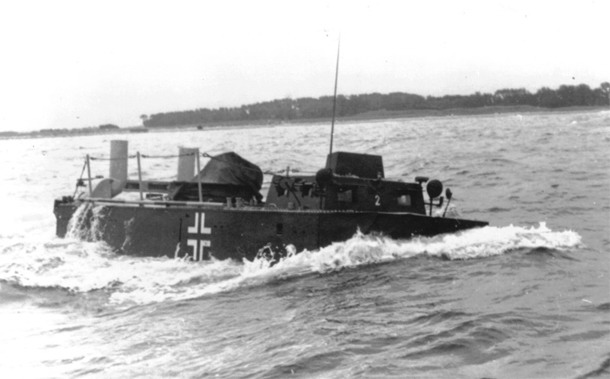
LWS-II under way on water; not a great deal of the vehicle protruded above the surface, source: Flickr.com with the permission of the publishing user, edited
The LWS-II measured 8.25 metres in length, 2.8 metres in width and 2.5 metres in height. The 17-tonne vehicle could reach a speed of up to 45 km/h on land and up to 12.5 km/h on the water. Three fuel tanks with a combined capacity of 470 litres gave a range of approximately 240 km on land and 80 km on water. As the presence of a rod antenna confirms, the vehicle was equipped with a radio. The crew of the LWS-II consisted of probably three men: a driver, a commander and a radio operator.
Testing naturally also included trials of the complete Panzerfähre assembly — two LWS-II tractors with the pontoon secured between them. Surviving photographs show that during the trials the pontoon initially carried only a turretless Panzer IV hull with additional ballast weights, but later also a complete combat-ready tank of the same type, crew included. Although the tests went broadly well and the amphibious vehicle met the army's requirements, series production never followed. By 1942 — and even more so thereafter — the Wehrmacht had entirely different priorities than preparing for a major amphibious landing operation. The two prototypes built thus remained the only examples of their kind. According to some sources, both prototypes were eventually deployed in April 1945 during the defence of the town of Wolgast in north-eastern Germany, and both reportedly sank — or were sunk — in the Peenestrom strait. One of them was subsequently said to have been salvaged by the Soviets and taken to the USSR for examination.
Technical data
|
weight: |
17 t |
|
length: |
8.25 m |
|
width: |
2.8 m |
|
height: |
2.5 m |
|
engine: |
Maybach HL 120 TRM |
|
engine output: |
300 hp |
|
max. road speed: |
45 km/h |
|
max. water speed: |
12.5 km/h |
|
fuel capacity: |
470 l |
|
range - land: |
240 km |
|
range - water: |
80 km |
|
crew: |
3 men |
|
armour: |
14.5 mm |
|
armament: |
- |
ARTICLE
CONTENTS:
Reproducing text from the Panzernet website without the written consent of the operator is prohibited.